
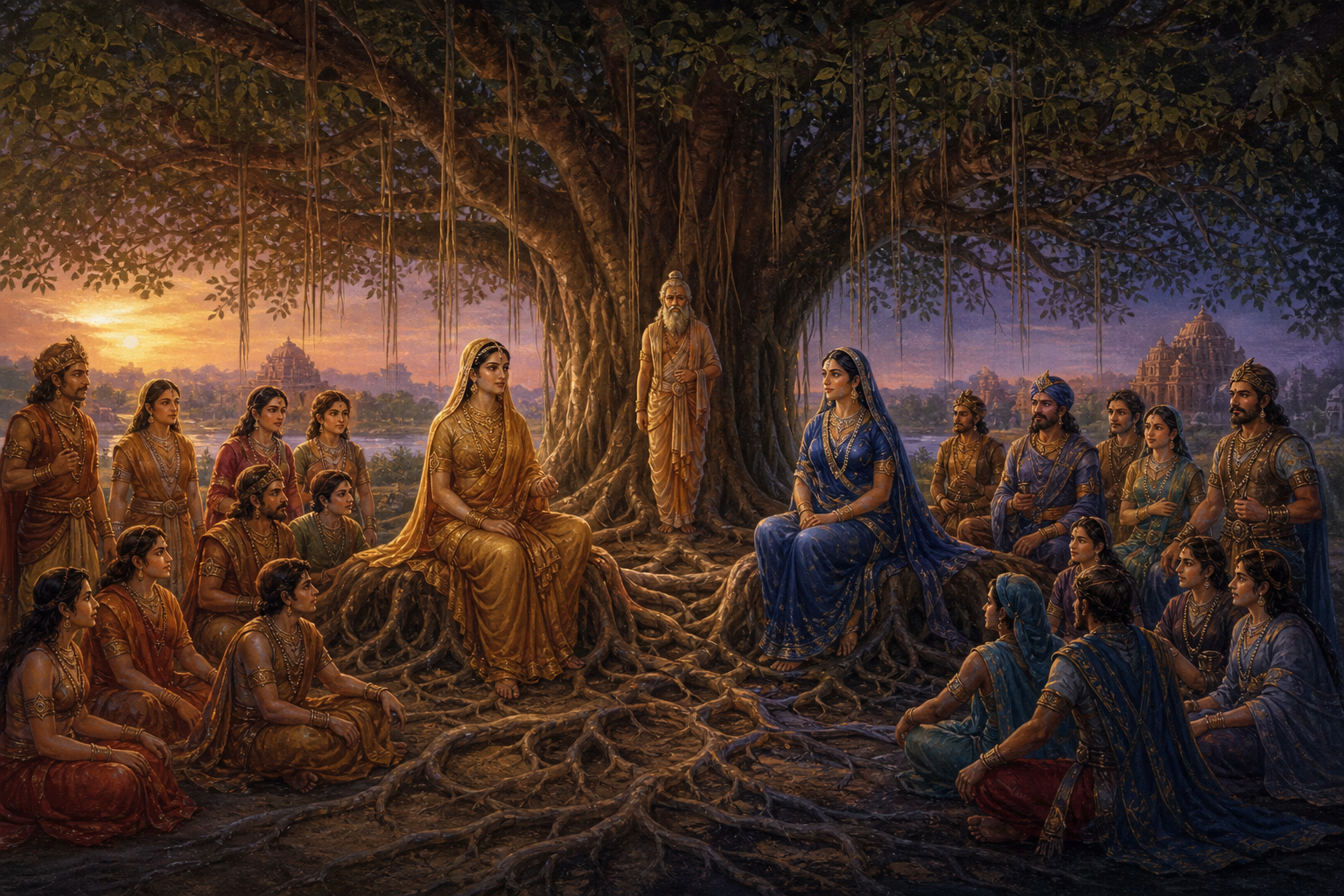
If you have seen Daityas described through Diti and Danavas through Danu, you may be asking a reasonable question: were Asura communities matrilineal? The careful answer is narrower and more interesting. Hindu genealogical traditions preserve a strong form of maternal classification, but maternal naming alone does not prove an entire system of female-line descent, inheritance, residence, or rule.
That distinction lets you recognize what the maternal names actually preserve without forcing them into a modern social category. It also reveals something easy to miss when Asuras are treated only as opponents of the Devas: mothers, daughters, marriages, and maternal kin are part of the structure of these narratives, not decorative details.
The names prove maternal classification, not a complete social system
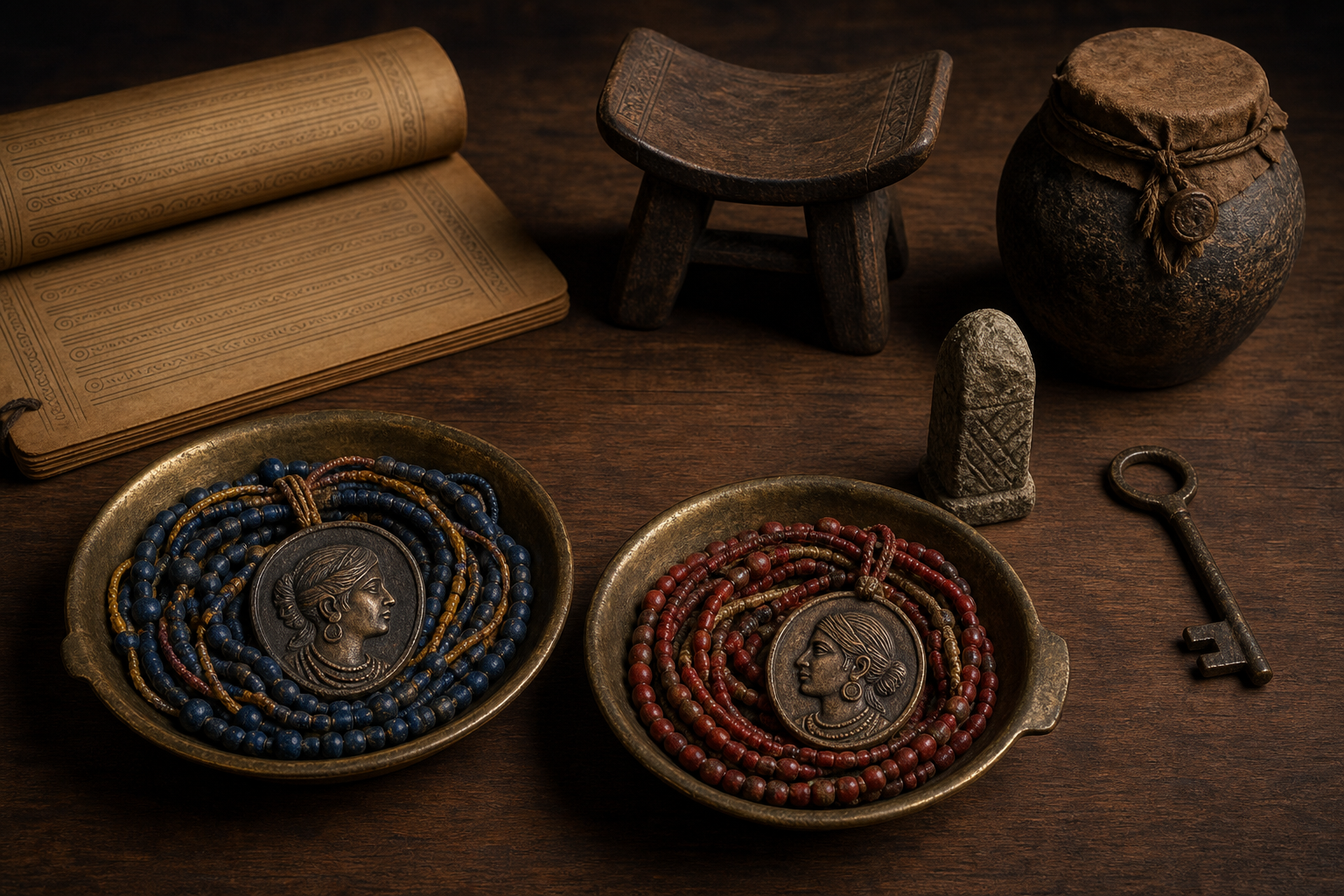
The clearest evidence lies in the group names themselves. The Daityas are identified through Diti and the Danavas through Danu, even though Kashyapa is acknowledged as their father. The mother therefore serves as a classificatory ancestor: her identity distinguishes one body of descendants from another.
This is maternal eponymy, meaning that a collective name is derived from a female ancestor. It is real evidence for the importance of maternal affiliation. It is not automatically evidence for every institution commonly associated with matriliny.
| Claim | What it would require | What the genealogy supports |
|---|---|---|
| Maternal naming | A group identified through a mother or female ancestor | Directly supported by Daitya-Diti and Danava-Danu naming |
| Matrilineal descent | Formal membership or succession regularly transmitted through the female line | Possible as a question, but not established by the names alone |
| Matrilineal inheritance | Property, rank, or office passing through women or maternal kin | Not demonstrated by maternal labels |
| Matrilocal residence | A married couple living with or near the wife’s family | Not demonstrated by genealogy |
| Matriarchy | Women holding predominant political or institutional authority | Not demonstrated by maternal naming |
If you are writing or speaking about these lineages, use the narrowest accurate formulation: “The genealogies classify important Asura groups through their mothers.” Do not silently expand that statement into “All Asuras lived in a matrilineal society.” The first follows from the naming pattern; the second would require evidence about inheritance, marriage, residence, and succession.
Why Diti and Danu matter even when Kashyapa is the father
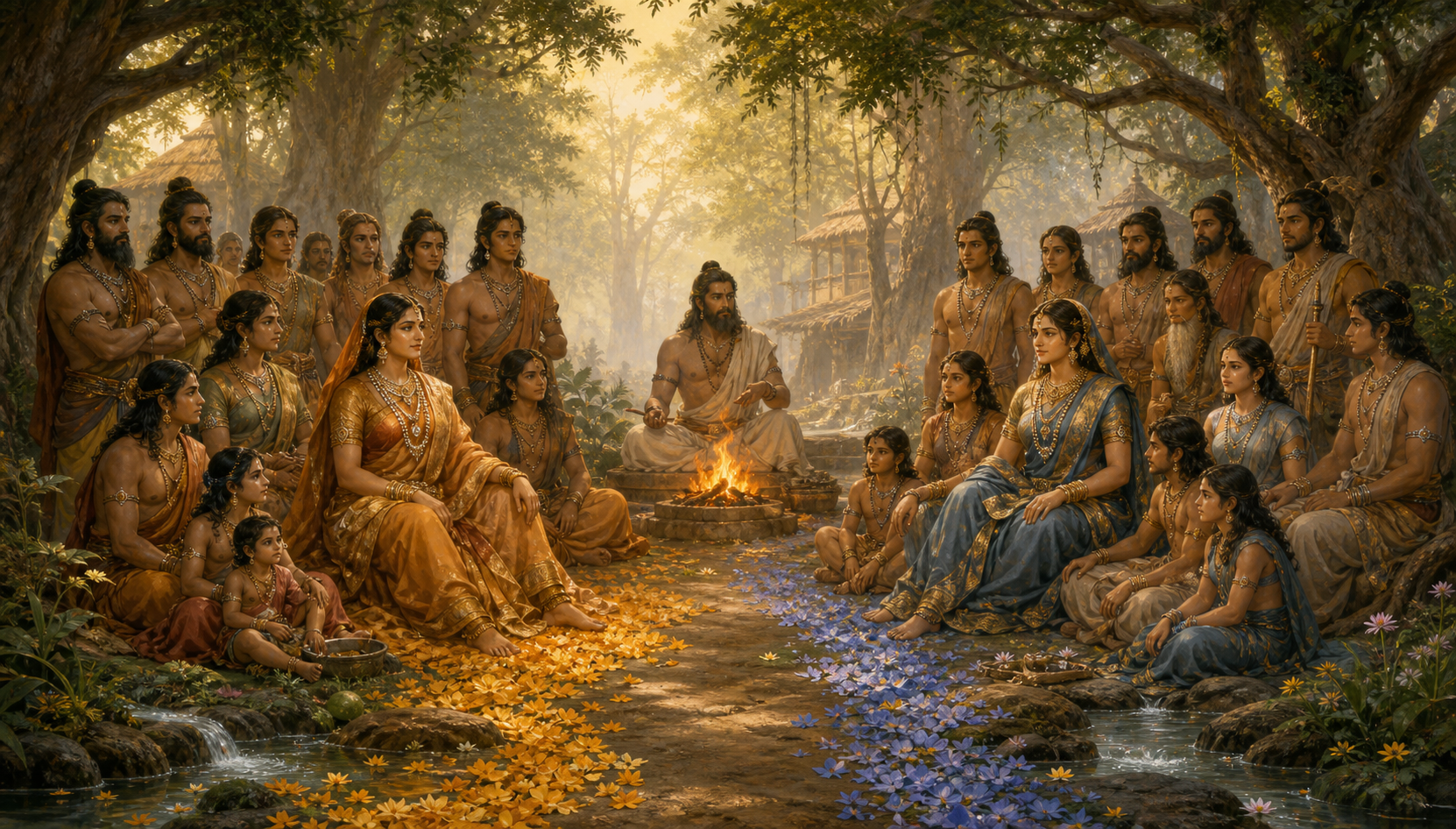
Shared paternity does not erase maternal difference. Kashyapa connects the genealogies, while Diti and Danu distinguish their respective descendants. The safest inference is that motherhood carries genuine taxonomic weight: knowing the father is not enough to tell you which named lineage a figure belongs to.
This pattern is not confined to beings classified as Asuras. Aditi is remembered as the mother of the Adityas, who are associated with the Devas. The parallel matters because it prevents a crude conclusion that maternal identity was peculiar to an alien or oppositional “Asura culture.” Diti, Danu, and Aditi all function as maternal anchors within a larger field of Indic genealogy.
You can read such a genealogy more reliably by following four steps:
- Record both parents. Do not treat a named father as the only genealogically meaningful parent.
- Identify the collective name. Ask whether descendants are grouped through the father, the mother, another ancestor, or a theological quality.
- Notice what the name does. Does it distinguish branches, explain alliances, organize a conflict, or preserve a remembered relationship?
- Stop where the evidence stops. A name can establish affiliation without establishing property rules, domestic residence, or political supremacy.
This method is more useful than beginning with the modern labels “patriarchal” or “matriarchal” and trying to make every detail fit one of them. Start with the relationship the narrative preserves. Apply a larger social category only when several kinds of evidence support it.
A daughter can carry lineage without proving female-line inheritance
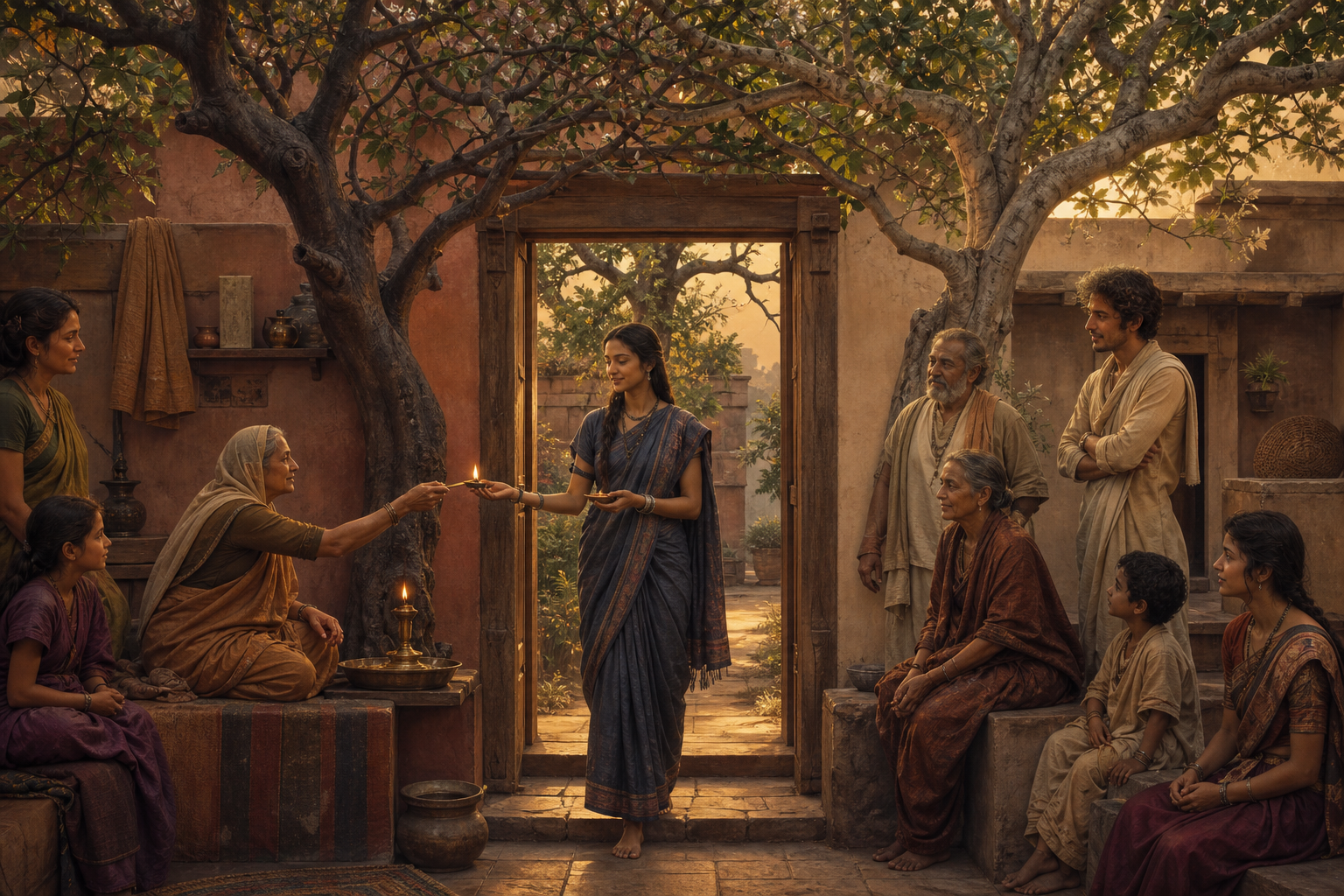
Maternal identity is not visible only in the names of large clans. Women can also carry lineage into new political and moral relationships. Devayani’s place in the Yayati cycle is useful here. Her marriage, counsel, and natal affiliation make her consequential to developments across Deva-Asura boundaries; she is not a genealogical dead end merely because she is a daughter.
That gives us a precise insight: a daughter may transmit relationships, obligations, memory, and legitimacy even when a narrative does not describe a formal system of inheritance through daughters. In this sense, continuity is larger than property. A lineage also persists through marriages, alliances, counsel, conflict, ethical choices, and the identities assigned to later generations.
It would still be too strong to turn Devayani into proof that daughters and sons possessed identical legal rights in every setting. Narrative consequence is not the same thing as an inheritance code. What the episode permits you to say is that female kinship can redirect dynastic and moral trajectories. That is already a substantial claim, and it does not need exaggeration.
When assessing another woman in an epic or Puranic genealogy, ask three separate questions:
- Identity: Are descendants or relatives named, classified, or remembered through her?
- Agency: Do her choices, counsel, marriage, vows, or natal relationships change what happens?
- Institution: Is there explicit evidence that descent, residence, property, or office follows a regular rule through women?
A “yes” to identity or agency does not manufacture a “yes” to institution. Keeping the questions separate protects both the dignity of the female figure and the integrity of the interpretation.
Key takeaways
- Daitya and Danava are maternal lineage labels derived from Diti and Danu, while Kashyapa remains the acknowledged father.
- Maternal eponymy proves that mothers matter to classification; it does not by itself prove matrilineal inheritance, matrilocal residence, or matriarchal government.
- Aditi and the Adityas show that maternal naming also appears on the Deva side, so the pattern should not be treated as uniquely Asuric.
- Devayani demonstrates how a daughter can carry alliances, obligations, and lineage consequences across family boundaries.
- The most defensible conclusion is that Hindu genealogical memory accommodates more than a single, exclusively paternal way of expressing identity.
Use the pattern to widen Dharmic history, not flatten it
The maternal identities of Diti, Danu, and Aditi complicate any account of Hindu tradition that assumes ancestry was always imagined through fathers alone. They also complicate the opposite claim that one naming pattern reveals a universally matrilineal Asura civilization. A plural civilizational memory can preserve paternal and maternal affiliations at the same time.
The wider Dharmic world offers meaningful parallels, provided you compare functions rather than declaring every tradition socially identical. Buddhist memory reveres Māyādevī as the Buddha’s mother. Jain traditions give auspicious significance to the mothers of Tirthankaras. Sikh teachings honor women rather than treating them as spiritually negligible. These examples support a shared regard for motherhood and female consequence; they do not prove that Hindu, Buddhist, Jain, and Sikh communities all followed one kinship system.
The same restraint applies to historical matrilineal practices among certain communities in Kerala. Their existence shows that the Indic world has accommodated diverse family arrangements. It does not establish direct descent from Diti, Danu, or an Asura population. Treat Kerala as evidence of civilizational plurality, not as a missing genealogical link.
You can test any claim about Asura matriliny with a simple wording check:
- Well supported: “Maternal affiliation organizes named branches of Asura genealogy.”
- Well supported: “Women can be consequential bearers of lineage relationships and political alliances.”
- Needs more evidence: “All Asuras inherited status or property exclusively through their mothers.”
- Not established by the names: “Asura society was a matriarchy.”
- Invalid leap: “Modern matrilineal communities must descend from Asuras.”
The next time you encounter a sweeping claim, return to the genealogy. Write down who is named through whom, separate affiliation from inheritance, and mark the point where evidence becomes speculation. You will arrive at a conclusion that is more modest than a civilizational slogan and more revealing than the assumption that only fathers carried identity.
References
