
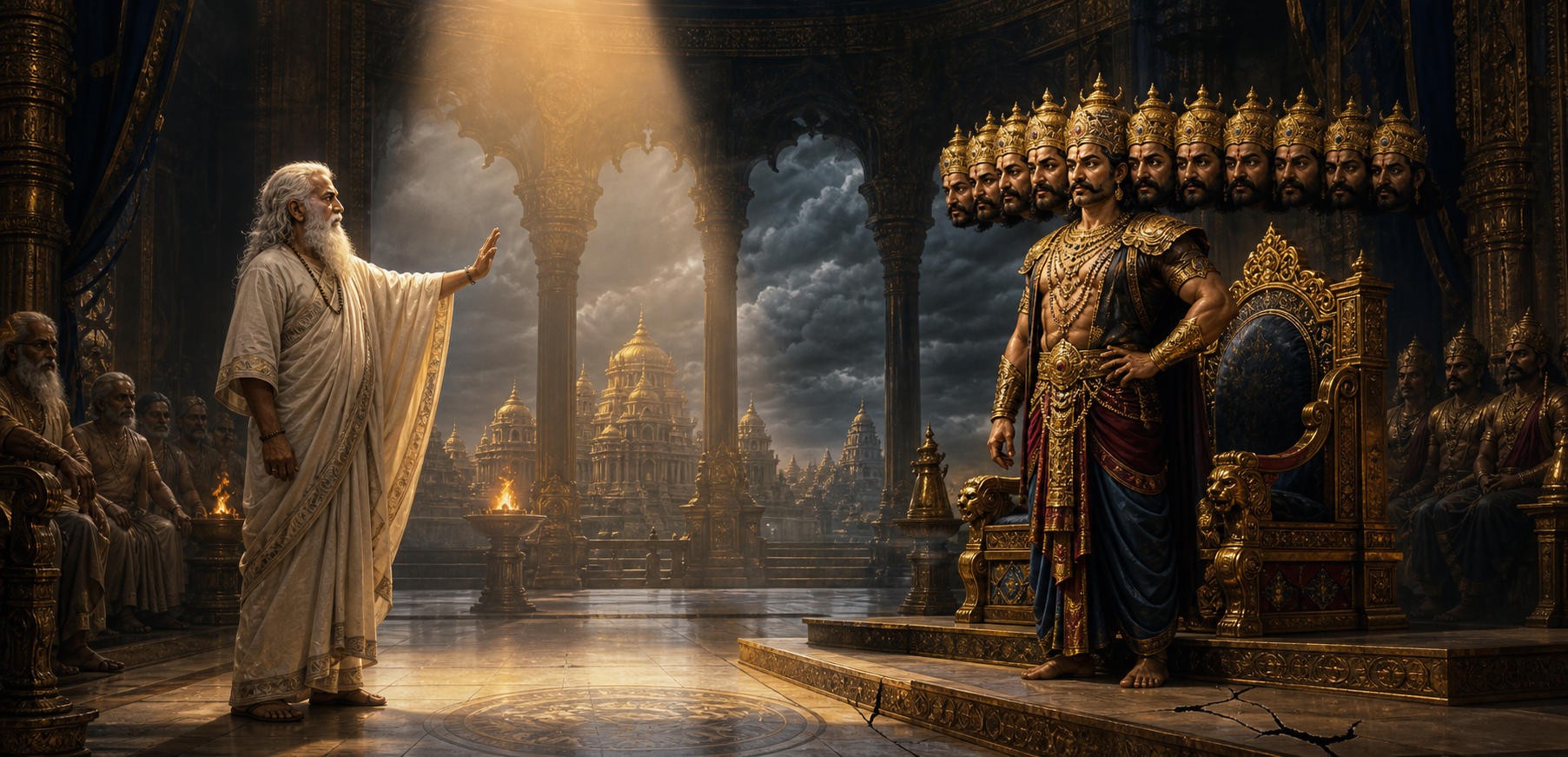
If you came looking for the exact moment when Shukracharya cursed Ravana, begin with an important distinction: this episode belongs to certain Puranic and regional retellings. It should not be presented as though every Ramayana recension narrates the same exchange in the same words.
That does not make the episode unimportant. Read carefully, it answers a deeper question: how could a ruler of Ravana’s learning, devotion, power, and strategic ability bring ruin upon himself? The curse matters because it names a course Ravana is already choosing. It is less a trap laid by an enemy than a warning about what unchecked ahankara will eventually do.
First, separate the traditional claim from its interpretation

In the Shukracharya motif, the preceptor of the asuras recognizes Ravana’s growing hubris and foresees that violations of sacred boundaries will end in defeat at the hands of Sri Rama, the defender of dharma. The language is often described as a prophetic curse. Its force lies in the connection it establishes between Ravana’s conduct and Ravana’s fate.
A responsible telling should preserve the limits of that claim. Do not assign a verse to the Valmiki Ramayana, a Purana, or another named scripture unless you can provide its exact textual location. Do not turn a later paraphrase into a quotation. Hindu narrative tradition is larger than any single recension, but respect for that richness requires naming differences rather than erasing them.
If you are teaching, discussing, or sharing this episode, use three simple checks:
- Name the level of certainty. Say that the episode appears in some Puranic and regional tellings, not simply that “the Ramayana says” it.
- Separate words from meaning. Unless you have a verified passage, describe the pronouncement in your own words instead of inventing dialogue for Shukracharya.
- Keep the moral claim proportionate. Shukracharya’s curse foreshadows Ravana’s fall; it does not erase the many decisions by which Ravana makes that fall possible.
This method neither dismisses regional sacred memory nor confuses it with a uniform textual canon. It lets you receive the teaching without making a historical or scriptural claim that you cannot support.
Ravana’s downfall is a chain of consequences, not one curse
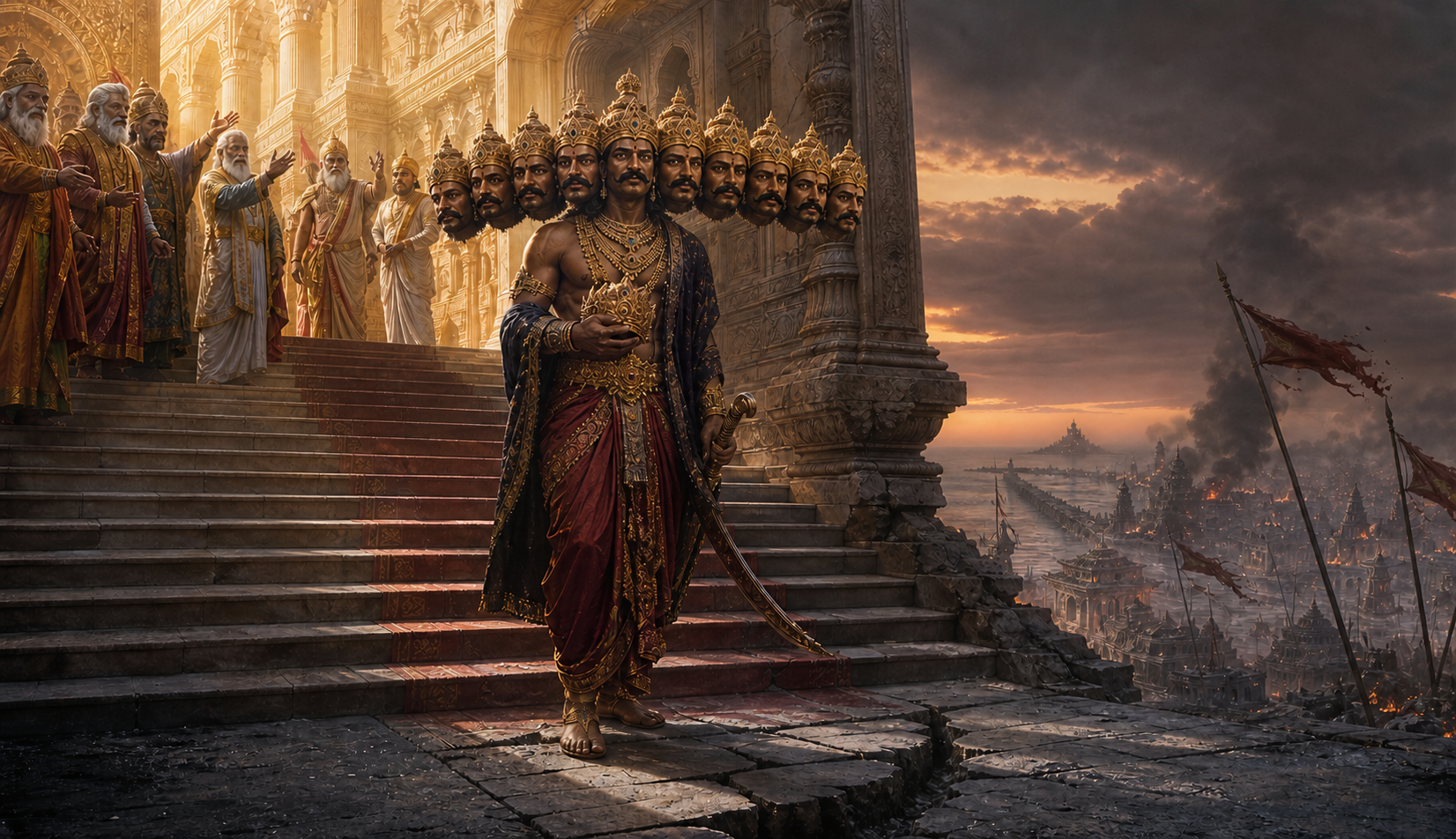
The easiest mistake is to imagine a curse as a single supernatural switch: someone pronounces it, fate activates, and Ravana loses. The wider Ramayana tradition presents a more demanding pattern. Ravana repeatedly crosses boundaries, receives warnings, and continues. Each choice reduces the space in which repentance or correction remains possible.
Several connected motifs make that pattern visible:
- Nandi’s pronouncement follows Ravana’s arrogance at Kailasa and anticipates the decisive part that the vanaras will play in his defeat. The being Ravana treats with contempt becomes a sign of the power he has failed to understand.
- Vedavati’s vow places the dignity of a woman at the center of moral consequence. Ravana’s strength cannot convert violation into legitimacy.
- Nalakubera’s curse, associated with the Rambha episode, establishes a boundary and consequence around Ravana’s transgression. Power does not give him moral ownership over another person.
- Shukracharya’s warning or curse interprets the accumulating pattern. A ruler who will not restrain himself will eventually confront a power ordered by dharma rather than appetite.
These are not interchangeable episodes, and they need not belong to one identical textual layer to illuminate the same ethical structure. Ravana’s ruin is cumulative. His offenses generate vows, enemies, limits, and consequences. His pride then prevents him from reading any of those consequences as a reason to change.
This distinction changes how you understand Sri Rama’s victory. Rama does not merely arrive as a stronger combatant. He becomes the champion through whom an order damaged by Ravana’s choices is restored. The final battle is therefore the visible end of a moral collapse that began long before the battlefield.
Why an asura guru can condemn an asura king
Shukracharya’s identity makes the episode sharper. As preceptor of the asuras, he is not a convenient partisan for Ravana’s opponents. He represents disciplined knowledge, ascetic attainment, political intelligence, and the duty of a guru to speak what a ruler needs to hear.
A true guru does not turn wisdom into flattery. Counsel must restrain the disciple when ability outruns character. In that sense, Shukracharya’s pronouncement is an act of teaching even when it takes the form of a curse: it exposes the destination contained within Ravana’s conduct.
Ravana’s tragedy is not that he lacks impressive qualities. His knowledge, devotion, prowess, and authority make his failure more revealing. He can acquire learning, but he will not allow learning to govern desire. He can recognize power, but he cannot accept a moral limit on his own power. He can receive counsel, but only counsel that leaves his pride undisturbed.
This gives you a practical way to judge leadership without being dazzled by talent. Ask three different questions:
- Capacity: Can this person understand difficult matters and act decisively?
- Character: Does this person respect boundaries when violating them would be advantageous?
- Teachability: Can this person receive an unwelcome truth from someone entitled to speak it?
Ravana scores highly on capacity and disastrously on restraint and teachability. That imbalance is the warning. Intelligence can increase the reach of adharma when humility no longer directs it.
Read the curse as an ethical prognosis
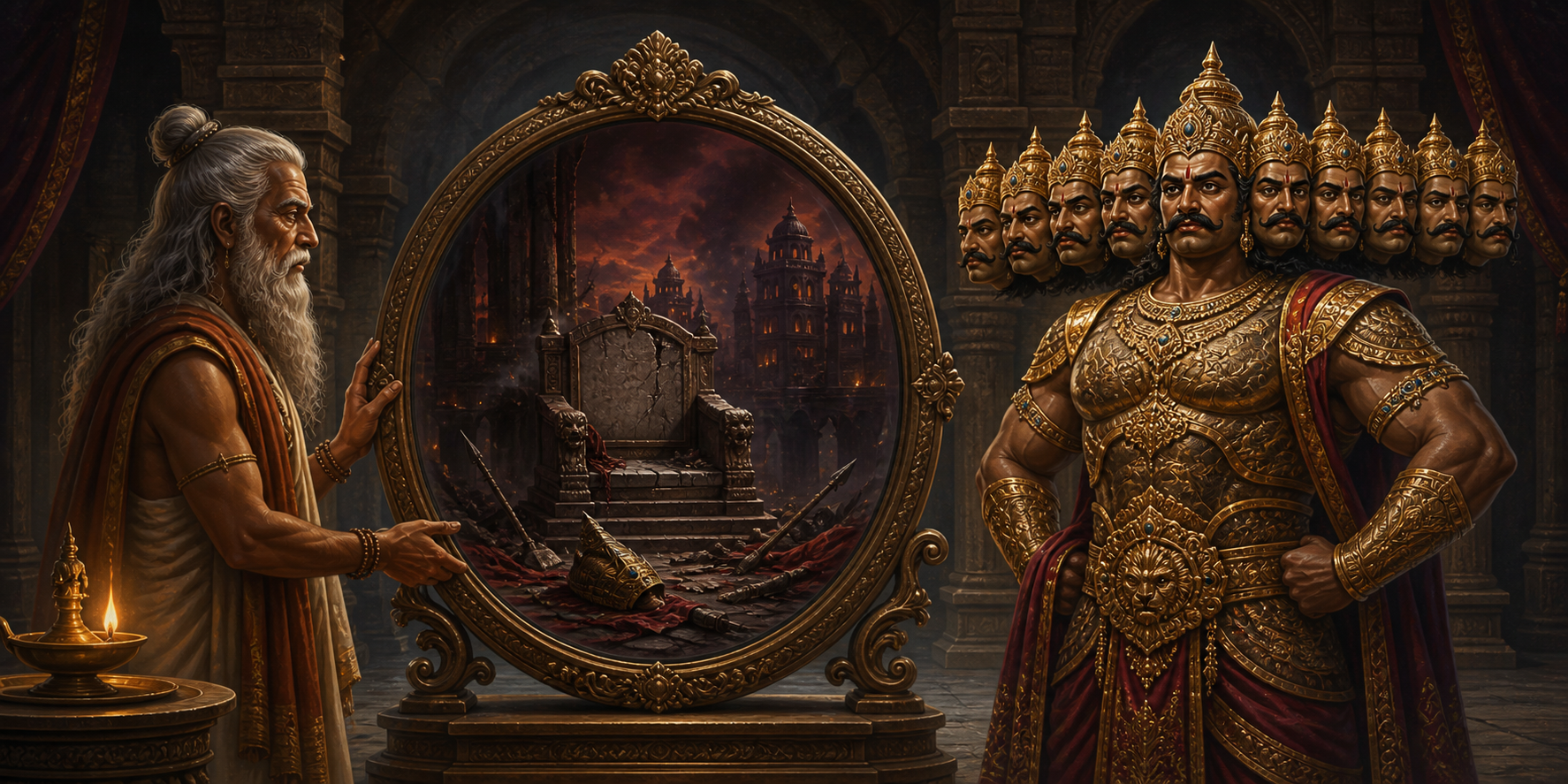
A prognosis does not create the condition it identifies. It tells you where a condition is heading if its causes remain active. Shukracharya’s curse can be read in this way: Ravana’s conduct has acquired a direction, and his refusal to change makes the outcome increasingly difficult to avoid.
This reading need not deny the sacred or metaphysical significance of a curse. It clarifies why the curse belongs in a dharmic narrative. The pronouncement is not arbitrary anger. It gives moral form to causality: transgression bears fruit, repeated transgression hardens disposition, and hardened disposition rejects the very counsel that could interrupt the cycle.
The sequence is worth noticing in your own decisions:
- A boundary becomes inconvenient. Desire or ambition begins to treat restraint as an obstacle.
- The first violation is rationalized. Ability, status, or past achievement is used as an excuse.
- Correction feels like disloyalty. The adviser who names the problem is treated as the problem.
- Repetition changes character. What began as one choice becomes a settled way of responding.
- The delayed consequence arrives. By then, the person calls it hostile fate because admitting causality would require admitting responsibility.
You can interrupt this sequence before it hardens. When trustworthy counsel makes you defensive, write down the boundary at issue, who will bear the cost if you cross it, and what action would still repair the harm. Then ask whether you are rejecting the advice because it is false or because obedience would limit you. That final distinction is often where ahankara reveals itself.
The same test applies to institutions and kingdoms. A leader who cannot be contradicted eventually loses access to accurate information. Advisers learn to protect themselves with silence. Injured people stop expecting justice. Authority may look intact for a time, but its moral and practical foundations are already weakening. Ravana’s Lanka therefore offers more than an account of one powerful king: it shows how command without self-command becomes structurally fragile.
Key takeaways for reading Ravana’s fall
- Shukracharya’s prophetic curse should be identified with certain Puranic and regional retellings, not attributed indiscriminately to every Ramayana tradition.
- The curse does not replace Ravana’s moral agency. It announces the consequence of a path he repeatedly chooses.
- Nandi, Vedavati, Nalakubera, and Shukracharya reveal different boundaries that Ravana violates or refuses to respect.
- Ravana’s knowledge and power do not save him because he lacks the humility required to let wisdom govern conduct.
- Sri Rama’s victory represents the restoration of dharma after accumulated adharma, not the activation of an isolated magical penalty.
The next time you hear that a curse caused Ravana’s downfall, ask a better question: what truth did the curse reveal while change was still possible? Then bring that question closer to home. Identify the counsel you least want to hear, examine the boundary it protects, and correct the choice before consequence becomes destiny.
References
