

If you have heard someone explain another person’s suffering as “their karma,” Shravana Kumara’s death should make you stop. He is devoted, compassionate, and innocent, yet he is killed while serving his blind parents. His suffering cannot honestly be turned into evidence that he deserved it.
The episode gives you a more demanding understanding of karmic justice. It asks you to protect the innocent, examine the choices that cause harm, and hold power accountable even when the harm was unintended. Karma becomes a discipline for your own conduct, not a verdict you pronounce on somebody else’s pain.
Read the tragedy in the order it happens
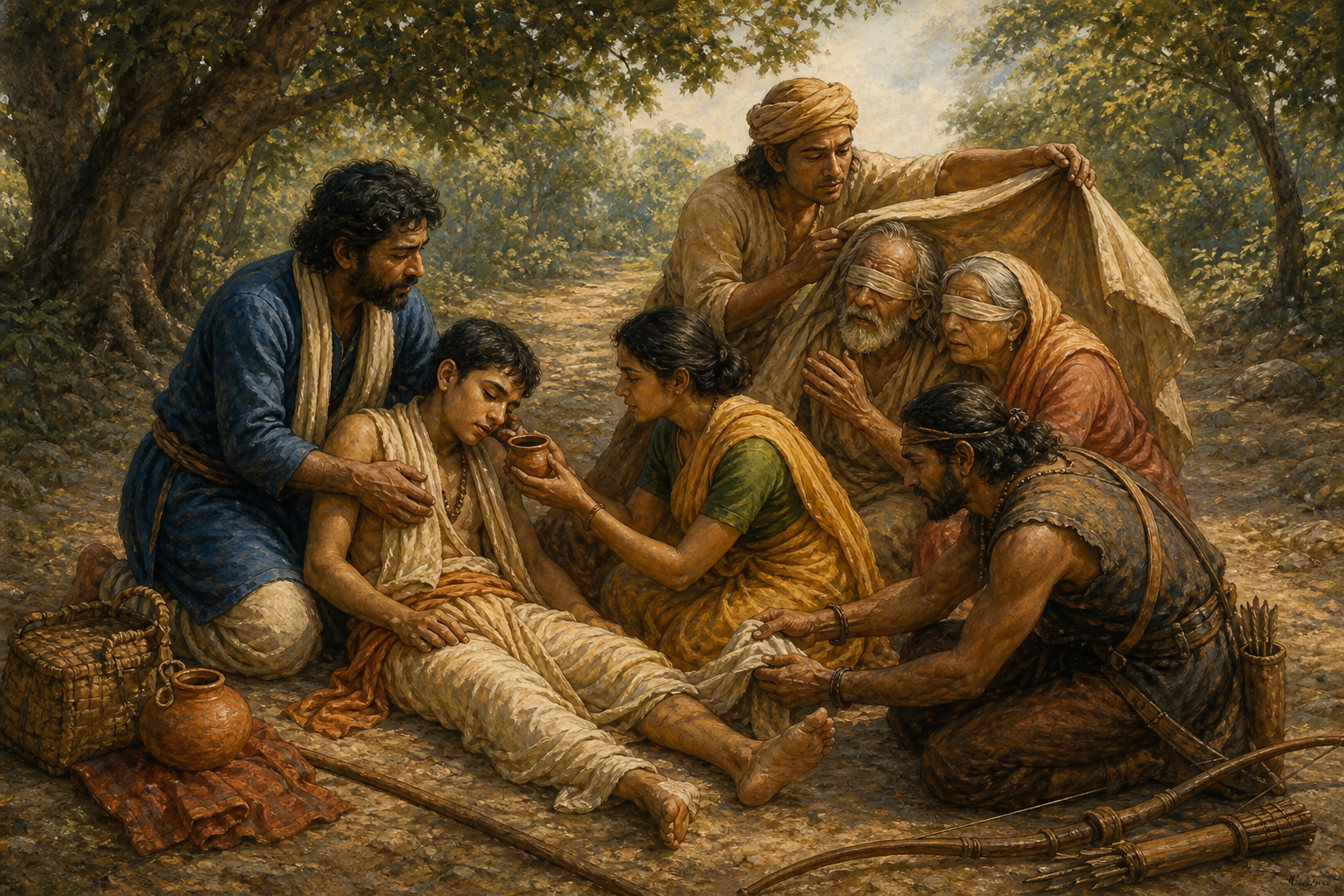
Shravana Kumara is travelling on pilgrimage with his elderly, blind parents, carrying them on a yoke. At a forest hermitage, he goes to obtain water for them. King Dasharatha is hunting by sound and releases an arrow in error, striking Shravana instead of the target he imagined.
The order of these details matters. Shravana is not endangered while neglecting his parents or pursuing a selfish aim. He is harmed in the middle of seva. Even after being struck, his first concern is that water should reach his parents. The wound does not displace his attention from their immediate need.
Dasharatha then faces the parents whose son he has killed. Overcome by grief, they declare that he too will die in anguish caused by separation from his son. The consequence arrives later when Rama leaves for vanvas and Dasharatha dies in sorrow. The king who brought unbearable separation to one family eventually experiences separation within his own.
This sequence gives you the safest way to interpret the episode. Begin with visible duties, choices, and consequences before speculating about invisible causes. Shravana has accepted a duty of care. Dasharatha has a duty of restraint because his power can kill. The parents depend upon the son who is taken from them. Each part of the tragedy becomes morally intelligible without inventing a hidden offence for Shravana.
That method also works outside scripture. When harm occurs, first establish what happened, who acted, what could have been checked, who bore the loss, and what duty now remains. A theory about cosmic justice must never become an excuse to skip those questions.
Innocent suffering is not proof of hidden guilt

A crude version of karma treats every misfortune as a receipt for an unknown offence: if a person suffers, that person must somehow have earned the suffering. Shravana’s place in the Ramayana does not support that equation. He stands precisely as an innocent sufferer and a model of filial dharma.
The episode gives no basis for assigning him a secret moral fault. Adding one would reverse its ethical direction. Instead of feeling the weight of an innocent life destroyed by a rash act, you would place the burden of explanation on the victim. That move protects the comfortable observer and weakens accountability for the person whose action produced the harm.
Karmic justice here concerns moral causation: an action enters the world, affects other lives, and eventually brings a corresponding consequence to the person who set it in motion. It does not mean that every victim’s suffering is a publicly readable record of guilt. The narrative tells you what Dasharatha did and what followed for Dasharatha. It does not give you permission to manufacture a past-life case against Shravana.
This distinction matters whenever you encounter unexplained suffering. You may believe that life contains causes beyond immediate perception while also admitting that you do not know those causes in another person’s case. That humility is not a rejection of karma. It is a refusal to pretend to possess knowledge you have not been given.
Use karma inwardly by asking, “What am I setting in motion through this choice?” Do not weaponize it outwardly by asking, “What hidden fault made you deserve this?” The first question disciplines your conduct. The second can turn metaphysics into indifference.
Shravana’s death also corrects the opposite error: the belief that visible virtue guarantees immediate protection from every tragedy. His devotion does not make him physically invulnerable. Dharma is not a transaction in which one good act purchases immunity from every harmful action performed by someone else. His goodness remains real, his suffering remains undeserved, and Dasharatha’s responsibility remains morally consequential at the same time.
An accident can be unintended and still create a debt

Dasharatha does not intend to kill Shravana. That fact distinguishes his error from a planned murder, but it does not make the death morally empty. His target is accidental; the release of the arrow is not. He chooses to act on a sound before confirming what is there.
This is where the episode becomes especially important for anyone who holds authority. Greater power enlarges the possible consequence of a mistaken assumption. A king with a weapon must exercise more restraint than a bystander with no capacity to inflict the same irreversible harm. Position does not place a person outside karmic causation; it increases the care required before action.
Before making a consequential decision on incomplete information, ask four questions:
- What do I actually know? Separate what you observed from what you inferred.
- What can this action damage? Consider the person who will bear the loss, not only the goal you hope to achieve.
- Can the result be reversed? The less reversible the action, the stronger the need to verify first.
- Am I accepting the risk on someone else’s behalf? Power becomes dangerous when the decision-maker receives the benefit while another person absorbs the possible harm.
Dasharatha’s mistake is an ancient example of acting on signal without verification. Its modern forms include punishing someone on the strength of a rumour, forwarding an accusation before checking it, or making a decision from a partial account when the consequences will fall on a vulnerable person. The instrument changes; the moral failure remains recognizable.
Once accidental harm has occurred, explaining your intention is not the first duty. Stop the harmful process. Attend to the affected person’s immediate need. State what you did without using your lack of malice to reduce the reality of the damage. Tell those affected what can and cannot be repaired. Then change the decision rule that allowed the harm, so remorse becomes restraint rather than a temporary feeling.
The parents’ curse must be read within this structure. In the episode’s karmic logic, it gives Dasharatha a consequence analogous to the one he caused: separation from a beloved son followed by death in grief. Its function is not to teach you to enjoy retaliation or to curse everyone who wrongs you. It reveals that the sorrow of those harmed cannot be dismissed merely because the powerful person says the harm was a mistake.
The symmetry is morally instructive, but it is not repair. Dasharatha’s later anguish does not return Shravana to his parents. Justice cannot make an irreversible act unhappen. That is why restraint before action and service after harm matter so much: another person’s punishment is never a substitute for the care the victim needed.
A Dharmic response begins with service, not speculation
The most faithful way to remember Shravana Kumara is not merely to admire his filial devotion. It is to translate that devotion into a duty you can perform. His example joins tenderness to effort: he carries his parents, seeks what they need, and continues to think of them when he himself is dying.
You do not need to reproduce the outward form of his pilgrimage or romanticize exhaustion. Begin with the actual dependency in front of you. Ask an elder what help is wanted rather than deciding for them. Choose one recurring responsibility, put it on a real schedule, and make sure it does not vanish during busy weeks. Transport, paperwork, provisions, household work, or a dependable conversation can become seva when it answers a real need with consistency and respect.
The same practical order applies when you witness suffering you cannot explain. Let karuna direct your attention to the person’s pain. Let ahimsa prevent you from adding blame or humiliation. Let seva move you toward useful assistance. Let accountability examine the decisions and powers that produced the harm. Metaphysical speculation can wait; the person in need should not have to.
These priorities create genuine ethical common ground across Dharmic traditions. Compassion in Buddhism, ahimsa in Jainism, and seva joined with justice in Sikhism resonate with the duties illuminated by Shravana’s story. This does not make the four traditions doctrinally identical. It identifies a shared test of spiritual seriousness: how you act toward vulnerable life when care costs time, restraint, or comfort.
Four ordinary situations let you put that test into practice:
- When an elder depends on you: identify one neglected need, agree on the help, and give it a recurring place in your calendar.
- When you hold authority: increase verification in proportion to the harm your decision could cause. Do not treat confidence as evidence.
- When you cause harm: say plainly, “I did this. It caused this harm. This is what I will do now.” Do not hide the consequence behind a defence of your intention.
- When someone else suffers: replace “It must be their karma” with “What do they need, and what responsibility is visible here?”
This is restorative justice at a human scale. It does not deny consequence, excuse carelessness, or demand that a harmed person pretend nothing happened. It directs moral energy toward truth, protection, repair, and a wiser rule for future action.
Key takeaways
- Shravana Kumara’s innocence prevents his suffering from being used as proof that every victim deserves what happens.
- Karma is safest as a question about the consequences of your own conduct, not as a claim about another person’s hidden guilt.
- Dasharatha’s lack of malicious intent changes how his act is judged, but it does not erase the death, the parents’ loss, or his responsibility.
- The parents’ curse expresses a corresponding moral consequence; it is not a general permission to pursue revenge.
- The more power you possess, the more carefully you must verify before taking an irreversible action.
- Compassion, ahimsa, seva, and accountability provide the right order of response when innocent suffering confronts you.
At your next consequential decision, pause long enough to separate observation from assumption. At your next encounter with suffering, offer service before explanation. If you already owe someone repair, make the first concrete part of it before defending what you meant. That is how Shravana Kumara’s story becomes lived dharma rather than admired memory.
References
