
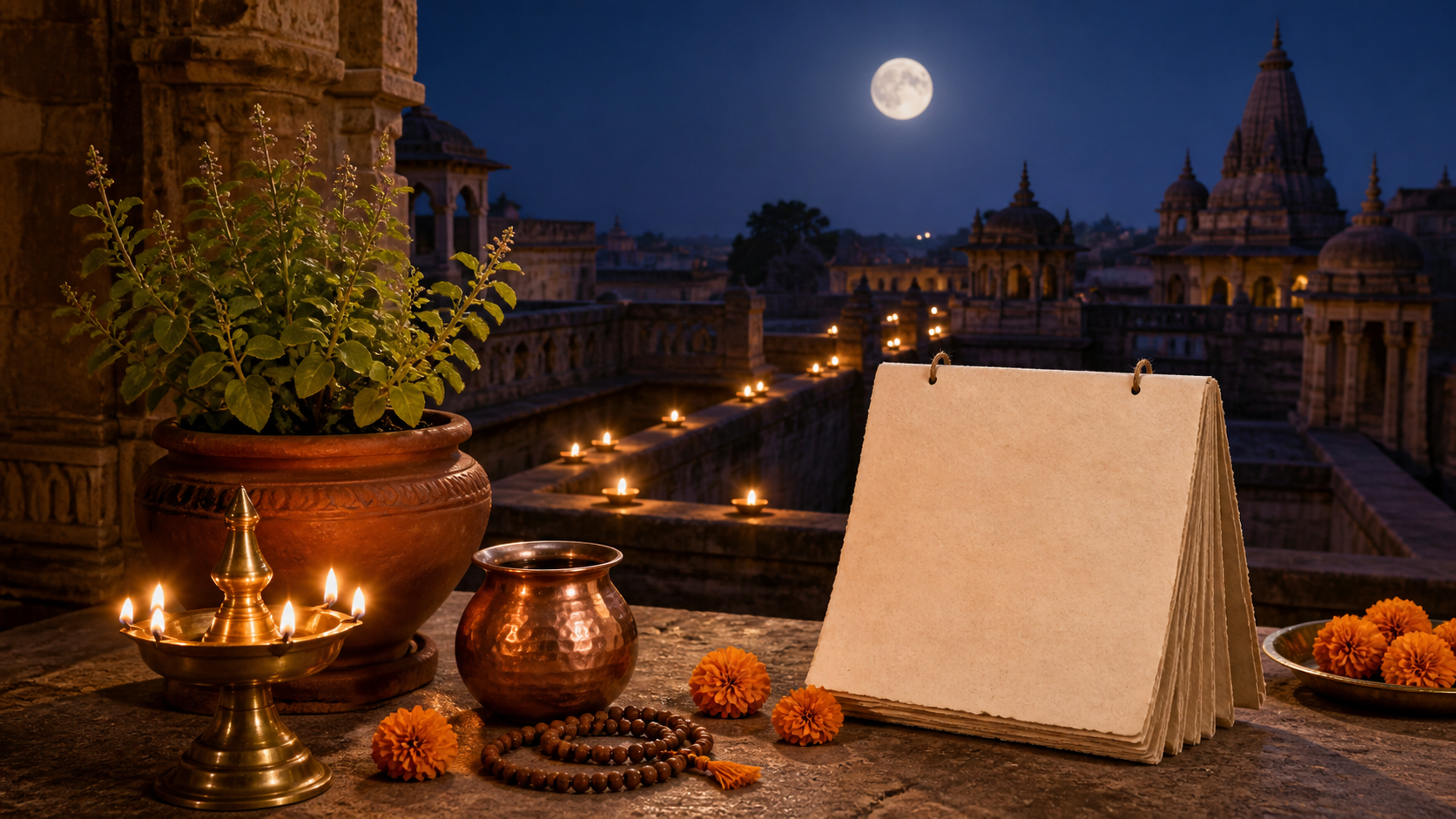
If one calendar tells you that Kartik 2025 runs from October 22 to November 20 while another ends the month on November 5, you do not have to decide which one is “real.” They are using different ways of placing month boundaries around the same lunar cycle.
The practical answer is simple: choose your household’s regional calendar first, use a Panchang calculated for your location, and then schedule each observance by tithi rather than by the Gregorian date alone. That keeps Govardhan Puja, Tulsi Vivah, Kartik Purnima, daily deepa offerings and the completion of a vrata in their proper sequence.
The calendar system comes before the festival list
A Hindu lunar month is divided into two pakshas. Shukla Paksha is the waxing fortnight, counted from Pratipada after Amavasya through Purnima. Krishna Paksha is the waning fortnight, counted from Pratipada after Purnima through Amavasya. Those fortnight names and tithis remain stable even when regional calendars disagree about where the named month begins or ends. The apparent disagreement comes from the Amanta and Purnimanta systems: an Amanta month ends at Amavasya, while a Purnimanta month ends at Purnima.
For many households following Marathi, Kannada, Telugu or Gujarati reckonings, the working Kartik 2025 span is October 22 through November 20. The Kannada Kartika Maasa follows the same dates, while Akasha Deepam is likewise observed through this October 22–November 20 window in several regional traditions. In North Indian Hindi calendars, however, Kartik Purnima on November 5 formally concludes Kartik.
This also explains a common Diwali puzzle. In the Marathi Amanta calendar, Diwali Amavasya occurs at the end of Ashwin, immediately before Kartik begins. Govardhan Puja and Bhau Beej then belong to Kartik Shukla Paksha. A North Indian calendar may name the surrounding month differently without changing the underlying tithis or the order of observances.
- Write the calendar tradition on your family plan: for example, Marathi Amanta, Kannada Panchang or North Indian Purnimanta.
- Add the city for which the Panchang was calculated. A Delhi tithi boundary should not be copied blindly into a Toronto, London or Bengaluru schedule.
- Keep one Panchang as your primary reference for the whole vrata. Mixing a festival date from one regional system with a muhurta from another is a reliable way to create confusion.
- When a family lineage or temple has an established rule, follow that rule for its ritual. The temple’s observance may be tied to sunrise, moonrise or another prescribed tithi window rather than to midnight on the civil calendar.
The dates that anchor Kartik 2025
The following calendar is a planning map, not a universal muhurta sheet. It shows what you need to prepare and where a local calculation still matters.
| Civil date or window | Lunar marker | What to plan | What to verify locally |
|---|---|---|---|
| October 21 | Amavasya changes to Shukla Pratipada | Keep the earlier part of the day for Amavasya practices such as quiet prayer, tarpana according to family custom, charity and remembrance. Prepare for the bright fortnight after the tithi changes. | The broad Indian reference places Amavasya until 4:26 PM. Do not treat that clock time as universal. |
| October 22 | Kartik Shukla Pratipada in Amanta calendars | Begin the regional Kartik vrata, daily Akasha Deepam or deepa-dana routine. Many communities mark Balipadyami, Govardhan Puja or Annakut. | The same broad reference keeps Pratipada until 6:17 PM on October 22; local coordinates can shift the boundary. |
| Kartik Shukla Paksha | Dwitiya through the bright fortnight | Yama Dwitiya or Bhau Beej follows the opening observances. Prabodhini Ekadashi and the regional Tulsi Vivah period come later in the fortnight. | Do not assign Tulsi Vivah a date merely by counting Gregorian days. The widely used ritual window lies between Shukla Ekadashi and Purnima, with the selected day varying by lineage and locality. |
| November 5 | Kartik Purnima | Plan Purnima vrata, snana, deepa-dana, temple worship, japa, charity and community Deepotsavam. The day is also known as Tripurari or Tripuri Purnima and is associated with Dev Diwali. | Confirm when Purnima Tithi prevails at the ritual anchor used by your tradition. This date closes Kartik in North Indian Hindi calendars but not in Amanta calendars. |
| November 20 | Amanta Kartik concludes | Complete the month-long discipline and the daily Akasha Deepam observance used in the relevant southern and western calendars. | Verify the concluding Amavasya and any family-specific completion rite. Do not mistake November 20 for a second Kartik Purnima. |
A civil date tells you when to gather lamps, flowers, food or family members. It does not by itself select a muhurta. A full Panchang considers tithi, vaara, nakshatra, yoga and karana, along with local sunrise and the ritual rule being followed. If the timing matters for a formal vrata, Tulsi Vivah, temple seva or a new undertaking, check the city-specific Panchang before inviting people.
Build a Kartik discipline you can actually sustain
Kartik is better approached as a daily rhythm than as a collection of disconnected festival dates. You do not need to stack every regional custom into one oversized routine. Choose a small practice that suits your sampradaya and household, then keep it steady.
- Begin the morning deliberately. Where health, weather and household circumstances permit, take an early Kartik snana and make a short sankalpa. Follow it with japa or one manageable recitation rather than an ambitious programme you will abandon after several days.
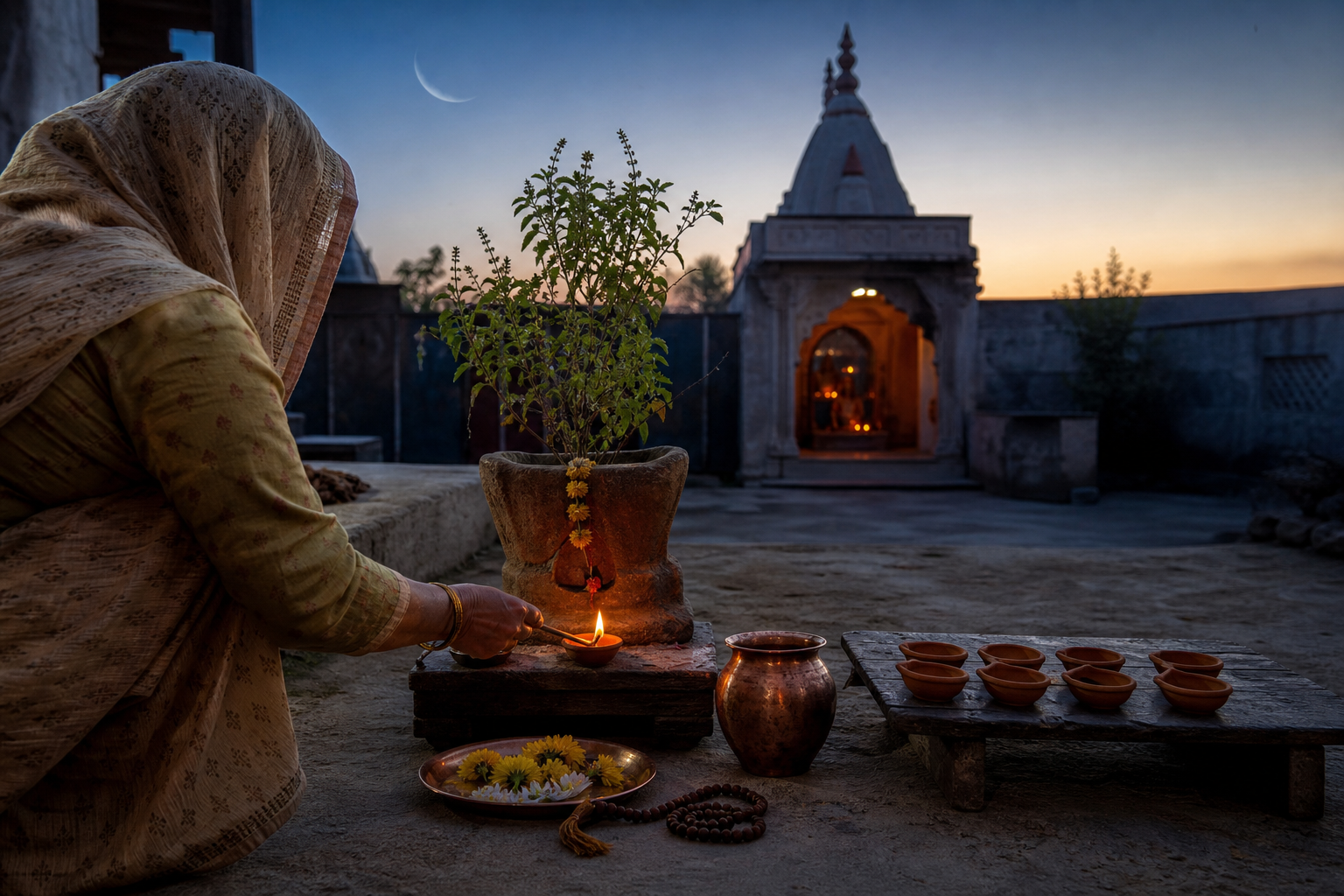
- Give dusk a fixed place in the day. Light one diya at the home altar, Tulsi vrindavan, courtyard, balcony or another appropriate place. Akasha Deepam traditionally raises the lamp so that it faces the open sky, turning the evening flame into a repeated offering rather than occasional decoration.
- Choose one stream of recitation. A Vaishnava household might select Vishnu Sahasranama, Bhagavad Gita or Bhagavata Purana reading. A Shaiva household might use Shiva stotras or “Om Namah Shivaya.” Consistency matters more than accumulating texts.
- Attach restraint to service. A sattvic diet, reduced excess and a vrata become more complete when joined to dana, annadana or practical seva. Decide at the beginning what you will give and when; otherwise charity is easily postponed until the month is over.
- Mark the weekly emphasis that belongs to your tradition. Kartika Somavara gives Mondays special importance for Shiva worship in Karnataka and other regions. Vaishnava households may emphasize Damodara worship. You can respect both without pretending that every family must perform both.
For an Akasha Deepam routine, prepare an earthen or brass lamp, cotton wick and the oil used by your family, commonly sesame oil or ghee. Place an elevated lamp on a stable, non-flammable support, protect it from strong wind, and keep it away from curtains, dry decorations and roof edges. Children and animals should not be left near an open flame. A glass chimney or secure lantern can help in a windy location; if building rules prohibit flames, do not improvise around them.
The simplest authentic plan is often the most durable: one clean lamp at dusk, one short prayer, one chosen restraint and recurring service. If you later add temple visits, longer parayana or special Monday worship, add them because they deepen the vow—not because a checklist makes you feel that a modest observance is inadequate.
Let the two fortnights shape different kinds of practice
The October 21 transition gives Kartik’s opening its spiritual logic. Amavasya is suited to inward attention, ancestral remembrance, simplification and giving. After Pratipada begins, the waxing moon supports renewal, visible worship and community celebration. If your family avoids inaugurating undertakings during Amavasya, do not assume that every hour of October 21 is equivalent; the tithi changes during the civil day.
Shukla Paksha carries the most visible sequence: Govardhan Puja or Annakut, Bhau Beej, Prabodhini Ekadashi, the Tulsi Vivah period and the luminous culmination of Kartik Purnima. This is the natural time to organize shared worship, temple offerings, family meals and public deepa-dana. Put the preparation dates on your ordinary calendar, but label the rites with their tithis so that younger family members learn the lunar sequence rather than memorizing a floating set of Gregorian dates.
After November 5, an Amanta household is still in Kartik. The month continues through Krishna Paksha until November 20. Do not stop a month-long lamp or vrata on Purnima merely because a North Indian calendar closes Kartik that day. Instead, let the waning fortnight become quieter: maintain the daily vow, consolidate what you began, complete promised dana and prepare for the concluding Amavasya. A Purnimanta household can properly complete its named Kartik observance on Purnima because it is following a different month boundary.
Share the season without erasing distinct traditions
Kartik’s language of light, restraint and generosity resonates beyond one Hindu regional calendar. Jain communities mark the New Year period around Kartik Shukla Pratipada and observe Jnan Panchami; the Buddhist Kathina season emphasizes generosity and support for the Sangha; and Sikh remembrance of Guru Nanak often falls around Kartik Purnima in years when the calendars align. These are not interchangeable ceremonies.
If you are planning a school, temple or community event, build the common ground around dana, seva, knowledge and ethical renewal while naming each observance accurately. That approach expresses Dharmic kinship without turning Jain, Buddhist, Sikh and Hindu practices into generic versions of one another.
Four questions that prevent Kartik calendar mistakes
Is Kartik 2025 October 22–November 20 or does it end November 5?
Both can be correct within their calendar systems. October 22–November 20 is the operative span in the cited Amanta-aligned Marathi and Kannada reckonings and for several regional Akasha Deepam observances. November 5 is Kartik Purnima and the end of Kartik in North Indian Hindi calendars. Use the span belonging to your household or temple tradition.
Can I use the 4:26 PM and 6:17 PM tithi boundaries anywhere?
No. They are broad Indian reference timings for the October 21–22 Amavasya-to-Pratipada transition. Tithi boundaries depend on location, so anyone outside that reference area—and anyone arranging a formal rite within India—should verify the time for the actual city.
Which civil date should I choose for Tulsi Vivah?
Do not choose from a generic date list alone. The commonly observed window extends from Kartik Shukla Ekadashi toward Purnima, but the selected tithi and muhurta vary by regional and family practice. Follow your temple or lineage, then confirm that tithi in a local Panchang before booking a venue or inviting relatives.
What should I do if I cannot maintain an elaborate vrata?
Set a minimum you can repeat: one lamp at dusk where safely permitted, a short prayer or recitation, one realistic restraint and a planned act of dana or seva. If you miss a day, resume the discipline without inventing a compensatory ritual; ask your family priest or teacher only if your lineage prescribes a formal rule for the vow you took.
Before you save or share a Kartik 2025 calendar, write the city and calendar system at the top. Then mark October 21–22, November 5 and—if you follow an Amanta calendar—November 20. Once those anchors are correct, you can place the family’s vrata, temple visits and service commitments around them without forcing one region’s calendar onto another.

References
- DharmaRenaissance Blog — Essential Panchang for October 21, 2025: Amavasya Muhurat and Shukla Pratipada Start
- DharmaRenaissance Blog — Essential, Complete Guide to Shukla Paksha vs Krishna Paksha: Master the Hindu Lunar Cycle
- DharmaRenaissance Blog — Kartik Maas 2025 (Marathi Calendar): Complete Guide—Discover Dates, Festivals, Auspicious Rituals
- DharmaRenaissance Blog — Kartika Maasa 2025: A Complete Guide to Karnataka’s Sacred Month and Festival Highlights
- DharmaRenaissance Blog — Akasha Deepam (Akasha Deepa Vratham) 2025: Complete Guide to Dates, Rituals, and Meaning
- DharmaRenaissance Blog — Kartik Purnima 2025: Complete Guide to Purnima Date, Puranmashi Timings, and Rituals
