
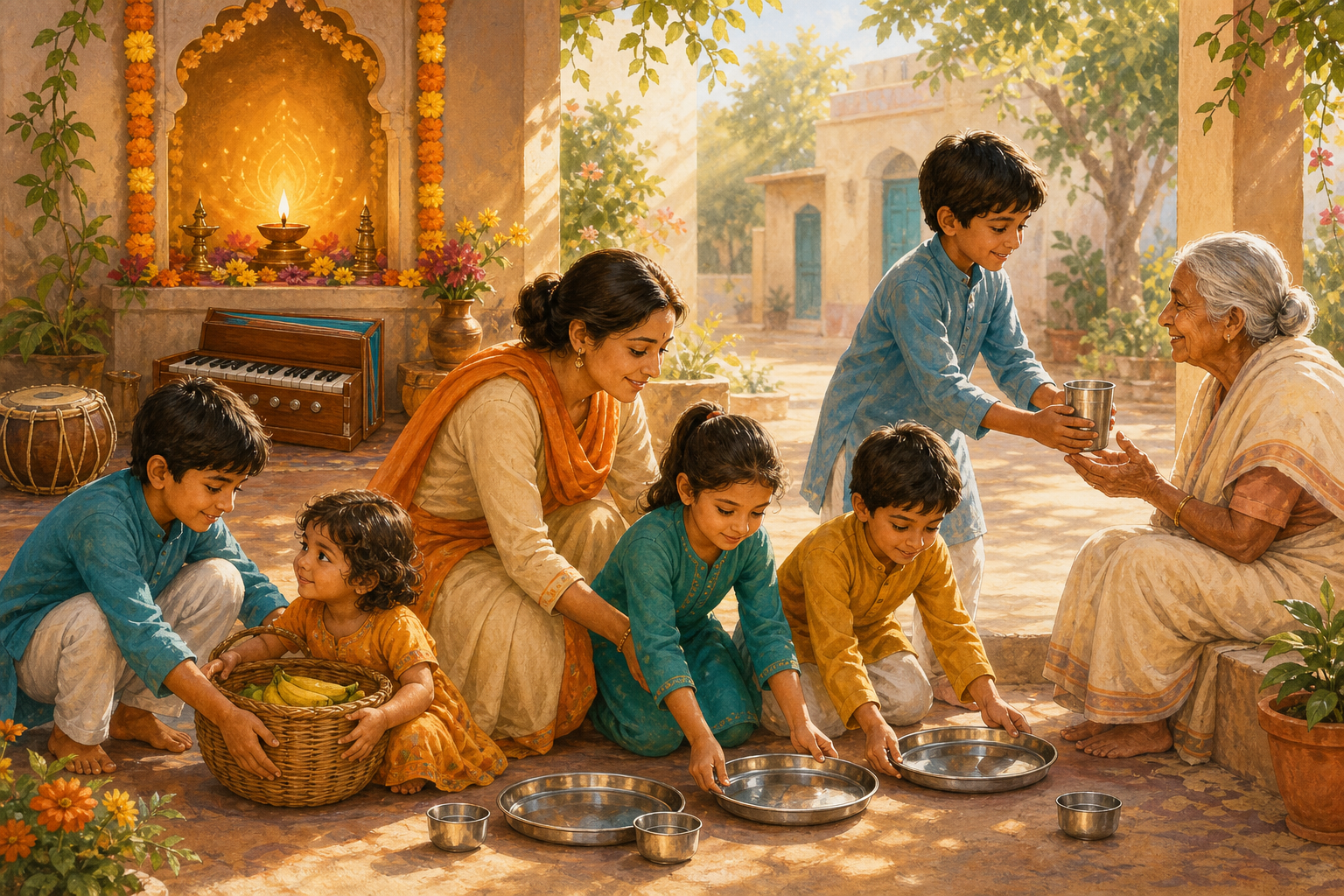
You may already have children who can recite a prayer, sing a bhajan, or retell a sacred story. The harder question comes later: does that learning change how they use talent, handle correction, include another child, or respond when a task is difficult?
If the answer is uncertain, adding more religious content will not necessarily close the gap. Bhakti-centered education forms character when remembrance leads to discernment, discernment is rehearsed through action, and action is offered as seva. That connection has to be designed into the learning experience.
Choose the character response before choosing the activity
A bhakti-centered curriculum does more than place a devotional period beside academic subjects. It gives knowledge and ability a governing purpose. The learner is not merely asking, What do I know? or What can I do? The deeper question is, Whom does this knowledge enable me to serve, and how should I use it?
That purpose becomes teachable only when you translate a broad value into a response that can be practiced. Seva, humility, gratitude, attention, and courage are worthy aims, but they are too abstract to serve as complete lesson objectives. Before planning an activity, finish this sentence:
When this situation arises, the learner will use this capacity in this way for the good of this person, community, or duty.
The resulting objectives should describe choices rather than moods:
- During group work, a capable student makes space for a quieter classmate instead of controlling every decision.
- After causing harm, the learner tells the truth, names the effect, and participates in a suitable repair.
- Before a cultural performance, students prepare carefully because reliability is part of the offering, not merely a route to applause.
- When a peer struggles, the learner offers useful help without turning that help into a display of superiority.
- When encountering another Dharmic tradition, the learner can recognize an ethical kinship without pretending that distinct teachings are interchangeable.
These actions can be observed, discussed, and improved. Inner devotion cannot be graded in the same way. A child who sings softly may be deeply attentive; a confident performer may still need to learn humility. Evaluate conduct and participation without claiming authority over the learner’s interior relationship with the divine.
This distinction also protects bhakti from becoming a tool of compliance. If adults use labels such as good devotee or bad devotee to control ordinary behavior, children learn to perform piety for approval. Name the actual conduct instead: You interrupted your partner; You left the shared work unfinished; You noticed someone needed help and stepped in. Precision makes correction fair and leaves devotion free from emotional coercion.
Use a repeatable path from remembrance to conduct

Character is not formed by hearing a moral once. It develops through abhyasa: returning to a worthy response until it becomes available under pressure. You can build that repetition through the same learning sequence across stories, songs, classroom work, family practice, and community service.
- Begin with remembrance. Use a sacred name, story, song, verse, image, or moment of silence that gives the lesson a devotional center. Keep it connected to the tradition being taught rather than reducing it to a generic motivational message.
- Name the moral relationship. Ask who has received a gift, who needs help, what duty is present, and what might distort the gift. Pride, fear, impatience, possessiveness, and the desire for recognition become easier to notice when they are connected to an actual decision.
- Rehearse the decision. Give learners a plausible situation before the real test arrives. Ask what seva would look like if they were the strongest student, the least experienced student, the person who made the mistake, or the person who was overlooked.
- Perform useful seva. Let the class meet a genuine need: preparing a shared space, helping a younger learner, welcoming families, supporting a cultural gathering, caring for learning materials, or completing an unglamorous part of a common task. Service should help someone beyond the person performing it.
- Reflect and re-enter. Ask what the learner noticed, what was difficult, who benefited, where ego appeared, and what should be tried differently when a similar situation returns. Reflection is not a victory speech; it is preparation for the next choice.
The sequence matters. A story without practice may remain an admired memory. Service without reflection can become routine labor. Reflection without another opportunity to act becomes talk. Remembrance, discernment, rehearsal, seva, and return create a complete formation loop.
A useful reflection prompt is concrete: Where did your ability become helpful to someone else? Follow it with: Where did the wish to be noticed interfere with the work? Those questions reveal more than asking whether the child was good. They connect capacity, motive, consequence, and responsibility without demanding a declaration of religious feeling.
Avoid paying for every act of service with prizes, points, or public praise. Recognition has a place, especially when it tells a learner exactly what was helpful. But if every act produces a reward, the reward quietly becomes the recipient of the effort. At times, let satisfaction come from seeing that the work was needed and completed well.
Let Hanuman teach the disciplined use of strength

Hanuman offers a particularly clear grammar for character formation because his greatness is not simply that he possesses extraordinary power. His childhood gifts are restrained from his own awareness until another person reminds him of them when dharmic duty requires their use. Jambavan’s reminder before the ocean crossing does not awaken power for spectacle. It enables Hanuman to serve Sri Rama, seek Sita, face danger, and return with what the mission requires.
Across Ramayana traditions, the sages’ shapa can therefore be taught as a pedagogical restraint rather than a merely vindictive punishment. Capacity is not denied; it is brought under dharma. The learner encounters a demanding idea: having a gift does not grant permission to use it whenever ego desires. Strength reaches maturity when it becomes answerable to purpose.
| Stage in the formation | Question for the learner | Adult responsibility |
|---|---|---|
| Gift | What capacity is present? | Notice it accurately without inflating the learner’s ego. |
| Restraint | When should this capacity not be used? | Set boundaries that protect people and the common work. |
| Reminder | What duty now calls the capacity forward? | Offer truthful encouragement connected to a real need. |
| Seva | How can the capacity serve rather than dominate? | Give responsibility, then examine its effect. |
This framework changes how you speak to a talented child. When a student dominates a group, Do not show off is incomplete; it addresses visibility but not purpose. Try: Your ability is real. What does this group need you to do with it? The answer might be to explain patiently, take a difficult supporting role, invite another idea, or finish the work nobody wants. The child is neither shamed for having strength nor licensed to possess the whole task.
The same story should not be used to tell a hesitant child to disappear. Humility is not self-erasure, and service is not passive obedience. Jambavan’s role matters because a timely reminder helps dormant capacity become courageous action. Some learners need restraint; others need a trustworthy person to tell them that the situation genuinely calls for their voice, effort, or leadership.
Before offering praise, decide which kind of reminder the learner needs. Flattery says, You are the best. Formation says, You have prepared for this, the group needs this capacity, and here is the duty it must serve. The second response joins confidence to accountability.
Make music, movement, and performance carry the curriculum

Bhakti is learned through the body and the community as well as through explanation. Vrajavasi school children using coordinated song and dance bring linguistic, musical, performative, and cultural learning into the same experience. Rehearsal can cultivate memory, rhythm, attentive listening, cooperation, confidence, and disciplined expression while keeping sacred and cultural inheritance alive.
Yet a devotional program does not form character merely because its content is sacred. Adults can still organize it around comparison, visibility, and applause. The polished singers receive the meaningful roles, less confident children become scenery, helpers remain unnamed, and the final performance matters more than the manner of preparation. A program can look devotional while teaching a hierarchy of attention.
Prevent that drift by writing down four aims before rehearsal begins:
- Remembrance: What name, narrative, teaching, language, or cultural form should remain with the learner?
- Skill: What should improve through practice – pronunciation, timing, listening, movement, narration, coordination, or memory?
- Character: What conduct should rehearsal require – patience, reliability, humility, courage, gratitude, or care for another learner?
- Service: Who is the offering for, and what genuine need does the gathering meet?
Then distribute meaningful responsibility across visible and less visible work. Singing, narration, rhythm, welcoming, arranging the learning space, supporting a younger participant, caring for materials, and helping the group recover from an error can all become formation tasks. Do not force public performance as proof of devotion. A quiet learner should have a real path to contribute without being treated as spiritually deficient.
Review the process as seriously as the presentation. Ask whether students arrived prepared, listened for cues, adjusted when someone struggled, shared access to central roles, completed support work, and recovered from mistakes without blame. These observations show whether the arts are carrying the character curriculum or merely decorating an event.
A multi-Dharmic setting can also use the arts to build informed respect. Compassionate service in the Buddhist bodhisattva ideal, Jain commitments such as ahimsa and aparigraha, and Sikh emphases on seva and nimarta offer ethical resonances with a bhakti account of humble service. Similarity should open a conversation, not erase difference. Preserve the names, narratives, practices, and theological integrity of the tradition being taught; shared civilizational values do not make every path identical.
Align the adults and assess conduct, not devotion
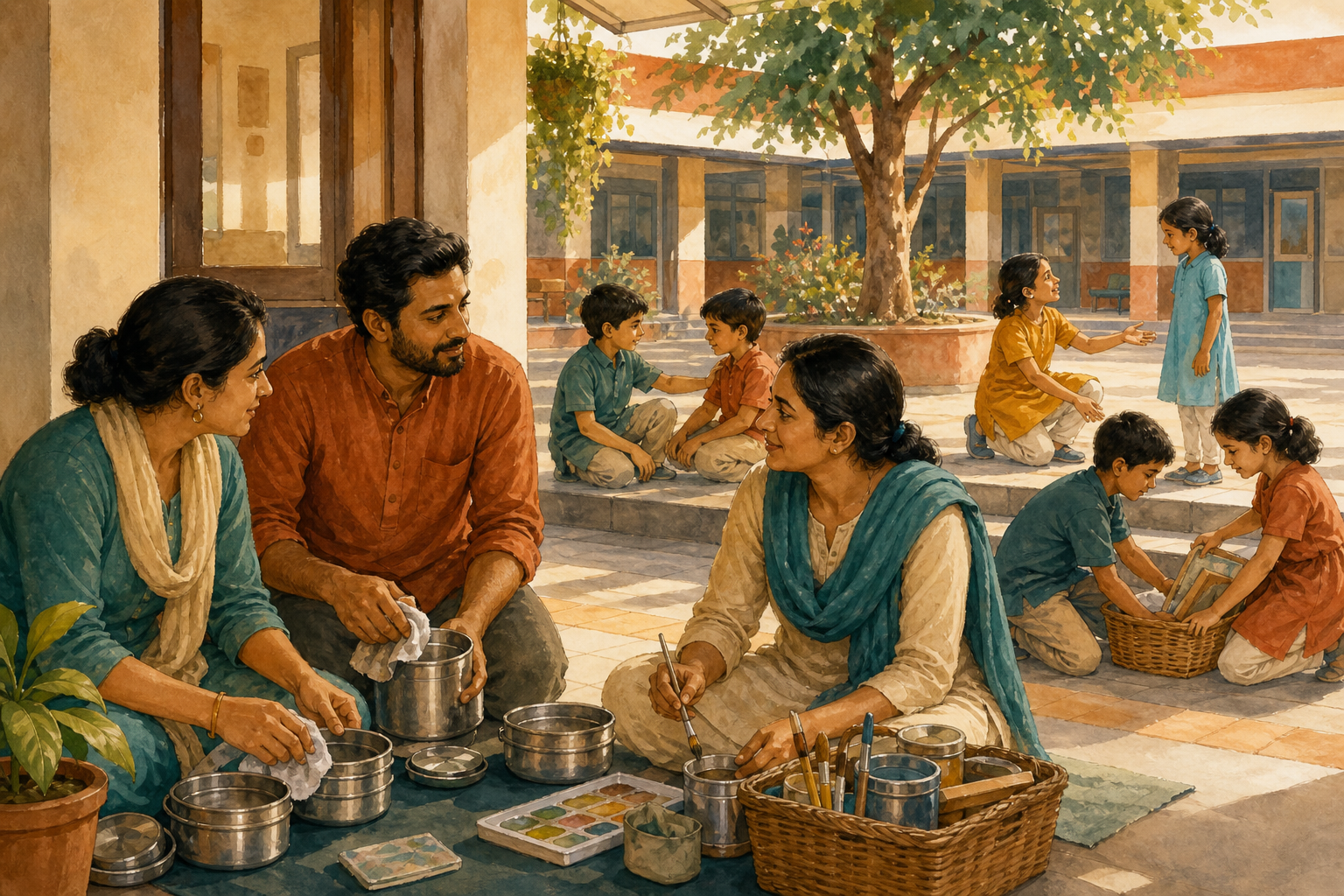
A child cannot easily learn humility from a program in which adults compete for recognition, or seva from a classroom where support work is treated as inferior. Character formation depends on the moral environment surrounding the lesson. Teachers, parents, volunteers, and community leaders need enough shared language that the child is not praised for dominance in one place and corrected for it in another.
A simple home-school-community covenant can establish that language:
- We will not use devotion as an insult, a threat, or a label for controlling a child.
- We will name conduct and consequences specifically when correction is needed.
- We will connect greater capacity with greater responsibility, not greater entitlement.
- We will give seva roles that meet actual needs, including work that brings little attention.
- We will model the practices we request by thanking helpers, admitting errors, making repairs, and accepting supporting roles.
- We will respect lineage-specific forms while teaching children to recognize ethical kinship across the Dharmic family.
Assessment should follow the same discipline. Do not grade love of God, sincerity of prayer, or the child’s presumed spiritual status. Record what can responsibly be known: the action witnessed, the situation in which it occurred, its effect on another person or the common task, and the response that still needs practice.
For example, Helpful is too vague. A more useful observation is: When a younger student lost the sequence, the learner slowed down, demonstrated it without ridicule, and then returned attention to the group. That evidence gives the learner something repeatable. It also helps adults distinguish character development from general likability or polished religious speech.
When conduct falls short, use restoration rather than spiritual shame:
- Name the action and its effect without attacking the learner’s identity.
- Ask which duty, relationship, or shared value was neglected.
- Choose a repair that addresses the actual harm or unfinished responsibility.
- Rehearse what the learner can do when the situation returns.
- Restore full participation after the repair instead of preserving humiliation as a warning.
This approach does not make expectations softer. It makes them more exact. The learner is accountable for conduct while still being treated as capable of returning to dharma.
Key takeaways
- Define character through observable choices, not devotional appearance.
- Move repeatedly from sacred remembrance to discernment, rehearsal, useful seva, and reflection.
- Use Hanuman’s example to join capacity with restraint, timely encouragement, and duty.
- Plan cultural performances around learning, shared responsibility, and service rather than applause alone.
- Assess conduct and skill, but do not pretend that an institution can measure inner bhakti.
- Correct through truth, repair, renewed practice, and restored belonging.
Begin with a recurring moment already present in your home, school, or mandir. Choose the character response it should form, connect that response to a sacred narrative or practice, give the learner a real responsibility, and revisit what happened. When that rhythm becomes ordinary, bhakti no longer sits beside education as an ornament. It becomes the way strength learns its purpose.
References
- DharmaRenaissance Blog – The Essential Story of Hanuman’s Curse: Discover the Secret Path to Eternal Seva
- Dandavats – Discover Vraja’s School Program: A Joyful, Bhakti-Rich Celebration of Learning and Culture
