
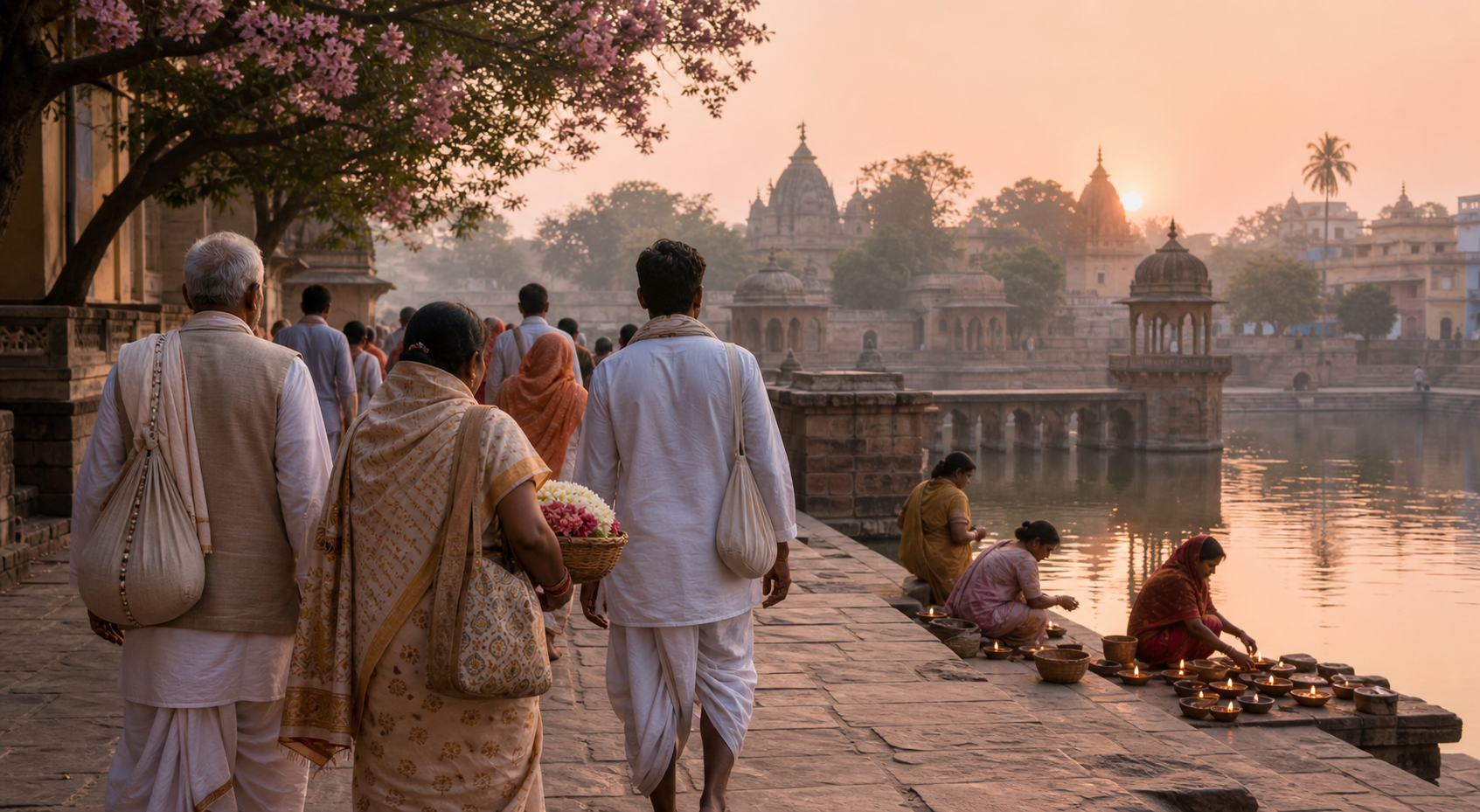
You can place Shantipur, Birnagar and Radha Kund on an itinerary and still miss what makes them sacred. The real question is not how many places you can cover. It is how to enter a living tirtha without reducing it to a photograph, a historical marker or a hurried ritual.
A meaningful Gaudiya pilgrimage joins three things: the person or lila remembered at the place, the devotional practice that keeps that memory alive, and the conduct through which you support the sacred community. Once you understand that pattern, each stop begins to tell you what kind of attention it requires.
Let each sacred place set the purpose of your visit
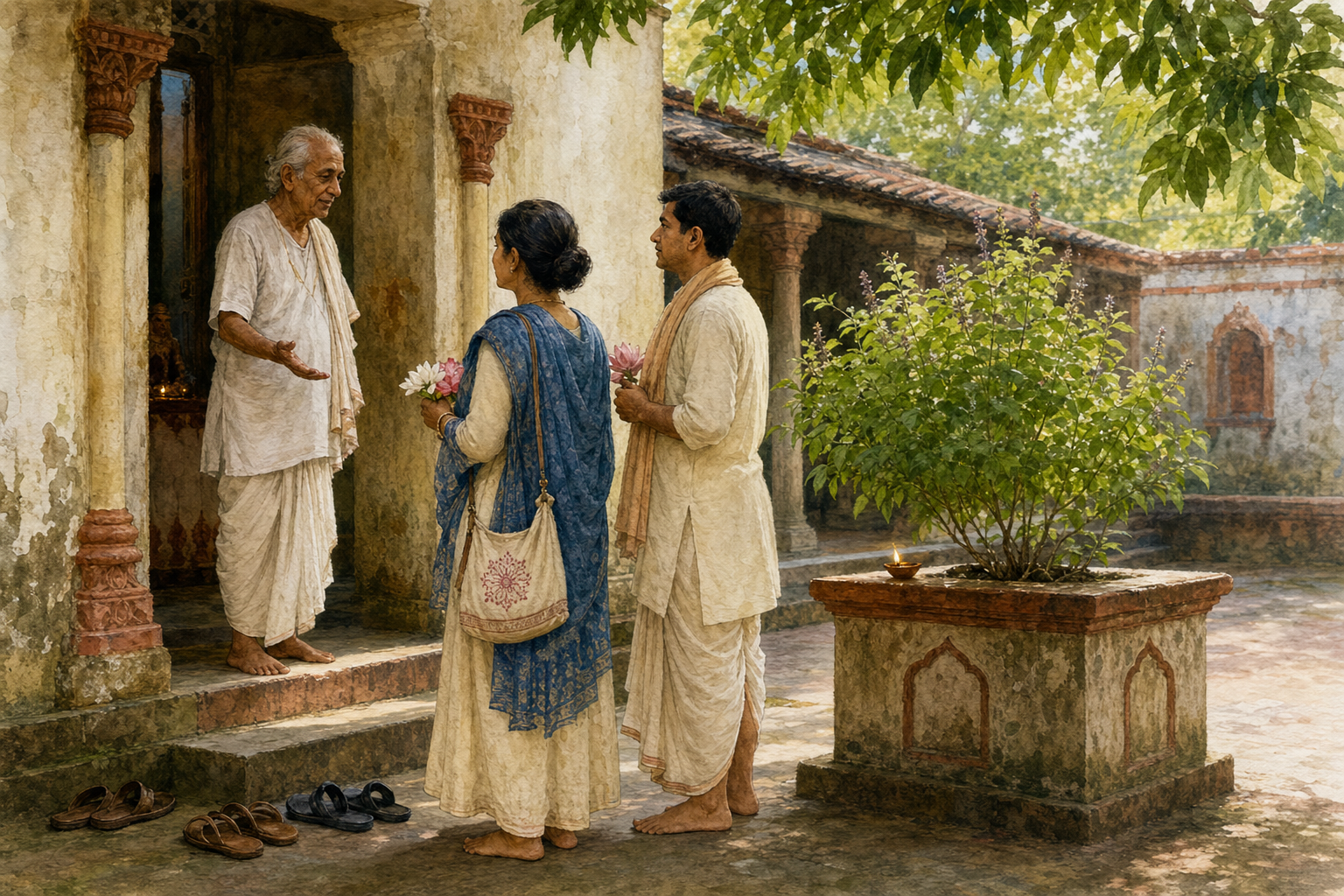
Sacred geography is not a collection of interchangeable temples. Shantipur, Birnagar and Radha Kund hold different memories within Gaudiya Vaishnavism, so they should not be approached with the same mental script. Before deciding what to do at a place, first ask whom or what the place asks you to remember.
Shantipur: prayer that becomes responsibility
Shantipur is associated with the residence of Advaita Acarya. In Gaudiya devotional memory, his fervent prayers for the Lord to descend in the age of Kali stand near the beginning of a movement shaped by compassion, congregational remembrance and shared spiritual purpose.
That memory gives you a practical way to visit. Do not treat Advaita Acarya as a name to acknowledge before moving on. Ask what moved him to pray so urgently, and what your own prayer is asking of you. Prayer in this setting is not passive wishing. It should sharpen your awareness of suffering, your dependence on divine grace and your obligation to serve.
When a discourse or kirtan is available, listen before trying to manufacture a private experience. Notice how the congregation remembers Advaita Acarya and how prayer becomes collective practice. A useful question to carry through Shantipur is: where am I waiting for change while withholding the prayer, service or cooperation that change requires?
Birnagar: devotion preserved through disciplined transmission
Birnagar is remembered as the birthplace of Srila Bhaktivinoda Thakura. Its importance lies not only in biography but in the revival, documentation and transmission of Gaudiya sacred knowledge. His intellectual and organizational labor reminds pilgrims that a tradition survives because devotees study carefully, preserve memory and make inherited wisdom intelligible to another generation.
Birnagar therefore calls for a different response from Shantipur. Bring a notebook, not merely a camera. Record what you need to learn more carefully, which practice in your own life lacks consistency, and what part of the tradition you are equipped to transmit without distortion. That last qualification matters. Passing on sacred knowledge is not the same as repeating a slogan; it requires study, context and fidelity.
- What teaching, memory or practice was preserved here?
- What would be lost if no one studied or transmitted it?
- What can you responsibly carry into your family or community?
Radha Kund: sacred water as a theology of prema
Radha Kund is not simply a beautiful body of water in the sacred landscape of Vrindavan. Gaudiya tradition remembers Sri Chaitanya Mahaprabhu as recognizing it as the holiest of holy places for cultivating prema-bhakti. Its sanctity is tied to Radha and Krishna, not to water in the abstract.
The traditional account connects Radha Kund and Syama Kund with the lila following Krishna’s subduing of Aristasura: Radha and her companions manifest Radha Kund, while Krishna manifests Syama Kund. The paired kunds make theology visible in the landscape. They direct attention toward divine relationship, loving reciprocity and the humility required to approach prema.
Begin here with quiet darshan or japa. If you undertake parikrama, keep a pace that protects attention rather than one chosen merely to finish. The point is not to collect the claim that you have circled a famous place. It is to allow remembrance to become steady enough that your movement, speech and treatment of others begin to reflect it.
Build your yatra around attention, not accumulation
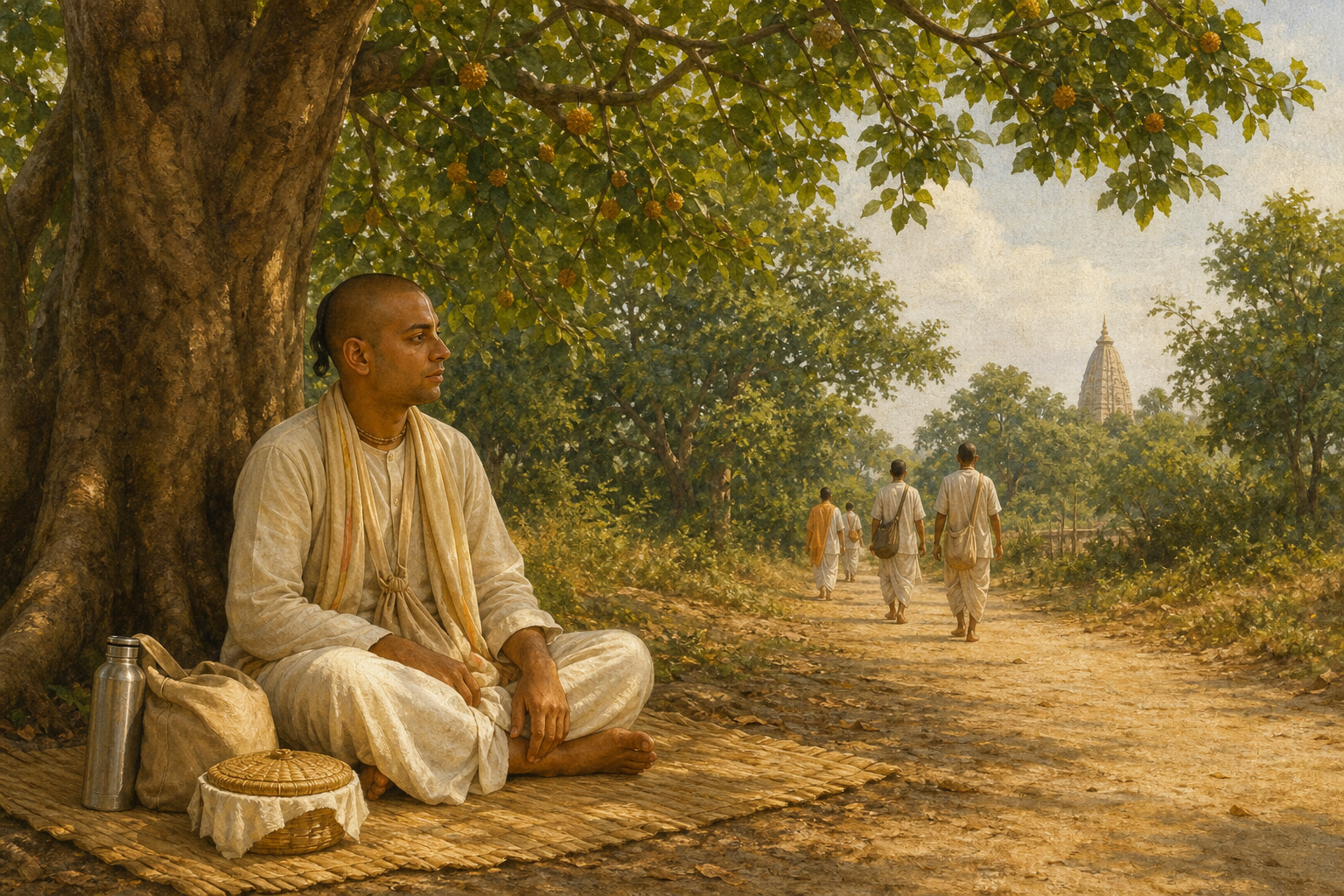
A crowded itinerary creates a predictable temptation: you leave one sacred place mentally before your body has left it, because you are already calculating transport, photographs and the next destination. The cure is not a more elaborate schedule. It is a repeatable rhythm that gives every visit a beginning, a center and a consequence.
- Learn the governing memory. Before arrival, know the person, lila or devotional relationship that gives the place its meaning. A small amount of accurate preparation is more useful than a large amount of disconnected information.
- State an intention. Put it in plain language: to hear about Advaita Acarya’s compassionate prayer, to understand Bhaktivinoda Thakura’s work of transmission, or to perform attentive japa near Radha Kund. An intention helps you distinguish what matters from what merely competes for attention.
- Pause on arrival. Do not make the camera your first act. Offer pranam, look carefully and allow the atmosphere of the place to set your pace.
- Hear before interpreting. If a discourse, kirtan or explanation is being offered, listen. A living community’s devotional memory supplies context that architecture alone cannot provide.
- Choose one embodied practice. Depending on the place and what is open to visitors, this may be japa, kirtan, darshan, prayer, parikrama or seva. Depth comes from sustained attention, not from performing every available act.
- Close the visit deliberately. Before leaving, identify one responsibility the place has revealed. It may concern daily sadhana, study, service, careful speech or the protection of sacred heritage.
This rhythm also protects you from comparing sacred places by emotional intensity. A quiet visit is not necessarily an unsuccessful one. Bhakti includes feeling, but mature feeling is held by disciplined sadhana. If a place leaves you with a clearer practice and a more truthful view of your responsibilities, the pilgrimage has already begun to work beyond the moment.
After each stop, use a few simple prompts: Whom did I remember? What quality became visible? Which practice supported that remembrance? What must change when I return home? These questions turn a sequence of destinations into a coherent yatra.
At Radha Kund, etiquette is part of the theology
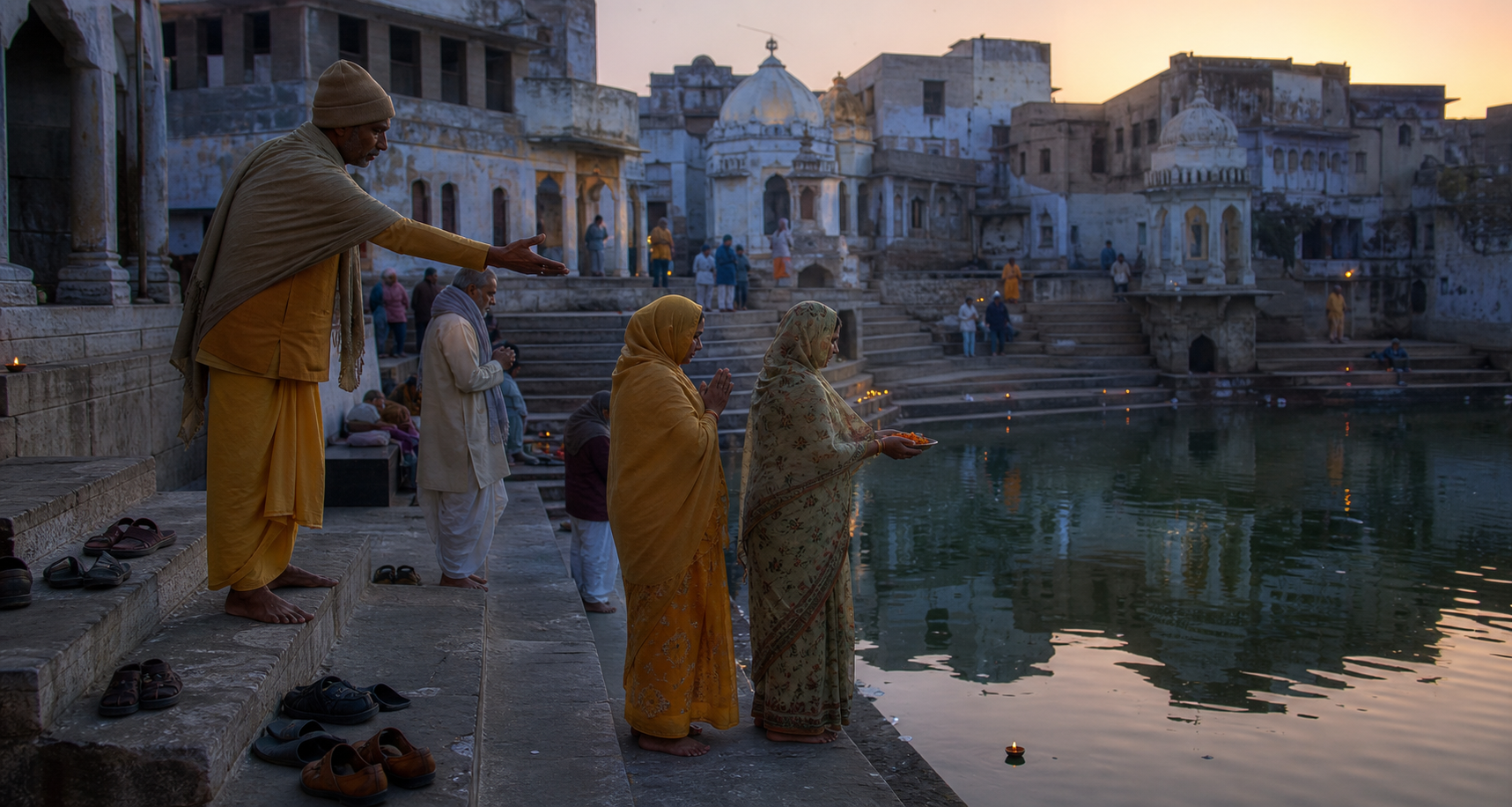
At a sacred kund, reverence has a physical form. How you dress, speak, move, photograph and handle waste affects both fellow pilgrims and the water itself. Etiquette is not an administrative layer placed on top of devotion. It is one of the ways devotion becomes visible.
- Wear modest clothing and keep your voice low. Residents and pilgrims may be engaged in japa, darshan or personal prayer. Your conduct should preserve that atmosphere.
- Perform parikrama respectfully. The customary direction is clockwise. Move without obstructing worshippers or turning the path into a setting for staged photographs.
- Use the camera with restraint. A sacred act is not automatically public because it occurs outdoors. Avoid intruding on worship, and seek permission before photographing people closely.
- Put no soap, detergent or food into the kunds. Protecting the ritual purity of the water requires keeping these materials out.
- Reduce the waste your visit creates. Refuse single-use plastics where possible, carry your waste to an appropriate receptacle, participate in cleanliness seva when suitable, and support credible conservation work.
- Do not assume that reverence entitles you to enter the water. Ritual bathing is especially associated with Bahulastami, when many pilgrims undertake snana, but you should follow current local instructions and the guidance of trusted temple authorities before participating.
If the maha-mantra is part of your practice, recite it softly and attentively: Hare Krishna Hare Krishna Krishna Krishna Hare Hare, Hare Rama Hare Rama Rama Rama Hare Hare. The volume need not announce your devotion to everyone nearby. The discipline is to bring the mind back to the holy names while leaving space for others to worship.
A useful test is simple: would your action still feel devotional if no photograph, public acknowledgment or dramatic memory came from it? Quiet japa, restrained speech and care for the water often ask more of the ego than conspicuous activity does. At a place associated with prema, that restraint is especially fitting.
Recognize living heritage without flattening Dharmic differences
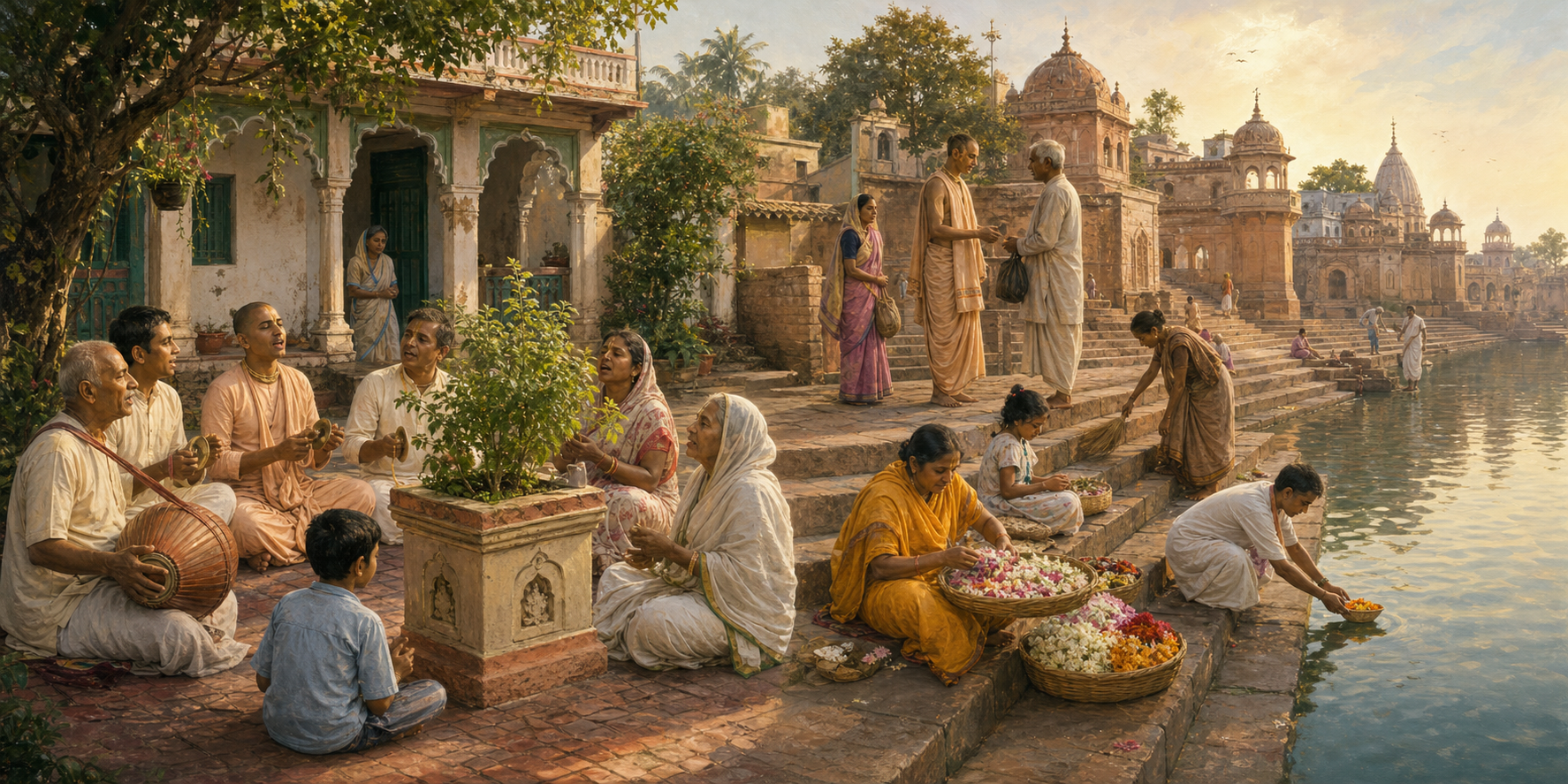
A heritage site can be preserved as architecture while losing the practices that made it meaningful. Living heritage is different. At Shantipur, memory continues through prayer, hearing and congregational devotion. At Birnagar, it continues through study and transmission. At Radha Kund, it continues through darshan, japa, parikrama and responsible care for the sacred waters.
This is why heritage stewardship belongs inside pilgrimage rather than outside it. Cleanliness seva, support for conservation, respectful treatment of residents and accurate transmission of sacred history are not secondary concerns for people who happen to enjoy preservation. They protect the material and communal conditions in which devotion can continue.
These places also help you notice a wider Dharmic family resemblance. Compassion, ahimsa, self-discipline and seva have recognizable resonances across Hindu, Buddhist, Jain and Sikh traditions. Sacred water likewise carries themes of purification, remembrance and renewal in Gaudiya tirthas, Buddhist offerings, Jain practices of pavitrata and Sikh sarovars such as the Amrit Sarovar.
Resonance does not mean sameness. Radha Kund cannot be understood by removing Radha, Krishna, their lila and the Gaudiya aspiration for prema-bhakti. A Sikh sarovar or a Jain practice should receive the same courtesy: understand it through its own tradition before drawing a comparison. Unity in diversity becomes meaningful when common ethical commitments are recognized without dissolving distinct theology.
- Ask which person, deity, lila or teaching gives the place its identity.
- Notice which repeated practice keeps that identity alive.
- Look for the ethical demand made on the pilgrim, not only the blessing the pilgrim hopes to receive.
- Identify the material responsibility – toward water, buildings, residents or cleanliness – that follows from reverence.
This way of seeing protects you from two opposite mistakes. One is to treat every tradition as unrelated and miss Bharat’s shared civilizational vocabulary of pilgrimage, non-harm, service and sacred water. The other is to call every path identical and erase the relationships that give each sacred place its particular force.
Key takeaways for your next Gaudiya pilgrimage
- Begin with the person or lila remembered at the site, not with the photograph you want to take there.
- Let the place shape your practice: compassionate prayer at Shantipur, disciplined study and transmission at Birnagar, and attentive japa, darshan or parikrama at Radha Kund.
- Choose depth over the number of stops. A smaller itinerary leaves room for hearing, reflection and seva.
- At Radha Kund, keep soap, detergent, food and avoidable plastic away from the water, and seek local guidance before ritual bathing.
- Treat residents and practicing devotees as members of a living sacred community, not as scenery within a heritage destination.
- Recognize shared Dharmic ethics without treating Hindu, Buddhist, Jain and Sikh practices as interchangeable.
- Leave every site with one specific commitment that can enter your daily sadhana, study or service.
Before you finalize your yatra, write one sentence beside every destination: “This place asks me to remember…” Complete the sentence, then choose the practice that supports that memory. Before ordinary routines return after the journey, put the resulting commitment into your calendar. That is how sacred geography begins to change the geography of daily life.
References
- Dandavats – Essential Pilgrimage to Shantipur and Birnagar: Discover Gaudiya Bhakti’s Living Legacy
- Dandavats – Complete Guide to Sri Radha Kund: Discover the ‘Liquid Love’ of Sacred Waters
