
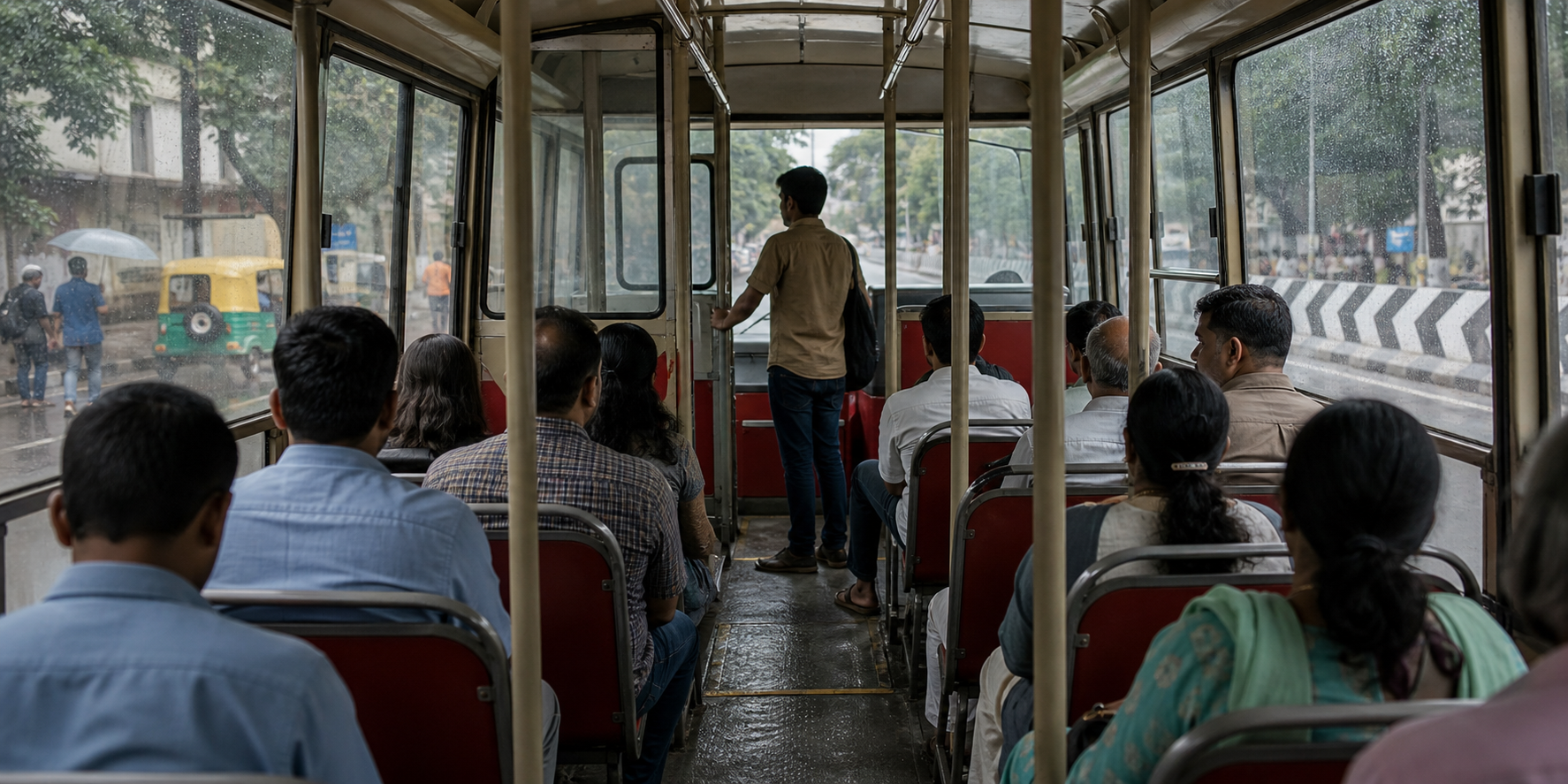
You notice a religious appeal pasted inside a BMTC bus. You want it removed, but you don’t want an ordinary commute to become a quarrel between passengers. The useful question is narrower than a religious debate: who authorised the display, and would the same rule be enforced if another community had put it there?
A reported Bengaluru case shows why that approach can work: Christian proselytisation stickers placed on the inner glass panels of a BMTC bus were promptly removed after a public objection on X. For a commuter, the practical lesson is to document the display, report the use of public property, request a rule-based remedy, and keep fellow passengers out of the dispute.
Neutrality begins with the bus, not the passenger
Religious neutrality in public transport is not a demand that commuters conceal their faith. A passenger’s tilak, turban, kara, prayer beads, scripture, or other personal observance should not be treated as equivalent to material fixed to a publicly operated vehicle. One belongs to the person; the other uses a shared civic asset to carry a message.
That distinction gives you a clear way to assess what you see:
- Personal expression: Something worn, carried, or quietly read by a passenger remains associated with that individual. It does not turn the bus into a platform for the message.
- Consensual conversation: Passengers may discuss religion, as they discuss politics or family life, when everyone involved is willing to participate. Persistent solicitation after someone declines is a different matter, but it should be addressed as conduct rather than as collective guilt.
- Material attached to the vehicle: A sticker, poster, leaflet, or contact appeal fixed to a window, seat, panel, or door can look as though the operator has permitted it. That is where authorisation becomes decisive.
- Officially approved communication: Safety notices, service information, paid advertising, and any cultural display selected by the operator should have an identifiable approval process. If no such process can be shown, enforcement should not depend on which religion appears in the message.
You do not have to settle whether a religious claim is true, respectful, or offensive before reporting an unauthorised display. Ask whether someone was permitted to place it on the bus. This keeps the complaint within an area the transport undertaking can actually investigate.
Consent matters as well. A person who boards a bus to reach work, school, a hospital, or home has not volunteered to become an audience for conversion appeals. The commuter cannot escape a fixed message in the same way that someone can leave a religious meeting; leaving the bus may mean abandoning the journey. Keeping vehicle interiors free from unauthorised persuasion therefore protects the ordinary purpose of the service.
How to report an unauthorised religious display
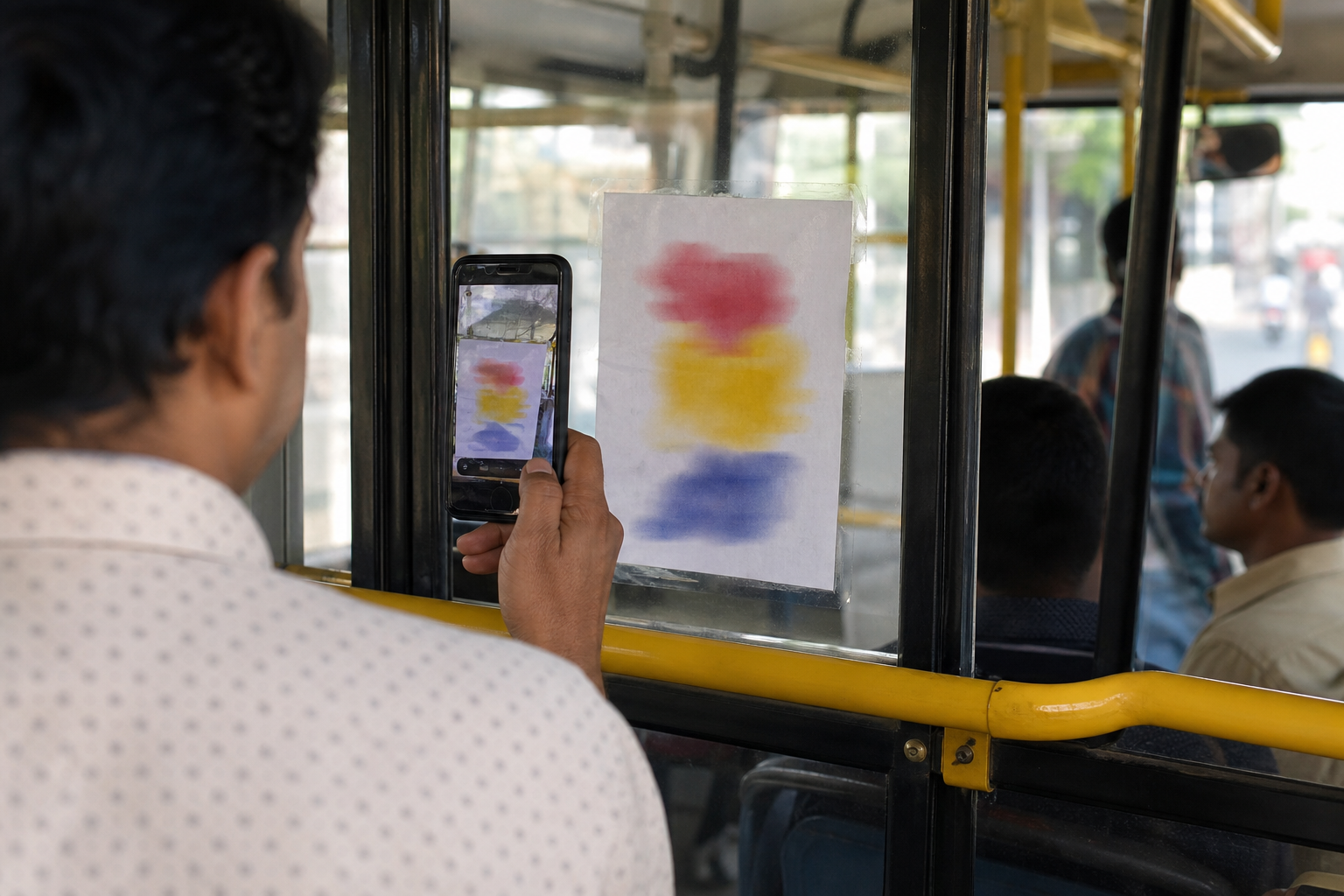
A useful complaint is calm, specific, and easy to verify. It asks for an administrative action rather than a public judgement against a community.
- Do not peel off or deface the material yourself. You may not know who placed it there, and removing it can create a confrontation or destroy the evidence needed to establish what happened. If there is no immediate danger, let authorised staff handle the physical removal.
- Record the context safely. If it can be done without distracting the driver or provoking anyone, take one wider photograph showing where the material is attached and one readable photograph of the message. Avoid capturing passengers’ faces unnecessarily. If photography is unsafe, make written notes after you alight.
- Identify the vehicle and journey. Note the bus number or another visible vehicle identifier, route, approximate time, direction of travel, and the sticker’s location inside the bus. A complaint saying only that something appeared on a Bengaluru bus is difficult to investigate.
- Describe what is visible, not what you assume. State that the material contains a religious appeal, conversion invitation, contact information, or another observable feature. Do not claim that the driver, conductor, BMTC, or an entire religious community placed or endorsed it unless you have direct evidence.
- Use BMTC’s officially listed complaint channel. Contact the channel the undertaking currently designates for commuter feedback. Ask whether the display was authorised and request removal if it was not. Because contact methods can change, rely on the details presently published by BMTC rather than a number copied from an old social-media message.
- Request a complaint reference and an outcome. Ask for confirmation that the specific bus was inspected, not merely an acknowledgement that your message was received. Keep the photographs and reference until the matter is resolved.
Copyable complaint wording: On [date] at approximately [time], while travelling on BMTC bus [vehicle identifier or route] towards [direction], I noticed a sticker attached to [exact location]. It appeared to contain [brief factual description]. Please confirm whether this display was authorised. If it was not, please arrange its removal, inspect the rest of the vehicle, and share the complaint reference and outcome. I request that the same rule be applied to unauthorised religious messaging from every community.
If the material contains a direct threat, incitement to violence, or a message targeting an identifiable passenger, treat safety as the immediate issue. Alert transport staff or the appropriate emergency authority rather than waiting for an ordinary display complaint to be processed.
Fair enforcement has to survive the substitution test
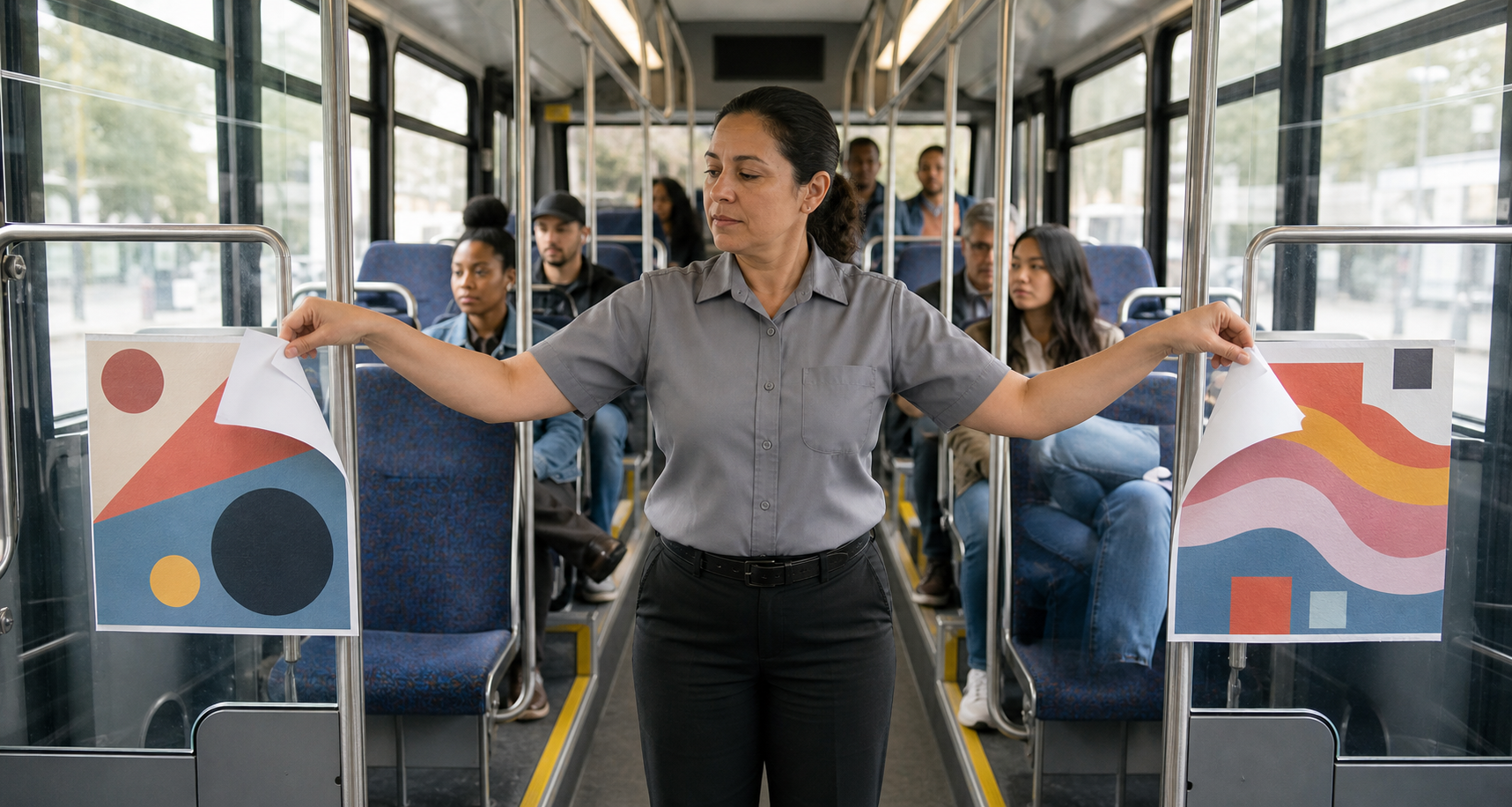
The easiest test of a neutral rule is substitution: replace the religion named on the sticker with another one. Would the authority still inspect the bus, verify authorisation, and remove the material if it was unauthorised? If the answer changes with the community involved, the process is not neutral.
This means an unauthorised Hindu, Buddhist, Jain, or Sikh appeal should be handled under the same rule as an unauthorised Christian, Muslim, or other religious appeal. That symmetry does not weaken a Hindu objection to proselytisation. It makes the objection principled, repeatable, and harder to dismiss as a demand for selective privilege.
Equal treatment does not require Bengaluru’s public life to become culturally blank. An operator may choose to carry official civic information, authorised advertising, or transparently approved cultural material. The relevant distinction is between an accountable institutional decision and a private actor quietly appropriating the vehicle’s surfaces. A published approval process lets commuters tell the difference.
BMTC and other transport undertakings can turn that principle into routine practice through a few visible controls:
- State the rule plainly: Signage should tell passengers that no private person may attach material to the vehicle without approval, regardless of its religious, political, or commercial content.
- Make reporting immediate: Put the official complaint method where a passenger can find it inside the bus. A route to report a violation is more useful than a rule commuters cannot act on.
- Inspect the whole interior: Routine checks should include inner glass panels, seat backs, doors, partitions, and other surfaces where small stickers can be missed.
- Give staff a neutral response: Drivers, conductors, and complaint handlers need not debate theology. A sufficient response is: the display will be checked for authorisation and removed if it is unauthorised.
- Close the loop: The complainant should be told whether an inspection occurred and what action followed. That small step turns enforcement into something the public can trust.
Accountability should focus on the vehicle, the placement, the approval record, and the remedy. Speculation about the unknown person responsible adds heat without helping staff locate and clean the bus.
A Dharmic response can be firm without becoming hostile
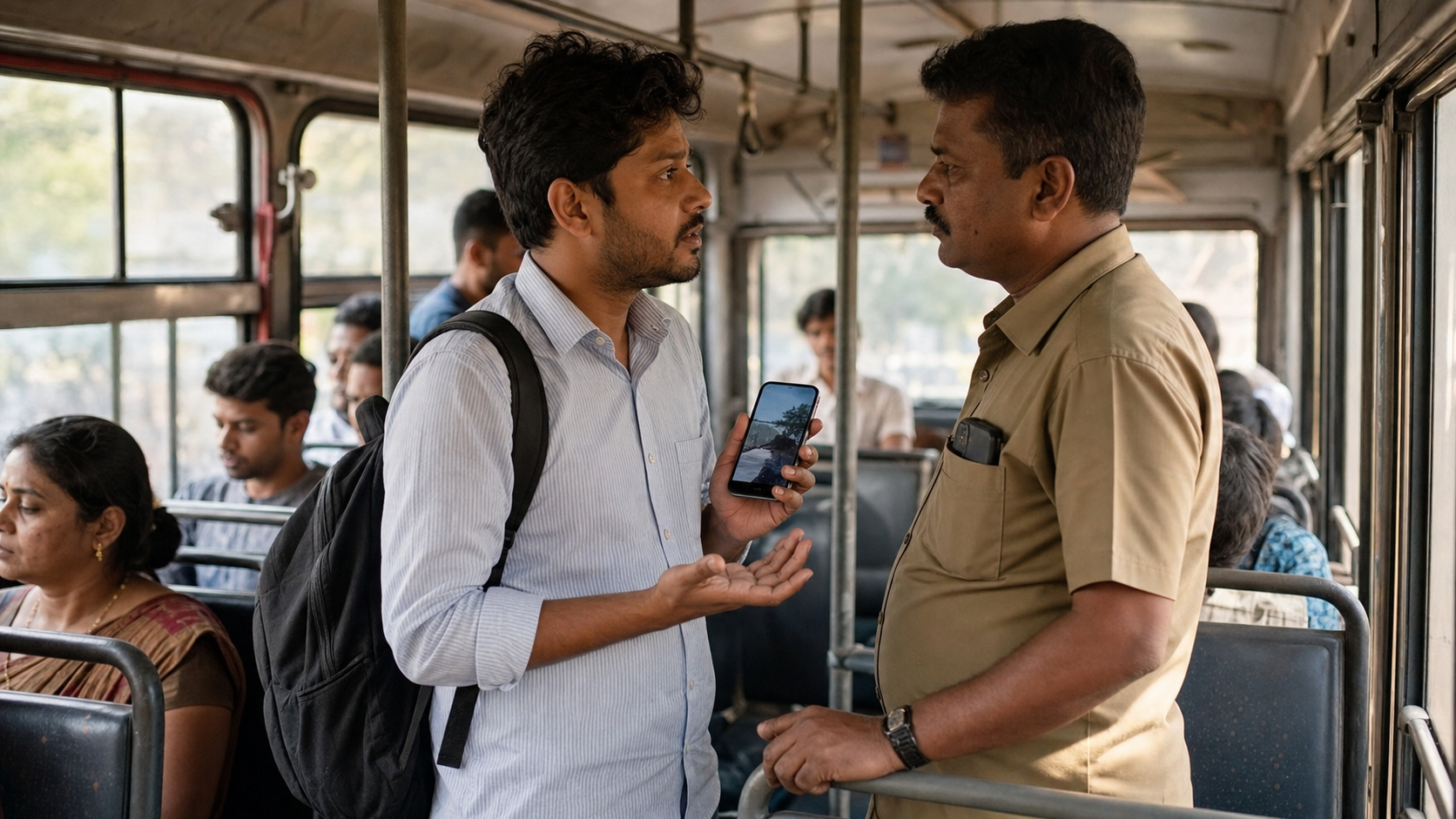
Hinduism, Buddhism, Jainism, and Sikhism are distinct traditions; civic unity does not require flattening their teachings into one theology. Yet compassion, non-harm, and responsibility for shared life offer a strong vocabulary for handling this issue. They support neither passive acceptance of an improper act nor hostility towards uninvolved people.
Ahimsa in this setting is not silence. You can object firmly to proselytisation placed before a captive audience while refusing to humiliate a passenger, abuse transport staff, or blame every member of the faith represented. The objection is to the unauthorised use of civic property and the intrusion it creates, not to the dignity of an ordinary Christian commuter or any other individual.
This is also where religious confidence matters. Dharma does not need a bus window commandeered by private hands in order to endure, and it does not benefit when enforcement becomes a contest over which group can place the most material. Homes, temples, gurdwaras, monasteries, community centres, and voluntary gatherings allow spiritual teaching to occur with context and consent. A public bus serves a different purpose.
A neutral transport service is not declaring that all religions are identical or that religious conviction belongs outside society. It is declining to make commuters absorb an unauthorised appeal as the price of completing a journey. That restraint leaves people of every tradition free to travel together without turning the vehicle into disputed religious territory.
Key takeaways
- Separate a passenger’s personal religious expression from material attached to the bus.
- Make authorisation, use of public property, and consistent enforcement the centre of your complaint.
- Photograph the placement only when safe, note the bus and journey details, and avoid exposing fellow passengers unnecessarily.
- Ask BMTC to inspect the vehicle, remove unauthorised material, and provide a complaint reference and outcome.
- Do not remove the material yourself or accuse drivers, conductors, passengers, or a whole community without evidence.
- Apply the same standard to Hindu, Buddhist, Jain, Sikh, Christian, Muslim, and every other religious message.
The next time you find such a display, reduce the incident to four verifiable facts: what was attached, where it was attached, which vehicle carried it, and whether it was authorised. Send those facts through the official channel and ask for a recorded resolution. That is how one commuter can defend both Dharmic dignity and a genuinely shared public space.
References
