

You may be trying to remain kind toward someone who has hurt you, while knowing that further passivity will invite further harm. Or you may have carried other people’s needs for so long that compassion now sounds like one more demand. Hindu contemplative practice offers a more exact aim: become tender enough to recognize suffering and steady enough to answer it without surrendering discernment.
Compassion and resilience become distorted when they are separated. Care without strength can turn into appeasement or depletion. Strength without care can harden into contempt. The practical task is to train both within the same prayer, breath, boundary, and decision.
Key takeaways
- Compassion does not require unlimited access to you. It requires a truthful response that avoids unnecessary harm.
- Resilience is not numbness. It is the ability to feel what is present, recover your capacity to choose, and act according to dharma.
- Choose one primary doorway: devotion to a form of Devi, Anahata-centered breath and mantra, or contemplative service. Depth is more useful than collecting techniques.
- When you are activated, ask what deserves care and what must be protected. Either question alone can mislead you.
- Measure practice by conduct under pressure: clearer motives, proportionate boundaries, less retaliatory speech, and more reliable service.
Get the aim right before choosing a technique
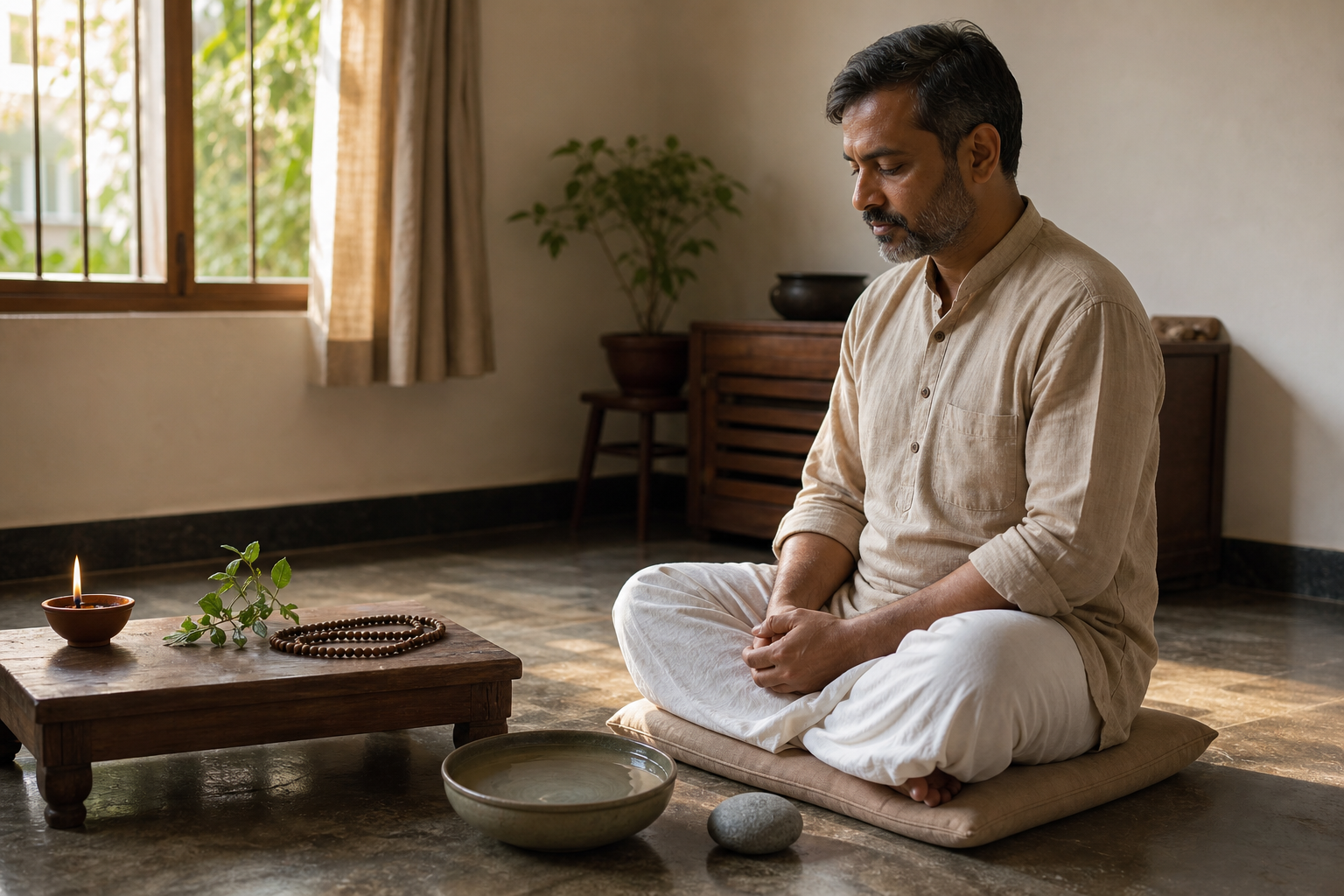
Compassion asks, ‘What response can reduce suffering without denying the truth?’ Resilience asks, ‘Can I remain present long enough to carry out that response without collapsing, fleeing into distraction, or retaliating?’ These are not competing questions. Each corrects the weakness of the other.
The devotional image of Sundarikali makes this integration visible. Her name joins sundara, associated with beauty and grace, with Kali, associated with time, transformation, and the force that dissolves ignorance. Her serenity does not cancel her protective power. It governs that power, so that courage serves what is worthy rather than becoming an excuse for aggression.
You do not contemplate such a form merely to feel peaceful. You let the form expose where your own qualities have become divided. Perhaps you are gentle because you fear confrontation. Perhaps you call yourself strong while feeding resentment. Perhaps you protect everyone except yourself. The image becomes useful when it reveals the missing half of your response.
- Compassion is not compliance. Compassion considers everyone’s dignity; compliance hands the decision to whoever applies the most pressure.
- Forgiveness is not automatic reconciliation. You can work to release vengeance while still requiring accountability, changed conduct, and rebuilt trust before restoring a relationship.
- Resilience is not suppression. Suppression insists that nothing affected you. Resilience admits the effect and restores your freedom to respond.
- Protective strength is not uncontrolled anger. Anger may alert you to a violation, but it should not decide the scale, language, or target of your response.
This union of care and strength also helps us recognize kinship without erasing differences among Dharmic paths. Karuna in Buddhism, ahimsa in Jainism, and seva in Sikhism express related ethical concerns, even though their doctrines, disciplines, and sacred languages remain distinct. A Hindu practice does not become less rooted because it recognizes that shared horizon.
Before you meditate, name the situation that actually troubles you. Avoid a vague aspiration to become more loving. Bring one living difficulty to mind and ask: ‘Where am I adding suffering?’ ‘What must not be permitted?’ ‘What action is genuinely mine?’ A contemplative practice becomes transformative when its answer enters your conduct.
Choose the contemplative doorway you can practice faithfully

Hindu Dharma offers different temperaments different entrances. These are not levels on a ladder, and you do not need to combine all of them. Choose the form that makes you more honest, stable, and responsible. If a practice produces pleasant feelings but leaves your conduct untouched, it has not yet reached the point of need.
Devi contemplation: let tenderness and protection share one form
Sundarikali is contemplated as a radiant manifestation of Divine Shakti whose calm beauty remains inseparable from protective force. This is especially useful when your inner picture of goodness has become passive, or when your picture of power has become harsh.
Place an image or sacred symbol before you if that belongs to your practice. Offer a flower if appropriate. Sit quietly and notice the union presented by the form: a presence that is serene without being helpless and formidable without being cruel. If you have a mantra or japa discipline from your lineage, use it. Otherwise, silent remembrance is sufficient; there is no need to improvise an esoteric mantra.
Bring your difficulty before Devi without rehearsing a case for your innocence. Ask where tenderness is required and where protection is required. Then reverse the questions. Ask whether what you call tenderness is actually fear, and whether what you call protection is actually wounded pride. This reversal is often where devotional contemplation becomes ethical discernment.
Japa, silent contemplation, and offerings of flowers can all support this devotional path. The object is not to imitate an icon’s outward appearance. It is to allow the contemplated form to educate your own use of attention, speech, and power.
Anahata practice: use breath, mantra, and inner space
If you respond more naturally to yogic meditation than to sacred imagery, Anahata offers another doorway. It is traditionally described as the fourth primary chakra, located at the center of the chest and functioning as a bridge between embodied concerns and higher spiritual insight. The name refers to the ‘unstruck sound,’ an image of resonance that does not depend on outer collision.
The traditional contemplative supports include the element air, a green luminosity, the bija mantra Yam, and a lotus with twelve petals. Use these as anchors for attention, not as claims that you must manufacture a particular sensation. A quiet mind, a vivid visualization, warmth in the chest, and no unusual sensation at all can each occur without proving spiritual attainment or failure.
The chakra map is a contemplative framework, not a medical diagnostic system. Tightness, pain, breathlessness, or changes in the chest should not be explained away as a ‘blocked heart chakra.’ Yogic mappings can support meaningful meditation while remaining distinct from medical models. Physical symptoms require appropriate medical attention.
Anahata practice also does not demand emotional exposure to unsafe people. An open heart is not an unguarded door. Its balance lies in remaining capable of goodwill while deciding carefully who receives your time, trust, confidence, and proximity.
Seva as contemplation: give compassion a defined task
Seva prevents compassion from remaining a private spiritual self-image. After meditation, choose a useful action that another person can actually receive. Prepare something needed, accompany someone through a difficult duty, care for a shared place, or give undistracted attention where it has been neglected. The action need not be dramatic. It must be real.
Define the service clearly: who it is for, what you will do, and where your commitment ends. A bounded promise is often more compassionate than an expansive offer you cannot sustain. It protects the recipient from disappointment and protects you from the resentment that follows habitual over-promising.
Service and contemplation correct each other. Meditation before service helps you notice whether you are acting from care, guilt, fear of disapproval, or a need to be indispensable. Service after meditation tests whether your inner warmth can become reliable conduct. Constructive service, gratitude, forgiveness work, and healthy relational boundaries all help carry heart-centered cultivation into ordinary life.
Build a daily practice that joins feeling to action

We would begin with one plain sequence and repeat it before adding complexity. Its purpose is not to create a special mood. It is to rehearse a dependable movement from bodily steadiness to compassionate intention, discerning reflection, and one concrete act.
- Take a stable seat. Keep the spine comfortably upright rather than rigid. A chair is suitable if sitting on the floor causes strain.
- Let the breath become smooth. Observe several natural cycles without pulling in extra air, extending the exhalation by force, or holding the breath. Relax the jaw and shoulders where you can.
- Bring the hands to Anjali Mudra. Rest the palms near the sternum if that is comfortable. If it is not, leave the hands supported and keep the same inward intention.
- Choose one contemplative center. For a Devi-centered practice, contemplate Sundarikali and use the japa or remembrance proper to your tradition. For an Anahata-centered practice, visualize a soft green luminosity and recite Yam from three to twelve times. Do not stack both merely to make the session feel more impressive.
- Rest in a welfare intention. Continue for five to ten minutes. You might use a plain aspiration such as: ‘May I meet suffering without adding avoidable harm. May I protect what dharma asks me to protect. May all beings find safety and ease.’
- Bring in the actual difficulty. Ask what in the situation needs care, what requires protection, and what responsibility belongs to you. Wait long enough to distinguish a considered answer from the first defensive impulse.
- Close with gratitude and a commitment. Choose one action you can complete: make a repair, state a boundary, offer service, seek counsel, postpone an inflammatory reply, or acknowledge a truth you have avoided.
If concentration is poor, complete the smallest honest version rather than abandoning the practice. Sit, take an unforced breath, remember your chosen form or intention, and name the next dharmic act. Elaborate sessions are not necessary for every difficult day. Repetition matters because the expected shifts are gradual and cumulative rather than instant.
Do not force the breath, use breath retention without proper instruction, or continue when a practice causes dizziness or panic. Return to ordinary breathing and orient yourself to the room. Chest pain or significant difficulty breathing needs medical attention, not a chakra interpretation. Persistent grief, trauma reactions, rage, or anxiety that disrupt daily functioning also warrants help from a qualified health or mental-health professional. Contemplative practice can accompany appropriate care; it should not replace it.
Carry the practice into the moment that usually defeats you

The decisive test is not how you feel while sitting in a quiet room. It is what happens when you are insulted, exhausted, frightened, or asked for more than you can responsibly give. In those moments, do not demand instant saintliness from yourself. Recover enough inner space to choose the next action.
When anger feels righteous
Protective energy can reveal that a boundary, person, community, or duty is being violated. It does not follow that every expression of anger is protective. Humiliation, exaggeration, collective blame, and revenge often add a second wrong to the first.
If there is no immediate danger, allow the body to settle before replying. Identify the precise conduct you oppose. Then state the limit without attacking the person’s humanity: ‘I will not continue while I am being insulted. We can return to this when the conversation can remain respectful.’ A specific boundary gives the other person information. An insult merely transfers your agitation.
If there is immediate danger, prioritize physical safety and seek suitable help. That is not the moment to remain in place for the sake of appearing spiritually calm. Contemplation can help you process and choose later steps after safety has been established.
When compassion has become over-giving
Before agreeing to a request, ask whether the help is truly yours to give, whether you can give it without breaking an existing duty, and whether it supports responsibility or shields someone from every consequence of their choices. A compassionate answer may be yes, no, or a limited offer.
Replace vague availability with a defined commitment. Say what you can do, when you can do it, and what remains outside your capacity. This is not a retreat from compassion. It converts goodwill into a promise that can be trusted.
When hurt has hardened into resentment
Do not force forgiveness as a way of avoiding anger, grief, or accountability. First name the injury accurately. Establish the boundary or safety measure the situation requires. Then practice refusing to feed fantasies of retaliation. Goodwill may grow later, but it cannot be made authentic by command.
You can also separate the person from the conduct without excusing either. A person retains human dignity; harmful conduct still requires a truthful response. This distinction lets compassion survive without making reconciliation compulsory.
When defending Dharma in public life
A pro-Dharma outlook is not proved by softness toward adharma, but neither is it proved by hatred toward persons. Firm cultural advocacy can remain factual, proportionate, and disciplined. Before speaking or sharing, ask whether the act protects something real, whether the claim is accurate, and whether the language serves correction or merely displays fury.
The Sundarikali principle is useful here: radiance without helplessness, protection without loss of moral center. If your defense of Dharma repeatedly makes you less truthful, less self-governed, or more eager to dehumanize, the method is contradicting the value it claims to defend.
Audit behavior instead of chasing spiritual feelings
Progress may include steadier breathing, greater emotional clarity, more capacity for forgiveness, and a calmer baseline during interpersonal difficulty. Yet the most useful evidence appears in choices you can examine.
- Recovery: After a trigger, do you regain the capacity to choose before you speak or act?
- Clarity: Can you name the exact harm or need without inflating it into a total judgment of another person?
- Proportion: Does your response fit the actual situation, or are you discharging the weight of older injuries?
- Boundaries: Can you refuse access or conduct without using cruelty as proof of seriousness?
- Service: Do compassionate intentions become completed acts, or do they remain private feelings?
- Release: Once the necessary action is taken, can you loosen the mental rehearsal of accusation and revenge?
If tenderness is increasing while your boundaries weaken, strengthen the protective question. If discipline is increasing while contempt grows, return to the welfare intention and the dignity of the person before you. If meditation feels profound but your behavior never changes, make the closing action smaller, clearer, and non-negotiable.
Begin with the difficulty already in front of you. Sit, breathe without force, take up your chosen form or mantra, and ask what deserves care and what requires protection. Then carry one answer into conduct. Compassion with a spine and resilience with a heart are not moods you wait to receive. They are capacities you rehearse until they shape how you meet the world.
References
- DharmaRenaissance Blog — Ultimate Guide to Goddess Sundarikali: Discover the Radiant, Compassionate Power of the Divine
- DharmaRenaissance Blog — Anahata (Heart Chakra) Explained: The Complete Guide to Discover Inner Balance and Compassion
