
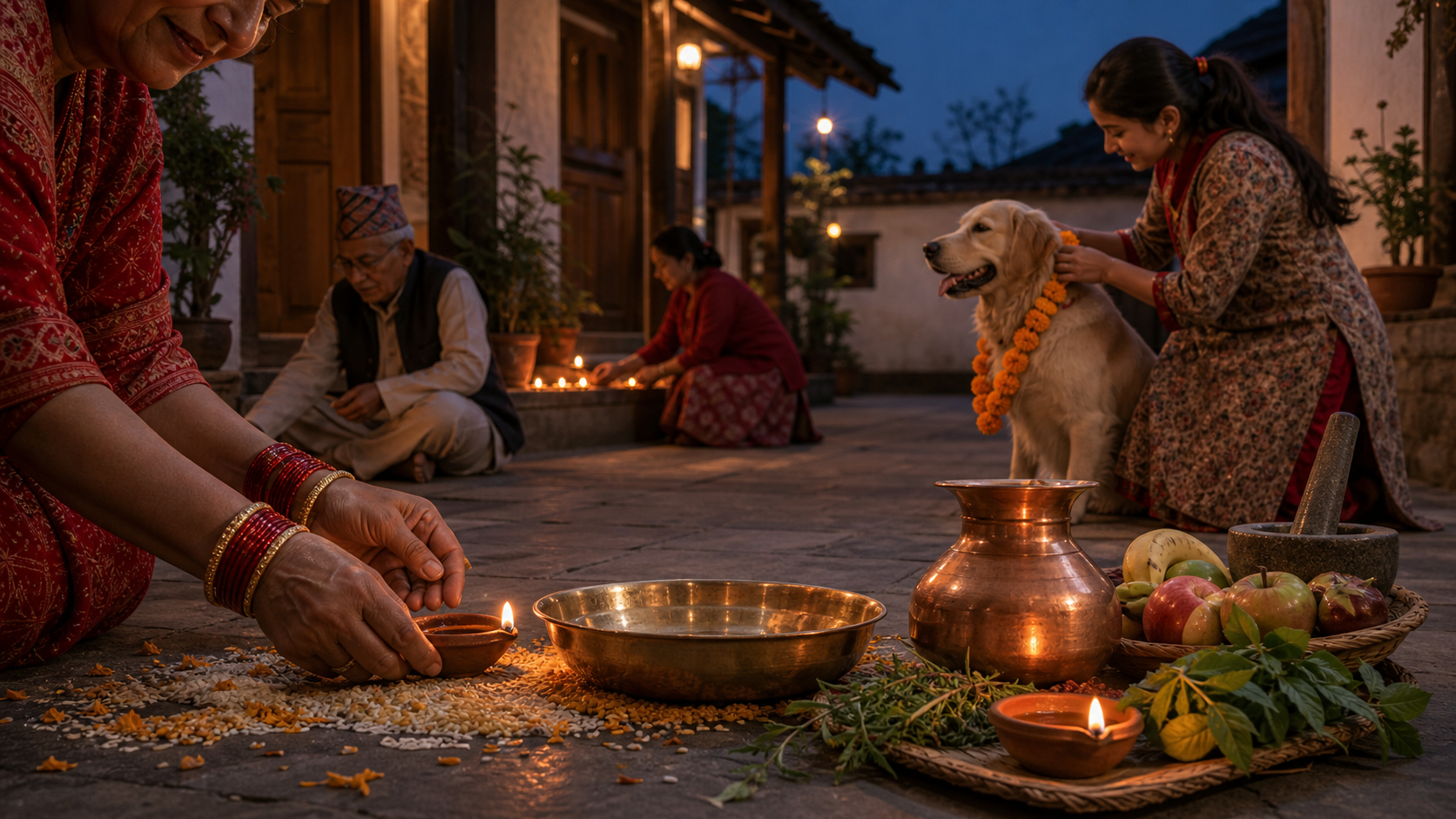
Your family calendar says Dhanteras, the temple announces Dhanvantari Jayanti, and your Nepali relatives or friends are preparing for Tihar. The dates overlap, but the names are not interchangeable. Treating them as three unrelated festivals is just as misleading as collapsing them into one generic Diwali ritual.
You can observe the season coherently by working at three levels: the auspicious household beginning associated with Dhanteras, the healing discipline of Dhanvantari Jayanti, and the five-day web of relationships honored during Tihar. The aim is not to perform every custom. It is to know what each action means before you include it.
The overlap is real, but the observances are not interchangeable
The cleanest way to understand the relationship is to separate calendar, focus, and scale. Dhanteras and Dhanvantari Jayanti commonly meet on Kartik Krishna Trayodashi, especially in western and northern India. Tihar is a wider Nepali festival cycle extending from the waning half of Kartik into the waxing half.
| Observance | Calendar shape | Central concern | What to preserve |
|---|---|---|---|
| Dhanteras | A Trayodashi observance associated with the opening of the Diwali season | Prosperity, responsible household order, and an auspicious beginning | Cleaning, lamps, gratitude, and a purposeful purchase when that is your family custom |
| Dhanvantari Jayanti | Kartik Krishna Trayodashi, often on the same civil date as Dhanteras | Health, Ayurveda, healing, disciplined living, and service | Dhanvantari invocation, mantra, reflection on health, and compassionate action |
| Tihar | A five-day Nepali cycle from Krishna Paksha into Shukla Paksha | Relationships among humans, animals, prosperity, nature, self, and kin | The day-by-day progression from Kaag Tihar through Bhai Tika |
Dhanvantari is remembered as the divine originator of Ayurveda and the physician of the devas. In the Samudra Manthan account, he emerges carrying the amrita-kalasha, the vessel of nectar. The image points toward vitality and the continuity of life, but it also places an obligation on the devotee: value health before illness forces it to the center of attention.
Dhanteras brings prosperity into the same ritual space. That need not reduce prosperity to buying something expensive. A utensil, a medical or Ayurvedic text, a clean kitchen, a repaired household object, or a commitment to use resources responsibly can carry more meaning than an impulsive purchase made only because the date is considered auspicious.
Tihar expands the field of gratitude across five observances. Crows, dogs, cows, prosperity, the natural world, the self, and siblings all enter the sacred frame. Calling Tihar simply Nepal’s version of one Diwali night misses this deliberate sequence.
These practices also carry values recognizable across Dharmic traditions: ahimsa, mindfulness, gratitude, restraint, compassion, and seva. Shared values create a bridge among Hindu, Buddhist, Jain, and Sikh communities; they do not erase the distinct ritual forms or the Nepali and Newar settings in which particular customs live.
Set the dates by location before planning the rituals
A tithi is a lunar day, not a midnight-to-midnight civil date. It can begin on one civil date and finish on another. That is why two calendars can display adjacent dates without either household acting carelessly. Location, panchang method, the time of the relevant tithi, and inherited family practice can all affect when a puja is performed.
The practical mistake is copying a date from an old festival page or another country and then building the entire family schedule around it. Use this order instead:
- Select a local calendar. Use a panchang calculated for your location, guidance from the temple you actually attend, or the Nepali calendar followed by your household.
- Record the tithi as well as the civil date. Write Kartik Krishna Trayodashi beside Dhanteras and Dhanvantari Jayanti. For Tihar, record each named observance rather than writing only one date for the entire festival.
- Confirm the family convention. Ask which evening your household uses for deep-daan, Dhanvantari puja, Laxmi Puja, Mha Puja, and Bhai Tika. This is especially important in diaspora families combining Indian and Nepali calendars.
- Share a named schedule. Instead of sending a message that says only Diwali puja, write the exact observance, date, and local time. That prevents relatives from assuming that Dhanvantari puja, Laxmi Puja, and Bhai Tika are happening together.
The 2025 dates show why this discipline matters. Dhanvantari Jayanti fell on October 18, while the Tihar cycle extended from October 18 through October 23. Calendrical treatments placed the principal Diwali and Laxmi observances around October 20-21. That one-day range is not a schedule to reuse in another year. It is a reminder to settle local timing before announcing the puja.
If members of the same family follow different calendars, do not turn the difference into a test of devotion. Agree on one time for the shared gathering, then let anyone who follows an additional tithi-based practice keep it. Ritual continuity is better served by clarity than by forcing a false uniformity.
Build a grounded Dhanteras and Dhanvantari observance
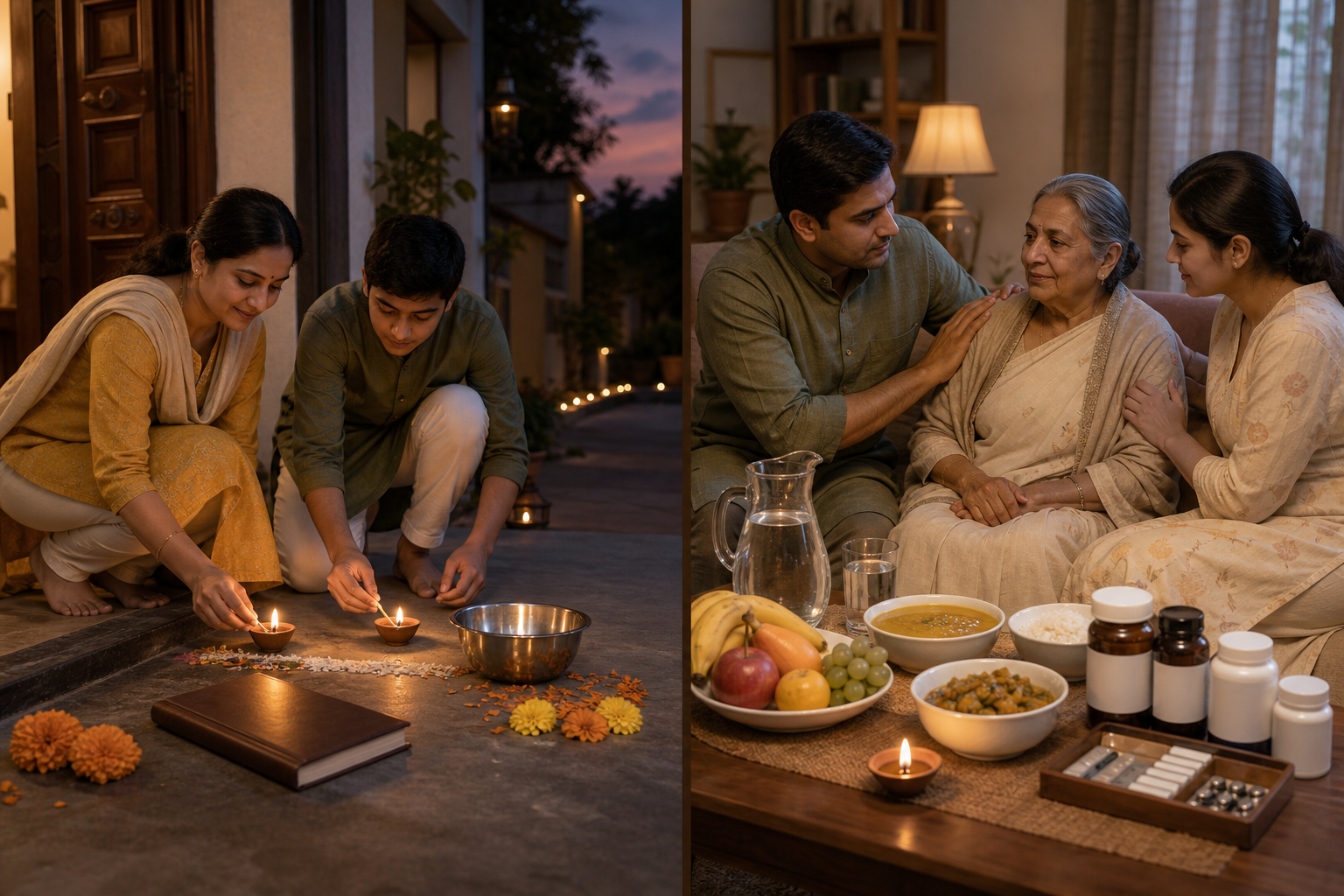
You do not need an elaborate altar to give the day a clear shape. A simple observance can hold prosperity, healing, gratitude, and service together without confusing their purposes.
- Clean before decorating. Clear the altar, entrance, kitchen, and the place where you keep medicines or health records. The physical act gives the themes of order and care a practical beginning.
- Prepare a restrained altar. Place an image or symbol of Bhagavan Dhanvantari if your household uses one. Add a lamp, fruit, clean water, and customary medicinal leaves such as tulsi or neem. Water or ghee may also be set aside for traditional ritual use.
- Choose a useful symbol of renewal. If purchasing something is part of your Dhanteras practice, choose an object you will actually use: a durable utensil or a sound book on Ayurveda or health. The price of the object is not a measure of the sincerity of the observance.
- Invoke Dhanvantari with attention. Recite the mantra at a steady pace, then sit quietly long enough to connect the prayer with an honest health responsibility.
- Carry the intention outward. Support a legitimate health camp, community kitchen, or organization providing appropriate medical assistance. If donating medicines, work through an organization able to verify what is needed and how it must be stored.
A commonly recited mantra is:
Om Namo Bhagavate Vasudevaya Dhanvantaraye Amrita-kalasha Hastaya Sarva Bhaya Vinashaya Sarva Roga Nivaranaya Trayi Mayaya Bhagavate Namah.
The prayer offers reverence to Bhagavan Dhanvantari, bearer of the amrita vessel, and asks for the removal of fear and disease. Do not turn that devotional meaning into a medical guarantee. Mantra, puja, yoga, pranayama, and an Ayurvedic way of life can be parts of spiritual discipline, but they are not reasons to delay diagnosis, discontinue prescribed treatment, or ignore serious symptoms. When care is needed, seek an appropriately qualified health professional.
The most useful vrata may be the one that continues after the lamps are put away. Choose one concrete practice: restore a regular sleep time, prepare a warm sattvic meal, return to a sustainable yoga or pranayama routine, organize medicines safely, or make the appointment you have been postponing. Pick an action you can repeat. A long list of seasonal resolutions abandoned after Diwali does not honor balance as well as one durable change.
This also clarifies the relationship between wealth and health. Dhanteras asks how resources enter and support the household; Dhanvantari Jayanti asks whether the life within that household is being cared for. The observance becomes coherent when your spending, daily habits, and seva answer both questions.
Follow Tihar as a five-day relationship, not a single puja
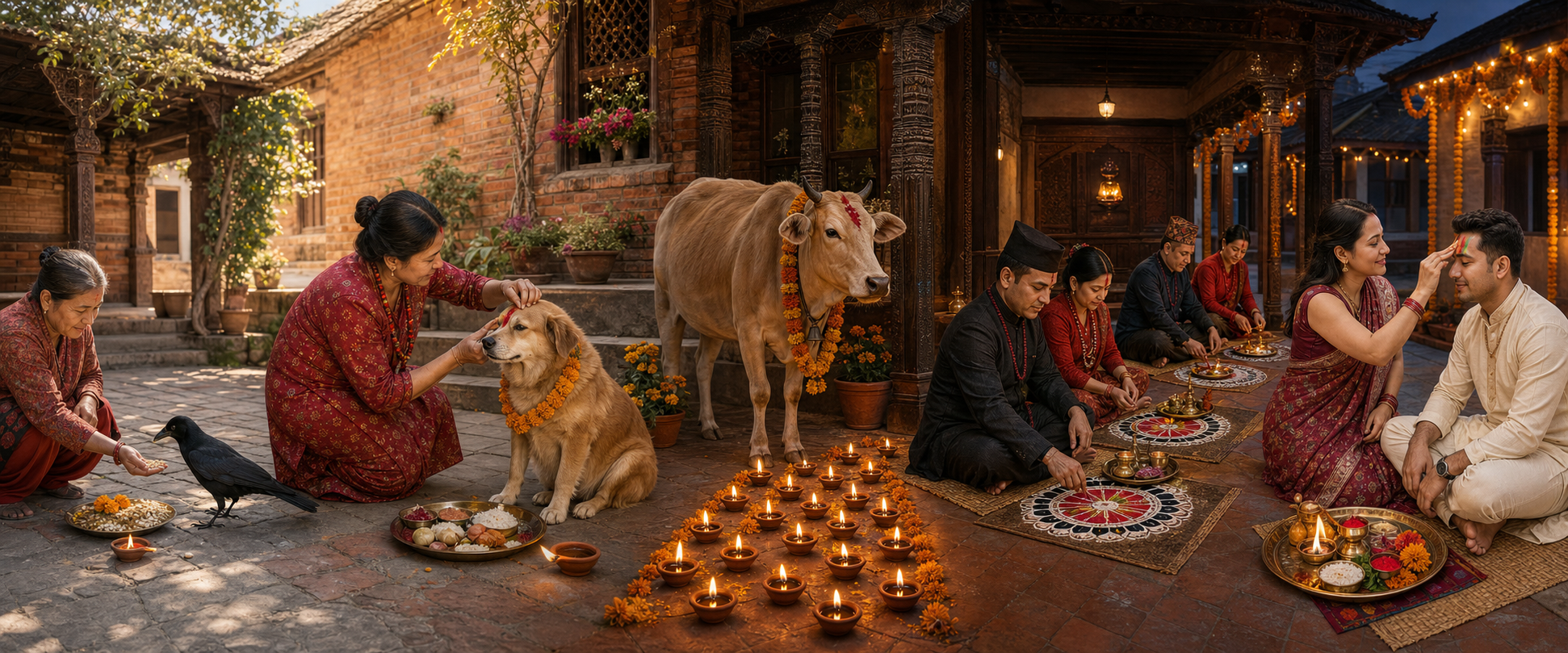
If Tihar belongs to your family or you have been invited into a Nepali household, preserve its sequence. Each day turns attention toward a different relationship. The progression is itself part of the teaching.
- Kaag Tihar honors crows as messengers. Begin with respect for forms of life that people often dismiss as ordinary or inconvenient. The point is not spectacle; it is the deliberate expansion of attention beyond the human household.
- Kukur Tihar honors dogs for loyalty and protection. Treat animal well-being as more important than a photograph. Do not force a garland, tika, clothing, or unfamiliar food on a distressed animal. Follow the animal’s comfort and the guidance of the person responsible for its care.
- Gai Tihar and Laxmi Puja welcome sustenance and abundance. Cows are honored, while clean homes, lamps, marigold garlands, rangoli, and mandala designs prepare a place for Laxmi. Keep oil lamps on stable, nonflammable surfaces and supervise them, especially around children, animals, curtains, and doorways.
- Govardhan Puja and Mha Puja turn gratitude toward ecology and the self. Mha Puja has particular importance in the Newar community, which also marks Nepal Sambat. If it is not your inherited practice, participate under the guidance of the host community rather than presenting it as a generic Diwali performance.
- Bhai Tika renews the sibling bond. Tika and blessings express mutual protection and affection. Confirm the family’s customary form in advance, especially when relatives live apart or when marriage and migration have brought several regional traditions into the same home.
Deusi-Bhailo singing and community sharing keep Tihar from becoming a private sequence of decorative acts. If you live outside Nepal, decide early who will host, which days the household can observe fully, and where the community gathering will happen. A modest day-by-day observance retains more meaning than compressing every rite into the most convenient weekend without naming what has changed.
Cultural sensitivity matters most when one photogenic custom begins to circulate apart from the festival. Kukur Tihar, for example, should not be detached from Kaag Tihar, Gai Tihar and Laxmi Puja, Mha or Govardhan Puja, and Bhai Tika as though it were merely a themed pet day. You can appreciate one observance while still explaining the sacred sequence around it.
The sequence moves from messenger to protector, from sustainer and prosperity to ecology and self, and finally to sibling kinship. Notice what this does: light is not treated as decoration alone. It becomes a way of seeing obligations that daily life lets you overlook.
Key takeaways for your household observance
- Confirm dates and muhurta through a panchang calculated for your location; never reuse the previous year’s civil dates.
- Dhanteras and Dhanvantari Jayanti may share Trayodashi and one family gathering, but name both intentions: responsible prosperity and disciplined care for health.
- If you make a Dhanteras purchase, choose something useful. Expense is not a substitute for gratitude, household order, or generosity.
- Let Dhanvantari worship produce one continuing health action, while keeping spiritual practice alongside rather than in place of qualified medical care.
- Observe Tihar as a five-day progression. Preserve the meanings of Kaag Tihar, Kukur Tihar, Gai Tihar and Laxmi Puja, Govardhan or Mha Puja, and Bhai Tika.
- When joining a Nepali or Newar observance as a guest, follow the host family’s calendar and ritual leadership instead of reconstructing the ceremony from isolated images.
Start with the local panchang, then write a short family schedule with one line for each observance you will keep. Choose the altar items, one act of seva, and one health commitment before shopping. That small act of planning will let the lights illuminate distinct relationships instead of blurring them into a single busy evening.
References
- DharmaRenaissance Blog – Dhanvantari Jayanti 2025: Complete Guide to Date, Mantra, Rituals, and Ayurveda Significance
- DharmaRenaissance Blog – Complete Guide to Tihar 2025: Discover Nepal’s Diwali Dates, Rituals, and Cultural Harmony
