
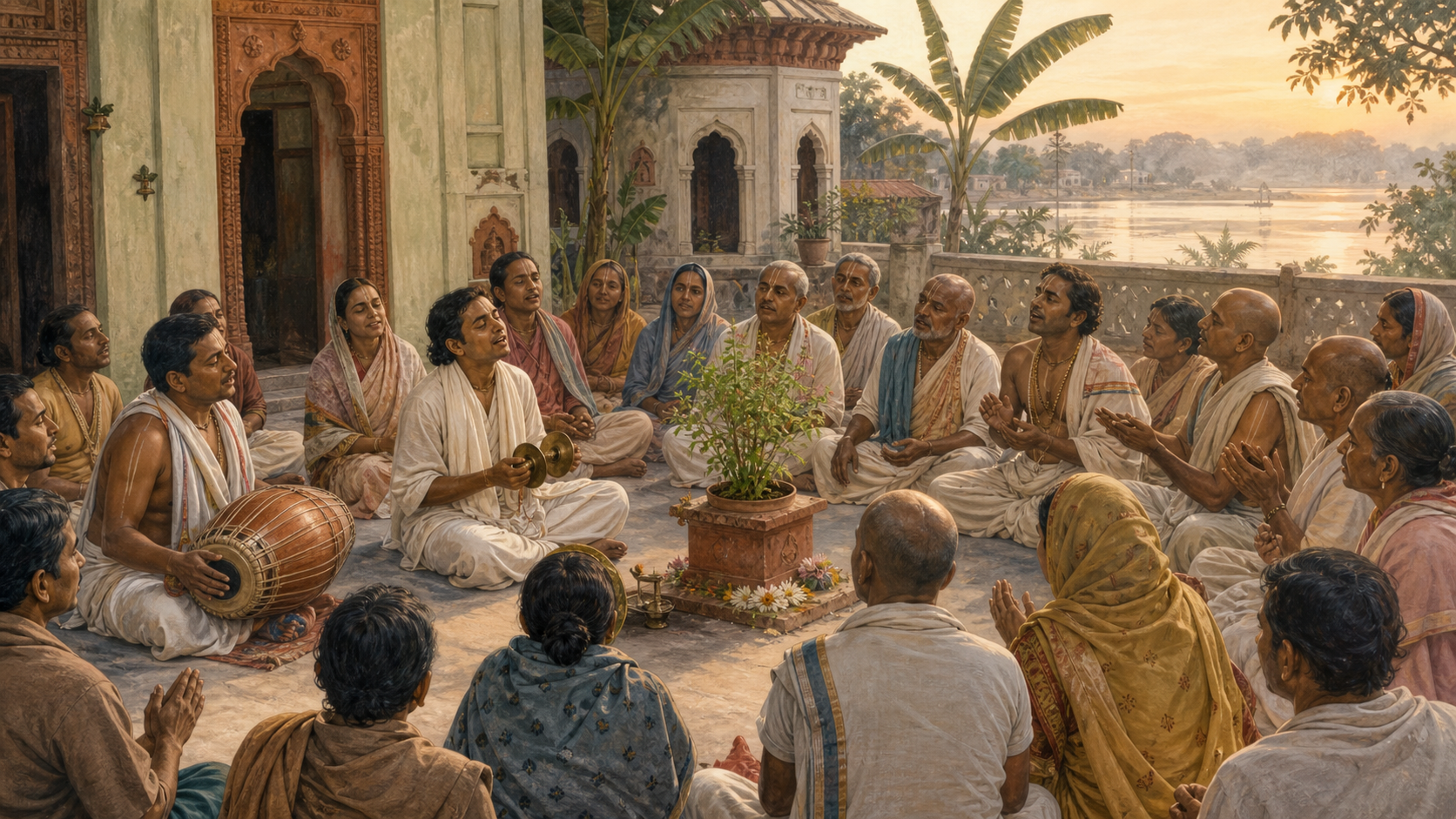
You may know Sri Vasudeva Ghosh as a name heard during a Vaishnava remembrance and still wonder what his life asks you to do. The answer goes beyond attending another kirtana. His example asks you to notice whether your chanting is becoming an offering to Sri Krishna or another activity arranged around your own voice, emotion, reputation, and reward.
The Vraja-gopis provide the demanding standard behind that question. Their devotion is not an invitation to manufacture ecstasy or imitate an exalted spiritual identity. It directs your attention away from self-display and toward affectionate, steady service. If remembering Vasudeva Ghosh changes one thing, let it make your practice less performative and more sincerely offered.
Why remember a kirtaniya through the Vraja-gopis?
Sri Vasudeva Ghosh is honored as a celebrated exponent of kirtana whose singing and devotional compositions embodied bhakti. That makes his legacy more than musical history. It presents kirtana as a way of directing the heart, not merely producing a beautiful devotional atmosphere.
Kirtana is congregational, but participation in a congregation does not automatically remove self-interest. You can sing Krishna’s names while silently measuring the quality of your voice, the response of the room, the intensity of your feelings, or the recognition given to you. The sound may be devotional while the attention remains self-centered.
The Vraja-gopis sharpen the test. Within this vision, devotional strength is the capacity to keep Sri Krishna at the center even when personal prestige, comfort, and accomplishment offer competing centers. Before judging your practice by its emotional intensity, examine its direction:
- Before kirtana, ask what you hope to receive. Peace, belonging, and inspiration are not wrong, but they should not quietly replace the person to whom the chanting is offered.
- While chanting, notice what happens when someone else leads. Listening without preparing your own moment in the foreground is itself a form of service.
- After kirtana, look for a practical effect. If chanting has softened the heart, patience, gratitude, and care for others should become easier to choose.
These checks move you from admiring Vasudeva Ghosh as a gifted singer to following the devotional orientation his kirtana represents.
Read Vrinda Devi’s forest as a map, not an entitlement

The forest of Vrinda Devi signifies the sweetness and intimacy of Vrindavan’s devotional life. In the Gaudiya vision, the refined devotion of the Vraja-gopis is associated with entering that sacred realm. For a practitioner, the safest and most useful reading is not, “I possess this exalted mood,” but, “What must be purified in me before such love can be approached?”
This turns poetic imagery into an inner map. Grace, humility, unwavering dedication, and affectionate service move the heart in the right direction. Power, status, intellectual pride, and the pursuit of worldly accomplishment cannot force an entrance. Learning about devotion is valuable, but knowledge becomes spiritually fruitful only when it changes how you remember, serve, and treat others.
Several counterfeits can look convincing from a distance:
- Self-forgetfulness is not self-hatred. The aim is to loosen possessiveness around service, not to cultivate contempt for yourself.
- Humility is not a public performance of inferiority. Its practical sign is teachability: you can receive correction, honor another person’s service, and continue without demanding recognition.
- Dependence on grace is not passivity. You cannot manufacture realization, but you can prepare the heart through remembrance, disciplined practice, scripture, and service.
- Affection is not emotion alone. A moving kirtana may awaken tears, or it may not. Steadiness when the feeling subsides is a more dependable test of your intention.
Vraja-gopi devotion therefore gives you a direction without granting you a spiritual title. Follow the direction. Leave claims about attainment aside.
A remembrance practice that continues after the singing

A meaningful observance does not require an elaborate program. It requires continuity between remembrance, kirtana, reflection, and seva. You can use the following sequence on Vasudeva Ghosh’s disappearance day or whenever you want to examine the quality of your chanting.
- Name the distraction before you begin. It may be a desire for recognition, a demand for an intense experience, impatience with other singers, or an urge to use devotion as an escape. Naming it prevents it from silently directing the practice.
- Read the relevant Srimad Bhagavatam passage attentively. Do not rush through it to reach the music. Note every quality that redirects attention from power and status toward grace, humility, and dedication.
- Enter congregational kirtana as both singer and listener. When another person leads, receive the name rather than evaluating the performance. When you lead, choose a melody and pace that help the congregation respond instead of displaying what only you can do.
- Allow silence after the final response. Ask where you resisted service, whose contribution you failed to honor, and which worldly result still feels necessary before you will serve wholeheartedly.
- Translate remembrance into one concrete act of seva. Complete a neglected duty, help someone without announcing it, offer appreciation where envy arose, or repair a careless interaction. Choose an act that reduces self-importance rather than feeding it.
- Carry one cue into your regular practice. Before the next kirtana, remember the same intention. Repetition matters because the heart is trained through steady return, not through a single elevated occasion.
The sequence matters. Scripture clarifies the goal; kirtana engages the heart; reflection exposes resistance; service tests whether the remembrance has entered ordinary conduct. Omitting the final movement into service makes it easy to confuse a temporary devotional mood with durable transformation.
Keep ecstasy, ethics, and dharmic comparison in the right order
The language of the Vraja-gopis is intimate and exalted, so it is especially vulnerable to misreading. Avoid using it to rank yourself above less emotional practitioners, imitate an advanced inner condition, or excuse neglect of ordinary responsibilities. A devotional ideal centered on selfless love should make you more reliable and compassionate, not less accountable.
Do not make singing compete with scripture or seva either. Vasudeva Ghosh’s legacy holds these practices together: congregational chanting gives devotion a shared voice, scriptural study protects its direction, and grateful service gives it visible consequences. Each corrects a weakness that can appear in the others. Study without service can nourish pride; singing without reflection can become performance; service without remembrance can lose its devotional center.
You may also recognize ethical resonances across the dharmic family. Selfless bhakti can be placed in respectful conversation with Buddhist maitri and karuna, Jain ahimsa and aparigraha, and Sikh seva and nam-simran. These parallels offer a language for mutual respect, but they do not make the traditions interchangeable. Each path retains its own teachings, practices, and understanding of the spiritual goal.
When discussing these connections, name the shared discipline precisely and then preserve the difference. You might say that several dharmic traditions train practitioners to weaken possessiveness and serve beyond the narrow ego. You should not conclude from that resemblance that Vraja-gopi bhakti is simply another name for every form of compassion, non-attachment, remembrance, or service. Unity becomes credible when it does not require erasure.
Key takeaways for your next kirtana
- Remember Vasudeva Ghosh by examining the purpose of your singing, not only by admiring his devotional artistry.
- Treat Vraja-gopi devotion as a direction toward Krishna-centered, self-forgetful service, not as a status you can claim or an emotion you must imitate.
- Judge a devotional experience partly by what follows it: greater humility, steadier remembrance, gratitude, compassion, and willingness to serve.
- Join scripture, kirtana, reflection, and seva so that each practice corrects the blind spots of the others.
- Honor ethical parallels among dharmic traditions without flattening their distinct teachings or spiritual goals.
At your next kirtana, choose one hidden shift: listen more carefully when another person leads, release the wish to be noticed, or perform one unadvertised act of service afterward. That small decision will not imitate the Vraja-gopis’ exalted love. It will place your feet in the direction their devotion reveals, which is the honest place to begin.
References
