

If you arrive at an Odisha temple early in the morning and see flowers, cloth, or ornaments being removed soon after worship, it may look as though the seva has paused. In Mailama, that changeover is itself an act of worship.
Knowing where the rite sits in the temple day helps you notice its real purpose: one phase of service is completed with care so that the next can begin in a renewed setting.
Key takeaways: a five-point visitor’s guide
- Mailama, also rendered Mailam, belongs to the daily nitya-seva of Odisha’s temples; it is a recurring transition rather than an occasional festival ceremony.
- Its central actions are the removal of earlier garlands, textiles, and ornaments, attention to the immediate worship space, and preparation of fresh vastra and alankara.
- At Puri’s Sri Jagannath Temple, Mailama follows Mangala Alati and precedes Abakash, placing it between the opening worship and the morning purification regimen.
- Early morning is usually the most useful time to look for this transition, but timing, visibility, and procedure vary by temple. Confirm the local arrangement instead of assuming Puri’s sequence applies everywhere.
- Watch the relationship between successive services. Mailama makes the most sense when you see what it completes and what it prepares, not when you treat it as an isolated spectacle.
What Mailama is, and what it is not
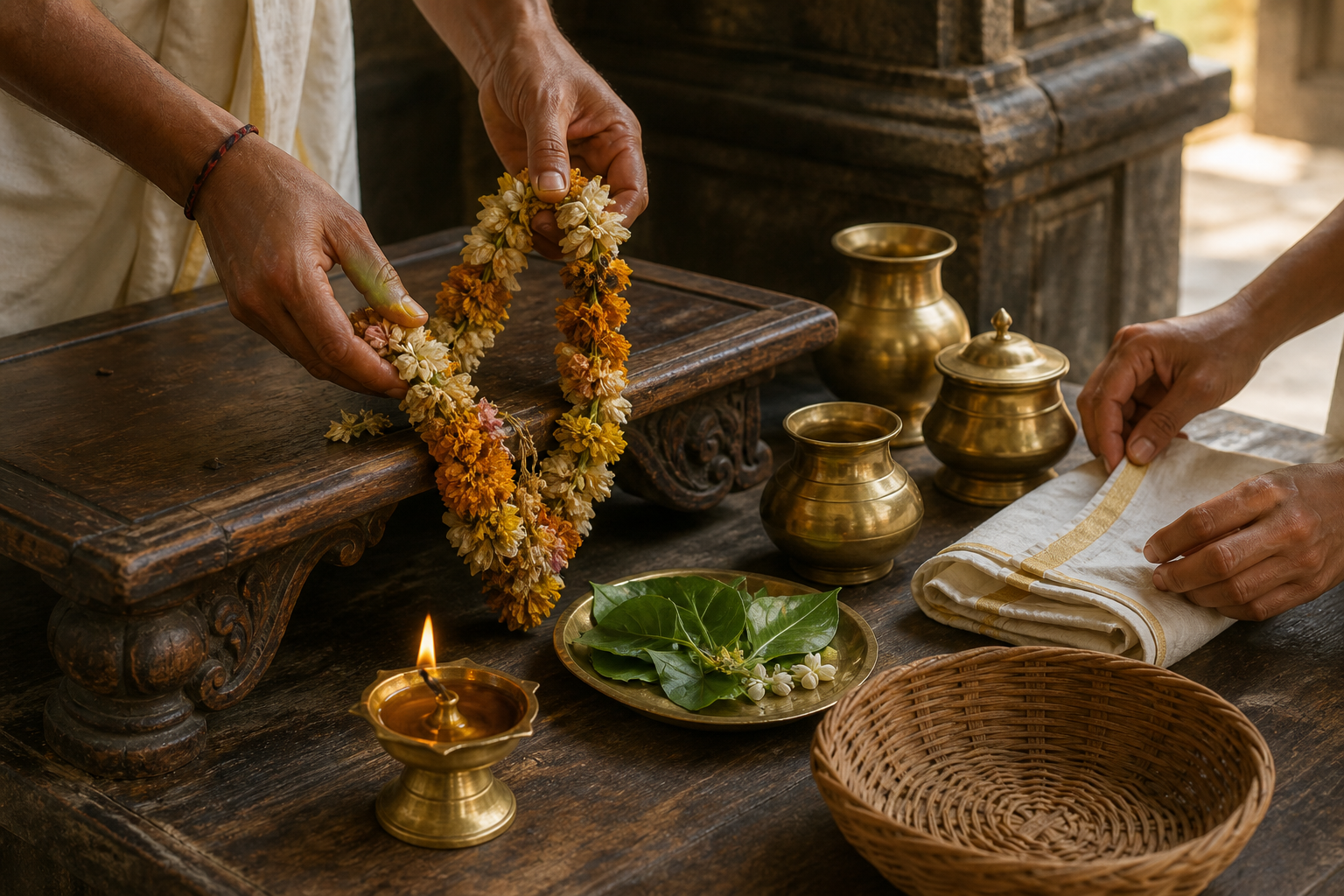
The English word cleansing can create the wrong expectation. Mailama is not simply a wash, a general cleaning session, or a change of costume. It is an ordered ritual transition from the adornments and offerings of an earlier period to a fresh state suitable for succeeding worship.
In practical terms, sevayats remove garlands, textiles, and ornaments used during the preceding phase, attend to the nearby sacred space, and ready fresh clothing and adornment. The visible actions may appear simple, but their placement and manner distinguish ritual service from ordinary tidying.
A few terms make the rite easier to follow:
- Seva is service offered to the deity. Nitya-seva is the regular daily cycle of such service.
- A sevayat is a temple functionary entrusted with a particular service. An archaka performs priestly ritual duties.
- The garbhagriha is the innermost sanctum in which the deity is enshrined.
- Vastra means clothing or textile, while alankara refers to adornment.
These distinctions matter because Mailama concerns more than the condition of material objects. It expresses shauca, or cleanliness; bhakti, or devotion; and shraddha, the attentive seriousness with which service is undertaken. A garland that has completed its role is not handled as meaningless clutter. Its removal belongs to the same devotional order as its earlier offering.
The rite also depends on inherited knowledge. Hereditary sevayats and trained archakas carry procedures involving timing, access, textiles, adornment, and sanctum care. As a visitor, you should therefore resist judging Mailama by how long it lasts, how much of it you can see, or whether its actions look elaborate. Precision and continuity, not public display, are the relevant measures.
Where Mailama sits in the Jagannath Temple day

Puri’s Sri Jagannath Temple provides the clearest map for understanding the rite. In a simplified outline of its daily liturgical rhythm, the services proceed as follows:
- Mangala Alati
- Mailama
- Abakash
- Sakala Dhupa
- Madhyana Dhupa
- Sandhya Alati
- Bada Singhara
The decisive relationship is the one near the beginning: Mangala Alati is followed by Mailama, which prepares the transition into Abakash and then Sakala Dhupa. Abakash belongs to the morning regimen of purification, while Sakala Dhupa is the first substantial food offering in this outline.
This tells you why Mailama should not be treated as an interruption between more important events. Without an orderly release of the earlier adornment, the succeeding service would lack a clearly prepared beginning. The rite is a hinge: modest in outward action, essential in the continuity of the day.
The sequence is a map, not a universal timetable. Procedures differ among Odisha’s temples, and a local shrine may use a different schedule, degree of elaboration, or arrangement of duties. When asking about Mailama, a better question is, Where does it fall in this temple’s morning seva? That will usually teach you more than asking for a supposedly standard clock time.
How to notice the ritual logic, even from a distance

You may not be able to see every action inside the sanctum. That does not prevent you from understanding Mailama. Look for three movements: completion, clearing, and preparation.
- Notice what is being completed. Earlier flowers, cloth, and ornaments belong to a finished phase of worship. Their removal does not repudiate the offering; it acknowledges that the offering has served its appointed moment.
- Notice how the interval is handled. A temporarily less adorned setting is not neglect. It is the space between two ordered states, during which attendants ready the sanctum for what follows.
- Notice what appears next. Fresh vastra, alankara, flowers, or other prepared materials reveal that cleansing is directed toward renewed service, not toward emptiness for its own sake.
Also pay attention to the attendants rather than only to the deity’s appearance. The sequence of hands, materials, and duties shows how devotion is sustained through disciplined work. Depending on your permitted view, a bell may mark a change, fresh flowers may replace those from the previous period, or the fragrance of sandalwood may accompany the renewed arrangement. Do not assign a technical meaning to every sensory detail unless a knowledgeable local custodian explains it; use those details to follow the transition as a whole.
Mailama can prompt an inward reflection, but it should not be reduced to a metaphor. It is first a particular temple service within Odisha’s Hindu tradition. From that firm ground, you can recognise a wider Dharmic resonance: disciplined service, humility, purification, and mindful conduct appear in distinct forms within Hinduism, Buddhism, Jainism, and Sikhism. The resemblance is meaningful precisely because the traditions need not be flattened into identical practices.
For your household worship, take the principle rather than copying a temple protocol. Complete one phase of puja, remove earlier offerings respectfully according to your family or sampradaya custom, care for the worship space, and prepare fresh materials before beginning the next observance. Puri’s hereditary seva rules belong to Puri; a domestic shrine should follow the tradition responsible for it.
How to witness Mailama with informed respect
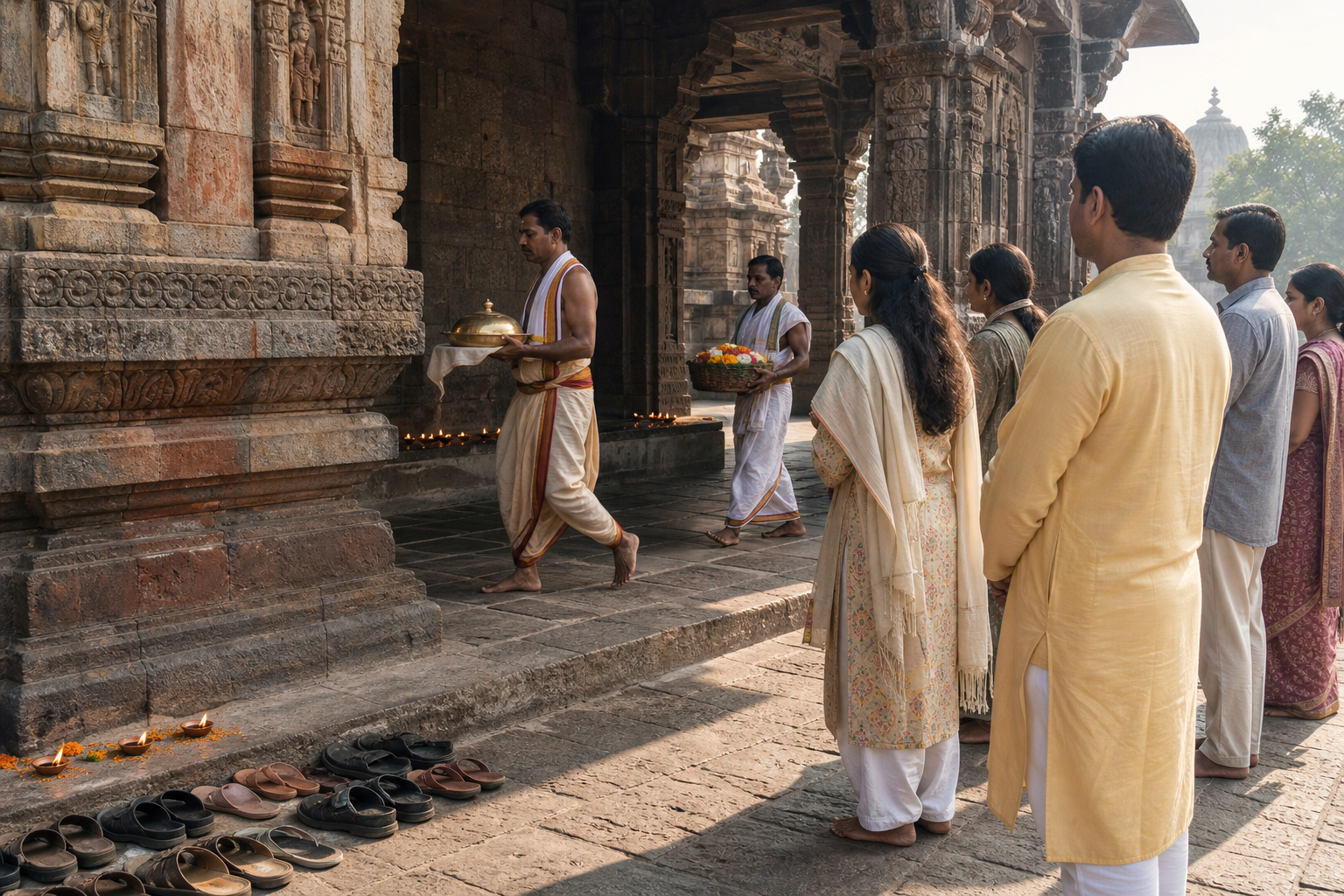
If seeing Mailama is part of your temple visit, plan around the seva rather than expecting the seva to accommodate your visit.
- Confirm locally. Early morning generally gives you the best chance to understand Mailama’s place in the worship cycle, but ask about that temple’s current timing and whether any part is visible from areas open to devotees.
- Learn the adjacent rites. At Puri, remember the compact sequence Mangala Alati, Mailama, Abakash, and Sakala Dhupa. Even if your view is limited, the order explains what the attendants are preparing.
- Follow the temple’s boundaries. Entry, movement, dress, silence, and photography are governed by local custom. Do not assume that visibility grants permission to move closer, record the rite, or interrupt a sevayat for an explanation.
- Observe the before and after. If the central actions occur beyond your sightline, compare the earlier adornment with the renewed arrangement and notice how the next service begins.
- Prepare children before entering. Explain that removing a garland or cloth is not a rejection of it. One offering period has ended, and careful removal makes the next act of worship possible. Ask them to identify what changed rather than demanding that they remain interested in a procedure they cannot see clearly.
- Let custodians supply technical details. A familiar visual action may carry a temple-specific meaning. When an explanation is available, listen for who performs the duty, when it occurs, and what succeeding seva it enables.
The next time you encounter this quiet changeover, ask one practical question: what is being completed so that the next seva can begin? That question will help you see Mailama as Odisha’s temple custodians have preserved it: renewal accomplished through disciplined, attentive service.
References
