
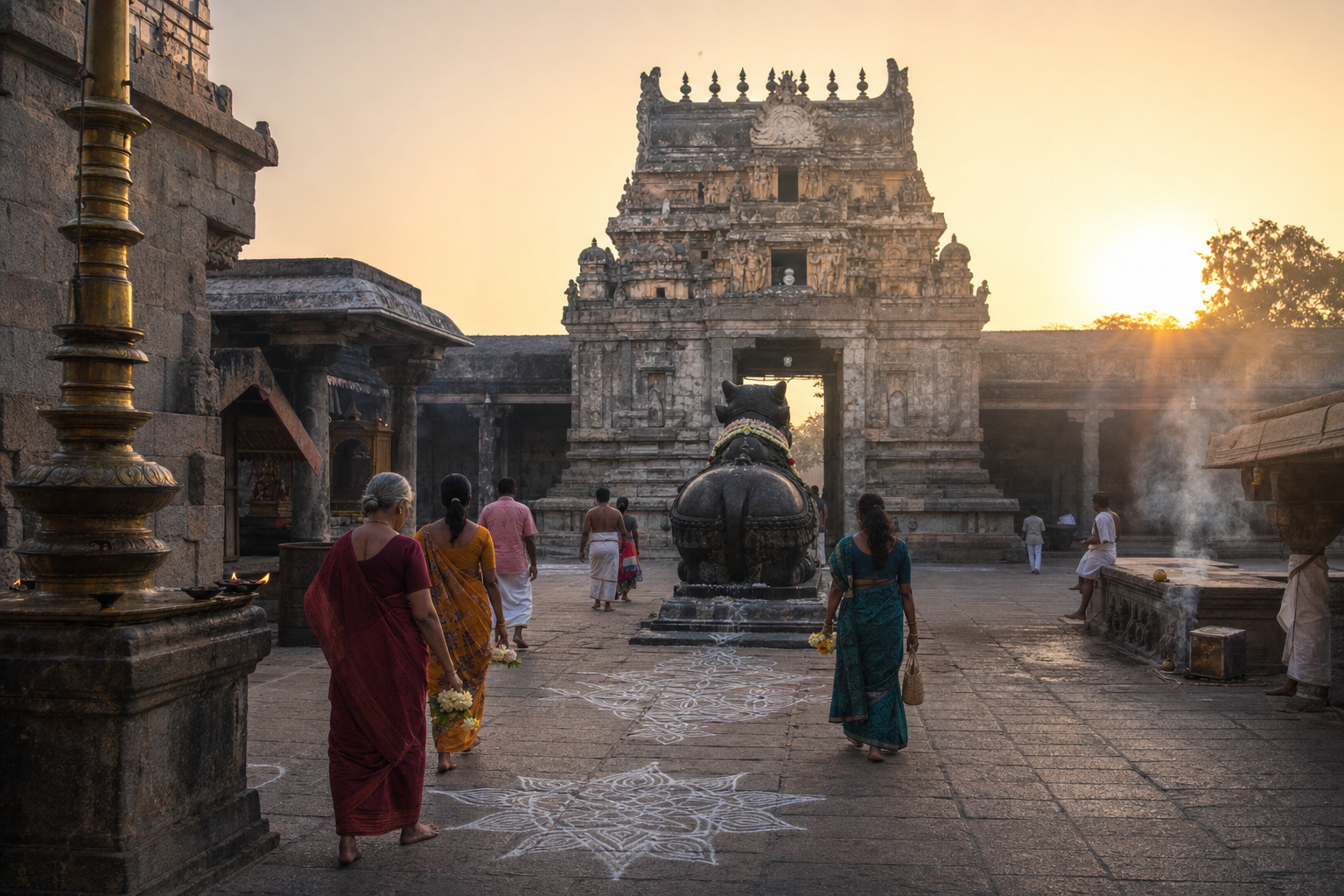
If you are planning a journey to South Indian Shiva temples, do not choose sites only by age, size, or photographic grandeur. That approach can make you miss the very thing you came to encounter: a sacred place where worship, architecture, local memory, and community life still meet.
You can understand far more without becoming an epigraphist or architectural historian. Approach each temple in a deliberate sequence: establish what is documented, notice how worship is ordered, listen for the names the community preserves, and record only what the evidence can support.
Key takeaways
- A Shiva temple’s heritage includes ritual continuity, community memory, sacred geography, architecture, and inscriptions; construction date alone cannot measure it.
- Keep inscriptions, oral tradition, direct observation, and your own interpretation separate in your notes.
- Choose a festival visit for processions and collective devotion; choose a quieter period when you want to study stonework and inscriptions closely.
- Ask which Agama or local ritual tradition governs worship instead of assuming that every Shiva temple follows the same procedure.
- Photograph and document with restraint: obtain permission, keep worshippers’ paths clear, and never touch or rub an inscription.
Stop using age as a shortcut for significance
A construction date answers one question: when a particular structure was built. It does not tell you how intensely the temple is used, what ritual discipline it preserves, how it shapes its town, or what earlier and later memories have gathered around it.
The Tandur Bhadrappa Temple was constructed in 1940 and follows the Veera Shaiva Agama procedure. Its modern-era date does not make it culturally incidental. Its ritual order, annual observances, and position at Tandur’s main chowrasta make it part of the town’s lived sacred geography.
Samalkot presents a different kind of historical record. Inscriptions preserve the settlement name Chalukya Bhimavaram, while local tradition remembers Bhimavara Kshetram. Those are related but distinct forms of evidence. The inscribed name belongs to the material record; the remembered kshetra name belongs to continuing cultural memory. Neither should be silently substituted for the other.
This distinction protects you from two common errors. The first is dismissing a functioning modern temple because it is not ancient. The second is assigning an ancient date or dynastic identity to every feature of an older complex. Temples are often layered places. A name, sculpture, inscription, ritual practice, and present structure may not all belong to one moment.
Before exploring, make a small identity card for the temple. Keep blanks where you do not yet have reliable information.
- Present name: Record the name used on the temple premises.
- Other names: Note historical, liturgical, and locally remembered forms without merging them.
- Location: Include the town, district, and the temple’s position within the settlement.
- Documented date: Specify whether the date applies to construction, an inscription, a renovation, or an associated event.
- Ritual tradition: Record the exact Agama or Shaiva lineage only when it is identified.
- Major observances: Distinguish annual festivals from weekly or daily worship.
Read the temple in five deliberate passes
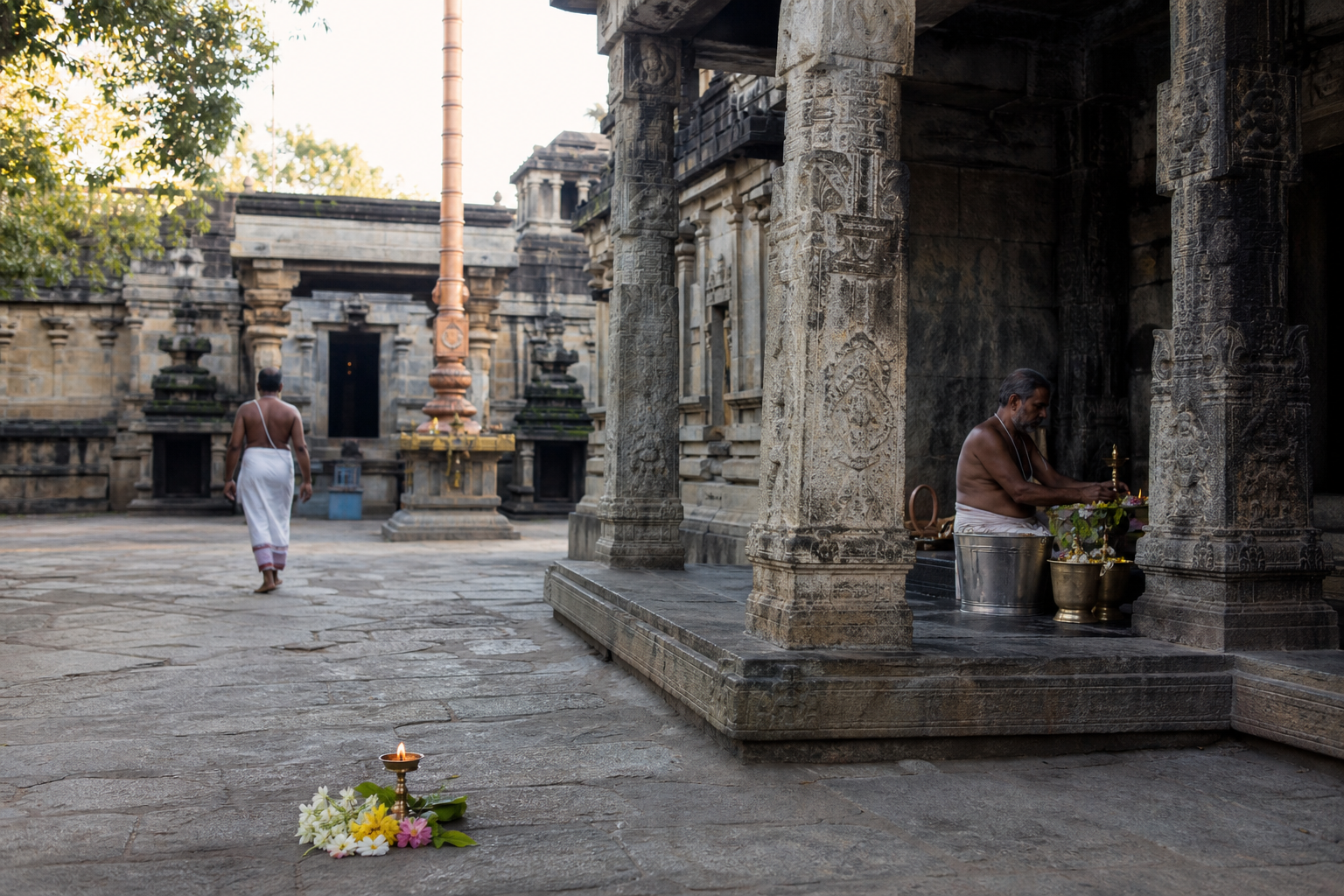
Do not try to absorb the entire complex as soon as you enter. A sequence keeps architecture from overwhelming ritual, and ritual from causing you to overlook the setting. It also gives you a repeatable method across very different temples.
- Begin with the setting. Before focusing on the sanctum, notice where the temple stands in relation to roads, markets, homes, and gathering space. Tandur Bhadrappa’s position at the town’s principal crossroads is itself meaningful. The temple is not isolated from civic life; it occupies a place where daily movement converges.
- Follow the sacred orientation. Observe how devotees approach the garbhagriha, where they pause, and which route they use. Do not block that movement while examining a wall or composing a photograph. At Kumararama Bhimeswara, sculptural work frames the garbhagriha within a proportioned South Indian temple layout. Read that art in relation to the sacred center, not as detached ornament.
- Identify the ritual discipline. Agama is not merely an architectural label. It concerns the ordered practice through which the deity is worshipped and the sacred space is maintained. Tandur’s identified Veera Shaiva Agama observance should therefore shape how you understand the temple. Ask respectfully which tradition is followed, then preserve the answer’s exact wording rather than generalizing it to other Shiva temples.
- Examine material evidence. Look for inscriptions and sculptural panels only after orienting yourself to the living space. At Samalkot, epigraphic panels contribute directly to the complex’s historical understanding. If you cannot read an inscription, record its location and visible condition. A permitted photograph is more honest than an improvised translation.
- Notice the community rhythm. Listen for how sacred sound, orderly movement, festival preparation, and ordinary darshan change the temple’s atmosphere. Heritage is also transmitted through repeated conduct: people arriving, worship being performed, space being prepared, and observances returning according to the religious calendar.
After these passes, divide your notes into three columns: observed directly, identified by an inscription or temple record, and heard as local tradition. Put personal interpretation in a fourth column. This simple separation prevents a compelling impression from hardening into an unsupported historical claim.
Choose festival energy or close observation
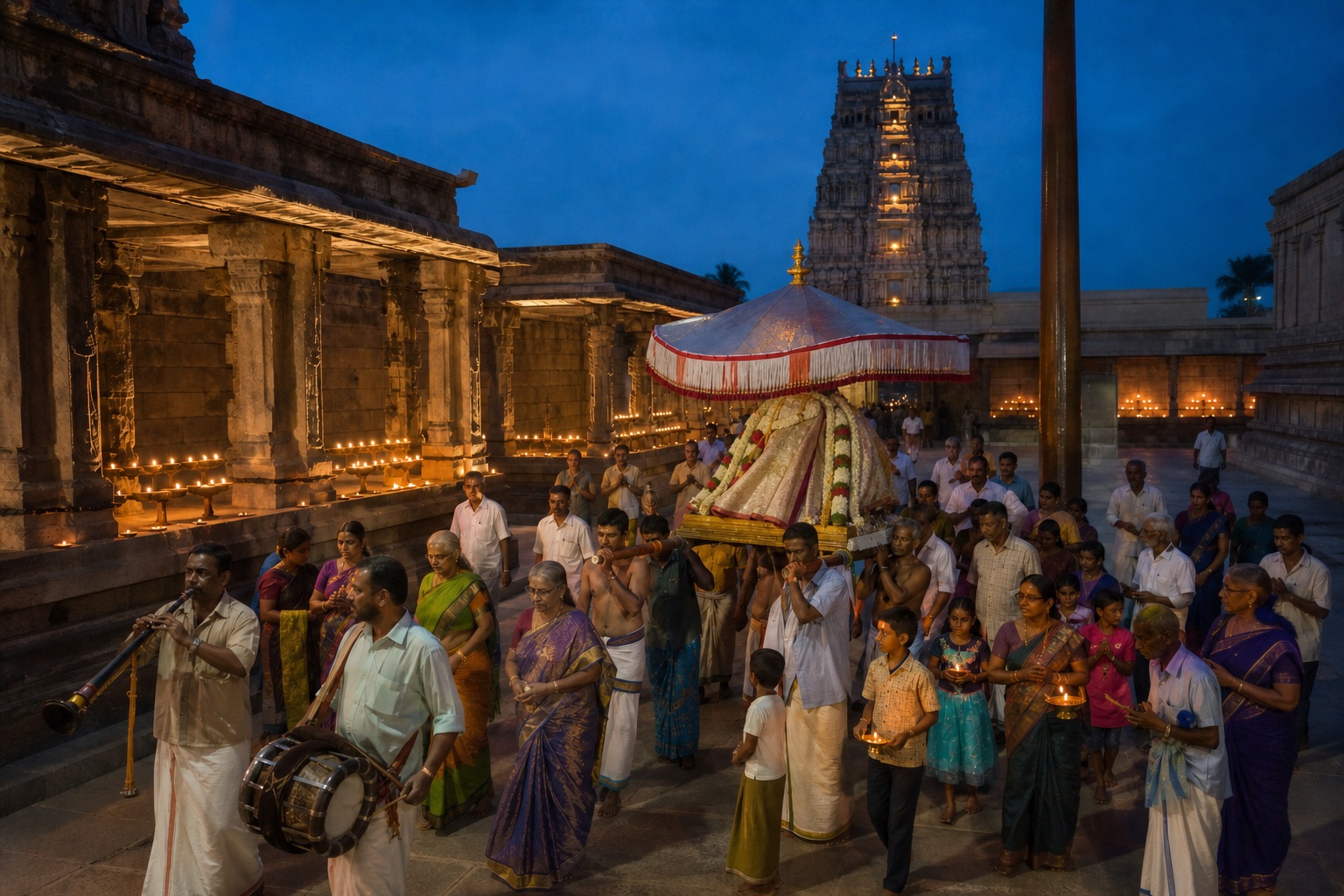
There is no universally best time to visit. Your purpose should decide the timing. A crowded festival can reveal the temple’s social reach and devotional intensity, but it may leave little room for close architectural study. A quieter day can expose details while withholding the collective experience that gives an annual observance its meaning.
At Tandur, Chaitra Masam in the Telugu calendar brings Rathotsavam and Brahmotsavams, with processional and communal worship drawing devotees from the surrounding region. Choose that period when you want to understand how the temple gathers a wider community. Choose an ordinary day, especially the calmer early-morning prayer period, when you want more space for reflection.
Kumararama Bhimeswara likewise offers different modes of encounter. Mahashivaratri expresses the annual festival rhythm, while Monday darshan belongs to recurring Shaiva observance. The first reveals exceptional intensity; the second lets you notice how devotion is sustained through the ordinary calendar.
If you have only one opportunity to visit, rank your purpose before making the journey:
- For darshan: Put access to worship ahead of photography or exhaustive note-taking.
- For a procession: Select the relevant festival period and accept that architectural access may be constrained.
- For inscriptions and sculpture: Prefer a non-festival window and allow unhurried time.
- For community heritage: Observe both formal ritual and the surrounding patterns of gathering, service, and movement.
Do not treat an inherited festival name as a complete travel schedule. Confirm the current date, opening arrangements, and visitor permissions locally before departing. If Samalkot is part of a regional itinerary, its stated location is approximately 12 km from Kakinada and 52 km from Rajahmundry; use those figures for orientation, then verify the route you will actually travel.
Make a heritage record that does not outrun the evidence
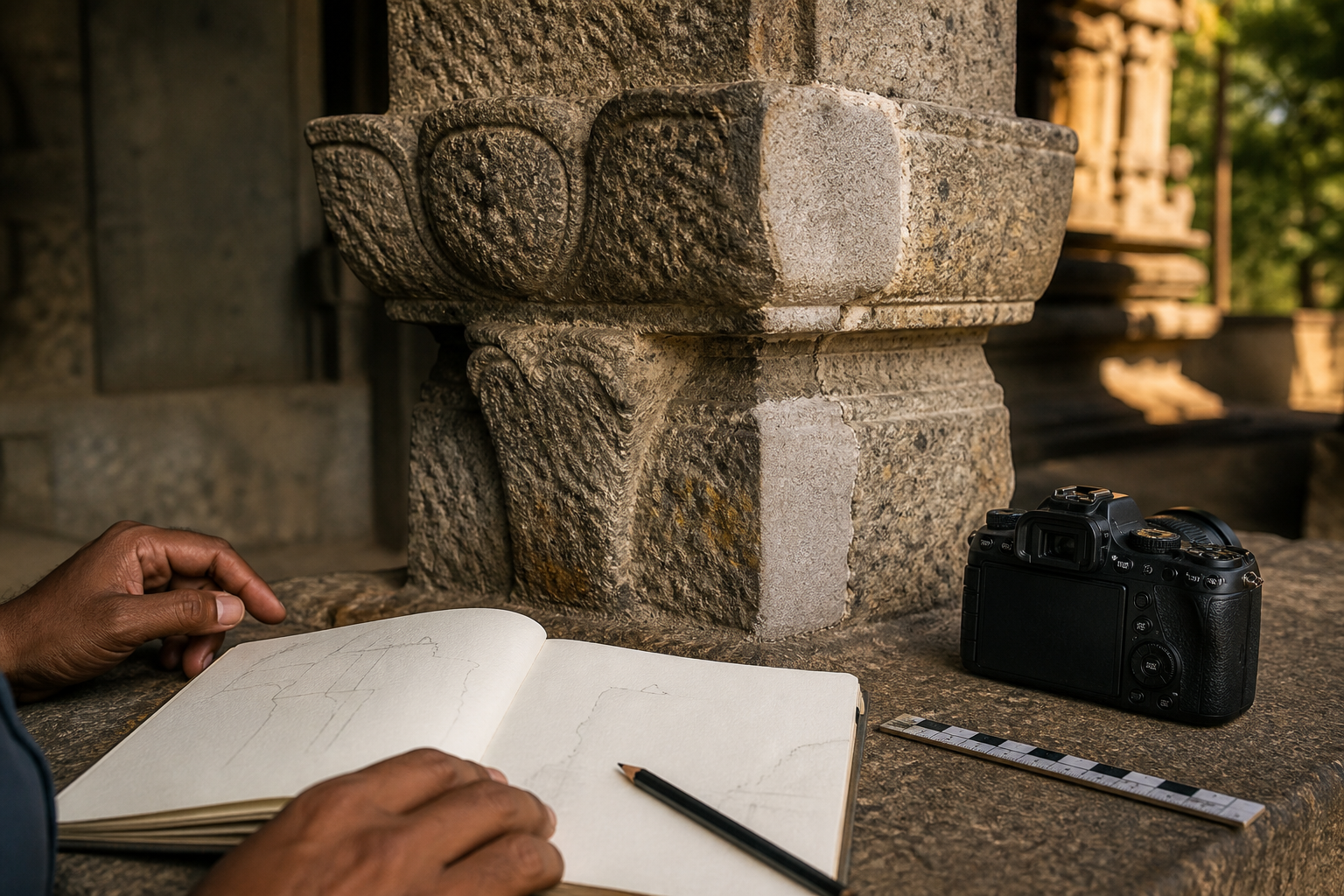
A responsible visitor does more than avoid physical damage. You also avoid damaging meaning. Mislabeling a temple, assigning an unsupported century, or presenting local memory as a literal translation can circulate long after a careless caption is posted.
Use precise evidence labels when you write or share photographs:
- Documented: Reserve this for a construction date, inscriptional name, or other clearly identified record.
- Locally remembered: Use this for a name or account preserved through community tradition.
- Visible during the visit: Use this for architecture, sculpture, ritual activity, and spatial relationships you actually observed.
- Interpretation: Mark your own conclusion as an interpretation, especially when connecting a temple’s location, form, and social role.
Your conduct inside the complex matters just as much. Ask before photographing a sanctum, ritual, worshipper, priest, or inscription. Keep entrances and circumambulatory paths clear. Never touch, chalk, wet, trace, or rub an inscription to make its letters more visible. Follow local instructions even when they interrupt the photograph or sequence you had planned.
Preserve names carefully as well. Tandur Bhadrappa Temple and Bhavigi Bhadreshwara Swamy Temple identify the same sacred place in the supplied heritage record. Kumararama, Bhimesvara, Bhimeswara, Chalukya Bhimavaram, and Bhimavara Kshetram do not all perform the same function. Note each form in its proper context instead of forcing every variation into one standardized label.
This disciplined attention is a dharmic act in its own right. Reverence is not only an emotion directed toward antiquity. It appears in how you enter, how you make room for worship, how accurately you transmit a name, and how readily you leave an uncertain claim unresolved.
On your next temple journey, give one shrine one full page of attention: complete the identity card, make the five passes, and label the evidence behind every important note. You will return with fewer careless claims, better questions, and a more faithful understanding of the sacred place that welcomed you.
References
- DharmaRenaissance Blog – Discover Tandur Bhadrappa Temple: A Complete Guide to Bhavigi Bhadreshwara Swamy’s Heritage
- DharmaRenaissance Blog – Discover Samalkot’s Kumararama Bhimeswara: The Complete, Proven Guide to a Sacred Legacy
