
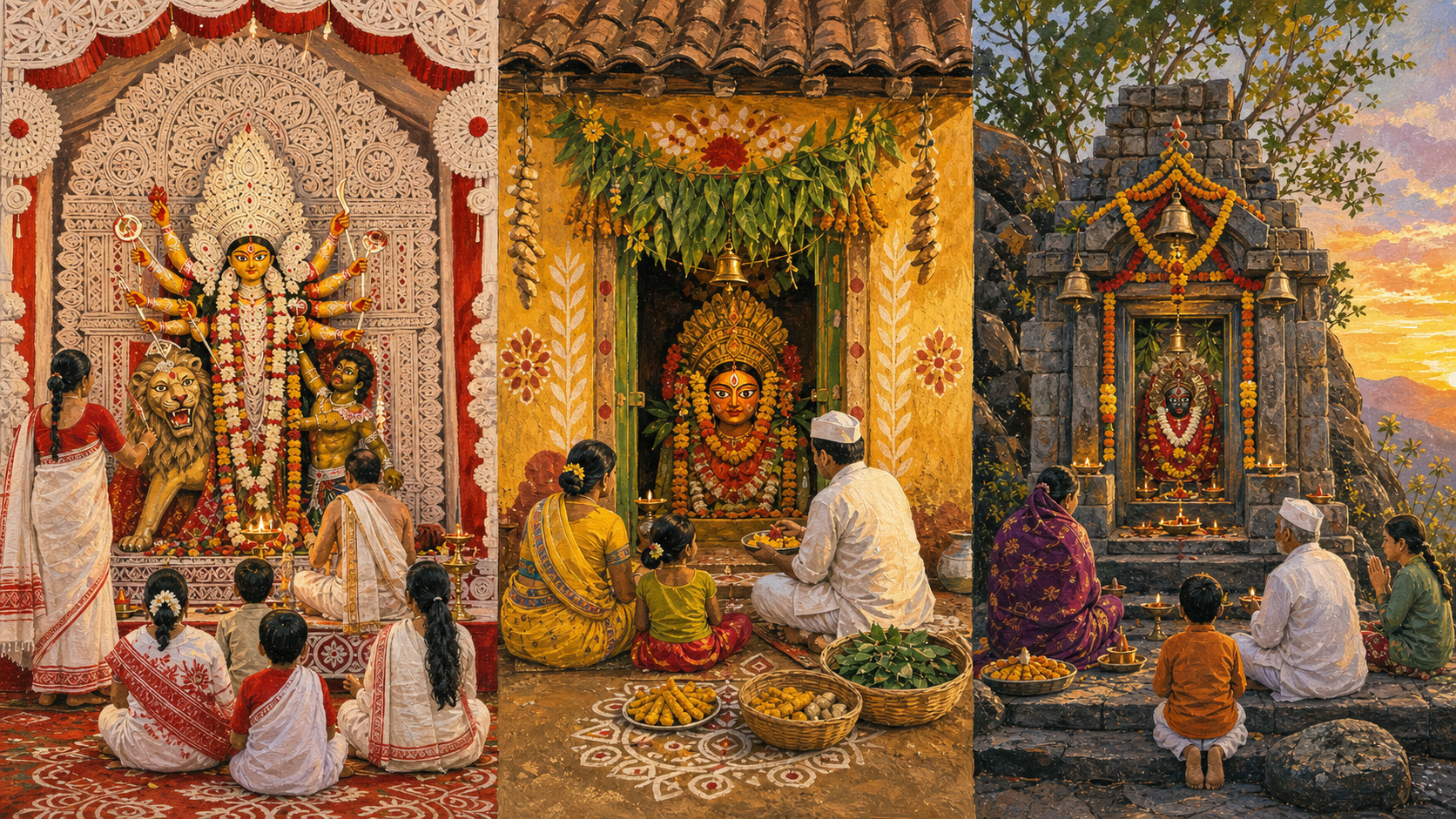
Perhaps Durga is central in your family, while someone you know speaks of Yellamma or Jagadhatri with equal intimacy. You may wonder whether these are different goddesses, local names for one Goddess, or somehow both.
You do not have to choose between unity and difference. Shakti offers a shared theological horizon; a regional tradition supplies the name, story, image, calendar, offerings and social world through which devotees encounter her. Hold both levels together, and you can approach goddess worship with more clarity and less presumption.
Shakti is the unity; the regional tradition is the grammar
When Hindus speak of Devi as Shakti, they are speaking of divine power rather than merely assembling a list of female deities. A particular goddess may be understood as an expression of that power, but this does not make her local identity disposable. Her place, narrative, iconography and ritual relationships tell devotees how the universal is approached here.
It helps to ask two questions instead of forcing one answer. Who is Devi at the theological level? How is Devi encountered in this community? The first question opens onto Shakti, motherhood, protection and cosmic order. The second directs you to a particular name, shrine, festival cycle, murti and discipline of worship.
Jagadhatri, for example, can be revered as a form of Durga without becoming interchangeable with every other form of Durga. Her association with West Bengal and Odisha, her serene lion-mounted image and her place after Durga Puja in many Bengali observances give her worship a recognizable regional and ethical character.
Renuka Yellamma is likewise revered as an embodiment of Shakti, but the worshipper approaching her at Kothlapur enters a different devotional setting: a rural Telangana shrine where coconut, turmeric and kumkum are familiar offerings. Those details are not decorative folklore. They are part of the way devotion takes material and communal form.
Keep three distinctions in view:
- Unity is not uniformity. Recognizing one Shakti does not require one ritual calendar, one iconography or one regional vocabulary.
- Translation is not substitution. Saying that a goddess is a manifestation of Devi may help you locate her within Shakta theology. It does not authorize you to replace her local practice with whichever Durga or Devi ritual you already know.
- Resonance is not equivalence. Jagadhatri’s challenge to ego can converse with Buddhist non-clinging, Jain restraint and the Sikh critique of haumai. That shared ethical concern does not erase the distinct doctrines and practices in which those ideas live.
Read any regional goddess through five local anchors
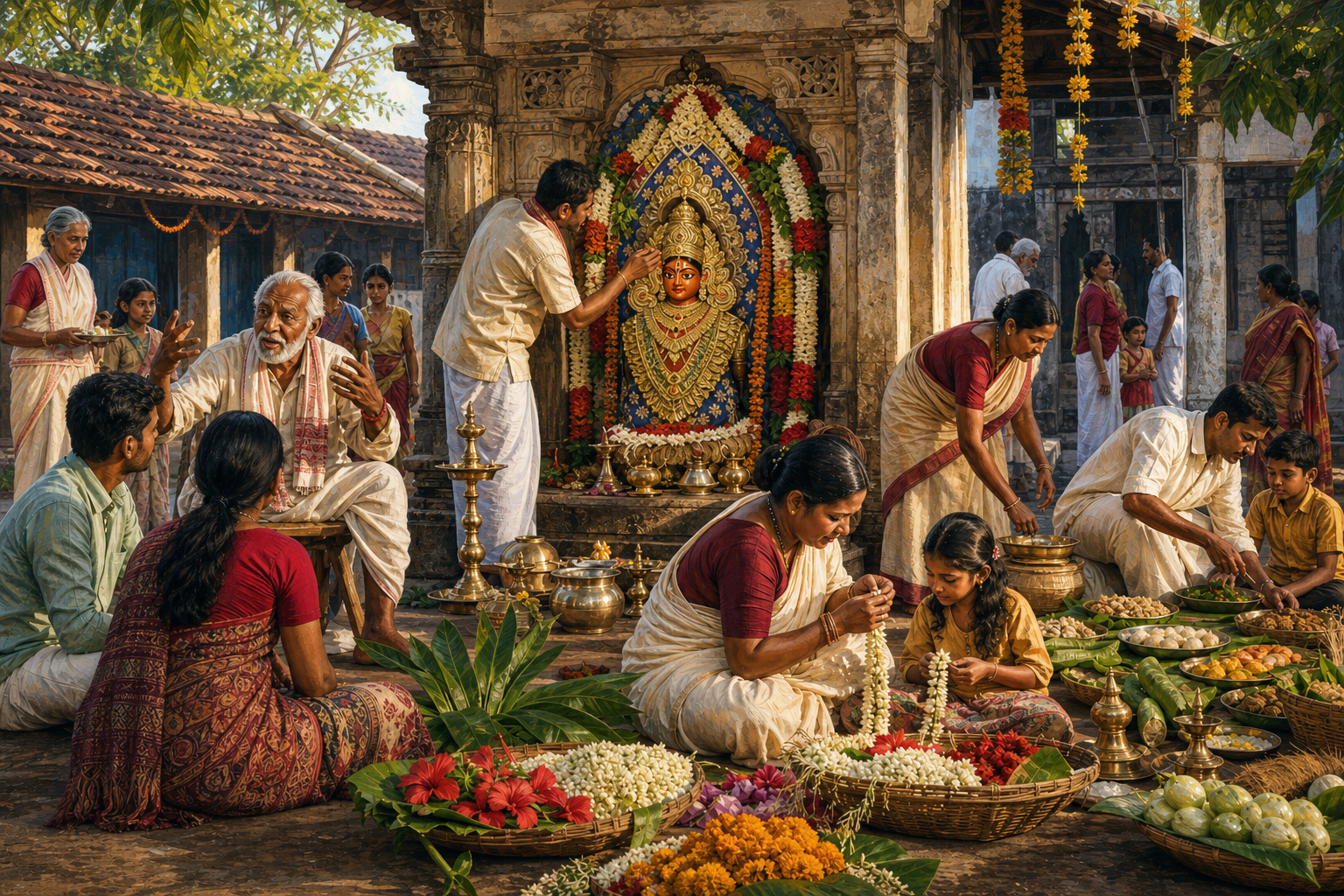
If you are trying to understand an unfamiliar Shakti tradition, begin with five anchors. This method works better than collecting deity names because it shows how theology becomes lived practice.
- Name and relationship. Record the full name used by devotees. Then ask how they address her: as mother, guardian, sovereign power, healer, teacher or another relationship. Do not assume that a familiar Sanskrit category exhausts the local name.
- Place. Identify the village, town, region and sacred setting connected with the form. Place can shape pilgrimage routes, festival participation, offerings and community memory. Kothlapur Yellamma Temple, for instance, is not an abstract symbol of Telangana; it is a particular shrine near Tandur in the Ranga Reddy district.
- Narrative and moral task. Ask what problem the goddess confronts and what quality her action asks the devotee to cultivate. A story about a defeated adversary may also be a teaching about pride, fear, responsibility or discernment.
- Iconography and ritual materials. Notice posture, vehicle, expression, number of arms and carried emblems without inventing meanings from memory. Then notice what devotees actually bring and do. A lion, a composed face, turmeric or kumkum can each belong to a distinct ritual vocabulary.
- Calendar and community. Find out when worship intensifies, who organizes it and how families participate. A festival occurring after another major festival, a favored weekday or a local jatara tells you how the tradition inhabits time. Confirm the actual schedule locally; a regional tendency is not a universal rule.
Use these anchors as a notebook template. If you cannot fill one of them confidently, leave it blank until you can ask a knowledgeable devotee, priest or community organizer. A blank space is more respectful than a polished guess.
This method also protects you from a common mistake: treating iconography as a code that can be decoded without context. A murti is visual theology, but it is encountered through narrative, puja and community memory. Ask what devotees understand the image to teach before assigning a meaning to every object.
Jagadhatri and Yellamma reveal two different devotional tasks
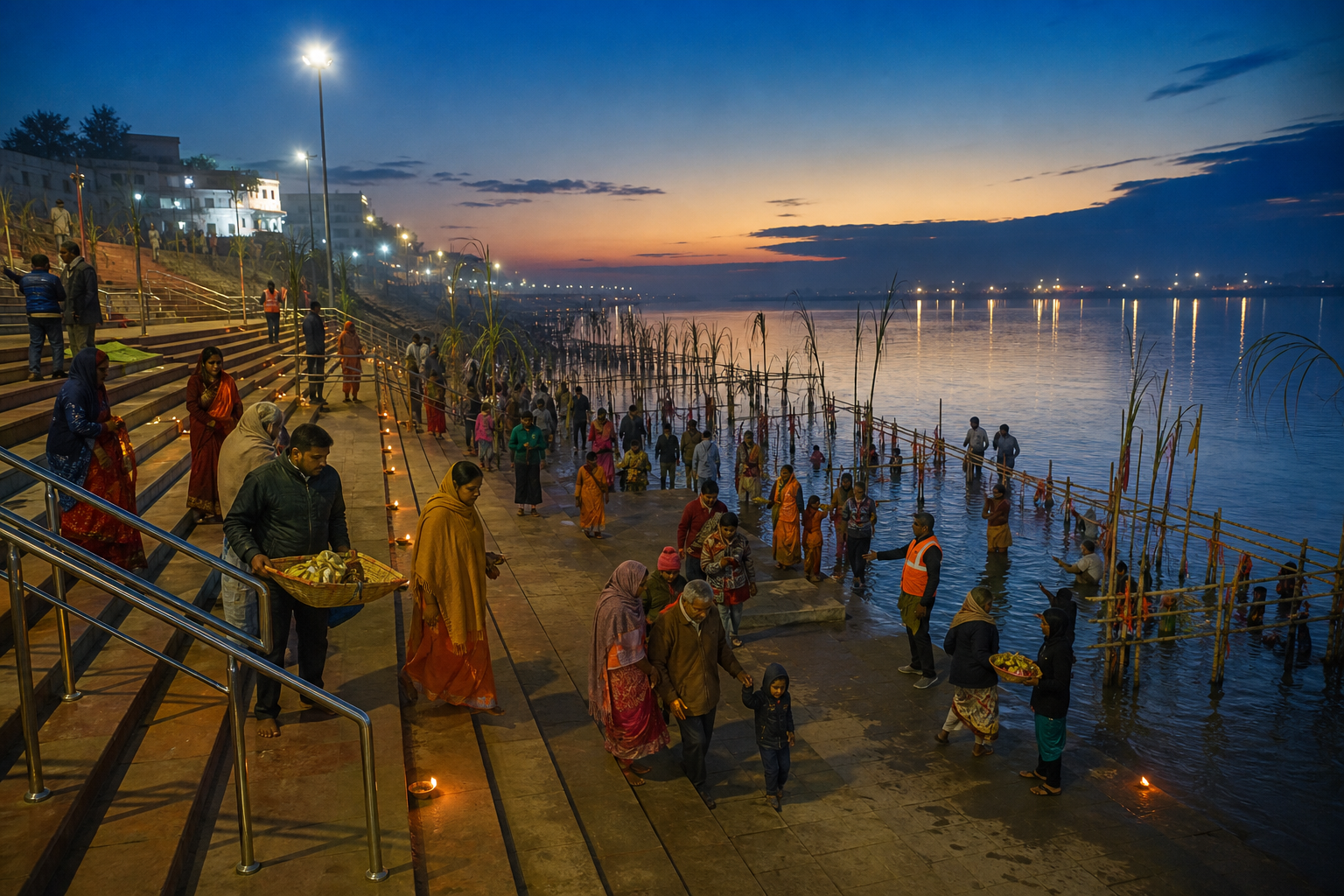
Applying the five anchors shows why the broad label of goddess worship is a starting point, not a complete description.
| Anchor | Jagadhatri | Renuka Yellamma at Kothlapur | What you should notice |
|---|---|---|---|
| Regional setting | Celebrated principally in West Bengal and Odisha | A shrine near Tandur in Telangana | Regional belonging is part of the tradition, not incidental background |
| Devotional emphasis | Calm protection, humility and ethical clarity | Maternal compassion, protection and renewal | Both are protective forms, but the relationship is articulated differently |
| Visible or material vocabulary | A serene four-armed goddess seated upon a lion | Coconut, turmeric and kumkum among familiar offerings | Read the image and the offering practice together |
| Ritual rhythm | Observed after Durga Puja in many Bengali traditions | Tuesdays and Fridays commonly bring higher attendance; special dates vary locally | Timing must be learned from the community rather than generalized from another shrine |
Jagadhatri’s best-known moral lens is ahamkara, the ego that mistakes borrowed power for personal possession. In a widely retold Puranic account, the devas lose sight of the source of their power, and the Goddess restores humility and cosmic order. Her composure matters as much as her strength. She does not represent frantic domination; she presents power governed by clarity and responsibility.
You can make that teaching practical without pretending to reproduce a formal puja. Before a difficult decision, ask where your need for recognition is interfering with dharma. If you are leading a family or community effort, name the contributions you have been treating as your own. If you perform seva, try completing one useful act without arranging to be praised for it. These are small tests of whether devotion is changing conduct rather than decorating identity.
Jagadhatri’s image supports the same examination. Her serene countenance, lion seat and four arms bearing traditional emblems place courage beside restraint. When you look at the murti, do not stop at the generic statement that the lion means power. Ask what kind of power a calm face requires: strength that does not need to advertise itself, vigilance without panic, and authority held for the common good.
Kothlapur Yellamma worship draws your attention to another dimension of Shakti: the intimate connection among deity, offering, shrine and local rhythm. Renuka Yellamma is approached through maternal compassion, protection and renewal. At this shrine, coconut, turmeric and kumkum make devotion tangible. The offering is not a prop for observing someone else’s culture. It belongs to an exchange of reverence, gratitude and dependence between devotee and Goddess.
This is why one temple must not be made to stand for every Yellamma tradition, just as one Bengali celebration cannot define every Shakta lineage. Kothlapur tells you what worship looks like at Kothlapur. It gives you an entry point, not a license to declare every local variation secondary or incorrect.
Approach a regional shrine as a participant, not a collector
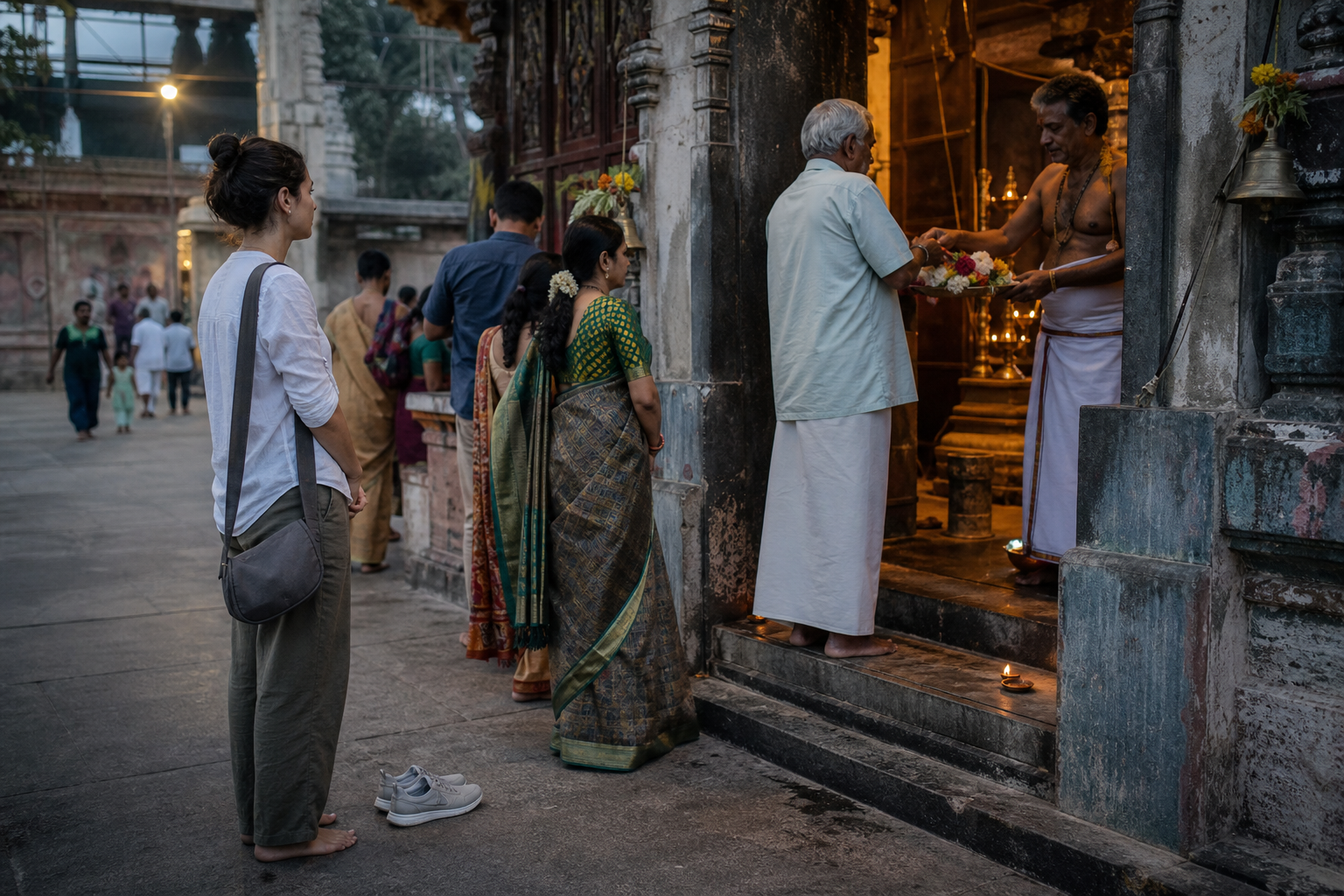
Before you go
- Learn the exact name and location. Write down the deity’s local name rather than arriving with only the word Devi. This makes it easier to ask useful questions and avoid imposing the practice of another shrine.
- Confirm the day’s schedule. Do not convert a commonly favored weekday into a guaranteed timetable. At Kothlapur, Tuesdays and Fridays often attract more devotees, while festival and special-puja dates can vary locally. Verify before setting out.
- Ask about accepted offerings. Coconut, turmeric and kumkum are associated with Kothlapur Yellamma worship, but local instructions should decide what you bring, where you place it and whether it is handed to temple personnel.
- Plan for the actual setting. Kothlapur is approximately 13 kilometres from Tandur, the nearest rail and service hub. Carry water, account for seasonal weather and do not assume that a rural shrine has the amenities of a large urban complex.
While you are there
Begin by observing. Wear modest clothing, remove footwear where required and follow the queue rather than looking for a faster route to darshan. If you do not know a ritual gesture, watch quietly or ask. Sincere restraint is better than confident imitation.
Let the community’s sequence set your pace. Darshan, pradakshina, aarti, bhajan and prasad are not interchangeable tourist activities. You may not participate in every element, but you can avoid interrupting it. Ask permission before photographing people, ritual actions or the sanctum.
At a public festival, remember that the lamps, music, artisan-made murti and shared prasad carry religious meaning as well as cultural beauty. Jagadhatri Puja, for example, brings families, artisans and neighbourhoods into a shared cycle of worship. Notice who is sustaining the practice: the people preparing offerings, organizing queues, teaching children, crafting images and cleaning the space.
Leave the precinct cleaner than you found it. Use the designated places for packaging and offerings, support local vendors without aggressive bargaining, and follow local instructions for disposal. Responsible craftsmanship and greater care around idol immersion show how a living tradition can protect continuity while responding to environmental duties.
After darshan
Carry home one instruction, not merely a collection of images. If you have worshipped Jagadhatri, identify one expression of ahamkara that needs correction. If Yellamma’s maternal protection drew you, choose one person or responsibility that requires more reliable care from you. Make the action specific enough to complete: acknowledge help, fulfil a neglected duty, offer quiet seva or repair a relationship in which pride has displaced gratitude.
If you are learning from afar, use the same discipline. Create a page with the five anchors: name, place, narrative, iconography or offerings, and calendar. Add only what you can trace to a trustworthy local or traditional context. For lineage-specific mantra, initiation or formal ritual, seek appropriate guidance rather than assembling a practice from disconnected fragments.
Key takeaways
- Shakti provides a language of divine unity; the regional name, shrine, story, image and calendar preserve the form’s particular identity.
- Study an unfamiliar goddess through five anchors: name and relationship, place, narrative, iconography or offerings, and community calendar.
- Jagadhatri joins protective strength to humility and the correction of ahamkara; her composure is part of the teaching.
- Renuka Yellamma worship at Kothlapur joins maternal protection to a specific Telangana shrine, local offerings and local rhythms of darshan.
- A practice from one temple or region should not be copied onto every shrine bearing a related divine name.
- The clearest test of devotional understanding is conduct: greater humility, more dependable care, sincere seva and respect for the community preserving the tradition.
Begin with one form of the Goddess connected to your family, language or region. Fill in the five anchors before moving on to another name. Then let one element of that tradition change what you do this week. That is how regional knowledge becomes relationship, and how reverence for one Shakti can deepen without erasing the many ways she is known.
References
- DharmaRenaissance Blog — Jagadhatri Unveiled: The Complete Guide to Durga’s Ego-Transforming, Protective Form
- DharmaRenaissance Blog — Discover Kothlapur Yellamma Temple: A Complete Guide to Telangana’s Renuka Shakti Shrine
