

You may have reached a quiet sitting in which thought nearly stopped, the mantra seemed to repeat itself, or the usual sense of being the meditator became faint. The natural question is, “Was that samadhi, and if so, which stage?” Intensity alone cannot answer it.
Ask a more precise question: what remained in the experience? Was there still an object, an observer, and an effort to attend? Did awareness become clearer or merely blank? And when you returned to ordinary activity, were you less reactive and more truthful? Those questions give you a workable map without turning meditation into a hunt for spiritual rank.
Samadhi stages track what remains in awareness
There is no single ladder whose labels are used identically by every Hindu school. In a practical Yoga and Advaita vocabulary, however, the central movement is clear: attention begins with a chosen support, becomes continuous, and eventually outgrows the division between meditator and object. Savikalpaka samadhi retains a subtle structure of knower, knowing, and known, while nirvikalpaka samadhi is described as awareness without those conceptual divisions.
| Practical phase | What remains | What you should notice | Your task |
|---|---|---|---|
| Collected attention | You, the chosen object, and deliberate effort are plainly present | Distraction still interrupts the practice, but returning becomes simpler | Keep returning to one support without judging each interruption |
| Sustained meditation | The meditator and object remain, while attention flows with fewer breaks | The object becomes vivid and mental commentary becomes less necessary | Stop adding analysis and let attention remain continuous |
| Savikalpaka samadhi | A refined distinction between knower, knowing, and known remains | Absorption is lucid rather than dull; the object may be breath, mantra, sacred form, or the subtle sense of “I” | Abide without trying to possess, prolong, or describe the state |
| Transition beyond support | The object and the effort to hold it begin to recede | Practice feels less like an action performed by a separate meditator | Soften unnecessary effort; do not force the disappearance of thought |
| Nirvikalpaka samadhi | The ordinary subject-object division is no longer operating | There is no conceptual observer standing apart to certify the experience while it occurs | Do not manufacture a claim about it; let recognition mature in humility |
| Integration | Ordinary distinctions return for daily life | Equanimity, honesty, non-harm, and responsibility should become steadier | Test realization through conduct, relationships, and service |
The first and last rows are not additional formal types of samadhi. They are included because they tell you how to approach absorption and how to evaluate what follows it. Without preparation, you may confuse a pleasant trance with realization. Without integration, you may make a large metaphysical claim from one unusual sitting.
Patanjali’s samprajnata samadhi is often aligned with savikalpaka samadhi, and asamprajnata samadhi is frequently compared with nirvikalpaka samadhi. Treat these as useful correspondences, not as proof that every school means precisely the same thing. The vocabularies arise within different philosophical explanations of consciousness and liberation.
Build the conditions that make concentration trustworthy
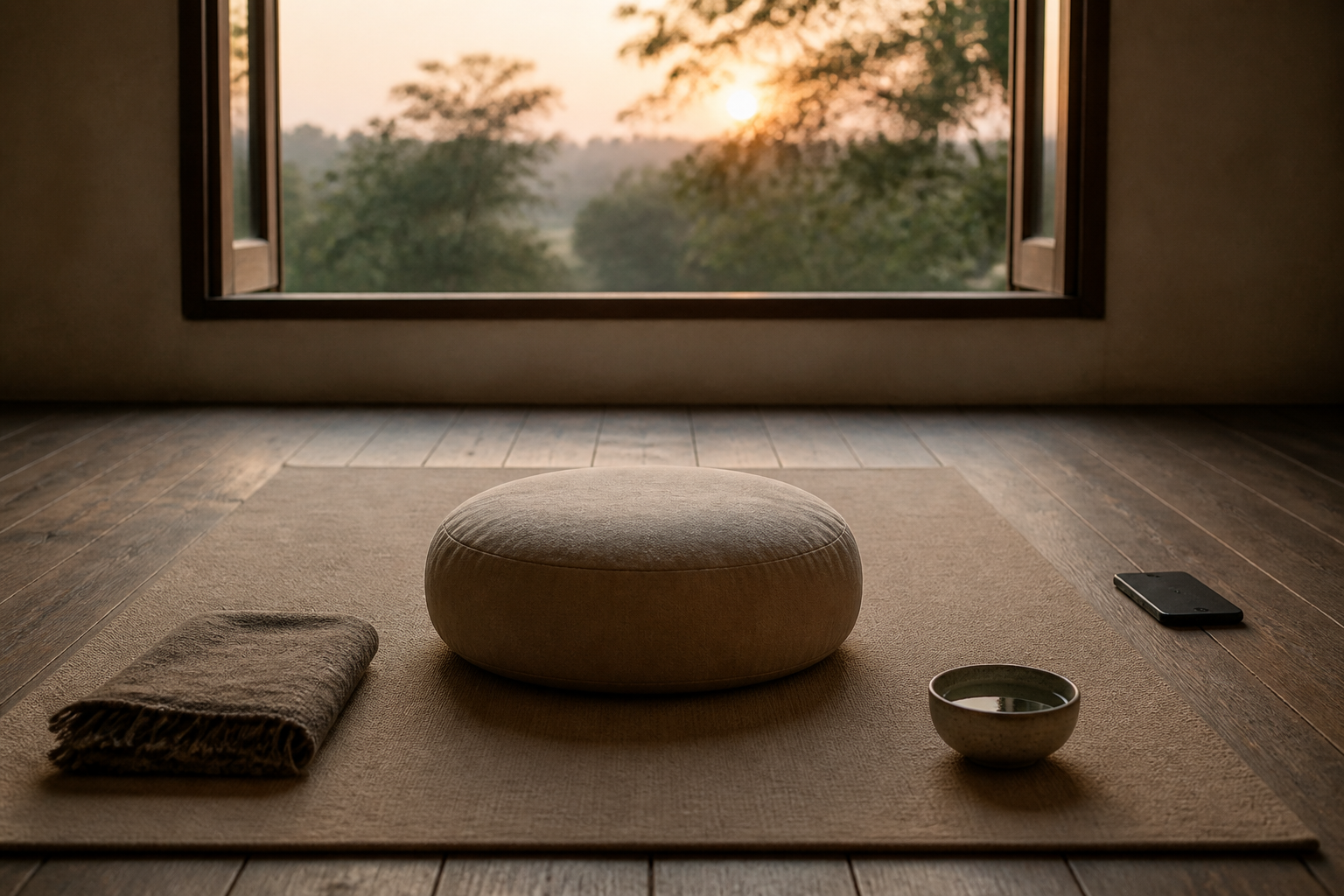
If your daily life repeatedly agitates the mind, technique alone will not produce stable absorption. A lie has to be defended. Resentment rehearses its argument. Possessiveness keeps checking what might be lost. These movements follow you to the meditation seat because the mind does not become a different mind when you close your eyes.
This is why classical yoga places ethical and personal disciplines before the culmination of meditation. The yamas are ahimsa, satya, asteya, brahmacharya, and aparigraha: non-harm, truthfulness, non-stealing, disciplined use of energy, and non-grasping. The niyamas are purity, contentment, disciplined effort, self-study, and surrender to Ishvara.
Use them as practical diagnostics rather than decorations. Before sitting, notice which unfinished matter is demanding mental rehearsal. If you have spoken falsely, correct the falsehood where doing so will not cause further harm. If anger is feeding on repeated inner speeches, stop rehearsing the prosecution during meditation. If acquisition has become compulsive, practise leaving one desire unanswered. A specific repair steadies the mind more effectively than a vague promise to become spiritual.
Your motive also matters. If you meditate mainly to acquire an identity as an advanced practitioner, every quiet moment becomes evidence for the ego’s case. Replace the question “How high have I reached?” with “What am I still clinging to?” That shift does not diminish aspiration. It removes a source of distortion.
Regularity is more useful than repeatedly changing methods. Choose a practice you can sustain, keep its place in your daily rhythm, and let familiarity reduce the number of decisions made on the cushion. Abhyasa is not dramatic. Its strength lies in returning before distraction hardens into habit.
Practise the movement from support to effortless awareness

Choose one support that fits your path
A meditation object is not a disposable tool to be abandoned whenever novelty fades. It gathers the mind. Use the breath if a simple sensory anchor steadies you. Use mantra japa if sacred sound naturally unifies attention. Use a deity’s form if devotion awakens reverence and concentration. Use inquiry into the sense of “I” if you have the discrimination and guidance to distinguish awareness from thoughts about awareness.
Do not rotate among several objects during one sitting because one feels insufficiently profound. Switching rewards restlessness. Stay with the chosen support unless it is clearly making you distressed or a qualified teacher has given you a different instruction.
- Settle the body and let the breath become unforced. The purpose is alert stability, not physical immobility at any cost.
- Recall your intention. You are practising clarity and freedom from grasping, not trying to collect an extraordinary experience.
- Place attention on the chosen support. Experience it directly before naming, interpreting, or evaluating it.
- When attention wanders, recognize the wandering and return. Do not turn every distraction into a discussion about your ability.
- As continuity develops, reduce mental commentary. Let the mantra be heard inwardly, the breath be felt, the sacred form be contemplated, or the sense of “I” be examined without constant narration.
- When attention is stable, notice whether the effort to hold it has become coarser than necessary. Release excess effort without deliberately dropping the object.
- End deliberately. Reorient to the body and surroundings, then carry one clear intention – patience, truthfulness, non-harm, or service – into the next activity.
Let the object recede; do not attack thought
The transition toward objectless awareness cannot be produced by violently suppressing thought. Suppression adds another struggle: a meditator trying to force the mind into silence. Savikalpaka practice instead refines the mind until attention is steady, transparent, and no longer crowded by commentary. Effort can then ease because it has completed its work.
Advaita’s neti-neti inquiry can support this easing. Notice a sensation, perception, emotion, or thought and recognize that whatever is observed cannot exhaust the identity of the observer. Release the claim “this alone is what I am” without denying the practical existence of the body or your obligations. Neti-neti is discriminative inquiry, not permission to neglect health, family, work, or dharma.
Bhakti approaches the same difficulty through surrender. Instead of making concentration another personal conquest, you offer attention, mantra, and the fruit of practice to the Divine. Viveka clarifies what is changing and what knows the change; bhakti softens the demand to own the result. Many practitioners need both.
Related disciplines appear across the wider Dharmic family, but they should not be collapsed into one doctrine. Buddhist jhana, Jain shukla dhyana, and Sikh Naam Simran each cultivate profound collectedness within their own accounts of insight, liberation, and the Divine. If you practise within one of these traditions, use its own teachings and competent guides instead of casually relabelling every absorption as Hindu nirvikalpaka samadhi.
Judge progress after the sitting, not by spectacle

A dramatic experience may be meaningful without being samadhi. Light, joy, bodily lightness, unusual spaciousness, loss of time, or a temporary absence of thought does not by itself establish the stage. The decisive issue is not how rare the event felt. It is whether awareness was lucid, whether the ordinary knower-known structure remained, and whether grasping weakened afterward.
- Test clarity. Dullness reduces the capacity to know; absorption refines it. If you emerge foggy and confused, do not rename the blank interval nirvikalpaka.
- Test dependence. If peace requires recreating the same sensation, setting, or inner image, attachment has formed around the experience.
- Test character. A practice that feeds superiority, dishonesty, or indifference has not matured into liberating wisdom, however concentrated the sitting appeared.
- Test function. Genuine practice should help you meet ordinary duties with steadier attention rather than make responsibility seem beneath you.
- Test humility. Because conceptual interpretation occurs after a contentless absorption, your later account can be mistaken. Hold the interpretation lightly and seek guidance before making public claims.
Savikalpaka samadhi is not a failed version of nirvikalpaka. It is lucid absorption in which the mind has become sufficiently subtle to reveal its own remaining structure. Treating it with impatience reintroduces agitation. Its proper work is to stabilize attention, refine perception, and loosen identification.
Nirvikalpaka samadhi is equally easy to misunderstand. It is not unconsciousness, escapism, or a possession that proves personal importance. If the meditator is busily thinking “I have reached nirvikalpaka,” conceptual distinction is plainly active at that moment. Do not force a label onto silence. Let the quality of life after practice provide the stronger evidence.
Deep meditation is not a substitute for medical or psychological care. If practice leaves you persistently frightened, disoriented, or unable to manage ordinary responsibilities, pause intensive practice and speak with a qualified mental-health professional. You can also consult a mature teacher who will take those effects seriously rather than automatically treating distress as spiritual advancement.
Key takeaways for your next stage of practice
- Identify a stage by the structure of awareness, not by the intensity or novelty of the experience.
- In savikalpaka samadhi, lucid absorption remains subtly organized around knower, knowing, and known.
- Nirvikalpaka samadhi cannot be forced by suppressing thought; it becomes possible as conceptual division and unnecessary effort subside.
- Ethics are part of the method. Ahimsa, truthfulness, restraint, self-study, and surrender remove disturbances that technique alone cannot settle.
- Use one suitable object consistently, reduce commentary as attention stabilizes, and allow effort to soften without chasing blankness.
- Measure maturation through humility, equanimity, responsibility, compassion, and seva after meditation.
For your next sitting, make one change only: choose the support in advance and remain with it. When the practice ends, record neither visions nor spiritual titles. Note where attention broke, where effort became strained, and whether you met the next person with greater steadiness. That is enough information to guide the following sitting.
References
