

You may be sitting in a seminar, attending a campus event, or reading a student-group announcement when a political argument about India suddenly becomes a judgment about your faith, family, temple, or right to belong. The false choice offered to you is stark: defend every position associated with the word Hindutva, or remain silent while Hindu identity is treated as suspect.
Do not accept that choice. You can support rigorous criticism of political ideas and still reject collective blame. The practical task is to identify what crossed the line, answer it precisely, preserve a reliable record, and seek a remedy that protects both open inquiry and Hindu students.
Start with the conduct, not the most dramatic label

Not every criticism involving Hindu nationalism, Indian policy, caste, a religious institution, or a historical claim is Hinduphobia. Political and religious ideas must remain open to scrutiny. Calling all uncomfortable criticism anti-Hindu weakens your case and makes genuine bias harder to expose.
The line is crossed when criticism of a defined idea, organization, policy, or person becomes a presumption about Hindus as people. Watch for collective guilt, loyalty tests, demeaning stereotypes, assumptions about what Hindu students believe, or language that presents their mere presence as dangerous. This is an operational test for campus discussion, not a claim that every objectionable remark necessarily violates university policy or law.
- Identify the actual object of criticism. Is the speaker discussing a policy, political movement, religious teaching, organization, government, or every Hindu in the room?
- Ask for the operative definition. Hindutva is a contested political term. A speaker should explain the meaning being used rather than moving between political ideology, civilization, culture, and religion whenever convenient.
- Look for actor-specific evidence. A serious claim should identify who did what. An assertion about millions of people based on ancestry or religious identity is a stereotype, not analysis.
- Notice whether students are being made to answer for strangers. A Hindu student is not a representative of every party, government, organization, or historical actor associated with India.
- Separate offence from exclusion. A harsh argument may be offensive without targeting you. Harassment, profiling, exclusion, threats, or adverse treatment based on perceived identity require a different response.
This boundary became central to objections from multiple US lawmakers to a Rutgers University event. Their concern was that framing Hindutva as a threat could stigmatize Hindu students when distinctions between a political term and a diverse religious community were not maintained.
A verbal disclaimer does not settle the issue. If someone says Hindutva is not Hinduism but then asks Hindu students to prove their innocence, renounce an assigned ideology, or explain their community’s supposed danger, the distinction has failed in practice. Point to that movement from a specific political claim to a collective judgment.
Key takeaways
- Criticism of a political ideology is legitimate; treating Hindu students as proxies for it is not.
- Ask for a clear definition of Hindutva and require claims to remain tied to specific actors and evidence.
- Describe exact words and conduct before applying a label such as Hinduphobia.
- Keep a contemporaneous record if the incident may affect your access, safety, education, or standing.
- Request a remedy proportionate to the harm while defending pluralism and open debate.
Choose the smallest response that can solve the problem
Before replying, decide what you need to change. A poorly defined term in a seminar, a stigmatizing event description, repeated targeting by a classmate, and a direct threat are not the same problem. Using the same response for all of them either underreacts to danger or turns a correctable discussion into an unnecessary institutional battle.
- For an imprecise classroom claim, ask a narrowing question. Try: What definition of Hindutva are we using here, and which part of this claim applies to specific political actors rather than Hindus as a religious community? The question places the burden of precision on the person making the claim.
- For a sweeping statement about Hindus, state the boundary. Try: I support scrutiny of political ideas. I object to treating Hindu students as stand-ins for a government, movement, or organization they did not choose to represent.
- For a planned event with stigmatizing framing, write before it occurs. Ask organizers to publish definitions, identify the scope of the claims, include qualified dharmic perspectives, use a moderator, and state that attendees will not be profiled or harassed. Viewpoint diversity does not require equal time for every assertion; it requires enough intellectual range to prevent caricature from posing as consensus.
- For repeated or consequential targeting, move to writing. Send a factual follow-up to the instructor, organizer, or relevant campus office. State what happened, what you already tried, and the remedy you want.
- For an immediate safety risk, leave the confrontation. Contact the campus safety channel or emergency service appropriate to the situation. Do not remain in danger merely to complete an argument or gather more evidence.
Do not lead with a demand to cancel a lecture merely because its thesis is hostile or poorly argued. First ask whether clearer definitions, better moderation, a revised description, or additional informed voices can correct the problem. Cancellation may be relevant when safety or targeted misconduct cannot otherwise be addressed, but it should follow the evidence rather than substitute for it.
You also do not owe anyone an improvised defence of every Hindu school, Indian political controversy, or period of history. A simple answer is sufficient: I can discuss the specific claim, but my religious identity does not make me responsible for every person or institution you associate with it.
Make a record that another person can verify

If an incident may require institutional action, write down the facts as soon as you are safe and able. Memory compresses discussions, especially when several people speak at once. A contemporaneous note lets you separate exact language from your interpretation and prevents the dispute from becoming competing general impressions.
- When and where: record the date, time, room, online platform, course, event, or student-group setting.
- Who was involved: identify speakers, organizers, witnesses, and recipients as accurately as you can. Do not guess at names or motives.
- What was said or done: place exact words in quotation marks only if you are confident they are exact. Mark everything else as a paraphrase.
- What preceded it: include the question, slide, reading, or exchange that supplied the immediate context. Context can strengthen a valid complaint and expose an overstatement before someone else does.
- Who was targeted: distinguish a general political claim from language directed at you, a named student, a campus group, or Hindus collectively.
- How you responded: note whether you asked for clarification, objected, left, contacted an organizer, or did not feel safe responding.
- What consequence followed: document exclusion from an activity, disruption of coursework, a grading concern, repeated unwanted contact, or another concrete effect only if it actually occurred.
- What supports the account: preserve the original event description, syllabus, slides, messages, emails, links, screenshots, and names of witnesses. Keep originals rather than relying only on cropped or annotated copies.
Do not secretly record a conversation unless you have checked the applicable law and university rules. Recording requirements vary, and an unlawful or prohibited recording can create a second problem. Written notes, preserved communications, publicly distributed materials, and voluntarily supplied witness accounts are safer starting points when you have not verified the rules.
Keep your incident summary short enough that an administrator can understand it quickly. A useful structure is: During [course or event] on [date], [person or organization] said or did [exact conduct]. I responded by [action]. The concern is [specific stereotyping, exclusion, harassment, threat, or other conduct], supported by [materials or witnesses]. I am requesting [specific remedy].
Add one sentence protecting the legitimate discussion you are not trying to suppress: I am not asking the university to prohibit criticism of political movements or Indian policy; I am asking it to prevent that criticism from being converted into collective assumptions about Hindu students. That sentence makes the principle and the boundary unmistakable.
Use the campus process without surrendering academic freedom

Campus structures differ. Before filing anything, read the current student handbook and the policies covering harassment, discrimination, classroom conduct, student organizations, events, academic grievances, threats, and retaliation. Check which office receives each kind of concern, whether the process is confidential or formal, what evidence is requested, and whether a deadline or appeal route applies.
A bias report, academic appeal, student-conduct complaint, and safety report may lead to different procedures. Do not assume that submitting one automatically begins another. If your university has an ombuds office, it may help you understand the routes, but verify whether that office can take formal action or only offer informal guidance.
- Ask for an in-room correction when it is safe and likely to work. A request for a definition or actor-specific evidence can stop a generalization before it hardens.
- Confirm the exchange in writing. Send a calm note summarizing what you understood, the distinction you raised, and the clarification you seek. Invite correction of any factual error in your account.
- Approach the person responsible for the setting. Depending on the case, that may be the instructor, event organizer, faculty adviser, department lead, or student-group leadership.
- Use the office named by university policy. Bring a concise incident summary, supporting materials, the steps already attempted, and a clear request. Ask what process is being opened and what communications you should expect.
- Escalate according to the published route. If the response does not address the documented conduct, use the specified review or appeal mechanism rather than sending an unfocused mass complaint.
Ask for a remedy that matches the problem. Possible requests include a written clarification of terms, a correction to an event description, moderated discussion rules, inclusion of qualified Hindu or other dharmic perspectives, restoration of access to an activity, review through the proper academic process, protection from targeted contact, or assurance that raising the concern will not produce adverse treatment.
Whether offensive expression can be disciplined depends on the institution, its governing law, and the applicable policy. Do not present a legal conclusion as settled until it has been checked by someone qualified to advise on your situation. Describe the speech, conduct, consequence, and requested remedy; let the relevant process determine its formal classification.
Academic freedom is not the private possession of a speaker or event organizer. It also protects your ability to question definitions, challenge unsupported generalizations, present evidence, and refuse an imposed identity. The strongest response does not ask for immunity from criticism. It asks the university to apply the same standards of precision, dignity, and inquiry to Hindus that it expects elsewhere.
Defend Hindu identity without speaking for every dharmic community
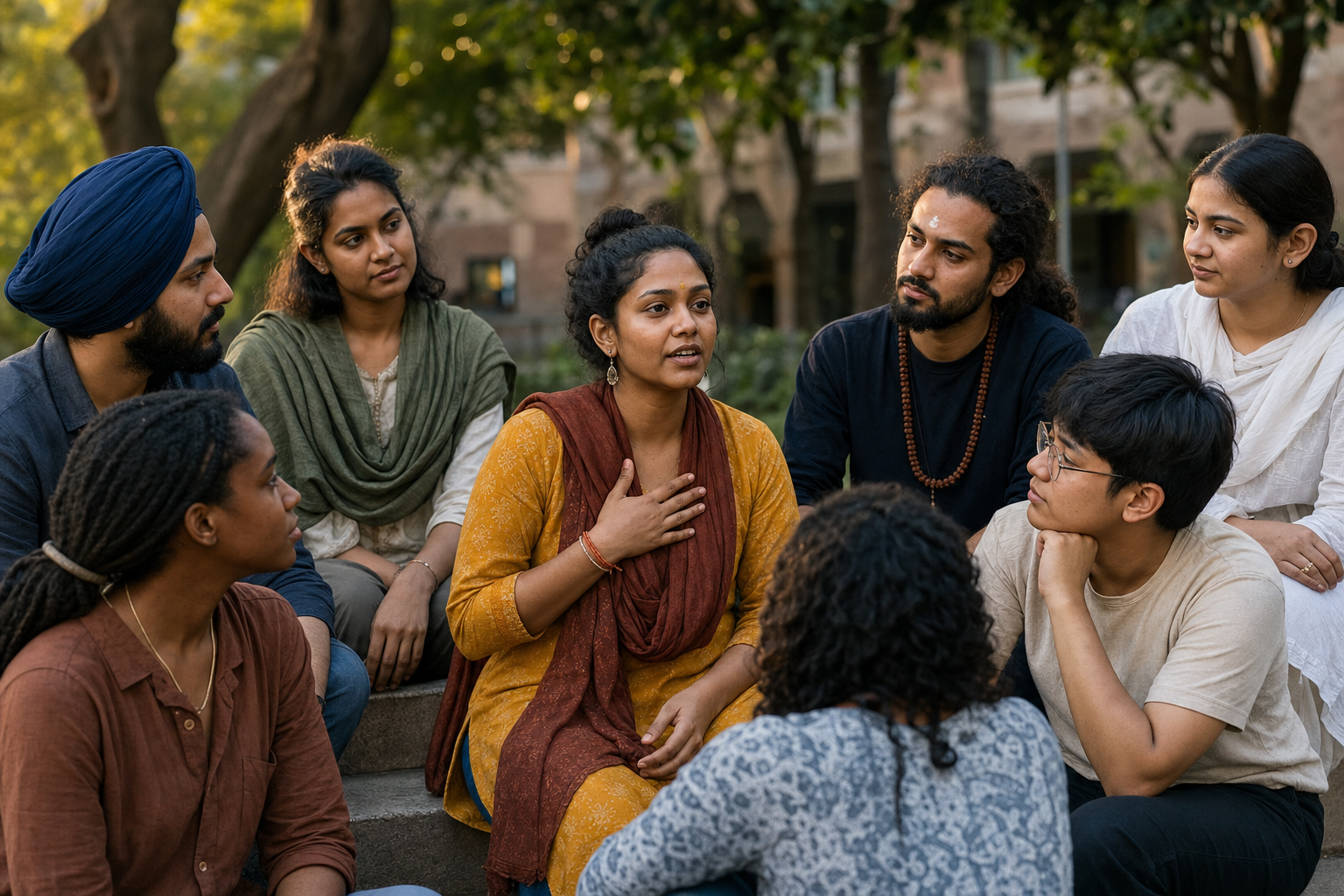
Hindu identity may be religious, cultural, familial, philosophical, civilizational, or several of these at once. Hindu traditions also contain many schools, practices, and political viewpoints. You do not have to accept another person’s political definition of your identity, and you do not need to pass a loyalty test to participate in campus life.
Speak from what you know. Say In my practice, In my family, or My position is when that is what you mean. Do not let pressure turn you into an involuntary spokesperson for all Hindus, and do not respond by claiming that your own experience represents every Hindu tradition.
Buddhists, Jains, Sikhs, and Hindus can recognize shared concerns about stereotyping and civilizational erasure while remaining distinct communities with their own institutions, histories, and internal disagreements. Invite solidarity around a precise principle: no student should be assigned a political position because of a dharmic identity. Do not presume that every member of another community shares your diagnosis or preferred remedy.
- Build agreement around fair methods. Transparent definitions, evidence tied to named actors, moderated dialogue, and rules against personal targeting are easier to defend than demands for ideological agreement.
- Do not label every critic anti-Hindu. Quote the specific generalization or conduct and explain why it is objectionable. Precision protects the credibility of the term Hinduphobia.
- Refuse collective blame in both directions. Do not answer a stereotype about Hindus with a stereotype about another religion, ethnicity, nationality, or political group.
- Protect personal information. Preserve evidence for the appropriate process, but do not publish private contact details or direct an online crowd at an individual.
- Keep political disagreement political. Name the policy, organization, government, or ideology under discussion. Do not allow ancestry or worship to become a substitute for evidence.
A compact response worth saving is: Political movements can be scrutinized. Hindu students should not be treated as stand-ins for those movements. Please define the term you are using and direct the claim to specific actors and evidence. It affirms debate, sets the boundary, and asks for an intellectually serious next step.
Before your next seminar or controversial event, save that response on your phone and create a blank incident-note template. If the discussion remains fair, you will not need either. If it crosses into profiling or harassment, you will be ready to answer calmly, document accurately, and ask for a remedy the university can actually deliver.
References
