
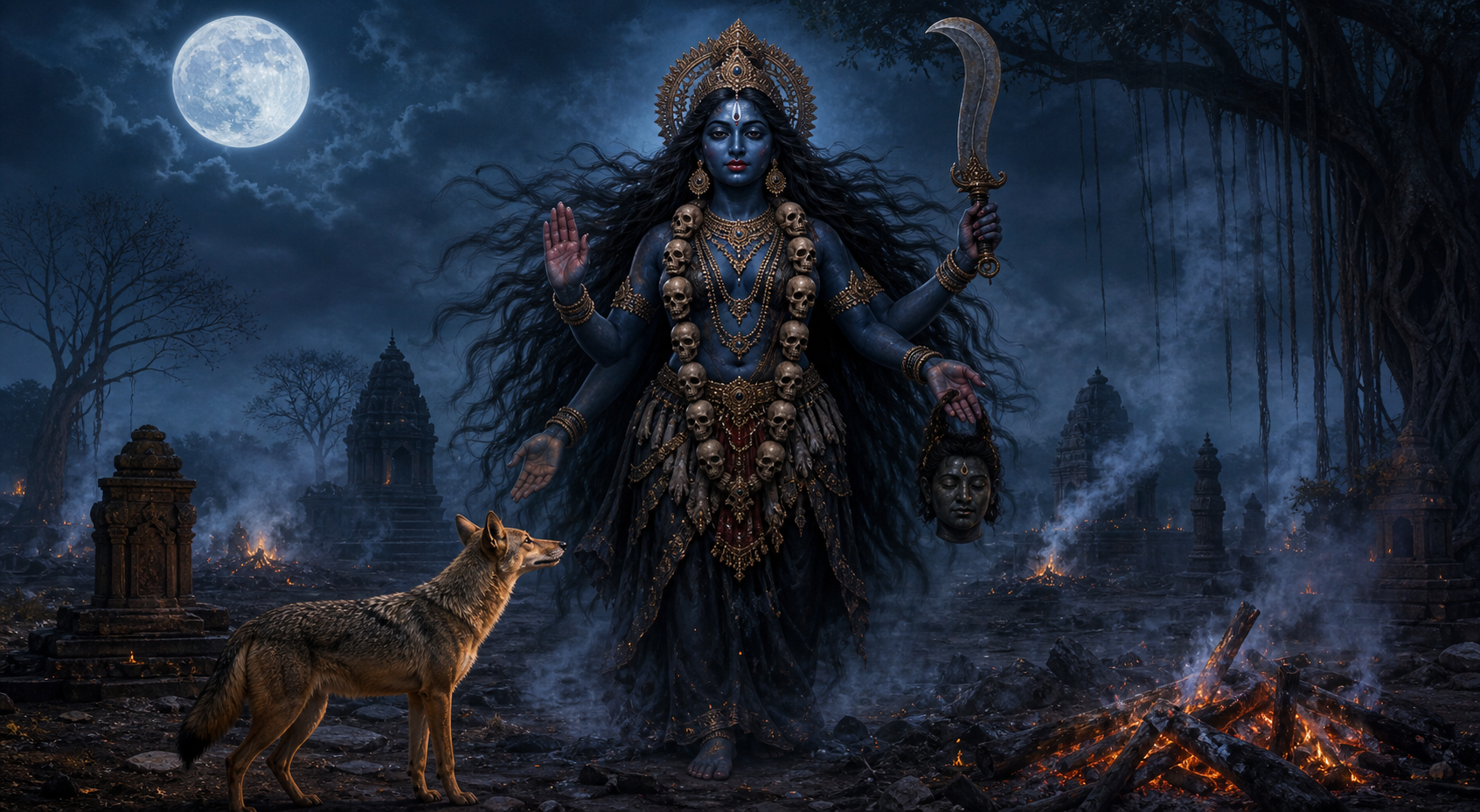
If Kali’s cremation-ground imagery leaves you wondering why the Divine Mother would stand among funeral fires with a jackal nearby, resist the two easiest reactions. Do not dismiss the scene as primitive horror, and do not soften it into decorative mysticism. Its unsettling character is part of its instruction.
The jackal and the smasana must be read together. The cremation ground reveals what cannot be kept. The jackal shows how life continues among the remains. Kali presides over both, turning an image of finality into a discipline of fearlessness, discernment, and compassionate action.
Read the whole scene before isolating the jackal
Sacred images rarely work like collections of unrelated objects. The deity, setting, gestures, companions, and atmosphere form a single symbolic grammar. If you pull out the jackal and ask only whether it is auspicious or inauspicious, you lose the meaning created by its relationship with Kali and the smasana.
Begin with three questions: Where is the animal? How does it live? What aspect of the deity does its presence make visible?
- Kali: She is transformative Shakti, confronting the ignorance, attachment, and ego that prevent clear seeing. Destruction is present, but destruction is not the final meaning. What is cut away is what binds.
- The smasana: A cremation ground is the place where claims of permanence fail. Possessions, reputation, status, and carefully maintained identities cannot prevent the body’s end. The setting therefore exposes clinging without permitting polite evasions.
- The jackal: The animal moves through darkness, boundary zones, and what other creatures leave behind. It belongs neither to the ordered centre of settlement nor wholly beyond human awareness. That makes it a fitting bearer of threshold symbolism.
In this iconographic reading, calling the jackal Kali’s vahana means more than identifying a mode of transport. A vahana expresses how divine power operates. The jackal carries Kali’s work into places respectable society avoids: death, exclusion, fear, decay, and the unglamorous labour of renewal.
This also corrects a harmful misreading. The scavenger is not a symbol of moral pollution. By consuming remains, it participates in the landscape’s renewal. Spiritually, that function becomes a metaphor for meeting the residues of experience – fear, pride, resentment, and possessiveness – and converting them into clearer judgement and service. You are not being asked to hate the unwanted parts of yourself. You are being asked to stop letting them accumulate unattended.
Key takeaways
- The smasana represents direct recognition of impermanence, not a fascination with death for its own sake.
- The jackal represents life at thresholds, including the capacity to work with what has been rejected or left unresolved.
- As Kali’s vahana or companion, it shows divine power operating beyond status, comfort, and social approval.
- Fearlessness here means remaining lucid in the presence of suffering. It does not mean becoming numb or reckless.
- The symbol has been understood only when contemplation changes how you treat loss, possessions, neglected duties, and people at society’s margins.
Why a jackal says something a lion cannot

A useful contrast can be made with Durga’s lion. The lion communicates majesty, visible strength, and sovereign command. It belongs naturally to an image of divine power confronting disorder in the public world. The jackal communicates another kind of sovereignty: the ability to enter what is feared, discarded, hidden, or denied.
This is not a ranking of Durga above Kali or Kali above Durga. It is a distinction between symbolic tasks. The lion makes power legible in regal form. The jackal overturns the assumption that sacred power must look regal at all. Kali does not require an admired animal to validate her authority. Her presence gives meaning to the marginal creature and the marginal place.
That inversion matters when you are tempted to judge spiritual worth by appearance. A prestigious role may conceal fear. Quiet work performed without recognition may sustain an entire family or community. A person pushed to the social edge may see truths that the comfortable centre has learned to ignore. Kali’s jackal does not romanticise hardship or exclusion; it prevents you from treating dignity as a reward for social approval.
The animal’s nocturnal cry sharpens the lesson. An unfamiliar sound in darkness does not allow the mind its usual sense of control. You can react by inventing threats, fleeing inwardly, or remaining attentive. The third response is the beginning of contemplative courage: notice fear, take genuine danger seriously, but do not let imagination become your master.
When you meet something that feels beneath notice – an unpleasant duty, a damaged place, an embarrassing failure, or a person excluded from respectable company – ask why you want to look away. The answer often reveals more about attachment to status than about the thing being avoided.
The cremation ground teaches detachment without indifference
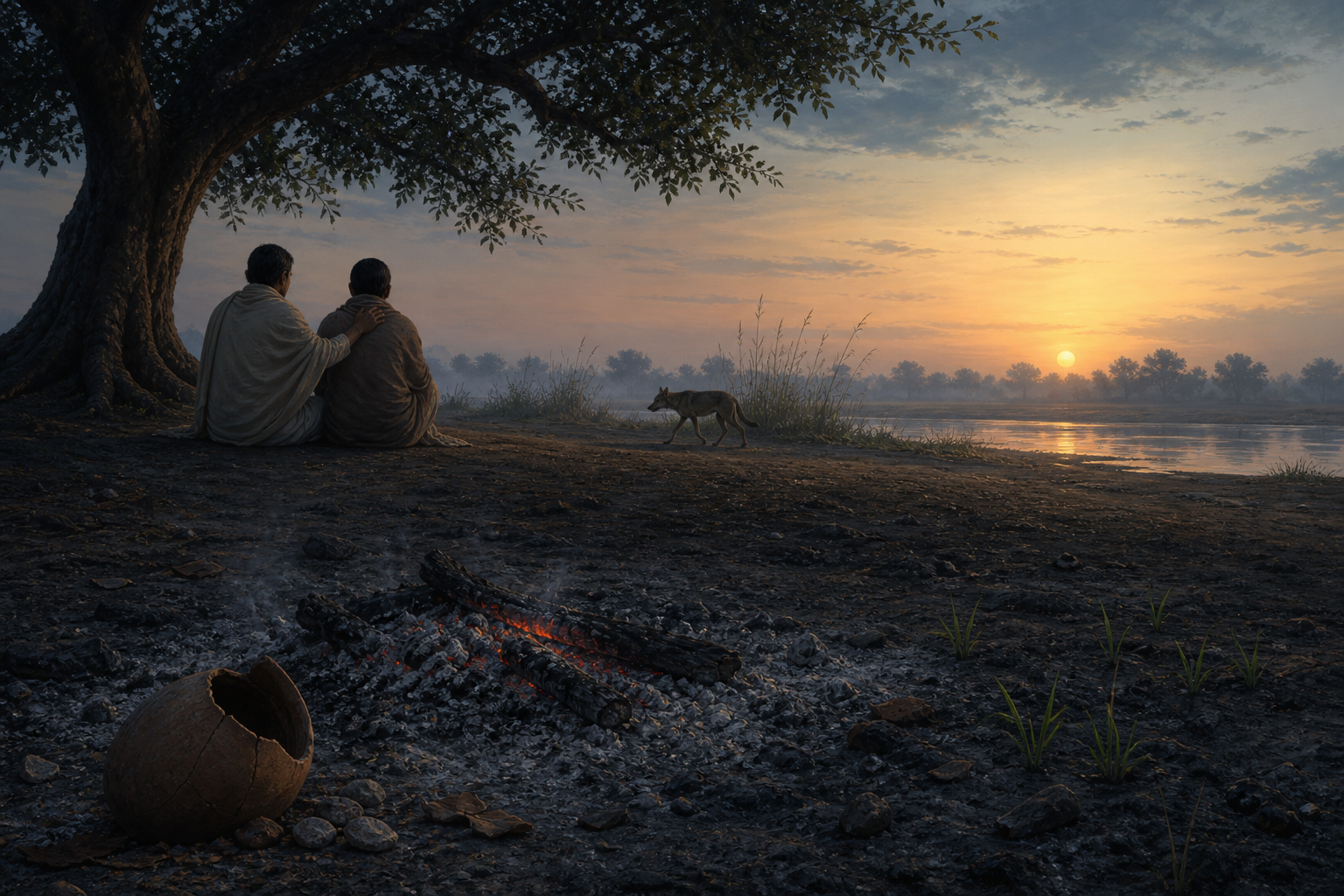
The smasana is uncompromising because death makes impermanence concrete. Yet its teaching is easy to distort. If everything passes, you might conclude that nothing matters. Kali’s presence points in the opposite direction. Because life is not possessable, the proper response is clearer attention to how you use it.
Three distinctions keep this contemplation from becoming morbid or evasive:
- Detachment is not neglect. Releasing the demand that a person, role, or possession remain forever does not release you from caring for it while it is entrusted to you.
- Fearlessness is not bravado. Nirbhau does not require denying vulnerability. It asks you to act without surrendering moral judgement to fear.
- Acceptance is not passivity. Recognising that change has occurred is what makes an appropriate response possible. Denial spends energy defending a world that is already gone.
This distinction becomes especially important in grief. Do not use impermanence as an order to stop mourning or as proof that love was misguided. The problem is not love. It is the demand that love exempt us from change. Mourning can honour a bond while gradually releasing the attempt to make the past return.
The same discipline applies to less final endings: a role you no longer hold, a belief that evidence has overturned, a family expectation you cannot fulfil, or a possession that has become a burden. The cremation-ground question is not, “How do I pretend this loss does not hurt?” It is, “What has truly ended, and what am I still trying to possess?”
Once the distinction is made, humility becomes practical. You can apologise without protecting a perfect self-image. You can give away what you keep only for status. You can change direction without treating an old plan as a sacred identity. The smasana removes the fantasy of permanence; it does not remove responsibility.
Bhairava and other Dharmic paths clarify the threshold
The jackal also belongs to a wider field of cremation-ground symbolism. Bhairava, a formidable aspect of Shiva, is associated with dogs or jackals and with places where ordinary social boundaries become unstable. The overlap connects Kali’s imagery with the indivisibility of Shiva and Shakti: awareness and energy, stillness and transformation, cannot finally be separated.
This does not make Kali and Bhairava interchangeable. It shows how related images can share a vocabulary while performing distinct theological work. When you encounter a threshold animal, darkness, bones, or a cremation ground in Dharmic iconography, do not assign a fixed meaning from a symbol dictionary. Ask which deity is present, what relationship the figures have, and what transformation the complete scene demands.
Comparable disciplines appear elsewhere in the Dharmic family, but they should be recognised as resonances rather than collapsed into one doctrine:
- Vajrayana Buddhism: Charnel-ground motifs confront fear and habitual attachment while directing insight toward emptiness and compassionate action.
- Jain Dharma: Anitya-bhavana turns attention toward impermanence, while aparigraha disciplines the impulse to accumulate and possess.
- Sikh Dharma: Nirbhau joins freedom from fear with a life directed toward sarbat da bhala, the welfare of all.
The common axis is ethically useful: see change clearly, loosen possessiveness, and widen care. The paths retain their own scriptures, disciplines, and theological frameworks. You honour their kinship best when you preserve those differences instead of treating every similar image or virtue as evidence that all traditions are saying exactly the same thing.
Bring the symbol into ordinary life without imitating ritual
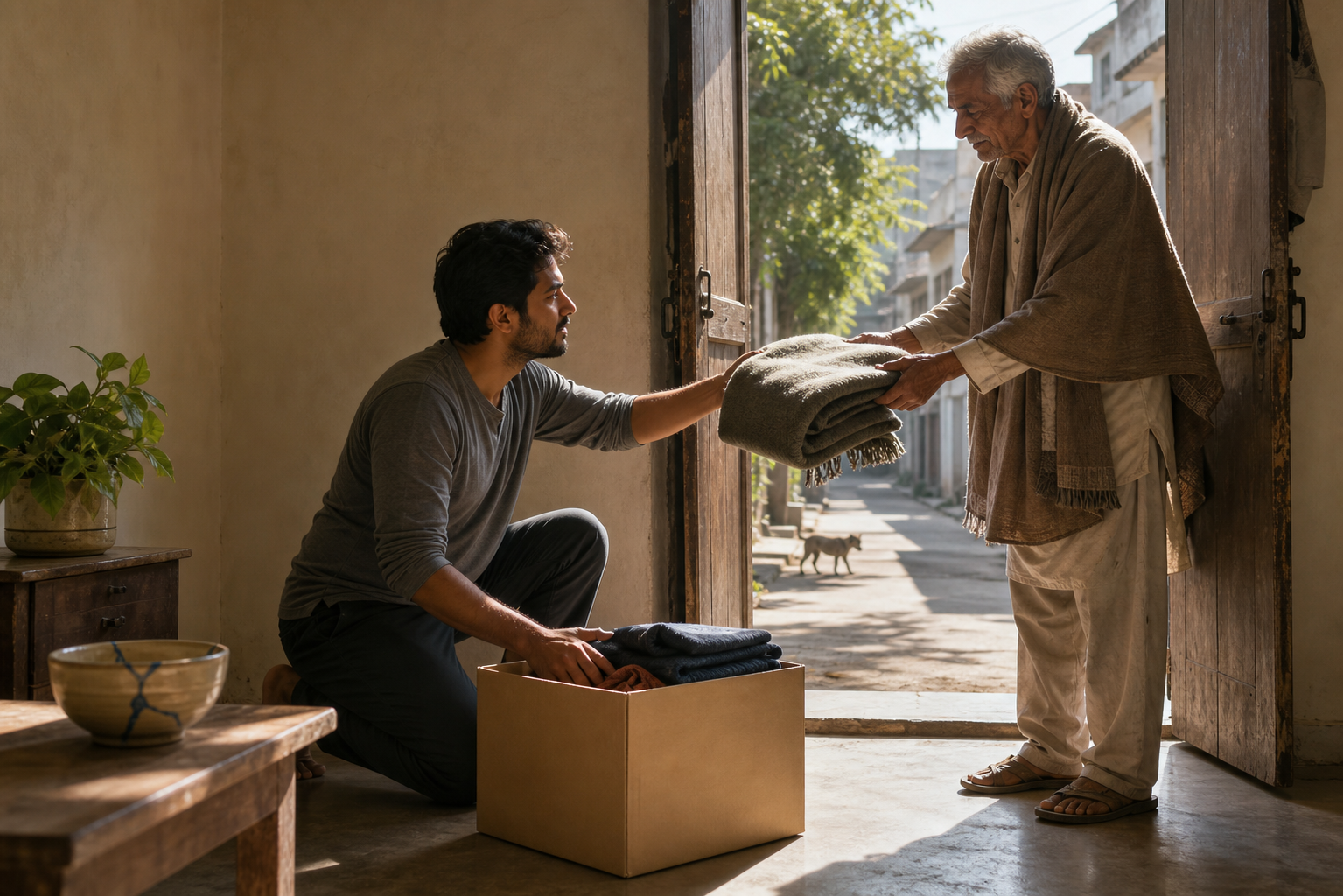
You do not need to imitate cremation-ground asceticism to learn from this image. Nor should a symbolic reflection be mistaken for instruction in lineage-specific Tantric ritual. A grounded practice begins with an actual threshold in your life and ends with an observable act.
- Choose one real ending or neglected edge. Use a situation that already exists: a responsibility you have avoided, an identity that no longer fits, a possession you cannot justify keeping, or a relationship whose form has changed.
- Name the clinging precisely. Complete the sentence, “This has changed, but I am still demanding that…” Precision matters. “I fear change” is vague; “I am demanding that my former status continue to determine how others see me” identifies the attachment.
- Apply the jackal’s question. Ask what must be released, what can still serve, and what needs responsible disposal. Do not force every loss into a positive lesson. Some things should simply be mourned; some mistakes require repair; some habits should end without being preserved.
- Convert residue into conduct. Let fear become careful preparation, pride become an apology, possessiveness become a gift, and discomfort with social margins become respectful service. This is the practical meaning of transforming obscuration rather than merely discussing it.
- Complete one outward act. Clear the neglected space, make the overdue acknowledgement, relinquish the unused object responsibly, or assist someone whose labour or suffering is usually ignored. Keep the action proportionate and concrete.
The ecological dimension deserves the same seriousness. A scavenger renews by dealing with remains, not by pretending waste does not exist. In daily life, that can mean consuming less, disposing of material responsibly, repairing what remains usable, and noticing who bears the hidden burden of society’s waste. The spiritual metaphor loses integrity if it produces elevated thoughts while leaving neglected places and people for someone else to handle.
The next time you encounter Kali in the smasana, pause before deciding that the darkness is hostile. Identify the threshold the image places before you. Then choose one thing you will stop denying and one neglected duty you will carry into the light. That is where the jackal’s symbolism becomes a lived discipline rather than an exotic idea.
References
