

A secular melody keeps returning to you. It carries memory and feeling, but you now want it to serve Krishna—and you do not want to produce a religious cover whose devotional language has merely been pasted over an unchanged secular mood.
The work begins before you write a rhyme. You need to decide whom the song addresses, what remembrance it should awaken, and which parts of the original can cross into bhakti without carrying their old meaning with them. The method below gives you a practical way to make those decisions.
Begin with the devotional destination, not the rhyme
A persistent tune deserves attention, but persistence alone does not make it sacred. Treat the recurrence as an invitation to examine the melody, not as proof that every feature of the old song should be preserved. The useful question is not, “How can I insert Krishna into these lyrics?” It is, “Where should this melody carry the listener now?”
Write the answer in a single purpose sentence before drafting the refrain. For example: “This song will turn longing into remembrance of Krishna,” or, “This song will express gratitude to Śrīla Prabhupāda for directing the heart toward Krishna.” If you cannot state the devotional destination plainly, you are not ready to revise the words.
Next, choose the primary addressee. A composition may honour the guru and lead the listener toward Krishna, but the relationship must remain intelligible. When one line sounds like an address to Krishna, the next like praise of the guru, and the next like a remnant of secular romance, the listener has to perform interpretive work that the lyricist should have completed.
- Who is being addressed in this verse: Krishna, the guru, or the listening community?
- What is the speaker doing: remembering, praising, thanking, seeking shelter, or offering service?
- What should remain in the mind after the refrain ends?
- Would the devotional meaning still be clear to someone who never heard your explanation?
That final question is decisive. Intention matters, but listeners receive the words and melody rather than your private intention. If a spoken introduction is required to rescue every ambiguous line, the transformation is incomplete.
There is a wider Dharmic principle here. Familiar musical forms can be redirected toward reverence and inward attention; comparable movements from familiarity to contemplation appear in Sikh kirtan, Buddhist recitative gāthā, and Jain stavan. This kinship should deepen respect rather than flatten distinct traditions. A Krishna bhajan should remain unmistakably rooted in Krishna bhakti even while its musical familiarity makes the doorway wider.
Preserve the melody’s emotional engine, not every association

The strongest adaptations do not fight the emotional character of the tune. They identify it and give it a new object. A melody shaped by yearning can carry longing for Krishna. A tender melody can express gratitude toward the guru. A confident, ascending refrain may suit resolve in devotional service. The emotion survives, but its direction changes.
Start by humming the tune without its old words. Notice its posture. Does it plead, celebrate, console, remember, or promise? Then ask whether that posture can honestly support the devotional purpose you wrote down. If the music communicates one disposition while the new words insist on another, neither will feel convincing.
You do not necessarily need to replace everything. A 1960s melody transformed into an offering to Prabhupāda retained its opening verse while redirecting the composition toward Krishna consciousness. That approach can work when retained language already permits a clear devotional reading and does not pull the listener back toward an unresolved secular object.
Test any retained line against three questions. Who does its pronoun refer to? What kind of love or loyalty does it describe? Where does the surrounding verse lead that feeling? A phrase such as “I need you” may sound devotional to its writer and romantic to everyone else. Naming Krishna, the guru, remembrance, shelter, or service elsewhere in the immediate passage can resolve the address without turning every line into an explanation.
The refrain deserves special scrutiny because it controls the song’s return. If old associations remain dominant, rewrite the refrain before discarding the whole melody. A clear refrain can reinterpret an otherwise familiar verse each time it returns. Conversely, a vague refrain allows the old song to keep its centre even when the verses contain devotional vocabulary.
Historical texture is not automatically an impurity. Memory can become a bridge between an earlier stage of life and present sādhana. But familiarity is only a vehicle. The destination must be established by the new words, the manner of singing, and the attention the song cultivates.
Rewrite the song in deliberate passes

Trying to perfect theology, poetry, rhyme, and singability at once usually produces crowded lines. Separate the work into passes so that each decision can be heard clearly.
- Describe the melody’s emotional centre in a few plain words. Do this without referring to the old story or performers.
- State the new devotional purpose and primary addressee. Keep this beside you while writing.
- Mark the musical anchors: the opening phrase, the repeated hook, the held notes, and the words that receive the strongest emphasis.
- Draft the refrain first. Give the listener a clear name, relationship, devotional action, or direction of remembrance.
- Write each verse around one movement of the heart. Do not make a single verse praise Krishna, explain a doctrine, thank the guru, narrate a life story, and invite congregational participation all at once.
- Sing every line aloud in the intended melody. Repair unnatural word stress, cramped sacred names, and phrases that can be understood only when read on a page.
- Review retained secular language last. Keep it only when the completed context has genuinely transformed its meaning.
A compact worksheet can keep the process honest: “Original emotional centre: ___. New devotional centre: ___. Primary addressee: ___. Remembrance or action invited by the refrain: ___. Old association most likely to distract the listener: ___.” If the last blank exposes a serious conflict, address it in the opening line or refrain rather than hoping repetition will make it disappear.
Do not overload the lyric merely to demonstrate doctrinal seriousness. Devotional clarity is not the same as theological density. A singable line that places the mind before Krishna can do more work than a catalogue of sacred terms squeezed into unsuitable metre. Let each verse carry one image, appeal, act of gratitude, or movement toward service.
Pay particular attention to names. A sacred name should not be distorted, hurried, or given an awkward stress simply to preserve an old rhyme. When the melody will not accommodate the word respectfully, revise the surrounding line or choose another melodic phrase. The tune is serving the offering; the offering is not serving the tune.
Accessibility also requires judgment. You can use simple language, provide the meaning of an unfamiliar term, or frame the song briefly before it begins. You do not need to dilute Krishna into a generic symbol so that every listener encounters something familiar. A welcoming devotional song can be specific about whom it praises.
Test whether the song functions as sādhana
A polished performance and a successful devotional offering are not identical outcomes. The practical test is what the song trains the mind to revisit. Does its repetition bring attention toward Krishna, gratitude to the guru, and willingness to serve? Or does the devotional language remain secondary to nostalgia, vocal display, or the cleverness of the adaptation?
Build chanting and reflection into the revision process. Chant before working on the lyric. Sing the new refrain without the old verses. Then sit quietly and notice what returns first: Krishna’s name, the devotional relationship, the former words, or the performer’s own self-consciousness. This is not a mystical scorecard. It is a direct way to observe what the composition is rehearsing in your attention.
- Test the intention: Can you name the service this song is meant to perform?
- Test the attention: After singing, what object occupies the mind without further explanation?
- Test the language: Are the addressee and devotional relationship clear from the lyric itself?
- Test the voice: Can the words be sung naturally without mangling pronunciation or emphasis?
- Test the accountability: If the song honours a guru or represents a particular bhakti lineage, would someone grounded in that tradition recognise the relationship as respectful?
When a test fails, revise the element that caused the failure. If the old identity overwhelms the new one, change the opening line and refrain. If listeners cannot identify the addressee, remove competing pronouns and establish the relationship earlier. If the melody forces sacred language into unnatural shapes, simplify the line. If the emotional posture contradicts the devotional purpose, set the tune aside rather than forcing it to carry work for which it is unsuited.
It also helps to hear the song in more than one devotional setting. Sing it privately, where performance energy cannot disguise weak attention. Offer it to a small group capable of commenting on pronunciation and meaning. Then consider how a listener unfamiliar with the original song would understand it. These perspectives reveal different problems: private practice exposes distraction, community singing exposes awkward phrasing, and a fresh listener exposes dependence on nostalgia.
Key takeaways
- Define the song’s devotional destination before writing new lyrics.
- Choose a clear primary addressee and relationship for each verse.
- Preserve the melody’s useful emotion while releasing associations that resist bhakti.
- Make the refrain unmistakably devotional; it governs how the entire song is remembered.
- Judge the result by the attention it cultivates, not merely by musical polish or lyrical ingenuity.
Give the transformed song a living devotional use
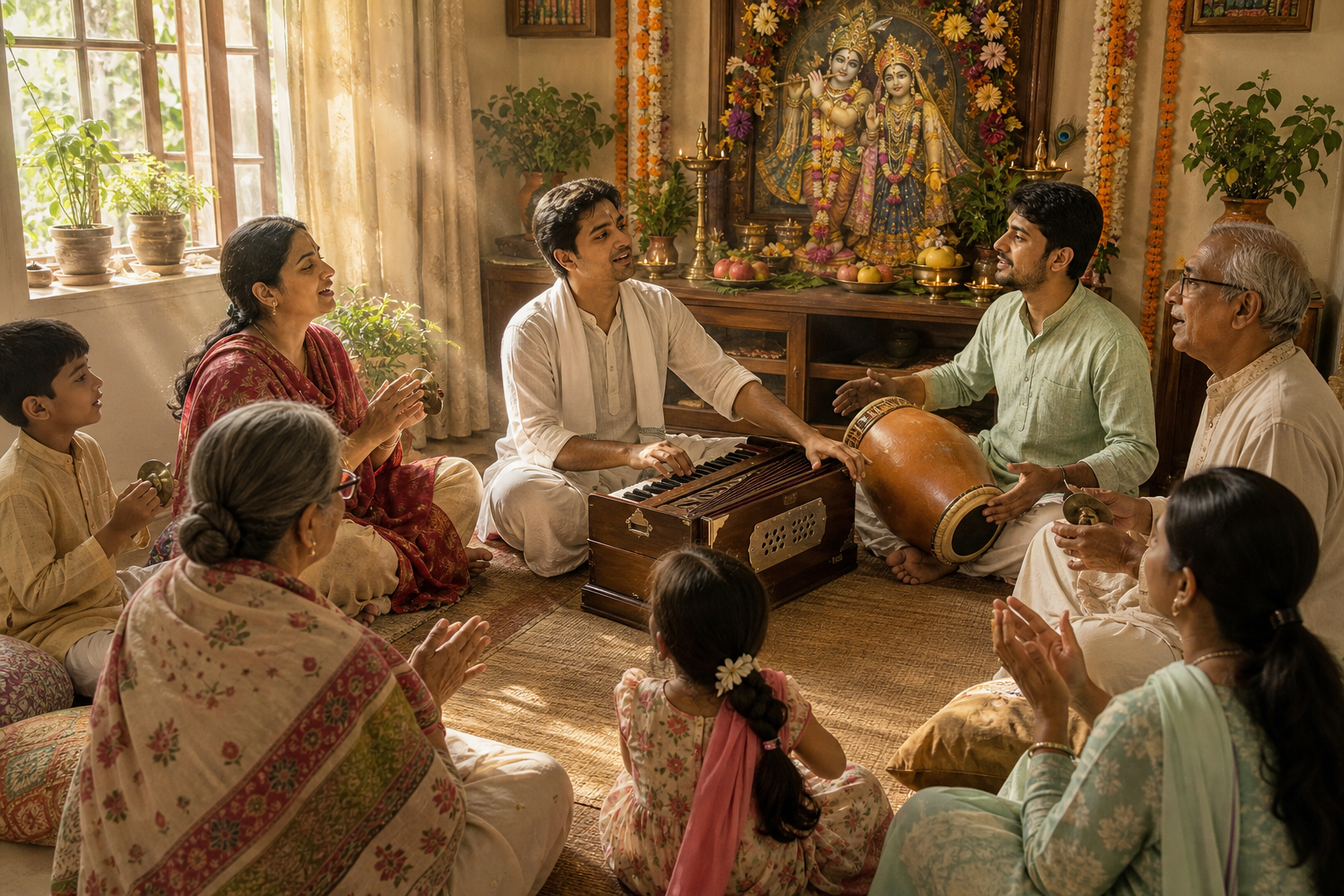
The transformation is not complete when the lyric sheet is finished. Decide where the song belongs. It may support personal remembrance, a small devotional gathering, a tribute to Prabhupāda, or a cultural setting where familiar musical language can invite people toward reflection. The intended setting affects how much introduction, translation, or congregational repetition the composition needs.
Keep a short note with the finished lyric stating its addressee, devotional purpose, and the meaning of any term that singers may not know. This prevents later performances from becoming detached from the intention that shaped the adaptation. If the offering stands within the guru-śiṣya tradition, record that relationship plainly rather than allowing it to become a decorative dedication.
Introduce the song briefly when context is needed, then let the composition do its own work. A long defence of the adaptation often signals that the lyric still depends on explanation. The listener should be able to hear where the emotion is going.
Your next step is small. Take the melody that keeps returning, write its emotional centre in plain language, and place beside it one sentence naming its devotional destination. Draft only the refrain. Chant, sing it, and observe what remains in the mind. If Krishna remains, you have the beginning of an offering rather than merely a rewritten song.
References
