
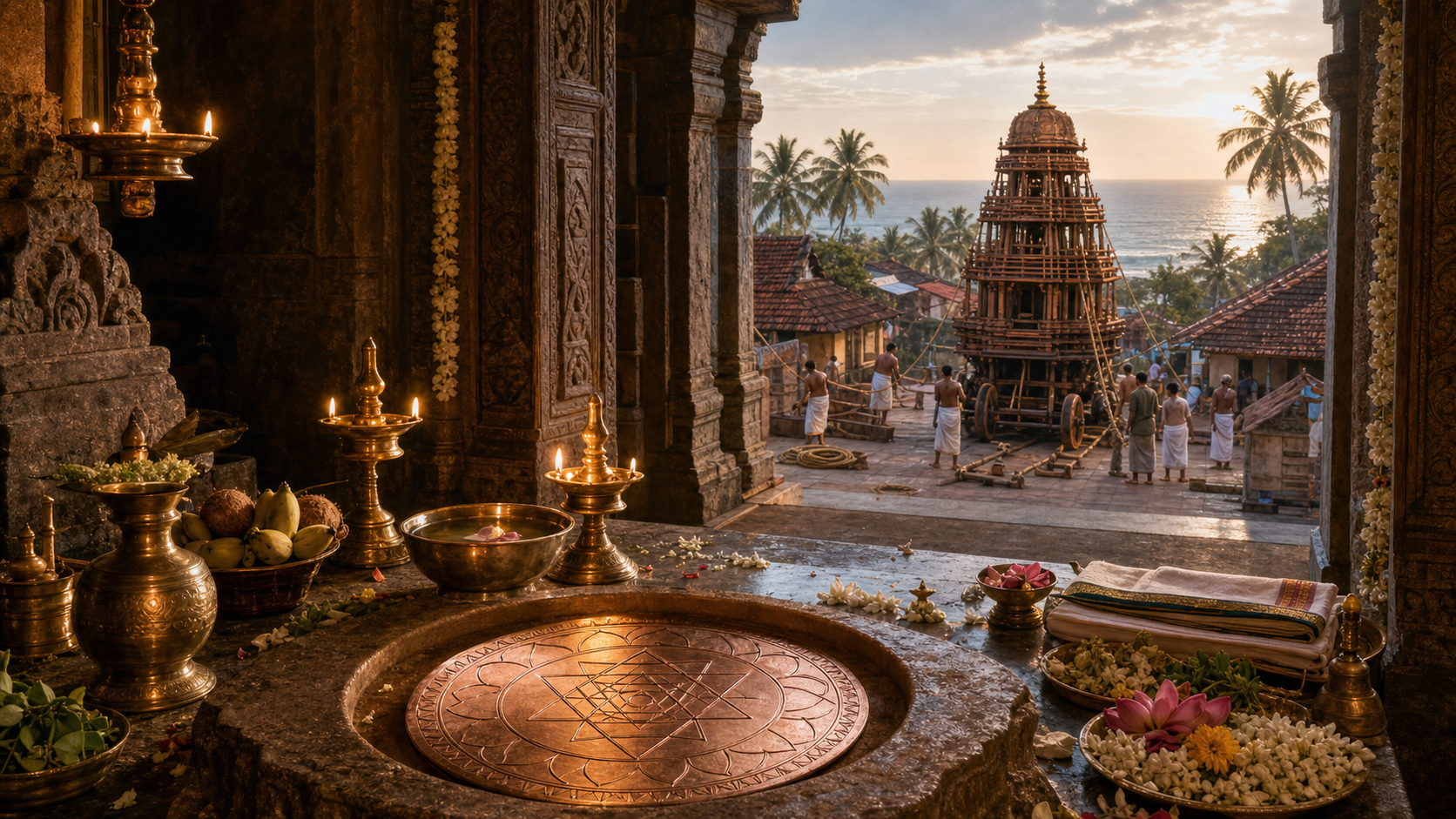
You enter a coastal temple and encounter several kinds of sacred form at once: a geometric diagram near an altar, lamps arranged in ordered space, a serpent design prepared for worship, a sanctum being renewed, or a chariot waiting to carry the deity into the street. It is tempting to put everything elaborate, ancient, or mysterious under the label “Tantra.” That shortcut makes the tradition harder, not easier, to understand.
If you want to worship responsibly, visit without treating ritual as spectacle, or explain these traditions to someone younger, look for their working grammar. Ask what the form contains, how it is activated, who completes it, and what obligation follows. The connection between Tantra and coastal temple culture lies at this level of disciplined sacred form, not in the claim that every rite is the same practice.
Do not call every elaborate ritual Tantra
Tantra is not a synonym for visual complexity, secrecy, folk religion, or any ceremony unfamiliar to an outsider. In Tantric worship, a yantra belongs to an integrated discipline. Its geometry works with mantra as sound, mudra as gesture, bhavana as contemplative visualization, nyasa as the installation of awareness, and offerings made in an intentional sequence. The diagram is therefore one component of a coordinated practice, not an isolated talisman.
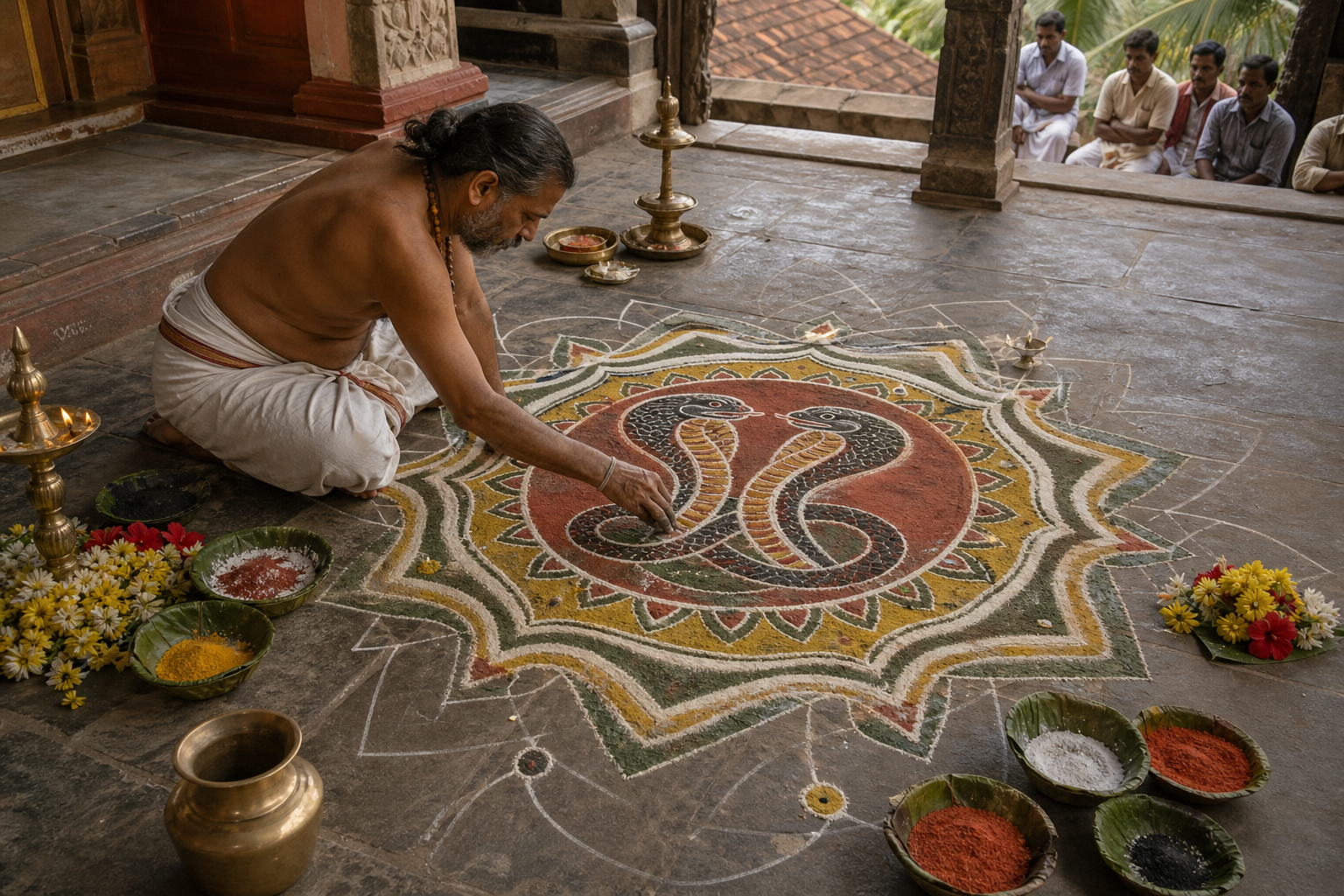
Coastal temple traditions have their own names, custodians, calendars, and purposes. Paryaya concerns the transfer of worship responsibilities among Udupi’s Ashta Mathas. Rathotsava carries a deity among devotees in a moving sanctum. Bhuta Kola and Daiva Nema honour guardian beings and ancestral protectors through night-long observances involving dance, vows, and oracular mediation. Nagamandala venerates naga deities through an intricate design, music, and circumambulation. Treating all of these as unnamed “Tantric rituals” erases the distinctions that tell you how to behave.
There is still a meaningful family resemblance. Each tradition can establish a boundary, orient participants toward a sacred centre, prescribe movement or sequence, and turn attention into obligation. A yantra does this at the scale of a diagram and a practitioner’s awareness. A chariot festival does it across a temple community and its streets. A sacred grove rite can extend the relationship to water, fertility, household well-being, and the surrounding land. Compare these functions, but keep the local names intact.
Read a ritual form through five coordinates
You do not need to know every mantra or regional history before you can begin observing intelligently. Use five coordinates when you meet an unfamiliar ritual form.
- Find the boundary. A classical yantra may begin with the bhupura, an outer square that marks and protects sacred space. In a coastal tradition, the operative boundary may be a sanctum, temple complex, sacred grove, procession route, field, or village shrine. The boundary tells you where ordinary movement gives way to prescribed conduct.
- Locate the centre. In a yantra, the bindu is the still central point toward which the structure leads. In temple worship, attention may converge on the deity in the sanctum, a consecrated kalasha, a naga locus, or the presence carried in a ratha. The centres are not interchangeable, but each tells you what the rite is organising attention around.
- Trace the path. The Sri Yantra contains nine interpenetrating triangles that generate forty-three smaller triangles around a bindu. Contemplation can proceed from its outer enclosure toward the centre. Nagamandala includes ritual circumambulation, while Rathotsava gives the sacred presence a public route. Ask whether the required movement is inward gaze, circular movement, procession, or an ordered series of offerings.
- Notice what activates the form. Lines alone do not constitute the whole practice. A yantra is joined to mantra, gesture, visualization, nyasa, vitalization, and offerings. Coastal ceremonies may use flag hoisting, Vedic recitation, homa, kalasha-abhisheka, music, lamps, vows, or collective pulling. Do not assume that one tradition’s activation can be transferred into another.
- Identify the resulting obligation. A sacred form is not complete when it produces an impressive sight. It may ask for sustained concentration, stewardship of worship, collective seva, gratitude, ethical restraint, care for water and fertility, fulfilment of a vow, or respect for a guardian relationship. This final coordinate distinguishes participation from consumption.
After a ceremony, try writing one sentence for each coordinate. If you cannot identify the centre or obligation, ask a local custodian what the rite is called and whom it serves. That question is more respectful and more informative than asking whether the ceremony is “really Tantric.”
Consecration turns an object into a responsibility
A yantra may be drawn or engraved on copper, silver, gold, birch bark, stone, or paper. Material precision matters, but an attractive object is not automatically equivalent to a consecrated ritual locus. Through practices such as nyasa and prana-pratishtha, the yantra is established for devotion, meditation, and offerings. Once you understand that distinction, buying a decorative print and receiving a form for disciplined worship no longer look like the same act.
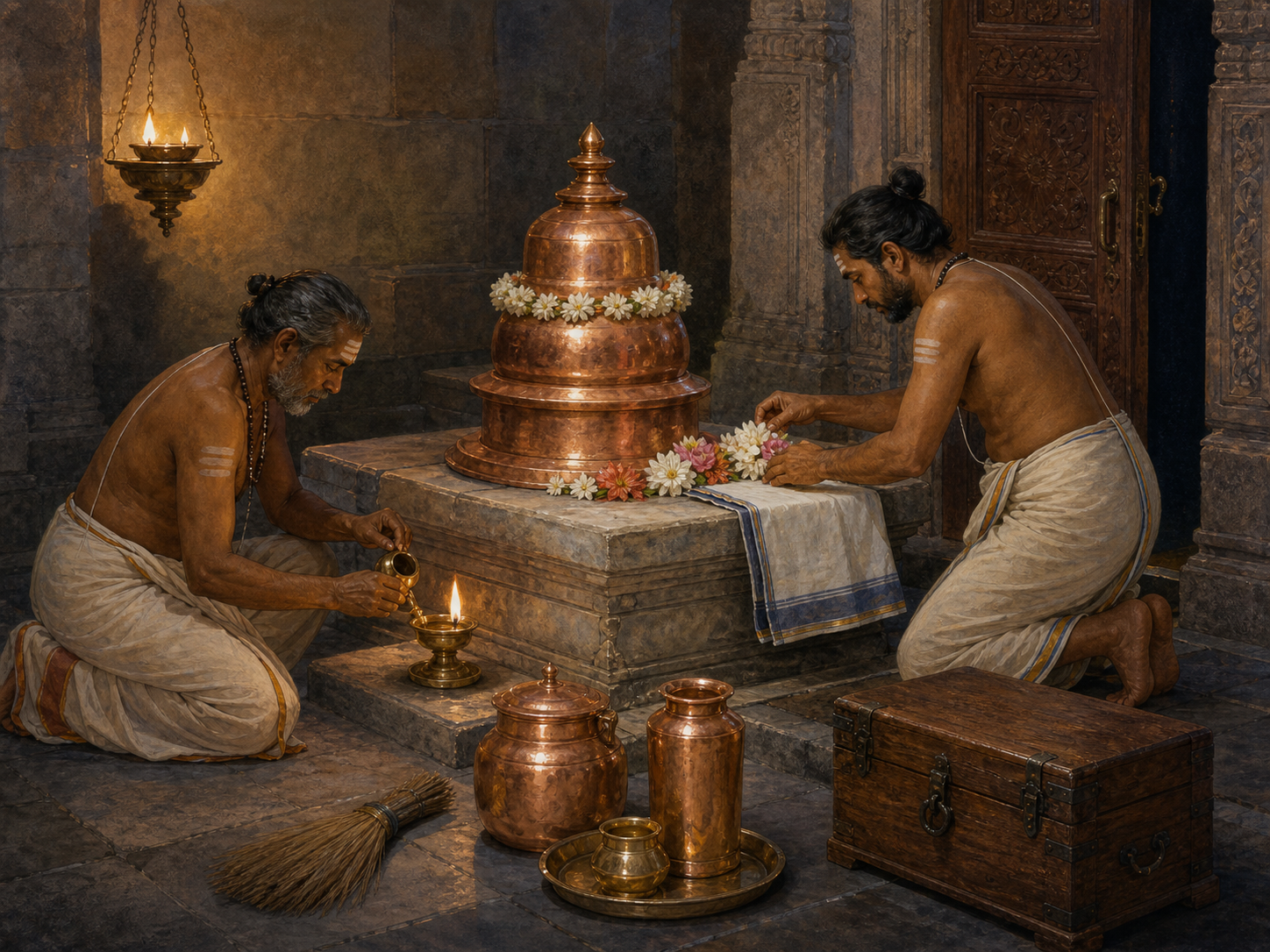
The same principle appears at temple scale. Renovation repairs a structure; Brahmakalashotsava ritually renews a sanctum after jeernoddhara through homa, kalasha-abhisheka, and prana-pratishtha. Artisans, priests, scholars, and devotees participate in a common work of continuity. Physical restoration and ritual reconsecration answer different needs, even when they belong to one larger undertaking.
If you are considering a yantra for home practice, make three decisions before placing it on an altar:
- Decide whether it is art, a contemplative aid, or a consecrated object. Do not move casually between those roles merely because the image looks sacred.
- Learn the practice that belongs to that specific form. Established instruction matters for its proportions, placement, mantra, offerings, and consecration. A generic ritual assembled from unrelated fragments can obscure the discipline the yantra was meant to support.
- Choose a commitment you can sustain. A clean, quiet altar and regular, attentive practice are more coherent than collecting multiple sacred diagrams without understanding their use.
The ethical test is equally important. Yantra practice is directed toward disciplined attention, devotion, serenity, and insight, not coercion. If a seller promises domination over another person or effortless results from possession alone, the claim conflicts with an approach grounded in dharma, compassion, and consistent sadhana. Sacred geometry can help steady attention, but geometry does not cancel ethics.
Sacred form expands from the altar to the coastline
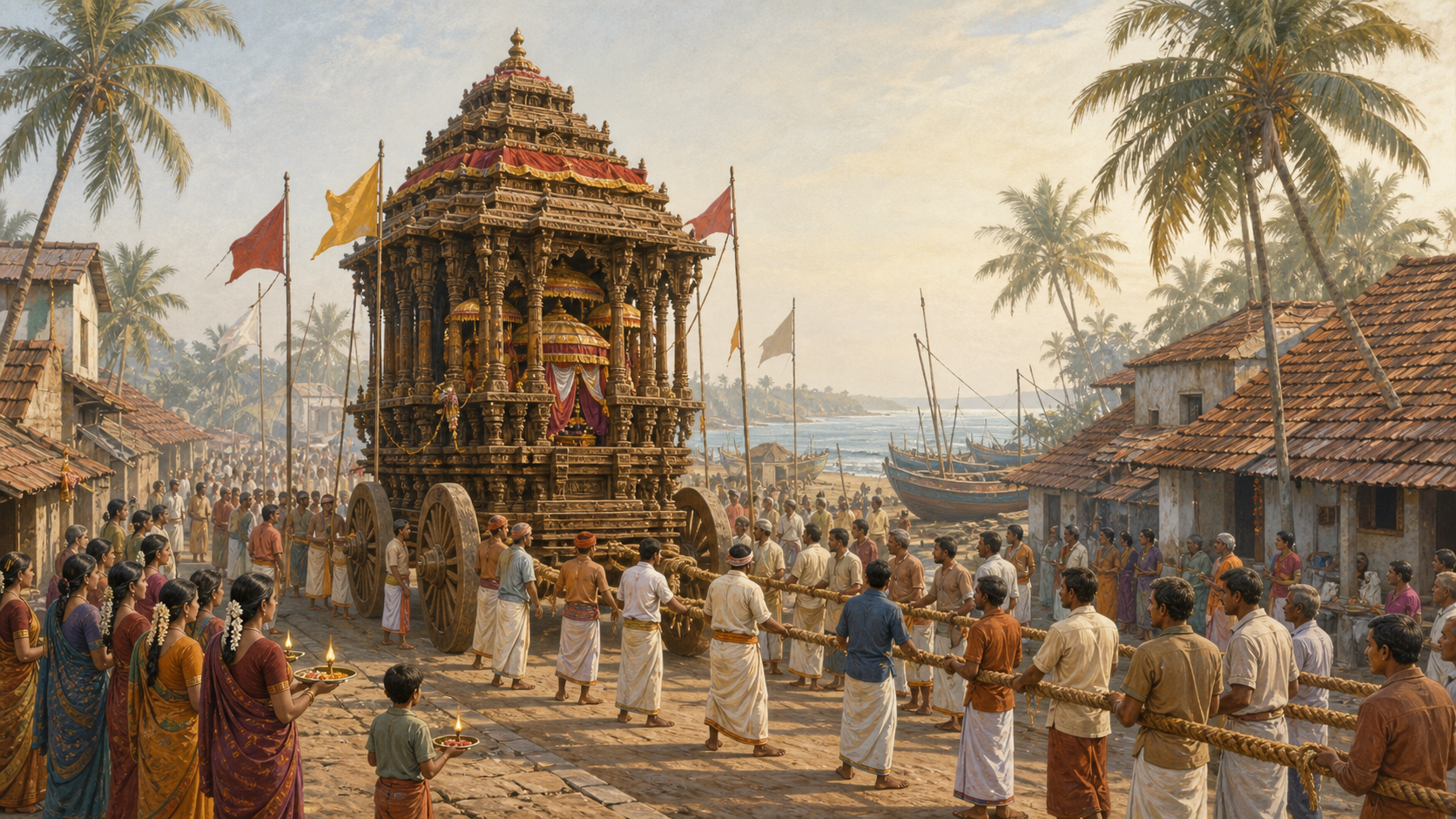
The clearest difference between private contemplation and a temple festival is scale. The deeper continuity is that form coordinates relationships. The following comparison helps you notice what changes as the ritual field grows.
| Ritual form | What is ordered | How people participate | What the form sustains |
|---|---|---|---|
| Yantra practice | Boundary, petals, triangles, circles, pathways, and bindu | Gaze, mantra, mudra, visualization, offerings, and inward attention | Concentration, devotion, and movement from multiplicity toward unity |
| Rathotsava | Deity, chariot, procession, and public route | Devotees pull the ratha and share in associated worship and service | A public bond between temple, deity, and community |
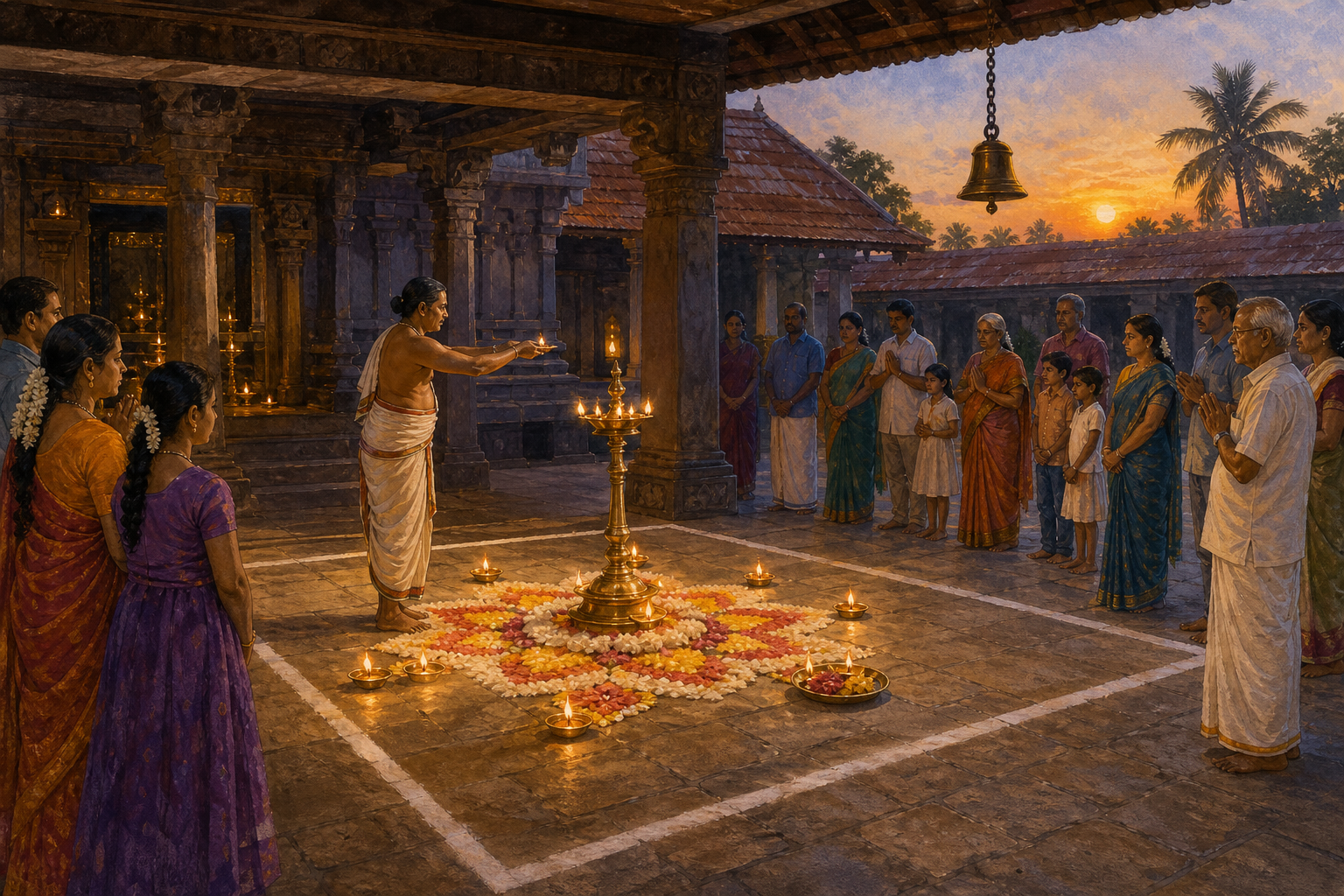
| Laksha Deepotsava | Large numbers of lamps arranged through sacred space | Families and pilgrims gather in shared luminosity and reverence | Purity, gratitude, ethical aspiration, and continuity of dharma |
| Brahmakalashotsava | Renovated temple, sanctum, homa, kalashas, and reconsecration | Priests, artisans, scholars, and devotees contribute distinct roles | The renewal of a living institution after physical restoration |
| Nagamandala | An intricate serpent design, shrine or grove, music, and circumambulation | Participants venerate naga deities and pray for auspiciousness | Relationships involving fertility, water sources, family, and landscape |
| Bhuta Kola and Daiva Nema | Night-long performance, vows, guardian presence, and oracular mediation | Community members approach within inherited local relationships | Protection and ethical bonds linking village, field, and shrine |
Time is also part of coastal ritual form. At Udupi, Paryaya provides a biennial transfer of worship responsibility among the Ashta Mathas. The transition joins procession and recitation to institutional stewardship: authority changes hands while disciplined worship continues. At Dharmasthala, Laksha Deepotsava marks Kartika through the lighting of myriad lamps. Pattanaje, observed in mid-May, formally closes the annual festival season and turns attention toward domestic worship and agricultural rhythms.
This calendar prevents religion from becoming only a private technique. Leadership must be transferred, sanctums renewed, festivals concluded, food shared, vows remembered, and the needs of land and water kept within moral attention. The coastline is not merely scenery around the temple. Roads, groves, fields, households, and water sources can all enter the ritual field.
When planning a visit, first learn where the event sits in its local calendar. A Paryaya transition, a reconsecration, a naga rite, and the close of festival season require different expectations. Follow the temple’s dress and access rules, support annadanam when appropriate, and listen to local oral histories before supplying your own interpretation. At a Bhuta Kola or Daiva Nema, especially, remember that you are witnessing a community’s protective and ethical relationship, not a performance staged merely for an audience.
Key takeaways for your next ritual encounter
- Shared ritual grammar does not mean identical theology. Use the exact names Yantra Puja, Rathotsava, Nagamandala, Bhuta Kola, Daiva Nema, Paryaya, or Brahmakalashotsava when that is the practice before you.
- Read every form through boundary, centre, path, activation, and obligation. These five coordinates reveal what the rite asks you to notice and do.
- Distinguish a sacred-looking object from a consecrated locus. Prana-pratishtha and continuing worship create responsibilities that decoration alone does not.
- Do not detach geometry from sound, gesture, visualization, offerings, ethics, and lineage. A yantra works within a discipline.
- At a coastal festival, look beyond the spectacle to stewardship, seva, ecology, agricultural time, and community memory.
- When you do not know your role, ask the local custodian before touching, moving, entering, or participating. Restraint is itself a useful form of reverence.
At your next temple or home altar, resist the urge to begin with a photograph or a grand theory. Learn the form’s proper name. Find its centre. Follow its sequence. Then make one fitting response: attentive mantra, a respectful circumambulation, support for annadanam, patient listening, or quiet withdrawal where participation is restricted.
Sacred form becomes legible when you see not only what it depicts, but what it disciplines. That is where a line becomes a yantra, a vehicle becomes a moving sanctum, a lamp becomes a communal vow, and a calendar becomes continuity lived in public.
References
- DharmaRenaissance Blog — Essential Guide to Yantras in Hindu Tantra: Discover Sacred Geometry for Transformative Worship
- DharmaRenaissance Blog — Discover 7 Essential Tulu Nadu Temple Rituals: Guide to Coastal Karnataka’s Sacred Traditions
