
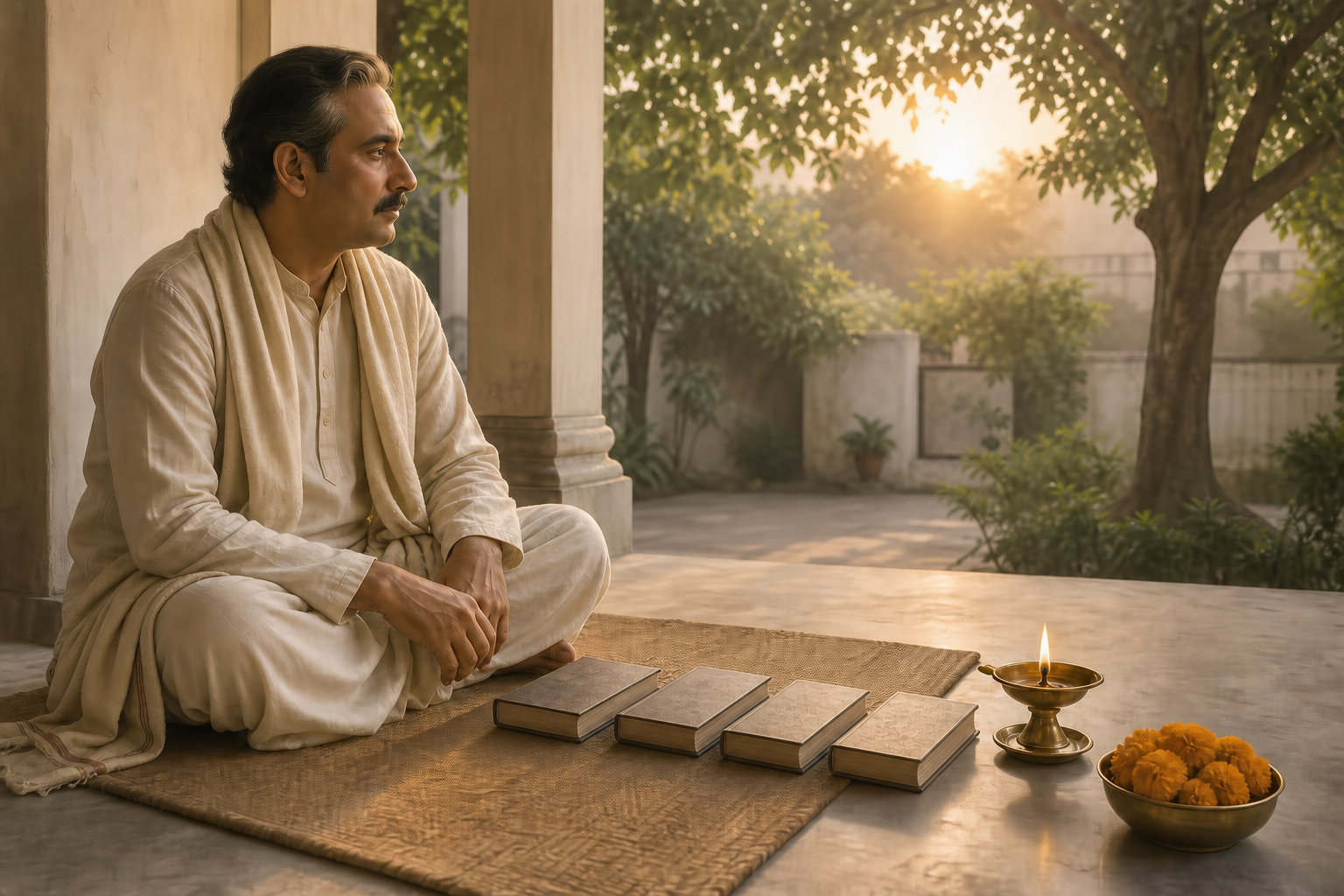
If you searched for Bhagat Ram Sharan Das hoping to find a long catalogue of books, institutions, or recorded teachings, you will meet a more demanding kind of legacy. Only a small number of biographical facts are presently available. The responsible task is to understand what those facts reveal without filling the silence with imagined achievements.
That restraint does not make his life irrelevant. His command of several languages, attraction to learned company, and commitment to the Hindu way of life illuminate how Sanatan Dharma passes from one generation to another: through study, satsanga, communication, conduct, and faithful memory. You can use that pattern in your own practice while keeping the historical boundary clear.
What can responsibly be said about his life
Bhagat Ram Sharan Das was born on March 6, 1915, in Pilakhua, in the Ghaziabad area of Uttar Pradesh, to an Aggarwal family of the Goyal lineage. He was also called Bhakta Ram Sharan Das. The form “Bhagat” belongs naturally to the devotional vocabulary of North India, where it denotes a devotee, but an honorific by itself should not be mistaken for proof of a formal office or monastic rank.
He showed unusual aptitude for Hindi, Sanskrit, Urdu, and Punjabi from childhood. He was drawn to saints, scholars, and learned circles, and he came into contact with such figures as his spiritual interests developed. These are the firm contours of the life presently before us.
They support calling him an exponent of Sanatan Dharma: someone remembered for understanding, embodying, and communicating the Hindu religious tradition. They do not establish a particular sampradaya, initiation lineage, bibliography, public position, or institutional career. We should therefore resist attaching unnamed gurus, invented discourses, or unsupported miracles to him. Reverence does not require embellishment.
When you encounter a new claim about him, apply a simple test. Ask whether it is an established biographical fact, a reasonable interpretation of that fact, or an unverified detail. Keep those three classes separate. This protects both historical truth and the dignity of the person being remembered.
His four languages point to a practical form of dharma

Hindi, Sanskrit, Urdu, and Punjabi opened different literary, devotional, and social worlds within the North Indian environment in which Ram Sharan Das grew up. His fluency should not be reduced to an impressive childhood accomplishment. It shows why language matters to the transmission of dharma.
Sanskrit can bring a student closer to the conceptual vocabulary of Hindu scriptures and philosophical traditions. Hindi carries teachings into a large field of everyday speech and devotional literature. Urdu and Punjabi create access to additional communities, poetic traditions, and modes of religious expression. Knowing several languages does not erase differences among them. It allows a thoughtful person to hear those differences before attempting to explain a shared concern.
You can put this principle into practice even if you are not multilingual. When studying a dharmic term, retain the original word beside its translation. Notice what the English equivalent leaves out. Then explain the idea once in traditional vocabulary and again in plain language that a younger relative or neighbour can understand. If the explanation becomes distorted in the second form, return to the original and refine it.
This is more than a study technique. It is a form of cultural responsibility. A tradition becomes inaccessible when its custodians refuse to translate it, but it becomes shallow when translation strips away every inherited distinction. The useful middle path is fidelity without obscurity. Ram Sharan Das’s linguistic formation gives you a concrete model for pursuing it.
Satsanga joins learning to the quality of one’s life
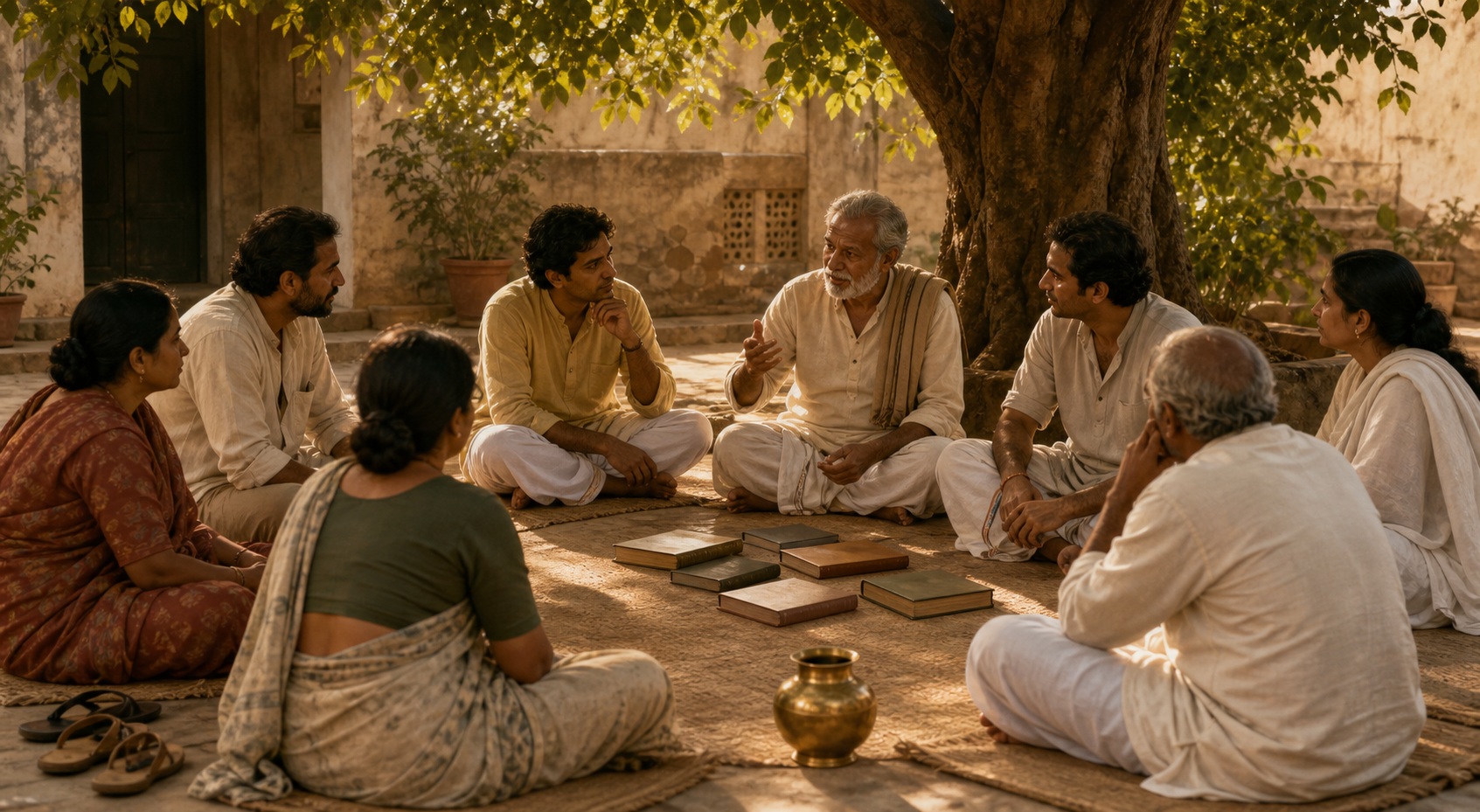
Ram Sharan Das’s contact with saints and scholars places satsanga near the centre of his spiritual formation. In its broad sense, satsanga is association with truth and with people sincerely oriented toward it. It may involve listening to a saint, studying with a scholar, joining devotional practice, or keeping company that strengthens discernment and self-command.
The important point is not proximity to a celebrated personality. The important point is what the association does to the learner. Worthwhile satsanga should sharpen your questions, direct you toward study, and improve your conduct. If a gathering produces only excitement, factional pride, or dependence on a personality, its religious appearance is not enough.
You can assess your own spiritual company by watching for three results. Do you leave with something definite to study? Does the teaching ask you to discipline a habit rather than merely admire an ideal? Does it make you more truthful and useful in ordinary relationships? These outcomes connect listening with abhyasa, sustained practice.
This also explains why saints and scholars both matter. Devotion without learning can become credulous. Learning without humility can become sterile. Sanatan Dharma has repeatedly made room for the meeting of the two: the warmth that turns the mind toward truth and the discipline that prevents feeling from being mistaken for truth.
Dharmic pluralism requires respect without erasure

A multilingual North Indian devotee naturally stood within a world of religious plurality. Hinduism, Buddhism, Jainism, and Sikhism have distinct scriptures, authorities, doctrines, disciplines, and historical identities. They should not be collapsed into interchangeable versions of one system. At the same time, their civilizational conversations make shared concerns visible, including compassion, learning, self-discipline, and service.
Sanatan pluralism is strongest when it can recognize both realities. “Many paths” should not become an excuse to stop learning what any path actually teaches. Nor should doctrinal difference become permission for contempt. Unity that requires erasure is fragile; difference that forbids dialogue is equally impoverished.
When you discuss dharmic traditions, use a three-part lens. Identify the ethical ground that permits cooperation. Preserve the tradition’s own vocabulary instead of replacing every term with a loose equivalent. Then state real disagreements accurately and without hostility. This method is especially useful in family discussions, community programmes, and interfaith settings, where polite generalities often conceal misunderstanding.
Ram Sharan Das’s linguistic range makes this principle tangible. Communication across communities begins with listening closely enough to know when two words overlap and when they do not. The purpose is not to manufacture sameness. It is to make truthful understanding possible.
Key takeaways for preserving and practising this legacy
- Keep the verified core intact. His birth in Pilakhua in 1915, Aggarwal-Goyal family background, command of Hindi, Sanskrit, Urdu, and Punjabi, and association with saints and scholars form the available biographical foundation.
- Do not convert admiration into unsupported biography. No specific guru, sectarian affiliation, book, institution, or public office should be assigned to him without evidence.
- Treat language as part of sadhana. Preserve important dharmic terms, investigate their meanings, and learn to communicate them clearly without flattening them.
- Judge satsanga by its fruit. Good spiritual company should deepen study, discipline conduct, and make service more concrete.
- Practise pluralism precisely. Recognize shared dharmic values while respecting the distinct teachings and identities of Hindu, Buddhist, Jain, and Sikh traditions.
- Preserve local memory methodically. Pilakhua, Ghaziabad, family networks, and surrounding communities are sensible places to seek photographs, letters, recollections, and other records connected with his life.
If you have family or community knowledge about Bhagat Ram Sharan Das, record who supplied each recollection, that person’s relationship to him, and when the account was collected. Photograph both sides of old documents, preserve their original captions, and label uncertain dates as uncertain. Seek permission before publishing personal material. Oral memory becomes far more useful when affection is accompanied by provenance.
You do not need to wait for a complete archive to act on the clearest lesson of his life. Choose a dharmic idea you care about, study its language carefully, bring it into serious company, and let it alter one aspect of your conduct. At the same time, preserve any evidence that may help the next generation know the person more fully. That combination of practice and truthful remembrance is a fitting way to honour an exponent of Sanatan Dharma.
References
