
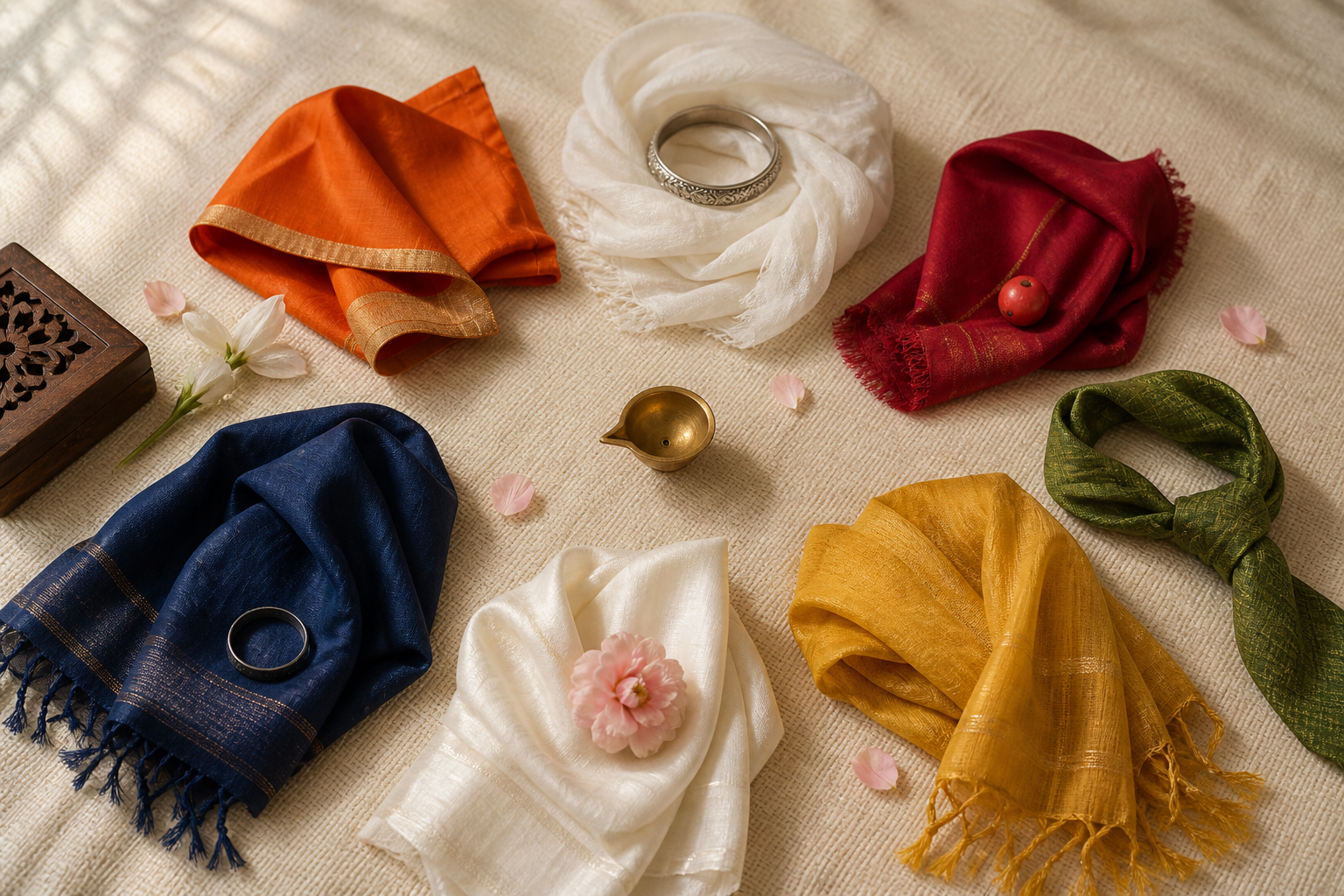
You remember that Monday is associated with white and Saturday with dark blue, but the rest of the week becomes a blur. Or perhaps you know the colours yet aren’t sure whether you need a complete outfit, a particular shade, or an elaborate ritual.
The practice can be much simpler. Choose one wearable colour connected with the day’s planetary ruler, give it a clear purpose, and let it remind you how you intend to act. A scarf, tie, turban detail, bangle, shirt, pair of socks, or piece of jewellery can do the work; you don’t need to rebuild your wardrobe.
The seven-day map you can use without guesswork
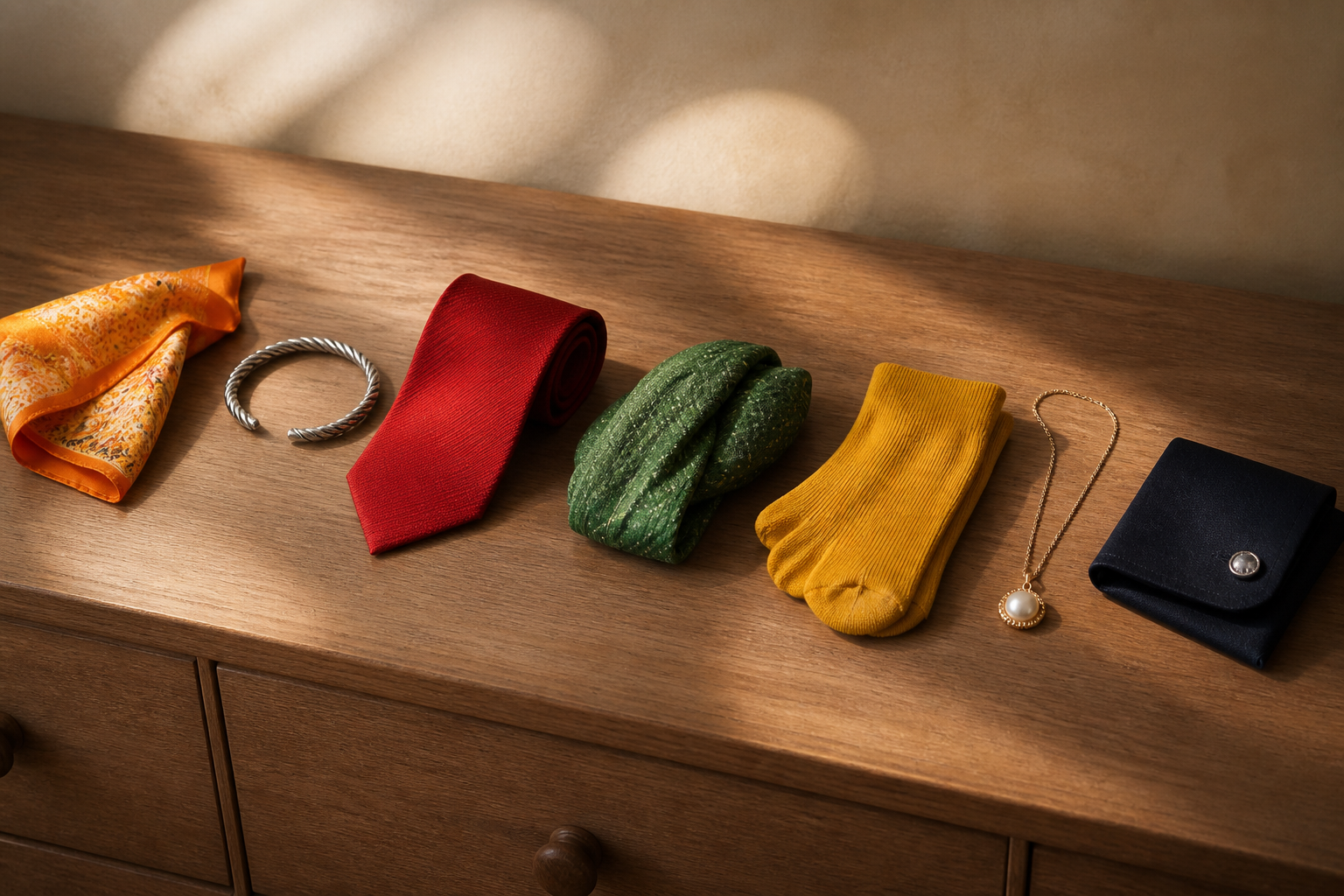
The traditional weekday sequence moves from Surya, Chandra, Mangala, Budha, Guru, Shukra, and Shani. Each ruler has a family of colours rather than one compulsory shade. That flexibility is what makes the practice workable in ordinary life.
| Day | Planetary ruler | Traditional colour family | Easy modern expression |
|---|---|---|---|
| Sunday | Surya, the Sun | Red, orange, saffron, maroon | Saffron stole, terracotta tie, warm-toned shirt, or gold-toned jewellery |
| Monday | Chandra, the Moon | White, cream, pearl, soft silver | White kurta or shirt, cream scarf, pearl detail, or silver-toned accessory |
| Tuesday | Mangala, Mars | Red, coral, rust | Coral scarf, rust pocket square, red bangle, or restrained red detailing |
| Wednesday | Budha, Mercury | Green and light green | Olive shirt, mint scarf, green tie, or emerald-toned accent |
| Thursday | Guru, Jupiter | Yellow, saffron, mustard | Mustard stole, yellow kurta, saffron accessory, or warm golden accent |
| Friday | Shukra, Venus | White, pink, gentle pastels | Pastel shirt, pink scarf, white garment, or delicate light-toned jewellery |
| Saturday | Shani, Saturn | Black, navy, indigo, deep blue | Navy jacket, indigo kurta, black shoes, or another structured dark element |
Two details prevent most confusion. First, you are choosing from a palette, not searching for a single exact colour. Olive can serve Wednesday as naturally as brighter green; navy can express Saturday without requiring black. Second, repeated colours are not mistakes. Sunday and Tuesday both use red, Monday and Friday both use white, and Sunday and Thursday both admit saffron. The distinction lies in the planetary association and the quality you bring to the day.
Wear the quality of the day, not just its colour
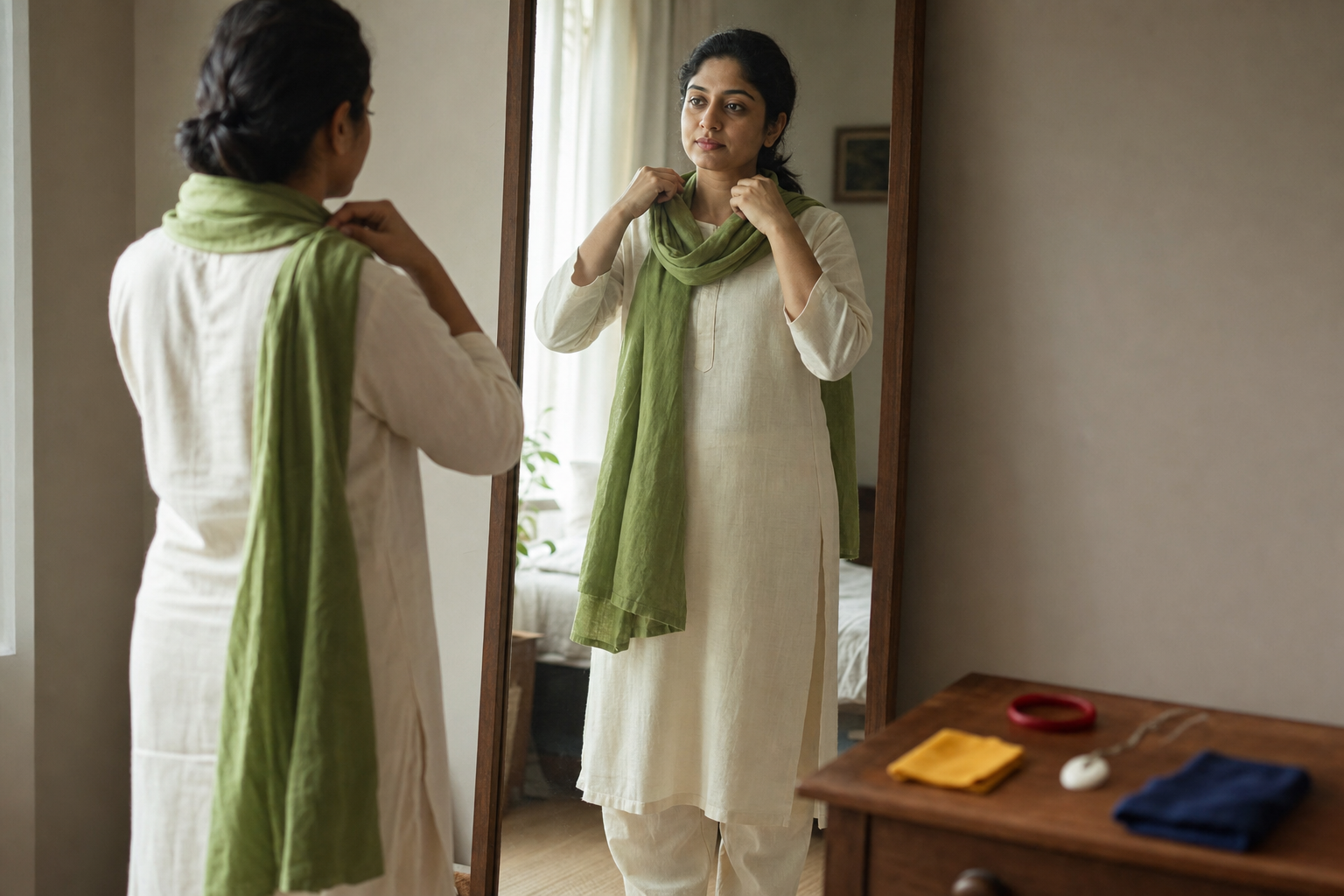
A colour becomes spiritually useful when it is tied to conduct. Without that connection, the practice can collapse into a weekly dress chart. Before getting dressed, name one quality you want the colour to recall. Then choose an action that gives that quality visible form.
Sunday: bring Surya’s warmth into purposeful action
Sunday’s red, orange, saffron, and maroon evoke vitality, leadership, and warmth. Use the day to set direction rather than merely project authority. A saffron scarf or terracotta accent can remind you to decide what deserves your energy in the coming week.
Choose one delayed decision, make it clearly, and communicate it without aggression. That is a more disciplined expression of solar confidence than wearing the brightest red available. If a strong colour would feel theatrical in your setting, a warm accent or gold-toned piece keeps the association present without dominating your appearance.
Monday: let Chandra create room for reflection
White, cream, pearl, and soft silver are linked with Chandra’s calm, receptive character. Monday’s practice is therefore not passivity. It is the ability to receive information before reacting to it.
Wear a light neutral and give someone your full attention in the first conversation that matters. If the week begins with emotionally charged work, let the colour cue you to pause, listen, and separate what was said from what you assumed. Light fabrics and gentle tones also fit study, prayer, caregiving, and other settings where a quieter presence is appropriate.
Tuesday: direct Mangala instead of displaying intensity
Mangala’s red, coral, and rust represent courage, discipline, and focused action. This is the day to move a difficult task out of avoidance. Pick something that requires effort, a boundary, or a firm answer, and begin it while the colour is still a conscious cue.
The useful distinction from Sunday is direction. Sunday’s warm palette points toward vitality and leadership; Tuesday’s red family points toward disciplined execution. If bright red makes you feel overstimulated or is unsuitable at work, choose coral, rust, or a small red detail. Mars does not need to become a costume.
Wednesday: use Budha’s green for clear exchange
Green and light green correspond to learning, communication, and adaptability. Wednesday is especially suited to writing, studying, negotiating, editing, and explaining something that others have misunderstood.
Let your green accent prompt one practical check: can the other person understand what you mean without asking you to decode it? Revise the confusing email, define the uncertain term, or ask the missing question. Olive and mint work easily with neutral clothing, while an emerald detail gives a stronger expression when the occasion allows it.
Thursday: make Guru’s yellow an obligation to share well
Yellow, saffron, and mustard carry associations of wisdom, generosity, guidance, and teaching. The colour is not a claim that you possess wisdom. It is a reminder to approach knowledge responsibly.
Study one subject with attention, offer useful guidance without showing off, or thank a teacher whose instruction still shapes you. If you are mentoring someone, ask what would genuinely help before giving an answer. Mustard is often the easiest professional option; saffron can take a more prominent place in devotional, festive, or community settings.
Friday: distinguish Shukra’s harmony from Monday’s stillness
Friday returns to white but adds pink and gentle pastels. Under Shukra, these colours point toward harmony, aesthetics, affectionate connection, and refinement. The practical emphasis is relationship and balance rather than Monday’s reflective receptivity.
Wear the palette when you are meeting friends, collaborating on creative work, tending a relationship, or bringing order and beauty to a shared space. Choose one gracious action to accompany it: repair a small misunderstanding, express appreciation precisely, or improve something others must use. Refinement becomes meaningful when it makes life more considerate, not merely more decorative.
Saturday: allow Shani’s dark tones to steady long work
Black, navy, indigo, and deep blue symbolize grounding, restraint, responsibility, and patience. Saturday’s palette suits maintenance, unfinished duties, planning, and work whose value appears slowly.
Choose a structured dark garment and finish one obligation you have repeatedly pushed aside. That may be less exciting than beginning something new, which is precisely why the association is useful. Let the colour remind you that steady progress does not need spectacle. Navy and indigo are also practical when black feels too severe or carries a different meaning in your family custom.
Build a weekday capsule from clothes you already own

The easiest way to abandon this practice is to make it expensive or complicated. Start by treating colour as an accent system. One item can serve more than one day, and the neutral clothes already in your wardrobe can remain the base.
- Audit by colour family. Look for one warm red or orange item, one white or cream item, one green item, one yellow or mustard item, one pink or pastel item, and one navy, indigo, or black item. You may already have the complete weekly range.
- Choose a repeatable anchor. Scarves, stoles, ties, pocket squares, bangles, earrings, socks, turbans, and jewellery are easier to repeat than complete outfits. Select what fits your actual dress rather than copying someone else’s form.
- Assign the overlaps deliberately. The same white garment can serve Monday and Friday. Pair it with a quieter silver or pearl detail on Monday and a pink or pastel accent on Friday. A saffron item can serve Sunday or Thursday when you consciously change the day’s intention.
- Keep the items visible together. A dedicated shelf, hanger, or small accessory box removes the need to remember every correspondence during a rushed morning.
- Name the day’s quality before wearing the colour. Use one short intention: lead warmly, listen first, act with discipline, communicate clearly, learn generously, create harmony, or persist patiently.
- Buy only after a real gap appears. If you decide to add something, favour an item you will wear repeatedly. Natural fabrics and responsibly produced dyes can connect the ritual with clarity, restraint, and care for the material world.
Professional dress rarely requires abandoning the practice. Use a tie, pin, bangle, scarf edge, shirt detail, or other permitted accent instead of a full colour block. If your work requires a uniform or protective clothing, keep that requirement intact. A non-interfering personal accessory, notebook, or object at your workspace can carry the reminder without compromising the function of what you must wear.
Festivals and personal observances may call for a brighter expression. A contemplative day may call for something quieter. The correspondence stays recognisable even when its intensity changes.
Keep the practice devotional without turning it into a rule
Weekday colours belong to a cultural and spiritual discipline, not a guaranteed mechanism for producing success. Wearing green on Wednesday does not ensure a negotiation will go your way, and a forgotten yellow garment does not make Thursday inauspicious. The clothing is a support for attention; your conduct remains the substance of the practice.
This distinction matters because fear quickly distorts a gentle observance. If you miss the colour, continue with the quality. Communicate clearly on Wednesday, teach generously on Thursday, or fulfil a responsibility on Saturday. You have not ruined the day by wearing the wrong shirt.
A general weekly palette also does not overrule personal guidance. Advice may vary with an individual’s astrological chart, stage of life, family practice, or sampradaya. If you follow a specific discipline received from a trusted teacher or astrologer, treat that instruction as personal guidance rather than forcing it into a generic schedule.
The colours can also be approached with respect across dharmic traditions. Saffron carries associations of renunciation and inner strength in Hindu, Buddhist, Jain, and Sikh settings, while white has a broad relationship with purity and ethical clarity. These resonances reveal a shared civilizational colour vocabulary, but they do not mean every tradition assigns identical theology or prescribes the same weekday practice. Unity does not require flattening meaningful differences.
The right measure is straightforward: does the practice make you more attentive to the quality you claim to honour? If solar colour accompanies arrogance, Martian red accompanies anger, or Venusian refinement becomes vanity, the outer correspondence has lost its purpose. Use the colour to examine conduct, not to decorate ego.
Key takeaways
- Sunday belongs to Surya, Monday to Chandra, Tuesday to Mangala, Wednesday to Budha, Thursday to Guru, Friday to Shukra, and Saturday to Shani.
- You can choose from each day’s colour family; an exact shade or complete matching outfit is unnecessary.
- Repeated colours carry different intentions: Sunday red emphasizes warmth and vitality, Tuesday red disciplined action; Monday white supports receptivity, Friday white harmony and refinement.
- A small accessory capsule is enough. Start with what you own, reuse overlapping colours, and keep the items where you can see them.
- The colour is a reminder, not a guarantee. Attach it to one observable action so that the day’s planetary quality appears in your conduct.
- Personal chart guidance, family custom, and sampradaya can appropriately modify the general weekday pattern.
On the next morning, choose one permitted colour from the table and name the quality it represents before you put it on. Give that quality one concrete expression during the day. In the evening, notice whether the visible cue changed how you approached the task. Keep the practice if it strengthens attention, and simplify it whenever the clothing begins to matter more than the dharma it is meant to recall.
References
