

If you are a Hindu student deciding whether to attend a contentious campus event, file a complaint, or stay publicly silent, your first task is not to win the argument. It is to separate intellectual disagreement from identity-based targeting, protect your immediate safety, and create a record that an institution can act on.
The Rutgers dispute grew from a 2025 program framed around Hindutva and concerns that its framing could cast suspicion on Hindu students. That concern deserves a precise response. Criticism of a political ideology is not automatically hostility toward a religion, but academic freedom cannot become a pretext for stereotyping, intimidation, or collective blame.
Key takeaways
- Do not treat every criticism of Hindutva, Indian politics, or a political organization as a safety violation. Focus on the words and conduct directed at students or religious communities.
- If there is an immediate threat, stalking, doxxing, or an attempt to confront you physically, leave the area and contact the current campus public-safety or emergency channel. A bias form can wait.
- Document exact words, actions, dates, locations, links, witnesses, and effects. Separate what you observed from what you inferred.
- Ask Rutgers for defined terms, clear event objectives, moderated questions, conduct rules, and a named route for safety concerns. These safeguards strengthen academic inquiry rather than suppressing it.
- If you organize a response, build it around student dignity and evidence. Do not publish private information, assign collective guilt, or answer one stereotype with another.
First decide what kind of incident you are dealing with

A harsh lecture can be inaccurate, selective, or intellectually weak without becoming a safety incident. Conversely, calm and academic-sounding language can still stigmatize students when it treats their religious identity as evidence of political guilt. The subject of the program is not enough to decide which situation you face. Examine the actual claim, conduct, target, and consequence.
| Situation | What to notice | What to do |
|---|---|---|
| Academic or political disagreement | A speaker criticizes Hindutva, a government, a political organization, or a historical interpretation without blaming Hindu students as a group. | Ask for definitions and evidence. Challenge overgeneralization through questions, counter-programming, or a written academic response. |
| Identity-based stereotyping or harassment | Hindus are described collectively as dangerous, disloyal, morally suspect, or responsible for conduct they did not commit; a student is targeted because they are or are perceived to be Hindu. | Preserve the exact language and context. Ask which campus process handles bias, harassment, discrimination, or student conduct, and request an explanation of that process before submitting sensitive information. |
| Immediate or potentially criminal safety concern | A threat, physical pursuit, stalking, exposure of private identifying information, an attempt to locate someone, or conduct that makes remaining in place unsafe. | Move to a secure place and contact trained safety personnel. Do not confront the person or wait for an administrative debate about terminology. |
The central distinction is between an argument about an ideology and treatment of a person because of religious identity. Hinduism includes diverse religious, philosophical, devotional, and cultural traditions. Hindutva is commonly discussed as a political or cultural ideology, but people use the term in different ways. A responsible campus program should therefore define it before making claims about it. It should not quietly move from a claim about Hindutva to a claim about Hindus.
Use four questions to test the boundary:
- Is the statement about a named ideology, party, government, organization, policy, or historical claim, or does it generalize about Hindus as people?
- Are Hindu students being asked to defend events merely because of their faith, surname, ancestry, or appearance?
- Is someone facing repeated unwanted contact, exclusion, a threat, exposure of private information, or interference with worship and student activity?
- What remedy fits the conduct: a scholarly answer, a moderated discussion, a bias report, a conduct complaint, or an urgent safety response?
Do not label a program Hinduphobic only because its conclusions are negative. Explain the specific generalization, omission, slur, exclusion, threat, or pattern that concerns you. At the same time, do not accept a political label as permission to presume that every visibly Hindu student holds one political view. Collective suspicion is not serious scholarship.
Rich McCormick, Sanford Bishop Jr., Shri Thanedar, and Suhas Subramanyam were reported to have raised concerns about civil rights, academic standards, and the campus climate. Their involvement shows that the controversy reached lawmakers. It does not, by itself, establish that a policy violation occurred or that any named participant intended harm. Students should still insist on a fact-based institutional review.
Build a record that can survive scrutiny

A report is easier to dismiss when it consists only of a label. It becomes actionable when an administrator can identify who did what, where it occurred, how it affected you, and what response you are requesting. Build that record as soon as it is safe to do so.
- Protect yourself first. Leave an unsafe area, go to a populated or secure location, and contact the appropriate emergency or campus-safety channel when the danger is immediate. Documentation is secondary.
- Record observable facts. Note the date, approximate time, location, event title, exact words or actions, and the people present. If you are uncertain about a person’s identity, describe what you observed without guessing.
- Preserve original material. Save full screenshots, messages, emails, event descriptions, public posts, links, and available recordings. Keep surrounding context rather than clipping only the most inflammatory sentence. Do not alter the originals.
- Separate fact, interpretation, and impact. Write what happened first, why you believe it involved Hindu identity second, and how it affected attendance, worship, class participation, housing, student activity, or personal safety third.
- Identify witnesses without exposing them. Ask whether they consent to being contacted. Keep their details in a private file rather than publishing a list on social media.
- Request a concrete remedy. Examples include a safety assessment, protection of private information, clarification of event language, moderated dialogue, enforcement of a conduct rule, correction of an inaccurate description, or information about the proper complaint route.
- Keep a response log. Save each submission and reply. Note which office received it, what that office said it could do, and whether it referred the matter elsewhere.
Neutral wording strengthens the record. Instead of writing that everyone at an event hated Hindus, identify the particular statement, who made it, and what happened next. Instead of asserting that the university endangered every Hindu student, state the safeguard you requested and the answer you received. Precision does not weaken a Hinduphobia complaint. It prevents the underlying conduct from being lost in an argument over rhetoric.
Before secretly recording a conversation, check the applicable law and university policy. Recording rules vary, and an unlawful or prohibited recording can create a separate problem. Written notes made immediately afterward, preserved messages, public event material, and consenting witnesses are safer forms of documentation when the rules are uncertain.
A campus bias-reporting route, a student-conduct complaint, and a public-safety report may serve different purposes. Ask what confidentiality the office can offer, who will see your information, whether the submission begins a disciplinary process, and how you will receive updates. Do not assume that one form automatically reaches every relevant office.
If you are helping as a parent or community leader, preserve the student’s control over ordinary decisions. Help organize the timeline, review the wording, and locate the right channel, but do not make the student the public face of a controversy without consent. Immediate danger is different: safety takes priority over communications strategy.
Ask Rutgers for safeguards that preserve debate
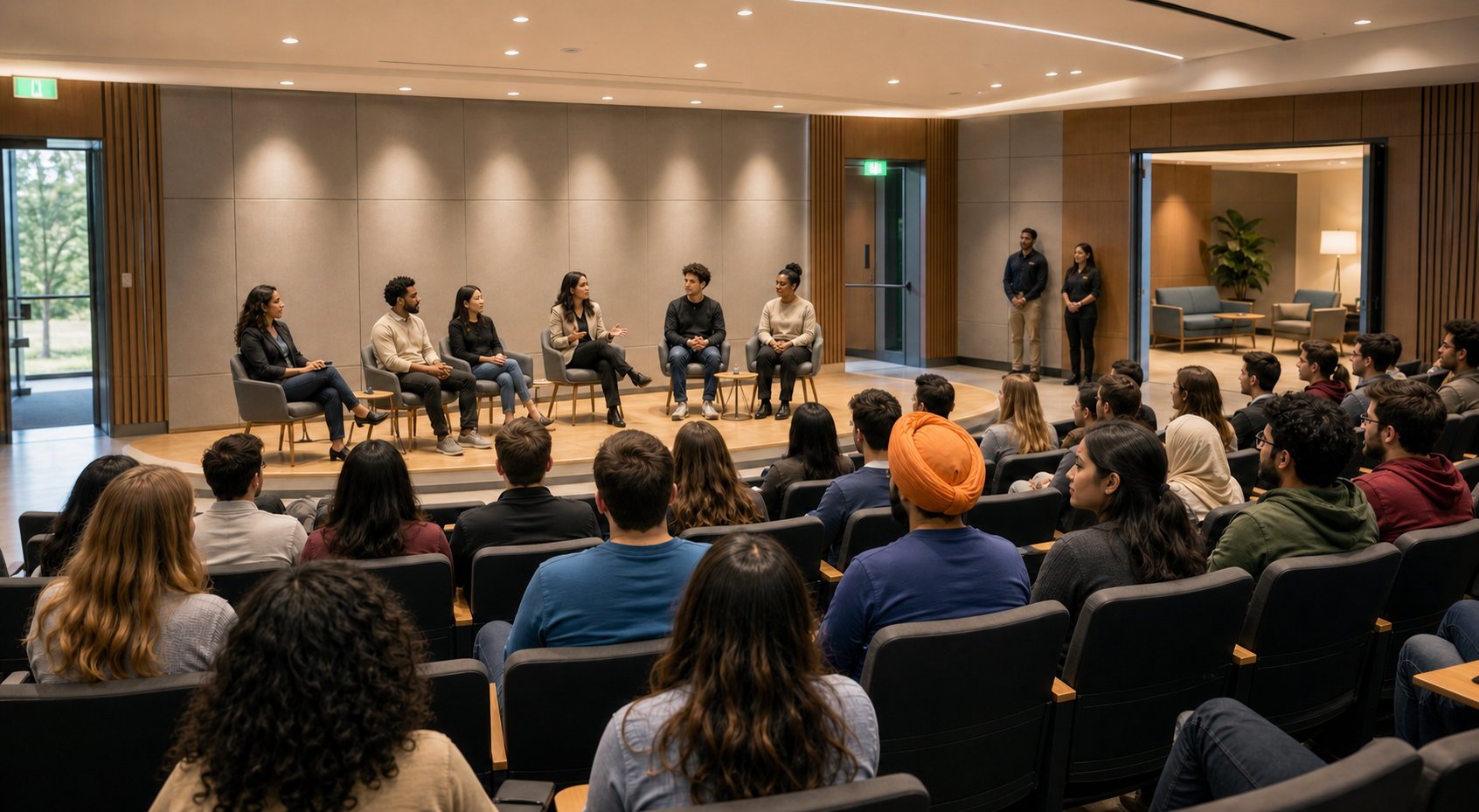
The most defensible request is usually not cancellation. Ask for a process in which controversial claims can be examined without turning Hindu identity into a campus liability. This keeps the focus on the university’s responsibilities: academic clarity, viewpoint access, orderly participation, and student safety.
- Definitions in advance: The event description should explain how it uses Hinduism, Hindutva, Hindu nationalism, and any other contested term central to the program.
- A stated scope: Organizers should say whether the program concerns history, political organizations, law, a government, diaspora activism, religion, or some combination of these.
- Evidence tied to claims: Broad statements about a religious community should not be allowed to ride on evidence about a particular organization or political actor.
- An accountable moderator: The moderator should interrupt personal targeting, keep questions relevant, and ask speakers to distinguish evidence from generalization.
- Structured questions: A visible process for taking written and spoken questions can include disagreement while reducing the risk that the loudest person controls the room.
- Relevant viewpoint diversity: Historians, legal scholars, Dharmic-studies specialists, civil-liberties voices, interfaith practitioners, and students can test different parts of the argument. Viewpoint diversity is not a demand for artificial symmetry; it is a demand that contested premises face informed questions.
- A published safety route: Students should know whom to contact about harassment, a disruption, an accessibility need, or an urgent threat before the event begins.
- A review after the event: Organizers and student representatives should record what worked, what failed, and which procedural change should govern the next difficult program.
A short written request can be more effective than a broad accusation. You can adapt this language: I support the university’s role as a place for difficult inquiry. Please confirm how this program defines Hinduism and Hindutva, who will moderate it, how questions will be selected, which conduct rules apply, and where a targeted student can obtain prompt help. I am requesting academic precision and a safe process, not immunity from criticism.
If you attend, prepare questions that expose category errors without assigning motives. Ask: What definition of Hindutva is being used here? Follow with: Does this evidence support a claim about a named movement, or about Hindus generally? If a speaker moves between religion, nationality, and politics, ask them to identify that transition. A precise question gives the audience something verifiable to evaluate.
If an answer remains evasive, document the exchange and pursue a written response afterward. Do not turn the room into a physical confrontation or attempt to shout down every claim. That can endanger students, obscure the original problem, and make procedural accountability harder to obtain.
Turn Dharmic pluralism into a campus practice

Hindu, Buddhist, Jain, and Sikh communities are not interchangeable. Each has its own teachings, histories, institutions, and internal disagreements. Their cooperation is most credible when it protects those differences while defending a shared rule: no student should be stereotyped, threatened, or made collectively responsible because of a Dharmic identity.
The Rutgers controversy prompted peaceful demonstrations, community statements, and calls for dialogue across Dharmic and interfaith constituencies. A durable coalition should now produce practical campus infrastructure, not only a public statement.
- A definitions sheet: Distinguish a religion, a political ideology, the Government of India, a political party, a named organization, and an individual student. Do not let criticism of one slide into guilt for another.
- A conduct compact: Permit sharp criticism of texts, institutions, movements, governments, and historical claims while rejecting threats, religious slurs, doxxing, exclusion, and collective blame.
- An escalation map: Identify the event host, the relevant student-affairs or conduct route, any applicable bias channel, chaplaincy or cultural support, and the current emergency contact. Verify these details before distributing them.
- A representative roundtable: Include students, historians, legal or civil-liberties expertise, Dharmic practitioners, and interfaith participants. Give each participant a defined question to solve rather than staging a symbolic meeting with no output.
- A follow-through owner: Assign someone to preserve correspondence, track promised actions, and bring unresolved procedural questions back to the university.
Public protest may be appropriate, but no student should be pressured to reveal their name, immigration situation, class schedule, residence, or religious practice to prove commitment. If you organize a demonstration, agree beforehand that participants will not expose private students, block exits, pursue opponents, or answer provocation with threats. Name a liaison who can communicate with university staff while others remain focused on the stated concern.
Chaplaincies, cultural centers, trusted faculty, and student groups can provide accompaniment and help a student navigate an unfamiliar process. They do not replace trained emergency personnel when danger is immediate, or qualified legal advice when a complaint could create serious disciplinary or legal consequences.
Before the next Rutgers event involving Hindutva, send the safeguards request in writing and save the response. If an incident has already occurred, build the factual timeline now, identify the remedy you need, and use the channel that matches the conduct. The goal is a campus where you can practice your tradition, reject collective suspicion, and still participate in rigorous disagreement without fear.
References
