

If you want to begin Thursday Lakshmi Puja but remember only the elaborate arrangements of Kojagari, do not wait until you can reproduce a festival at home. For the weekly Bengali observance, a clean altar, a lamp, and modest offerings of rice, banana, and sweets are enough to begin.
The important question is not how much you can display. It is whether the worship can become a steady household discipline. Keep your family’s inherited order where you have one. If you do not, begin with a simple framework that joins devotion to cleanliness, gratitude for food, right livelihood, contentment, and generosity.
Know which Lakshmi Puja you are observing
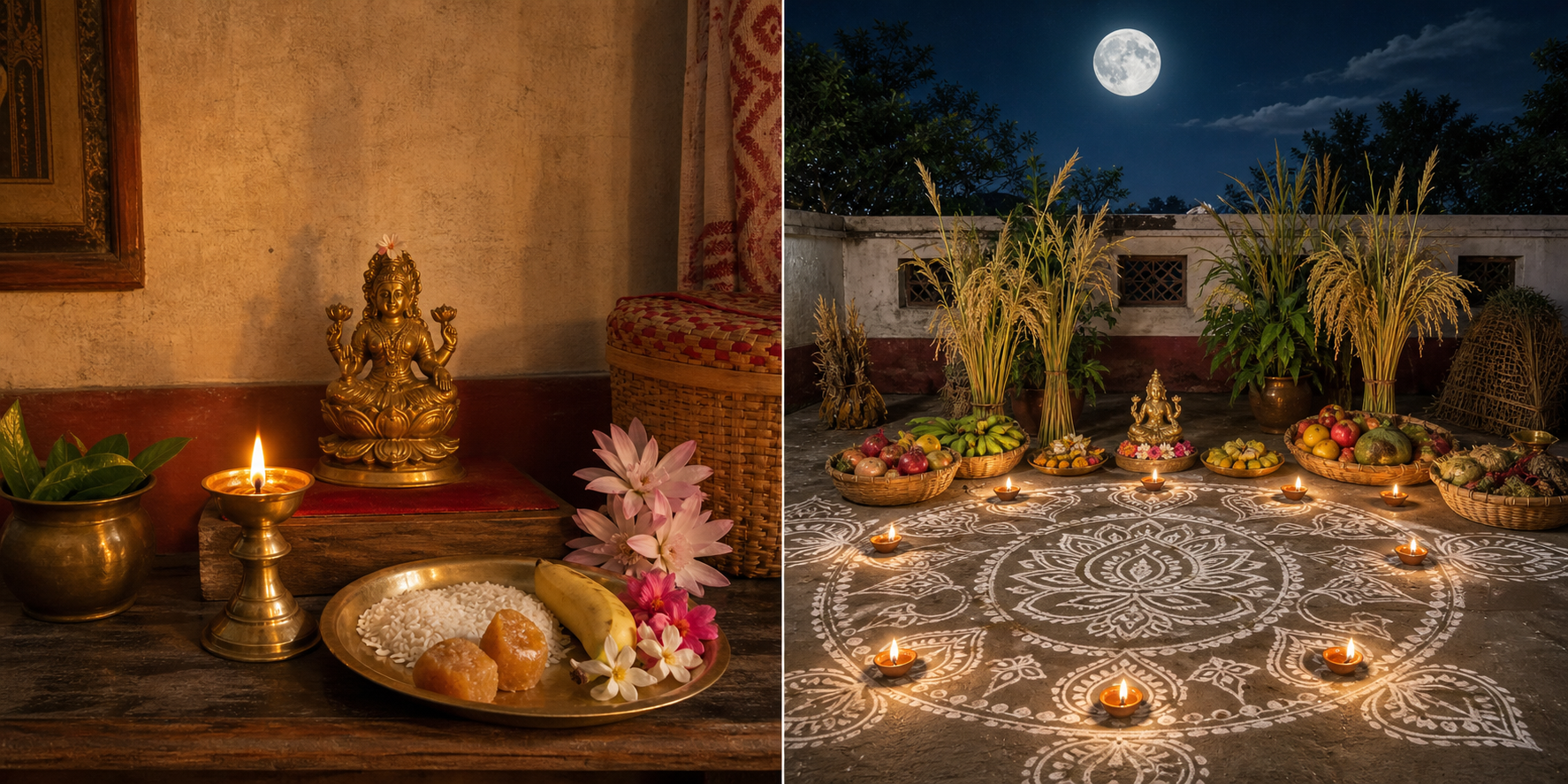
Weekly Thursday worship and Kojagari Lakshmi Puja belong to the same devotional world, but they are not interchangeable. Thursday worship carries Lakshmi’s presence through ordinary household life. Kojagari marks the bright seasonal celebration on Sharad Purnima after Durga Puja. Knowing the difference prevents two common mistakes: burdening the weekly rite with festival-scale preparation, or treating the annual festival as the only time Lakshmi belongs in the home.
| Point of distinction | Thursday Lakshmi worship | Kojagari Lakshmi Puja |
|---|---|---|
| Rhythm | A recurring Thursday household observance | A seasonal observance on Sharad Purnima after Durga Puja |
| Usual scale | Quiet, intimate, and repeatable | More festive, with lamps, conch sounds, family, and neighborhood participation |
| Primary emphasis | Food, household order, steady livelihood, and daily well-being | Seasonal rejoicing and the fuller celebration of abundance |
| Typical offerings | Rice, banana, and simple sweets | Rice, coconut, and homemade treats |
| Iconographic association | The two-armed Dvi-bhuja Lakshmi is often associated with the Bengali household tradition | Four-armed festival iconography is more prominent |
This is a difference of rhythm, not a ranking of importance. Kojagari gives the tradition its great seasonal radiance. Thursday worship keeps that light from becoming a once-a-year memory. In Bengal’s domestic religious imagination, Dvi-bhuja Lakshmi belongs especially to everyday nourishment, carefully kept grain, and a well-tended home.
Prepare a small altar without turning puja into shopping
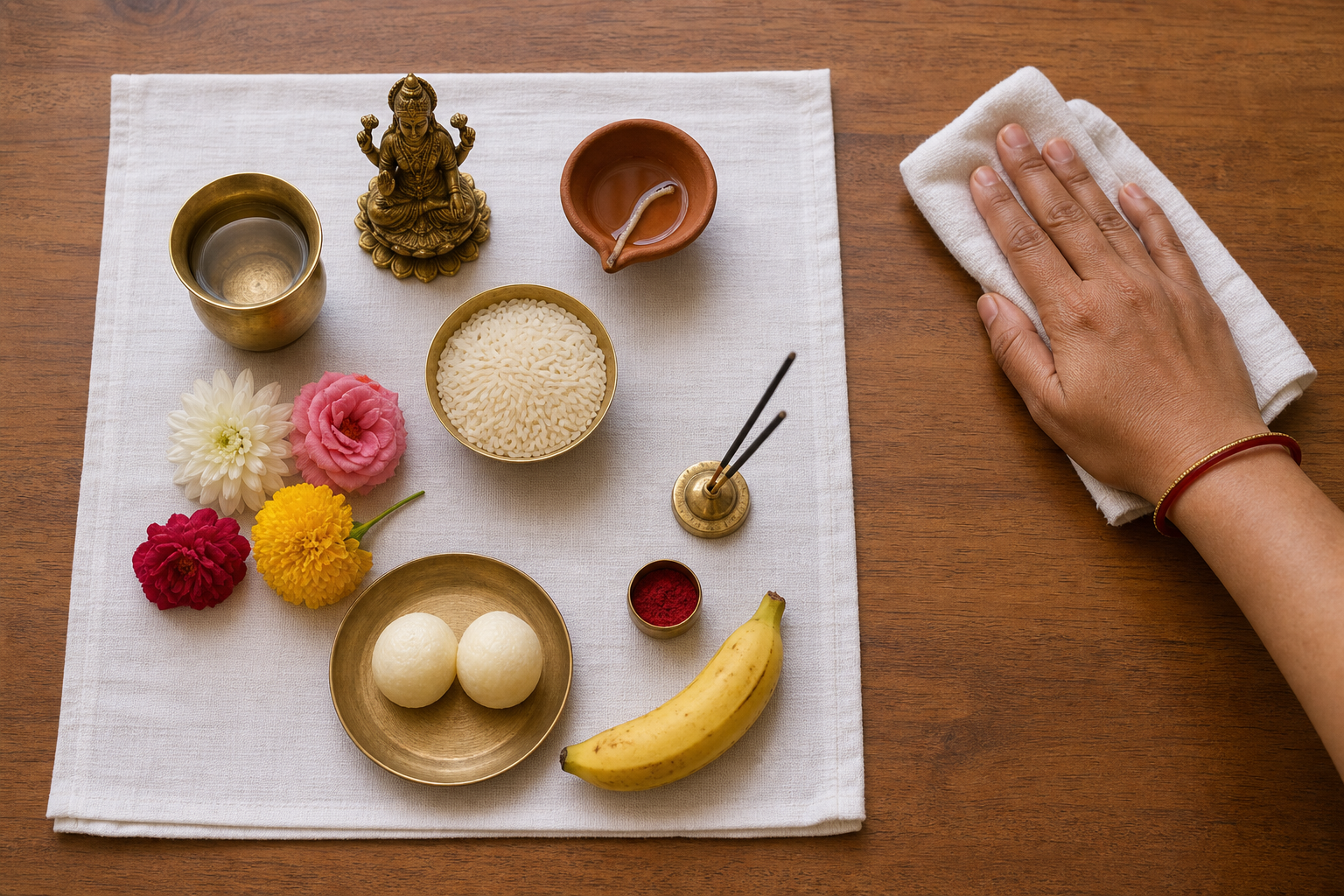
A weekly observance survives when its preparation is modest enough to repeat. You should be able to perform it during an ordinary working week, not only when you have hours to spare. Begin with four essentials:
- A clean altar or dedicated place for Lakshmi.
- A safely placed diya or lamp.
- Small, edible offerings of rice, banana, and a simple sweet.
- A brief prayer, stotra, name-recitation, or period of quiet devotion.
Clean the altar and the floor around it first. Tidy the home as you reasonably can, but do not postpone worship because the entire house cannot be deep-cleaned that day. The point is attentive care, not domestic perfection.
A rice-flour alpona gives the setting its recognizably Bengali character. Make one if you know the practice and have the time. An elaborate design is not a condition of worship. A clean, restrained arrangement is more faithful to the spirit of the observance than disposable ornament purchased merely to make the altar look full.
Flowers, coconut, seasonal produce, dhuno, and the sounding of a conch may be added where they belong to your household custom. Treat them as meaningful additions, not as a test that determines whether the puja counts. If an elder in your family preserves a particular arrangement, prayer, or sequence, ask before replacing it with a standardized checklist found elsewhere.
Use quantities your household can consume. A handful or small bowl of rice can express reverence for grain more coherently than an excessive display that later goes to waste. Place the diya on a stable, nonflammable surface, away from curtains, paper decorations, children, and pets. Do not leave the flame unattended.
Follow a simple Thursday sequence you can sustain
Bengali families do not all use one identical domestic liturgy. Your inherited parampara should therefore take precedence over a general outline. If you are starting without a family sequence, the following order keeps the observance clear and manageable.
- Prepare the place. Clean the altar and its immediate surroundings. Arrange the image or sacred focus already honored in your home.
- Set out modest offerings. Place the rice, banana, and sweet neatly. Add flowers, coconut, or seasonal produce only if they are available and customary.
- Light the lamp. Pause before beginning the recitation. Let the act mark a change from household busyness to attentive worship.
- Welcome Lakshmi with a clear intention. Pray for nourishment, harmony, honest livelihood, wise use of resources, and the ability to share what your household receives.
- Recite what you can recite sincerely. A short Lakshmi stotra or the Lakshmi Ashtottara Sata Namavali may be used. If you do not yet know a formal recitation, offer a brief prayer in words you understand rather than rushing through unfamiliar language without attention.
- Sit quietly for a moment. Bring to mind the food, work, relationships, and unseen labor that sustain the home. Gratitude becomes concrete when it has an object.
- Close without waste. Treat the edible offering as prasad and use or share it respectfully. Extinguish the lamp safely when necessary and leave the altar orderly.
You do not need to invent an authoritative clock time if your family has not given you one. Choose a calm part of Thursday that your household can keep consistently. Regularity is more useful than an ambitious schedule that collapses after a few weeks.
If a demanding week disrupts the routine, do not compensate with wasteful offerings or theatrical excess. Resume the practice with attention. A weekly vrata or household rhythm gains strength through return, not through anxiety about performance.
Carry Lakshmi’s ethic beyond the altar
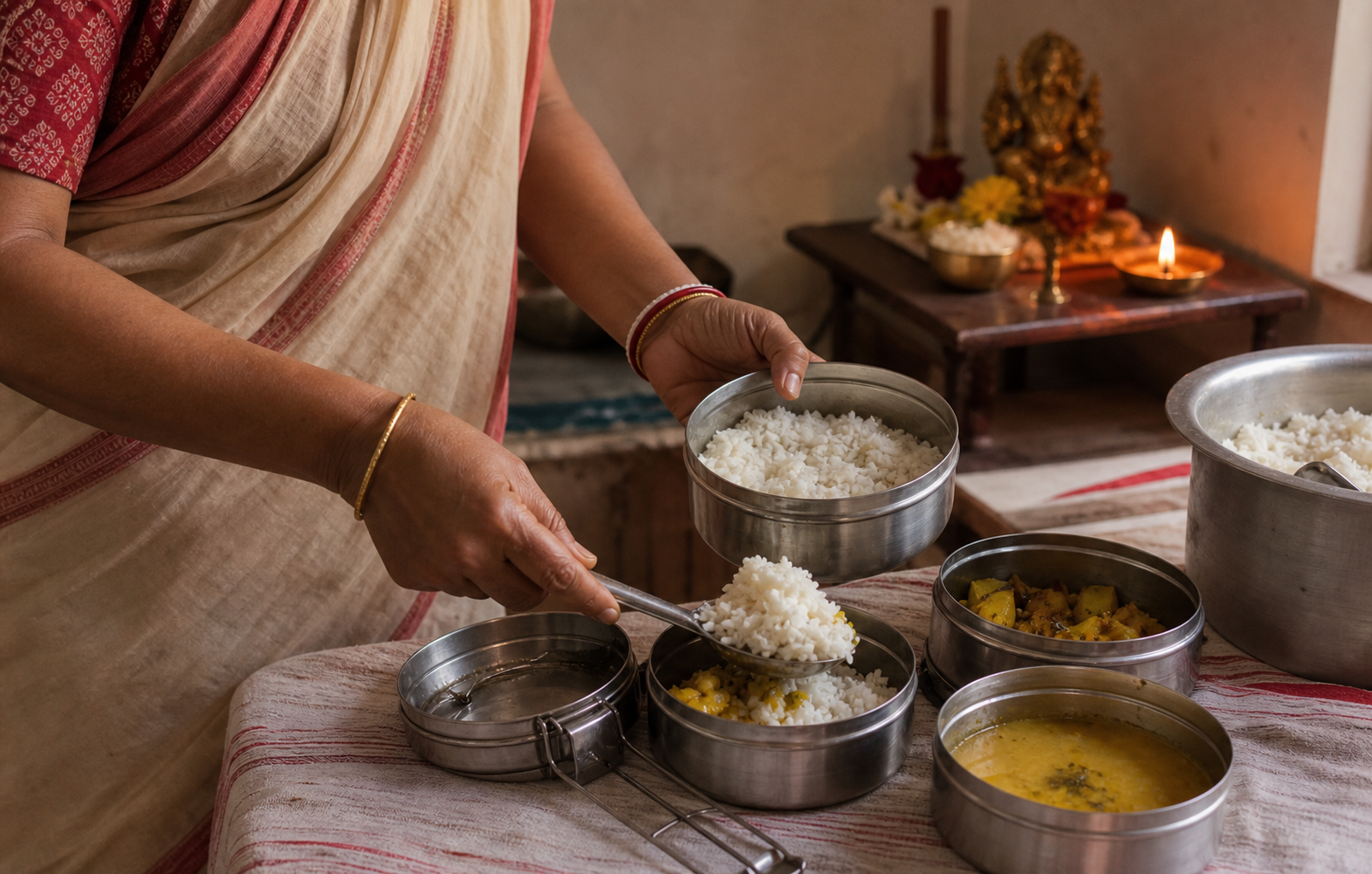
Thursday worship becomes thin if the altar is spotless while food is casually wasted and prosperity is pursued without right conduct. Bengali household Lakshmi joins annam, the food that sustains life, with sampad, the resources that support a household. That union changes what wealth means. Prosperity is not merely possession; it is the responsibility to preserve, use, and share well.
After the puja, make a short household review practical rather than abstract:
- Protect food. Check whether cooked food, fruit, or stored grain is close to being wasted. Plan its use before buying more.
- Care for storage. Clean one shelf, grain container, or food-storage area that has been neglected. Reverence for annam includes the ordinary work of keeping it properly.
- Examine livelihood. Notice one place where haste, greed, or display is pushing the household away from honesty, restraint, or contentment. Correct the specific action rather than making a vague promise.
- Practice hospitality or generosity. Choose one act within your means: share food, help someone with a practical need, or welcome a guest without making the gesture about status.
- Acknowledge household labor. Thank the person whose shopping, cooking, cleaning, budgeting, or caregiving usually remains unnoticed.
These habits explain why Lakshmi’s domestic worship can speak across the wider Dharmic family. Diligence, contentment, compassion, right conduct, and service are intelligible within Hindu, Buddhist, Jain, and Sikh moral life. The ritual remains distinctly Bengali, while the ethic it trains belongs to a larger civilizational understanding: material well-being and moral responsibility should not be separated.
Adapt the practice to an apartment or a home outside Bengal
A smaller home does not require a thinner practice. It requires better choices. Use a shelf or compact altar that can be kept clean. Scale the offerings to the number of people who will eat them. If building rules restrict open flames, follow those rules and preserve the devotional pause in the safest form available to your household.
Choose local rice, flowers, fruit, and seasonal produce rather than treating imported objects as proof of authenticity. Avoid single-use plastic decorations. Local materials, plastic-free decoration, and minimal-waste offerings allow ecological responsibility to reinforce the tradition’s reverence for nourishment.
If you want children or younger relatives to inherit the observance, give them one real responsibility: cleaning the altar, arranging the fruit, drawing part of the alpona, or learning a short prayer. Also ask an older relative which detail your family regarded as essential. Write down the wording, sequence, or explanation while it can still be passed on accurately. Continuity depends less on recreating a grand ancestral courtyard than on transmitting the meaning of one gesture at a time.
Key takeaways for a sustainable weekly practice
- Thursday Lakshmi worship is a recurring household discipline, not a reduced copy of Kojagari Lakshmi Puja.
- A clean altar, a secure lamp, rice, banana, a simple sweet, and sincere prayer provide a sound starting point.
- Follow your family’s inherited parampara when you have one; use a general sequence only where that guidance is absent.
- The Dvi-bhuja form emphasizes Lakshmi’s closeness to grain, domestic order, steady livelihood, and everyday well-being in the Bengali tradition.
- Keep offerings edible and proportionate. Waste contradicts a practice centered on reverence for food.
- Complete the worship through action: care for stored grain, examine how wealth is earned and used, recognize household labor, and practice generosity within your means.
Before the next Thursday arrives, choose the altar space, ask one relative about your family’s custom, and set aside only what you will genuinely use. Begin at a scale you can repeat. Let the lamp illuminate not only the shrine, but one household habit you are ready to put in order.
References
