
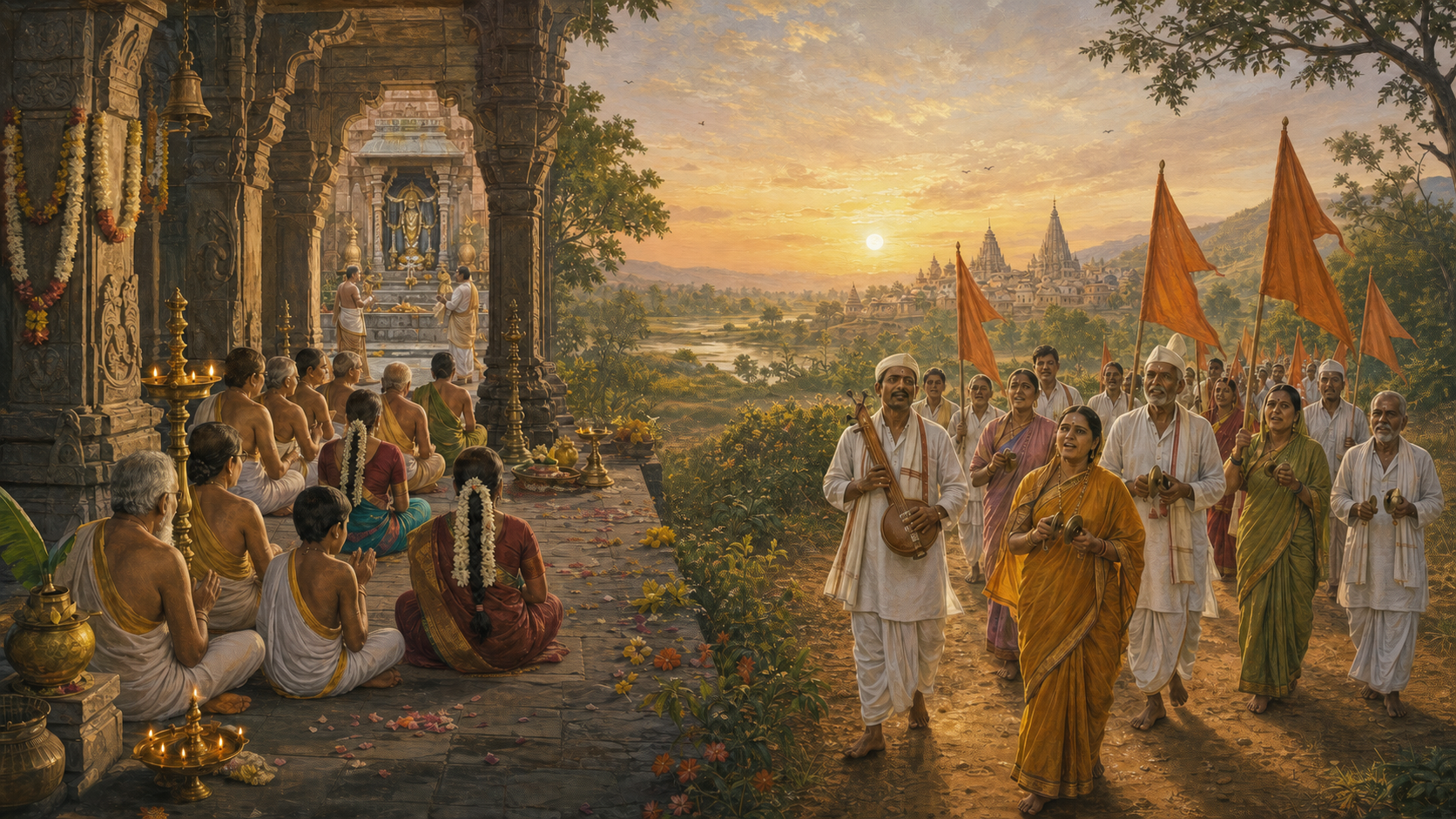
If you have heard an Alvar hymn in a South Indian temple and an abhang at a Maharashtrian kirtan, you may wonder whether you are meeting one Bhakti tradition in two languages. The answer matters. Treating them as identical hides what each does best; treating them as unrelated misses a major line of Dharmic continuity.
You can understand both traditions by watching four things: whom the devotee approaches, how devotion is expressed, where a community gathers, and what kind of conduct devotion demands. That frame reveals a shared Vaishnava heart without flattening the differences between Tamil temple hymnody and Varkari pilgrimage culture.
Key takeaways
- The Alvar and Varkari traditions both centre loving devotion to Vishnu: Sriman Narayana in the Tamil hymns and Vithoba, understood as a form of Krishna or Vishnu, in Maharashtra.
- The Alvars express surrender and dependence on divine grace through Tamil poetry that became part of temple worship. Maharashtrian saints emphasize remembrance of the divine Name, abhang singing, kirtan, pilgrimage, and accountable daily conduct.
- Vernacular language is not a decorative feature in either tradition. Tamil and Marathi enabled sacred teaching to circulate beyond narrowly learned circles and become part of household and public life.
- Neither tradition can be reduced to a revolt against all ritual. Each developed disciplined communal forms; the deeper challenge was to ritual hierarchy and social exclusion.
- The soundest comparison preserves theological differences while noticing shared Dharmic values such as humility, compassion, self-discipline, service, and respect for human dignity.
One Vaishnava family, two devotional grammars
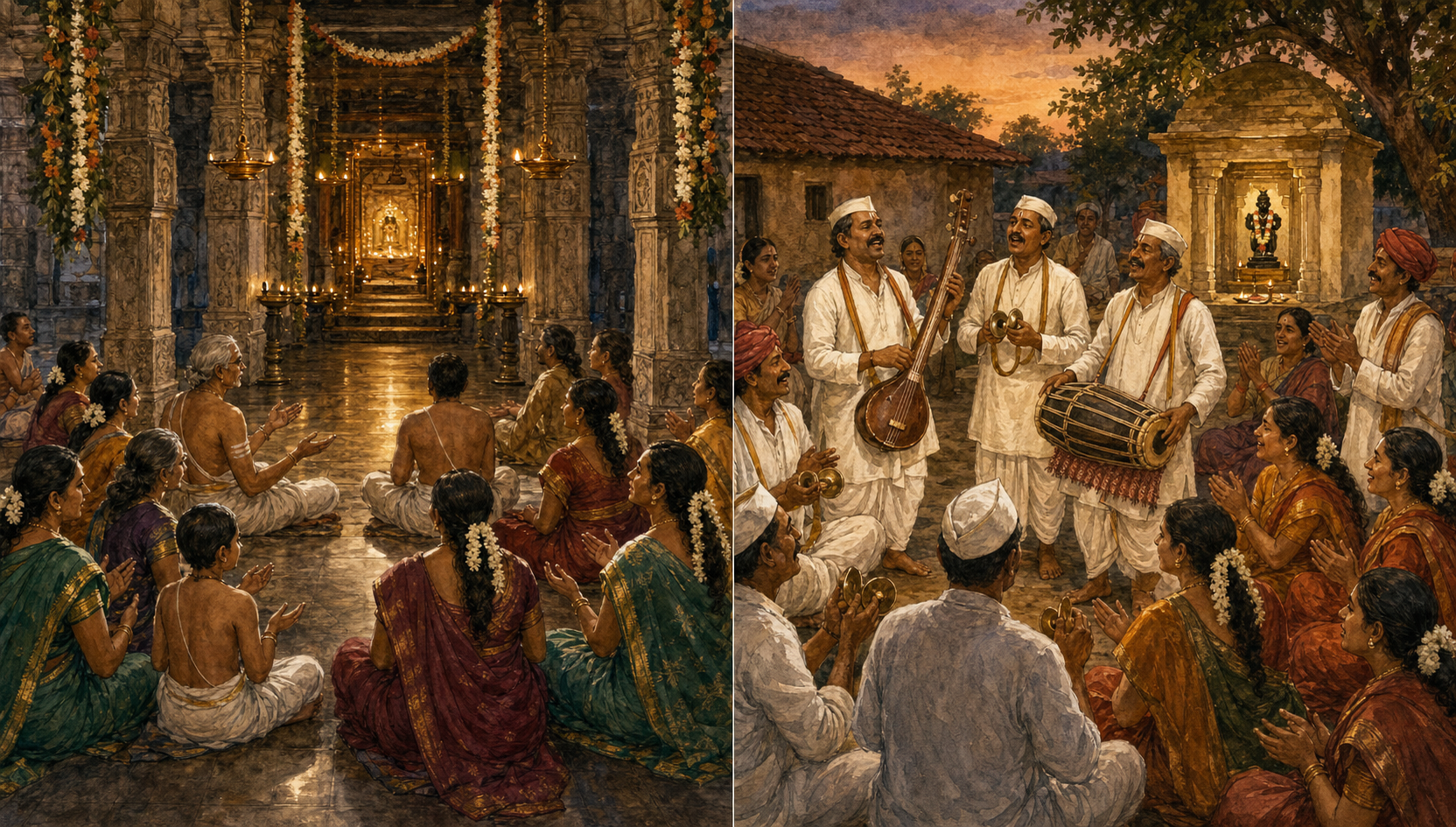
Begin by setting the historical boundary correctly. The twelve Tamil Alvars are generally placed around the sixth to ninth centuries CE, while the Maharashtrian saints considered here belong chiefly to the thirteenth through seventeenth centuries. They were not two contemporary groups conducting a direct debate. You are looking at kindred devotional currents that flowered in different regions and periods.
There is another necessary boundary. Maharashtrian Bhakti contains more than one current. Here the term refers chiefly to the Varkari tradition centred on Vithoba of Pandharpur. That precision keeps a useful comparison from becoming an unsupported description of every form of devotion found in Maharashtra.
The shared centre is not a vague belief that all spirituality is alike. Both traditions are recognizably Vaishnava. The Alvars sing to Sriman Narayana with longing, praise, intimacy, and surrender. Varkari devotion gathers around Vithoba, a form of Krishna or Vishnu who is approached through remembrance, song, pilgrimage, and morally responsible living. Their devotional languages overlap, but their characteristic accents remain distinct.
The Alvar grammar of surrender and grace
The Alvars’ hymns are preserved in the Nalayira Divya Prabandham, a Tamil corpus that became integral to Sri Vaishnava temple liturgy and everyday piety. Two terms help you listen attentively: prapatti, or surrender, and kripa, divine grace. These are not merely abstract entries in a theological vocabulary. They describe the devotee’s posture before the divine: humility, dependence, longing, and trust.
When you read an Alvar hymn, therefore, do not ask only what doctrine it states. Ask what relationship it enacts. Who is speaking to Narayana? Is the voice pleading, praising, yearning, remembering, or celebrating? Emotional intensity is part of the spiritual reasoning, not an ornament added after the theology.
Andal is indispensable here. Her presence among the Alvars shows that a woman’s devotional voice is not peripheral to the tradition’s literary memory. If you encounter a syllabus, talk, or anthology that presents the Alvars only through male figures and later male commentators, it has narrowed the tradition before explaining it.
The later Sri Vaishnava acharyas gave these devotional insights a systematic theological framework. This prevents another common misreading: the Alvar inheritance is not emotion standing against thought. Poetry, temple performance, scriptural authority, and disciplined interpretation came to support one another.
The Varkari grammar of the Name and ethical life
In Maharashtra, Dnyaneshwar, Namdev, Eknath, Tukaram, Chokhamela, and Janabai carried spiritual teaching through Marathi forms that people could hear, remember, sing, and repeat. Dnyaneshwar’s Dnyaneshwari stands alongside the abhang tradition, while congregational kirtan turns teaching into a shared vocal practice.
The central discipline of nama-smarana, remembrance of the divine Name, should not be mistaken for a verbal shortcut detached from life. In the Varkari pattern, remembrance belongs with humility, moral accountability, pilgrimage, and community. The useful question is not simply whether a person repeats the Name. It is whether remembrance changes how that person acts.
This difference in emphasis gives you a reliable reading key. In an Alvar hymn, attend especially to surrender, grace, and the devotee’s relation to Narayana within a temple-shaped sacred world. In a Varkari abhang, attend to the Name, the moral scrutiny of ordinary life, and the possibility of singing with others on a common path. Neither key explains everything, but each helps you hear what the tradition itself foregrounds.
Temple recitation and walking kirtan create different communities
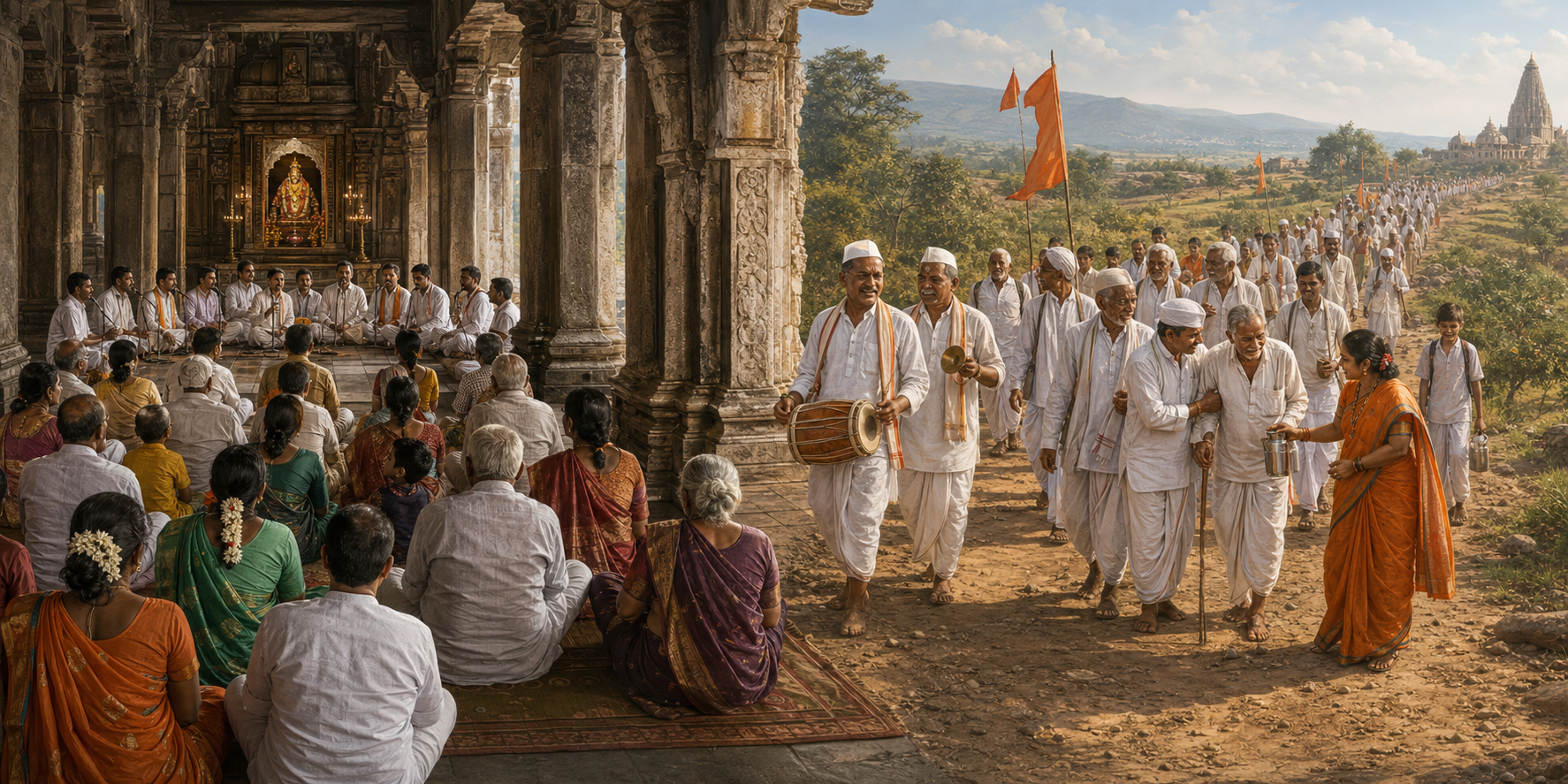
Bhakti does not live through ideas alone. It needs a place, a voice, a rhythm, and a gathering. The Alvar and Varkari traditions reveal two especially durable ways of turning personal devotion into public culture.
Alvar poetry became embedded in South Indian temple recitation and pilgrimage networks. The hymn is encountered within sacred geography: a particular deity, temple, procession, liturgical setting, and community of worshippers. Repetition within temple life carries Tamil devotional memory across generations. The result is not simply literature about temples; it is poetry that participates in worship.
Varkari culture places greater emphasis on itinerant and congregational forms. Marathi abhangs can travel in the memory and voice of the devotee. Kirtan gives the teaching a public setting, while the annual yatras to Pandharpur, especially around Ashadhi Ekadashi, make pilgrimage a collective discipline. People do not merely arrive at a sacred destination. Walking and singing together help form the devotional community.
You can think of these as two forms of cultural memory. Temple recitation binds poetry to a recurring sacred place and ritual life. Abhang, kirtan, and yatra carry remembrance through voices and moving congregations. One creates continuity through liturgical rootedness; the other displays the power of a portable song tradition. Both depend on disciplined repetition.
This corrects a misleading account of Bhakti as spontaneous feeling opposed to every organized form. The Alvar inheritance has temple liturgy, pilgrimage, and Sri Vaishnava interpretation. The Varkari inheritance has recurring pilgrimage, congregational singing, remembered compositions, and recognizable ethical disciplines. The real question is not whether a tradition has form. It is whether its forms deepen participation and devotion or become instruments of exclusion.
If you are studying either tradition, do not stop at a translated page. Notice where the words belong. Ask whether the composition is normally recited, sung, taught through kirtan, associated with pilgrimage, or heard during temple worship. A text removed from its performance setting can disclose meaning, but it cannot show you the whole devotional practice.
Inclusion becomes credible through language, voice, and conduct
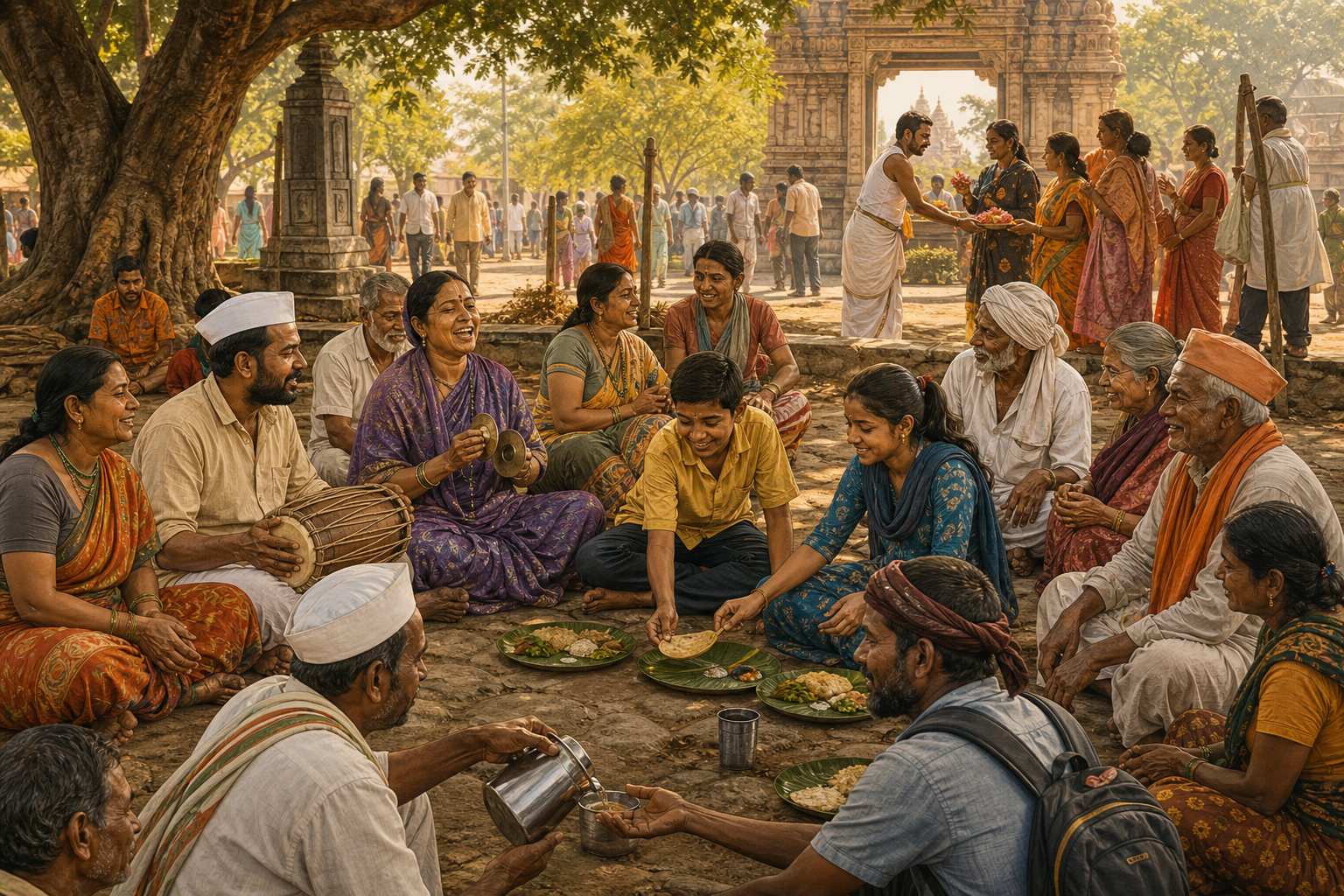
Claims about Bhakti and equality are easy to romanticize. A more responsible approach measures inclusion through concrete questions: Who can speak? Which language carries sacred teaching? Whose compositions enter communal memory? What ethical obligations follow from worship?
Tamil and Marathi matter because they widened the social reach of religious expression. A devotee did not need to encounter Bhakti only through a remote scholastic register. Teaching could be heard in the language of regional life, carried into homes, sung in public, and remembered without turning every participant into a formal theologian.
Vernacular devotion should not be described as the rejection of learning. The Alvar hymns eventually stood within a substantial Sri Vaishnava intellectual structure, and the Maharashtrian tradition was not devoid of doctrine. The more accurate point is that learned interpretation no longer exhausted the ways in which sacred understanding could be received and expressed.
Women such as Andal and Janabai must also be treated as voices, not as decorative evidence that a movement was inclusive. Read or hear their compositions within the main devotional story. Do not confine them to a separate paragraph on women after the supposedly central tradition has already been defined through men.
The same discipline applies to caste. The remembered presence of saints such as Chokhamela, along with the traditions’ wider emphasis on dignity and participation, challenges a socially homogeneous account of Hindu devotion. Yet a challenge to caste exclusivity should not be inflated into the claim that poetic affirmation automatically removed every social barrier. Devotional equality becomes meaningful when a community’s conduct reflects it.
That gives you a practical test. When a community praises humility but preserves contempt, or sings universal access while denying dignity in practice, it has not completed the ethical work its devotional language demands. Bhakti’s social force lies not in replacing worship with politics, but in refusing to separate love of the divine from treatment of the devotee standing nearby.
The reach of this devotional vocabulary also crosses later community boundaries. Hymns attributed to Namdev appear in the Guru Granth Sahib, giving a precise point of connection with Sikh reverence for the divine Name and congregational singing. That fact should be honoured without claiming that Varkari and Sikh traditions are interchangeable. A shared hymn or practice can create civilizational kinship while each path retains its own theological and communal integrity.
A similar discipline is needed when placing Bhakti beside Buddhism and Jainism. Compassion, non-harm, self-discipline, and inner transformation form a genuine shared ethical vocabulary. Sikh nam-simran and sangat offer especially clear resonances with remembrance of the Name and devotional gathering. These affinities support Dharmic conversation, but they do not erase differences in doctrine, authority, metaphysics, or forms of worship.
The better image is a family resemblance, not a single uniform system. Dharmic unity is strongest when it does not require every tradition to say the same thing. It allows communities to recognize shared moral disciplines while remaining truthful about their distinct paths.
How to encounter both traditions without flattening either
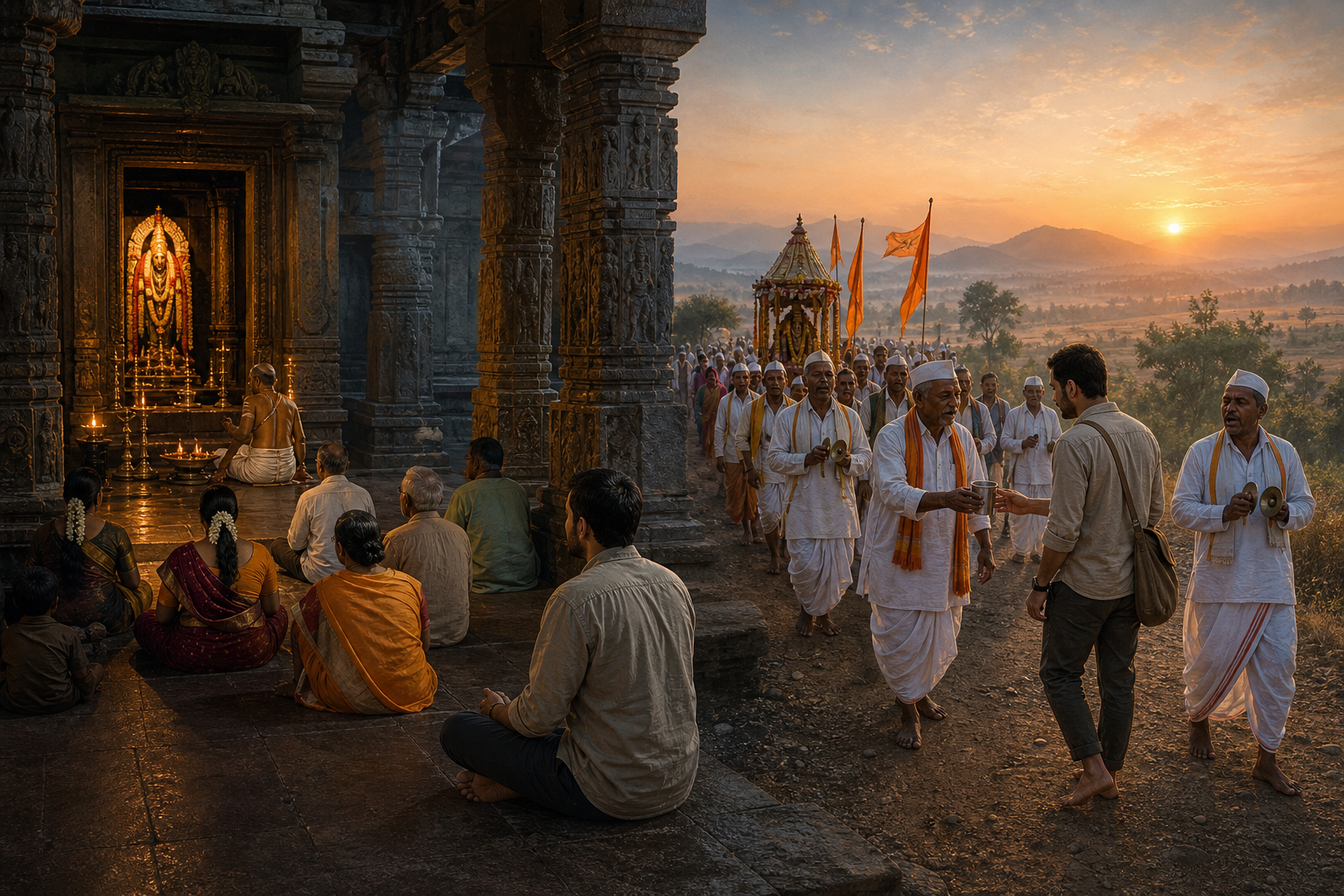
You do not need to master the whole history of Indian Bhakti before making a serious beginning. You do need a method that keeps poetry, theology, performance, and ethics in view at the same time.
- Define the comparison narrowly. Say Alvar and Varkari when those are the traditions you mean. Do not make every claim about all South Indian or Maharashtrian devotion.
- Pair representative forms. Place an Alvar hymn from the Divya Prabandham beside a Marathi abhang. Read translations for meaning, but also hear the original languages when a recitation or performance is available. Sound, repetition, and congregational response disclose features that prose summaries cannot.
- Ask the same questions of each composition. Identify the divine addressee, the devotee’s emotional posture, the practice being commended, the communal setting, and the expected change in conduct. A stable set of questions reveals both parallels and real differences.
- Restore the social setting. For the Alvar hymn, investigate its relation to temple worship and sacred geography. For the abhang, attend to kirtan, nama-smarana, Vithoba, and the Pandharpur pilgrimage tradition. Do not treat either composition as a free-floating poem.
- End with ethical application. Ask what surrender, grace, remembrance, humility, compassion, or service would require in ordinary relationships. If your encounter produces admiration but no scrutiny of conduct, you have seen only part of what these traditions preserve.
This method also protects you from two opposite errors. The first turns Bhakti into a featureless message that everyone believed the same thing. The second treats regional difference as isolation and misses the shared Vaishnava, vernacular, and ethical currents running through Bharat’s devotional history.
At your next encounter, choose one Alvar hymn and one abhang. Write down who is addressed, how devotion is performed, and what change in conduct is demanded. Then, if possible, hear each within its living communal form: temple recitation for the Alvar inheritance, and kirtan or pilgrimage singing for the Varkari inheritance. That small exercise will teach you more than a list of similarities because it lets each tradition speak in its own spiritual grammar.
The goal is not to decide which tradition represents Bhakti more completely. It is to let Tamil surrender and Maharashtrian remembrance sharpen one another. Carry the result into practice: devotion in a language people can receive, worship joined to dignity, and unity built through shared discipline rather than forced sameness.
References
