
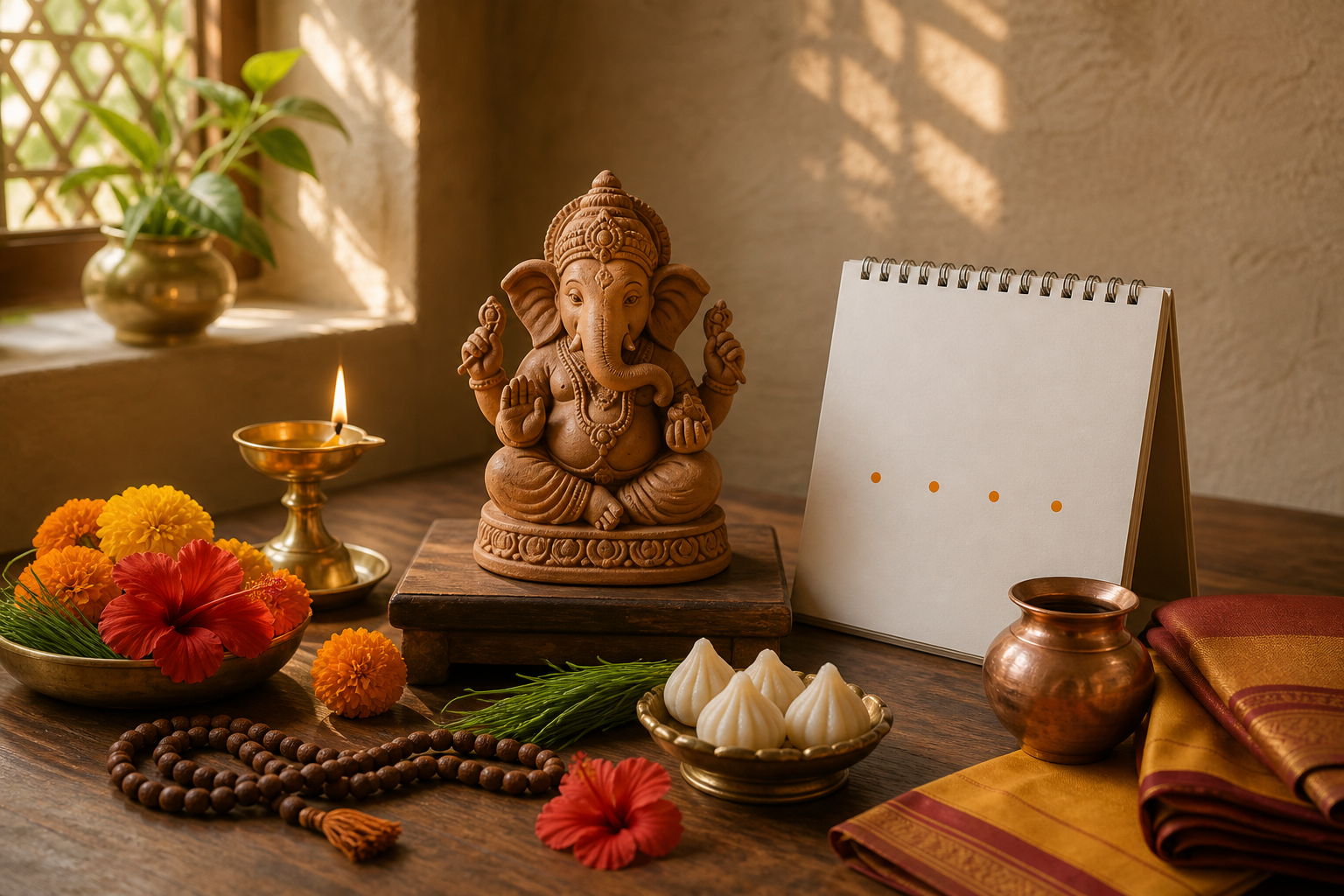
You may know the festival names already. The harder part is arranging a Bhadrapada calendar in which Ganesh Chaturthi begins, Rishi Panchami follows on the next date, Radhashtami arrives during the same festival window, and Ganesh Visarjan closes it.
For 2026, mark September 14, 15, 19 and 25 before you request leave, invite relatives or commit to a temple programme. Those four dates will give your household a workable structure; exact puja timings should still come from the panchanga and temple schedule used in your location and sampradaya.
Put these four Bhadrapada dates on your calendar
| Date in 2026 | Observance | What you need to decide |
|---|---|---|
| September 14 | Ganesh Chaturthi | Where you will observe it, how long your household observance will continue and who will handle the preparations. |
| September 15 | Rishi Panchami | Whether the vrata is followed in your family and what separate time and materials its practitioner will need. |
| September 19 | Radhashtami | Whether you will attend a temple programme or keep a focused home observance dedicated to Sri Radha. |
| September 25 | Anant Chaturdashi and the concluding Ganesh Visarjan date | Whether this is your chosen immersion day or whether your family tradition uses an earlier day. |
The sequence begins with Ganesh Chaturthi on September 14 and concludes on September 25. Rishi Panchami falls on September 15, while Radhashtami falls on September 19. This is a planning calendar, not a list of clock-time muhurtas: a civil date alone does not tell you when the relevant tithi begins or ends where you live.
Plan Ganesh Chaturthi as a festival window, not one day
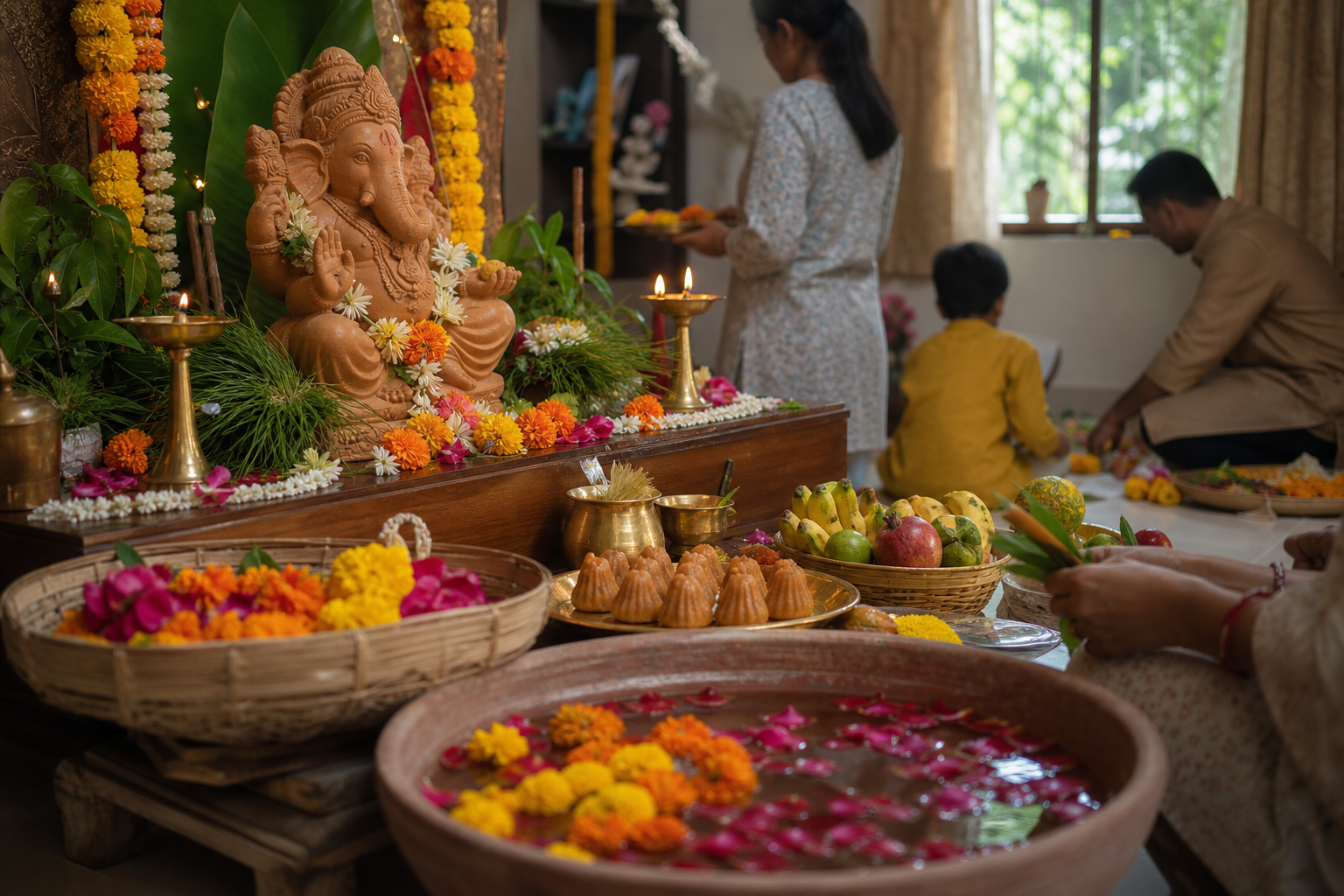
The most consequential decision is not what you will do on September 14. It is how long you intend to keep the home observance and when you will perform visarjan. In 2026, the Ganesh Chaturthi period runs from September 14 through September 25, with immersion usually associated with Anant Chaturdashi on the final date.
That closing date does not require every household to keep Ganapati for the entire period. Ganesh immersion is also performed on earlier customary days. Follow your family tradition, guru or temple practice rather than choosing a duration from convenience alone. What matters practically is deciding before the observance begins; otherwise work schedules, travel and community immersion arrangements can force a hurried ending.
- Decide whether your principal observance will be at home, at a temple or with a community mandal.
- Confirm your household’s intended visarjan day before September 14. If family members follow different customs, settle that question before invitations are sent.
- Block time both for the beginning and for the chosen immersion day. Treat setup, daily worship and conclusion as one commitment rather than unrelated events.
- If you will join a community immersion, confirm its time, gathering point and local arrangements before fixing your household schedule.
- Keep September 15 visible while making the Ganesh Chaturthi plan. Rishi Panchami follows immediately, so its preparation cannot sensibly be postponed until after the first day’s activity.
A shorter, attentive home observance can be more coherent than an ambitious plan the household cannot sustain. Choose the daily rhythm according to your tradition and the actual capacity of the people who will maintain it.
Make room for Rishi Panchami as a vrata
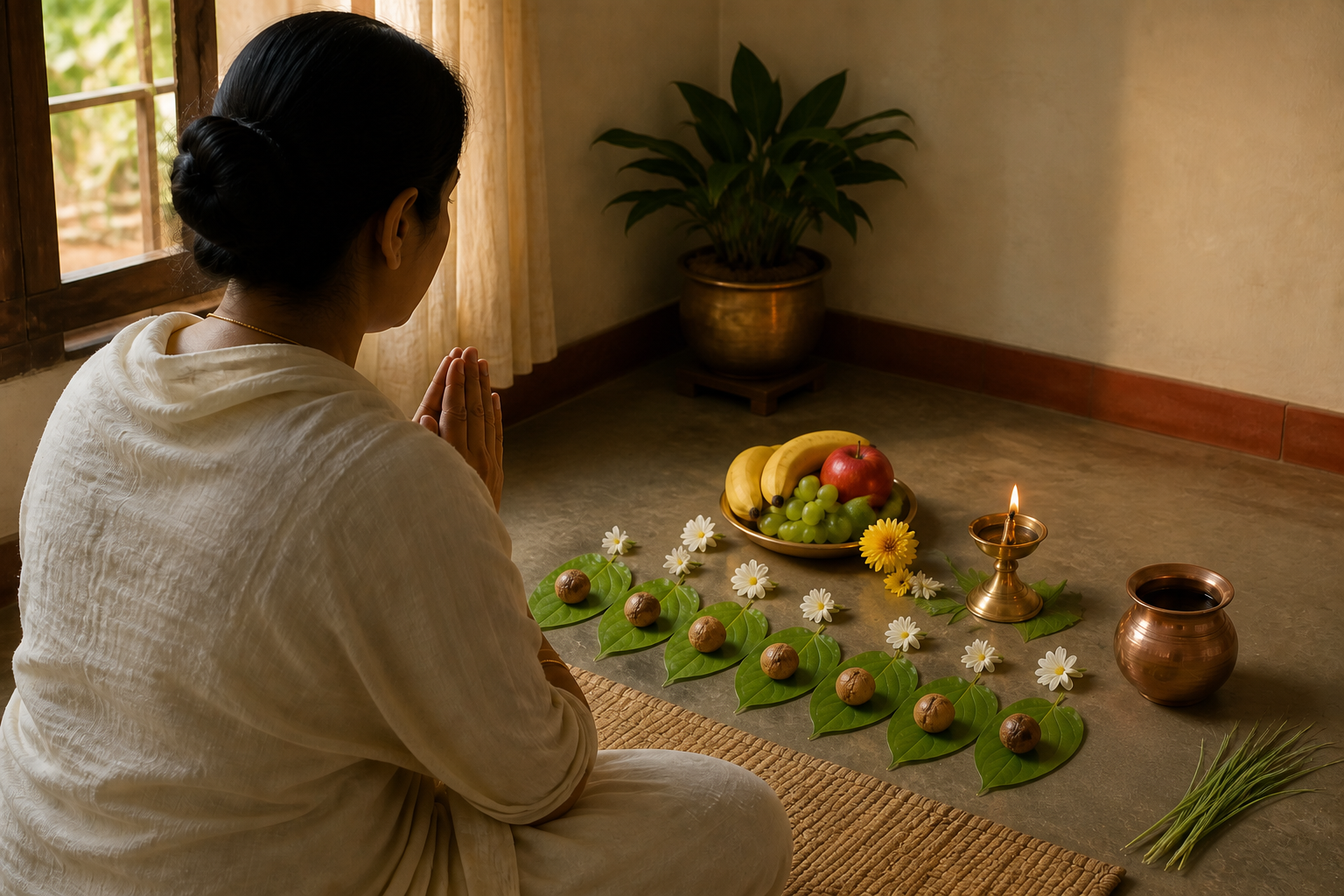
Rishi Panchami falls on September 15, the day after Ganesh Chaturthi. It is better understood as a vrata or puja than as a second public festival. Its worship is directed principally toward the Saptarshis, and the vrata is chiefly undertaken by women in traditions that observe it.
That distinction changes how you should prepare. A public celebration needs invitations, food planning and shared timing. A vrata needs protected time, the correct household procedure and clarity about who is undertaking it. Do not let the activity of September 14 consume the time or attention required on September 15.
- Ask now whether Rishi Panchami is part of your family practice; do not assume that every Hindu household follows the same vrata.
- Identify the person undertaking it and obtain the family’s puja instructions in advance.
- Prepare its requirements alongside the Ganesh Chaturthi materials, but keep the two observances conceptually distinct.
- Reserve a quiet period on September 15 rather than treating the vrata as an optional addition to the previous day’s gathering.
- Where customs differ, defer to the tradition actually followed by your household or sampradaya instead of assembling a hybrid procedure from unrelated online lists.
The phrase “mainly undertaken by women” describes a customary pattern, not a complete rule for every lineage. If you are unsure who observes the vrata or how it is performed, the useful next step is to ask the elder, priest or teacher who normally guides your family’s practice.
Give Radhashtami its own devotional focus
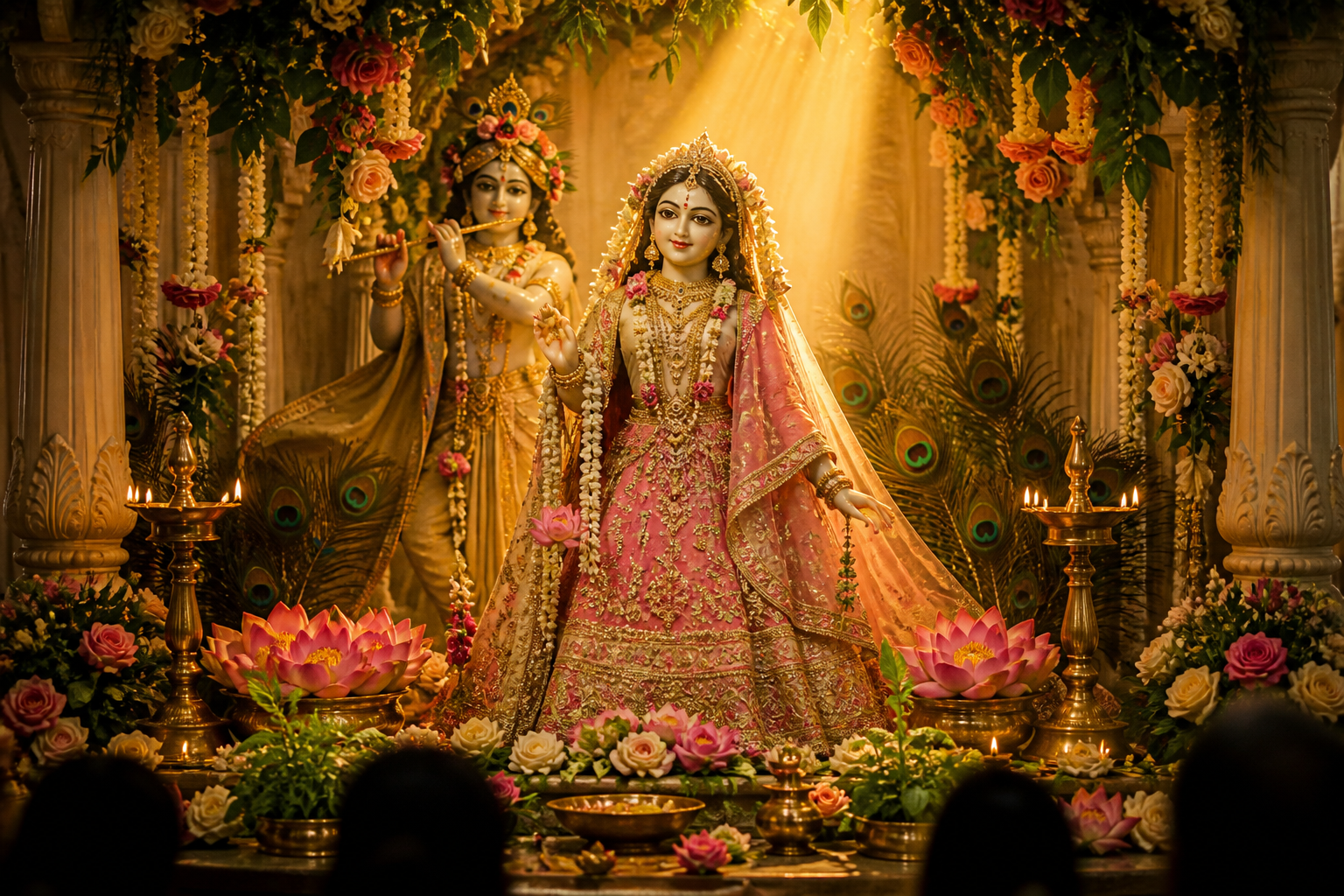
Radhashtami is observed on September 19, the Shukla Paksha Ashtami associated with the birth of Sri Radha. It arrives while the wider Ganesh observance is still underway, but it should not be treated merely as another item added to a generic festival programme.
If Sri Radha is central to your devotional lineage, check your temple’s September 19 programme before arranging a competing home gathering. If you will observe at home, decide on one clear devotional centre consistent with your sampradaya. Exact puja, vrata and fasting practices vary; use the method transmitted in your tradition rather than assuming that one internet timetable applies to every Vaishnava community.
The practical challenge is shared household capacity. A family maintaining Ganesh worship may already have daily responsibilities, visitors and a planned immersion date. Assign responsibility for Radhashtami separately so that its preparation does not become an improvised task on September 19. One person can confirm the temple schedule, another can prepare the home space, and the household can agree beforehand whether it is attending, hosting or keeping a quieter observance.
Key takeaways for your 2026 calendar
- Mark September 14 for Ganesh Chaturthi, September 15 for Rishi Panchami, September 19 for Radhashtami and September 25 for the concluding Ganesh Visarjan date.
- Plan September 14 and 15 together because Rishi Panchami follows Ganesh Chaturthi on the next calendar date.
- Choose your household’s visarjan day before Ganesh Chaturthi begins; September 25 is the concluding date, but earlier customary immersion days are also followed.
- Treat Rishi Panchami as a vrata with its own practitioner and preparation, not as a continuation of a public Ganesh celebration.
- Give Radhashtami a distinct devotional purpose even though it falls within the Ganesh festival window.
- Use these dates to reserve time, then confirm tithi boundaries, puja timings and local temple programmes through the panchanga and authorities your tradition follows.
Open your calendar now and block September 14 and 15 first. Decide the visarjan day next, then add September 19. When your local panchanga and temple programmes provide exact timings, replace those placeholders with confirmed hours, locations and household responsibilities.
References
- Hindu Pad — Ganesh Immersion 2026 | Ganapati Visarjan dates
- Hindu Pad — Rishi Panchami 2026 | Rushi Panchami Vrata
- Hindu Pad — Sri Radha Ashtami 2026 | Radhashtami Festival
