
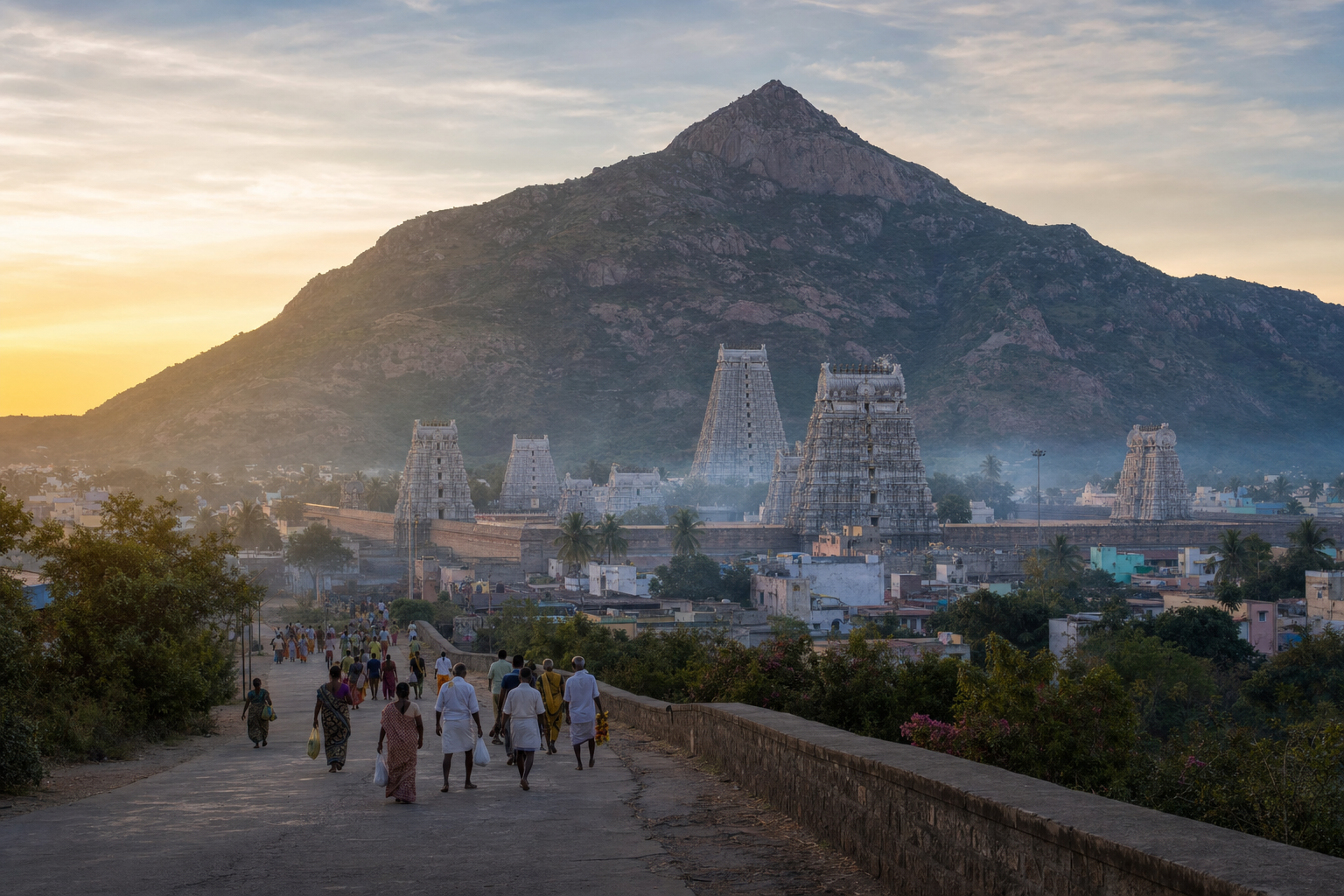
Perhaps Tiruvannamalai has moved from a name you barely knew to a place you can no longer dismiss. Now the practical questions have arrived. Should you begin at the temple or walk around the hill? How does Ramana Maharshi fit into a Shaiva pilgrimage? What if you complete every sacred stop and feel nothing dramatic?
Approach Arunachala as a sequence of encounters, not a list of attractions. Understand what the hill means, receive darshan, undertake Giripradakshina if it is physically safe for you, make room for silence, and judge the pilgrimage by what it changes after you return. That structure keeps devotion from becoming sightseeing and protects spiritual openness from turning into a demand for signs.
Before you go, decide what you are carrying to Arunachala
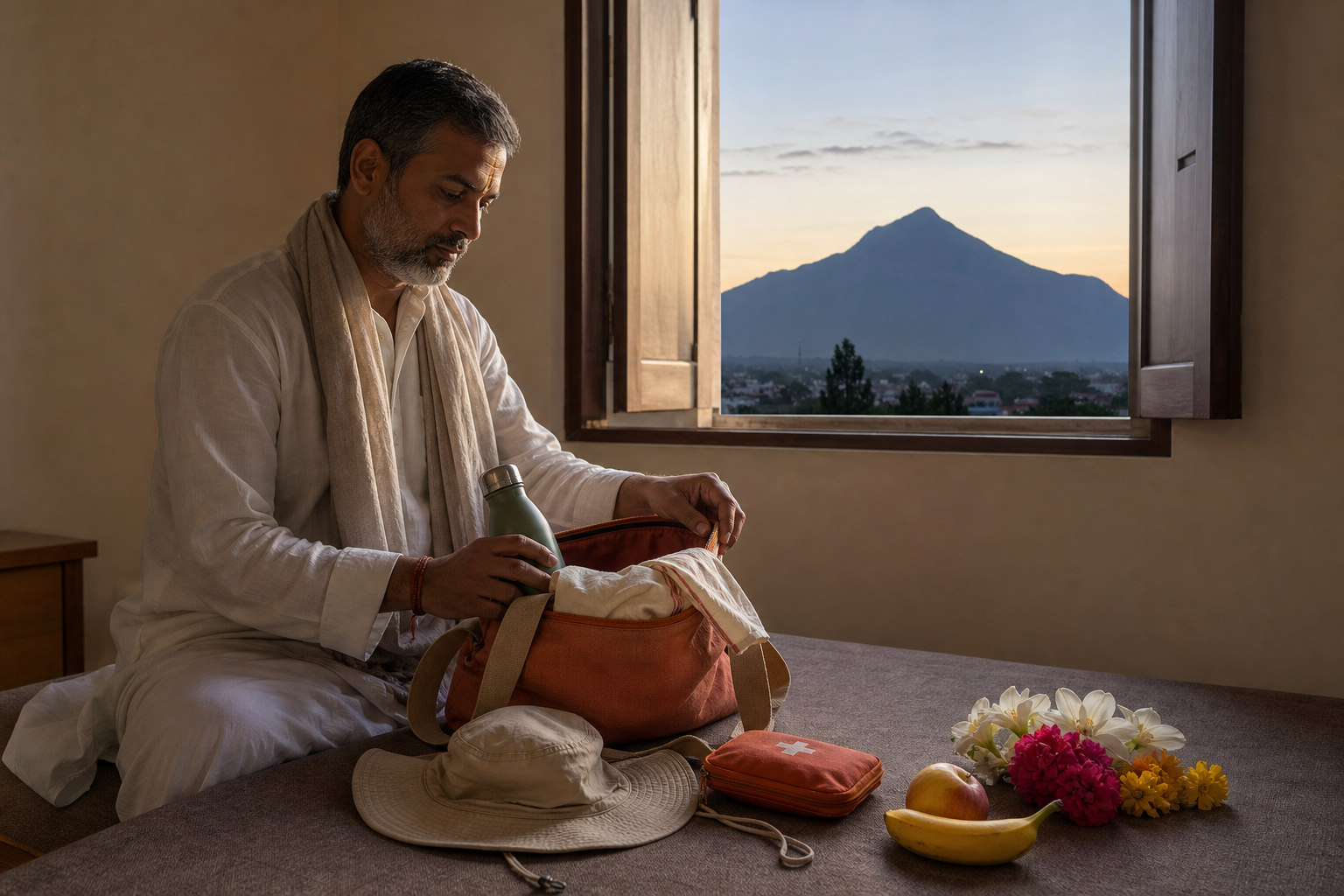
A sense of being called can be meaningful without becoming a claim that every coincidence is a divine instruction. You may have encountered the name Arunachala repeatedly, felt an unexplained attraction to the hill, or simply become curious about Ramana Maharshi. Respect that movement, but do not force yourself to prove where it came from. Devotion does not require you to manufacture certainty.
Before arranging the journey, write one sentence that states why you are going. Keep it honest enough that you would still accept the pilgrimage if the answer differs from the one you want.
- If you are going in devotion, choose the Shiva nama, mantra, prayer, or vow you will return to throughout the visit.
- If you are carrying grief or confusion, ask for the clarity to see your situation rather than demanding a particular outcome.
- If you are drawn by Ramana Maharshi, carry the inquiry Who am I? as a practice, not as a philosophical puzzle to solve.
- If you are seeking a sign about a major decision, change the request: ask what attachment, fear, or self-deception prevents you from seeing clearly.
One intention is enough. Ten petitions will scatter your attention before you reach the hill. A clear sankalpa also gives you something concrete to examine after the journey: not whether Arunachala performed on demand, but whether you became more capable of truth, steadiness, and surrender.
Meet Arunachala as temple, hill, and silent Guru
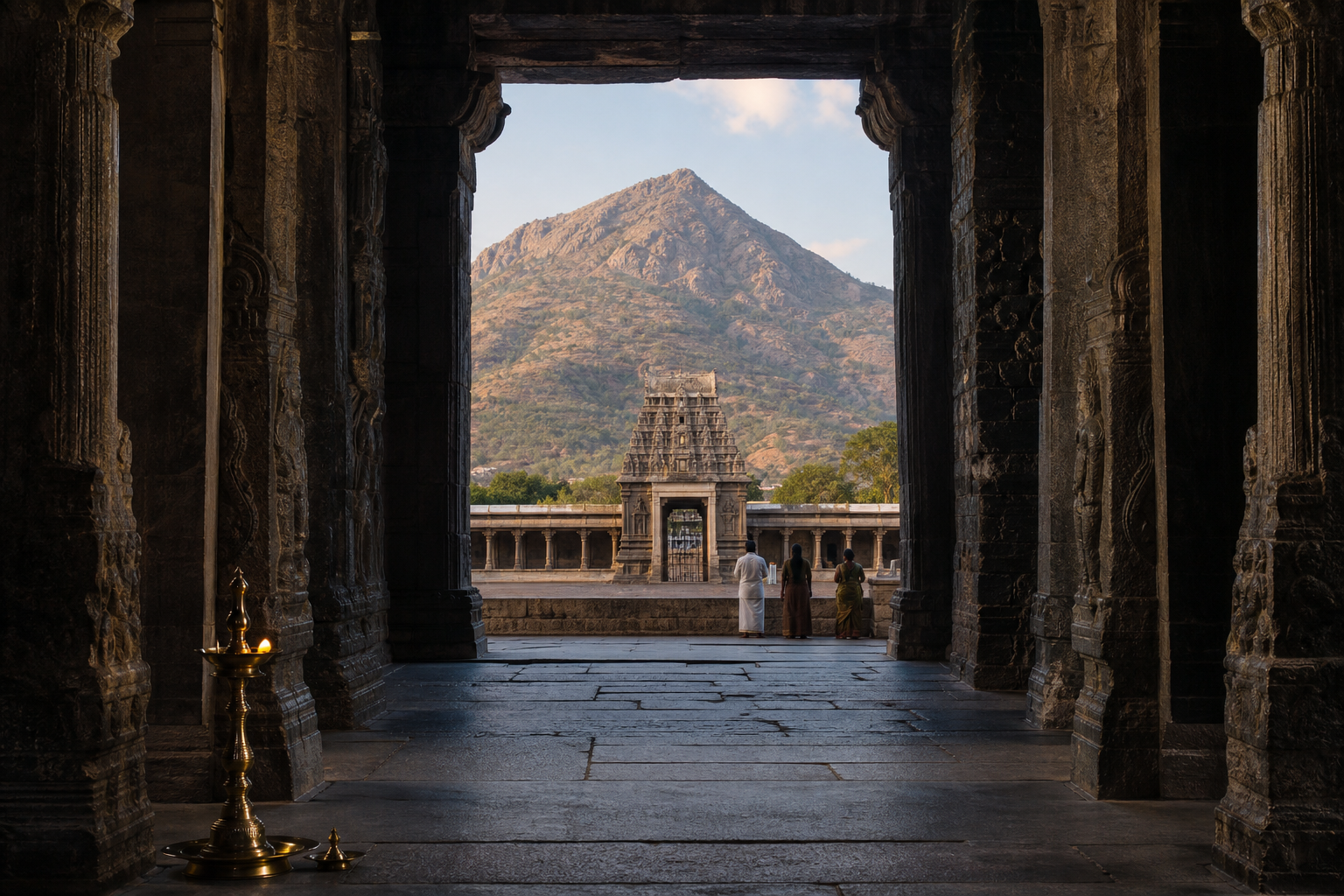
The Arunachala pilgrimage has three closely related centres: Arunachaleswarar Temple, the hill and its circumambulatory path, and the places associated with Ramana Maharshi. Do not make them compete for your time. Each trains a different faculty: temple worship gathers the senses into sacred form, Giripradakshina turns the body into prayer, and silent inquiry directs attention toward its source.
At the temple, encounter Agni without reducing it to spectacle
Arunachaleswarar Temple is one of the Pancha Bhuta Sthalams, where Shiva is worshipped through the five primordial elements. Arunachala represents Agni, or fire. Shiva is worshipped here as Annamalaiyar, yet the central theological claim reaches beyond the sanctum: the entire hill is revered as His visible form.
The Shiva Purana narrative associated with the kshetra gives you a way to contemplate that claim. When Brahma and Vishnu disputed supremacy, Shiva appeared as a column of fire with no discoverable beginning or end. Vishnu searched below, Brahma searched above, and neither found its limit. Vishnu admitted failure; Brahma falsely claimed success. The story turns the infinite flame into a discipline of humility: the Divine is not an object the ego can measure, possess, or use to establish superiority.
Carry that meaning into darshan. Instead of asking only, What can I obtain here?, ask, What am I still trying to control, measure, or falsely claim? Agni then becomes more than a ritual association. It becomes the fire that exposes pretence.
Give the temple its own place in your pilgrimage, even if Ramana Maharshi first drew you to Tiruvannamalai. The complex extends across nearly twenty-five acres, its Rajagopuram rises more than two hundred feet, and its masonry preserves centuries of patronage associated with the Pallavas, Cholas, Hoysalas, Vijayanagara rulers, and Nayakas. It also belongs to the Tamil Shaiva hymn tradition of the Nayanmars. You are entering a living sacred inheritance, not merely visiting the historical setting of a modern sage.
At the hill, let reverence replace the tourist’s gaze
A scenic mountain is something you stand apart from and admire. Arunachala asks for another relationship. If the hill is Shiva, walking around it is not exercise with religious stops added along the way. The whole circuit is pradakshina. The road, shrines, pauses, fatigue, noise, silence, and repeated return of the hill to your field of vision all belong to the practice.
This shift is simple but decisive. You do not need to generate a special mood every time you look at the hill. Offer attention instead. When the mind begins planning, judging, photographing, comparing, or searching for an extraordinary sensation, notice the movement and return to the presence before you.
With Ramana Maharshi, turn from atmosphere to inquiry
Ramana Maharshi came to Arunachala at sixteen after a profound awakening and remained there for the rest of his life. He spent important periods in Virupaksha Cave and Skandashram, regarding Arunachala not simply as holy geography but as Shiva and the silent Guru. Sri Ramanasramam later developed at the foothills, and the ashram, caves, and hill became inseparable from his life of contemplation.
If you visit these places, do not spend all your attention checking whether the atmosphere feels powerful. Sit quietly and examine the one who wants an experience. When a thought, memory, desire, or fear appears, ask who is aware of it. Then turn attention toward that apparent knower. The point of self-inquiry is not to recite the words Who am I? mechanically; it is to stop granting every passing thought the authority to define you.
Walk the fourteen-kilometre circuit without making it a test
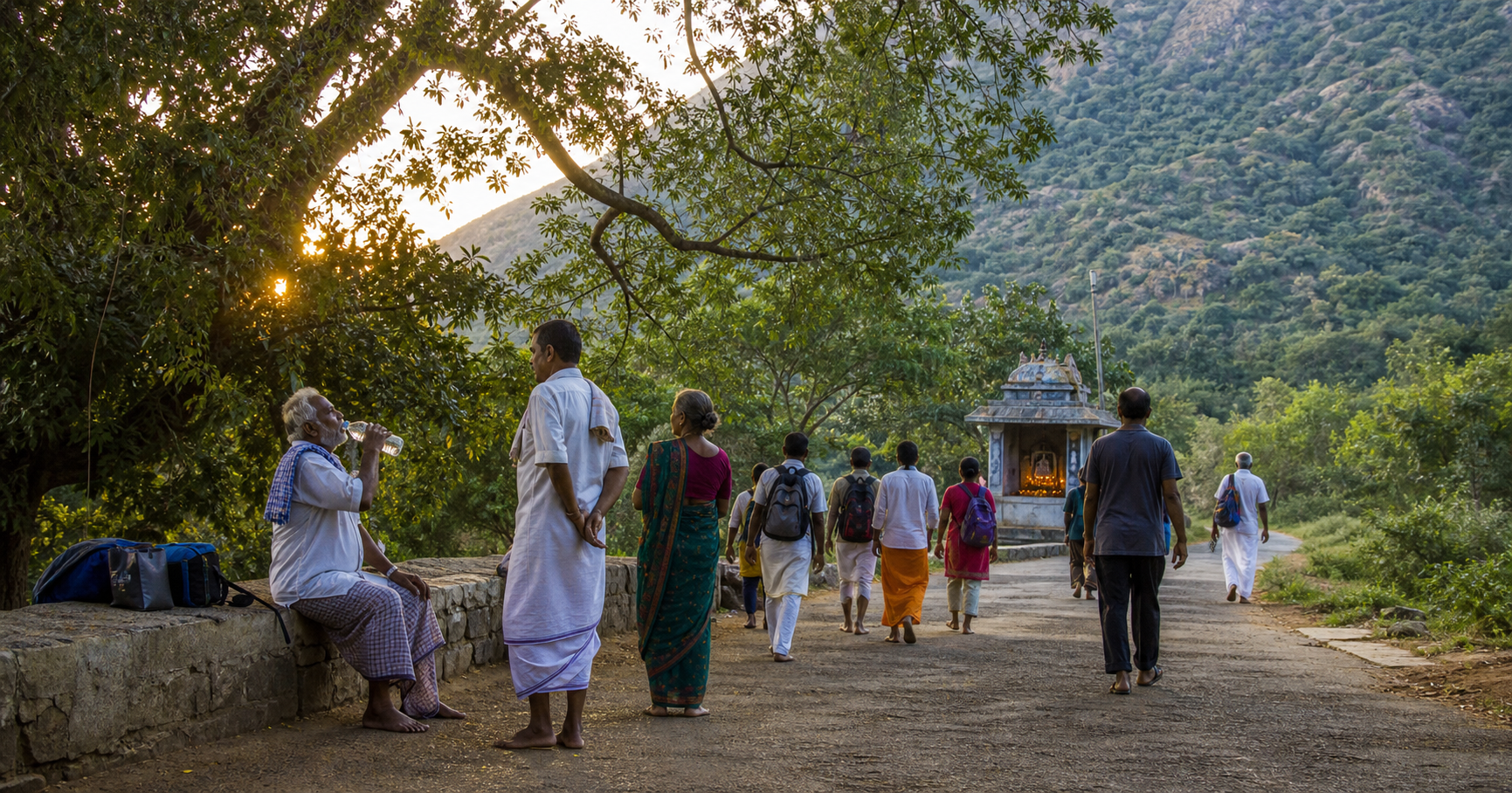
Giripradakshina follows a circuit of approximately fourteen kilometres around Arunachala. The route contains the Ashta Lingas associated with the guardians of the eight directions, as well as shrines, sacred tanks, and samadhis of saints. For devotees, circumambulating the hill is comparable to circumambulating Shiva directly, and the practice is traditionally associated with purification of mind, the burning of karma, sincere prayer, and a deepened bond with Arunachala.
Fourteen kilometres is long enough for enthusiasm to give way to habit, discomfort, or impatience. That transition is not an interruption of the pilgrimage. It is where the practice becomes honest. Use a simple discipline that you can sustain:
- Before beginning, face the hill, offer pranam, and state your one-sentence intention inwardly.
- Choose one anchor for the circuit: your usual Shiva nama, a prayer, attentive silence, or self-inquiry. Changing practices whenever the mind becomes bored only gives restlessness another form.
- At the Ashta Lingas, pause to bow and recollect attention. Do not turn the eight shrines into items to collect while remaining mentally absent.
- When irritation, fatigue, or distraction appears, acknowledge it without treating it as either spiritual failure or mystical revelation. Slow down, rest, or stop if safety requires it.
- At the end, resist the urge to evaluate the whole pilgrimage immediately. Sit quietly, offer gratitude, and record the clearest thing you noticed about your own mind.
Do not make physical completion a measure of devotion. If a medical condition, limited mobility, severe weather, or crowd conditions make the full circuit unsafe, choose a form of prayer your body can undertake responsibly. If you are uncertain whether a long walk is appropriate for you, obtain qualified medical guidance before the pilgrimage. Faith does not require you to ignore a real physical limit.
Travel conditions, temple access, route controls, and local transport can change. Confirm them shortly before setting out through current local authorities, the temple administration, your accommodation, or another dependable local contact. This matters especially around Karthigai Deepam. On the full moon of the Karthigai month, a large ghee-fed beacon is lit on the summit in remembrance of Shiva’s boundless column of fire, and the festival draws immense numbers of pilgrims for darshan and Giripradakshina. If you choose that period, prepare for a communal festival pilgrimage rather than assuming the conditions of a quiet retreat.
Judge the spiritual experience by its fruit, not its intensity
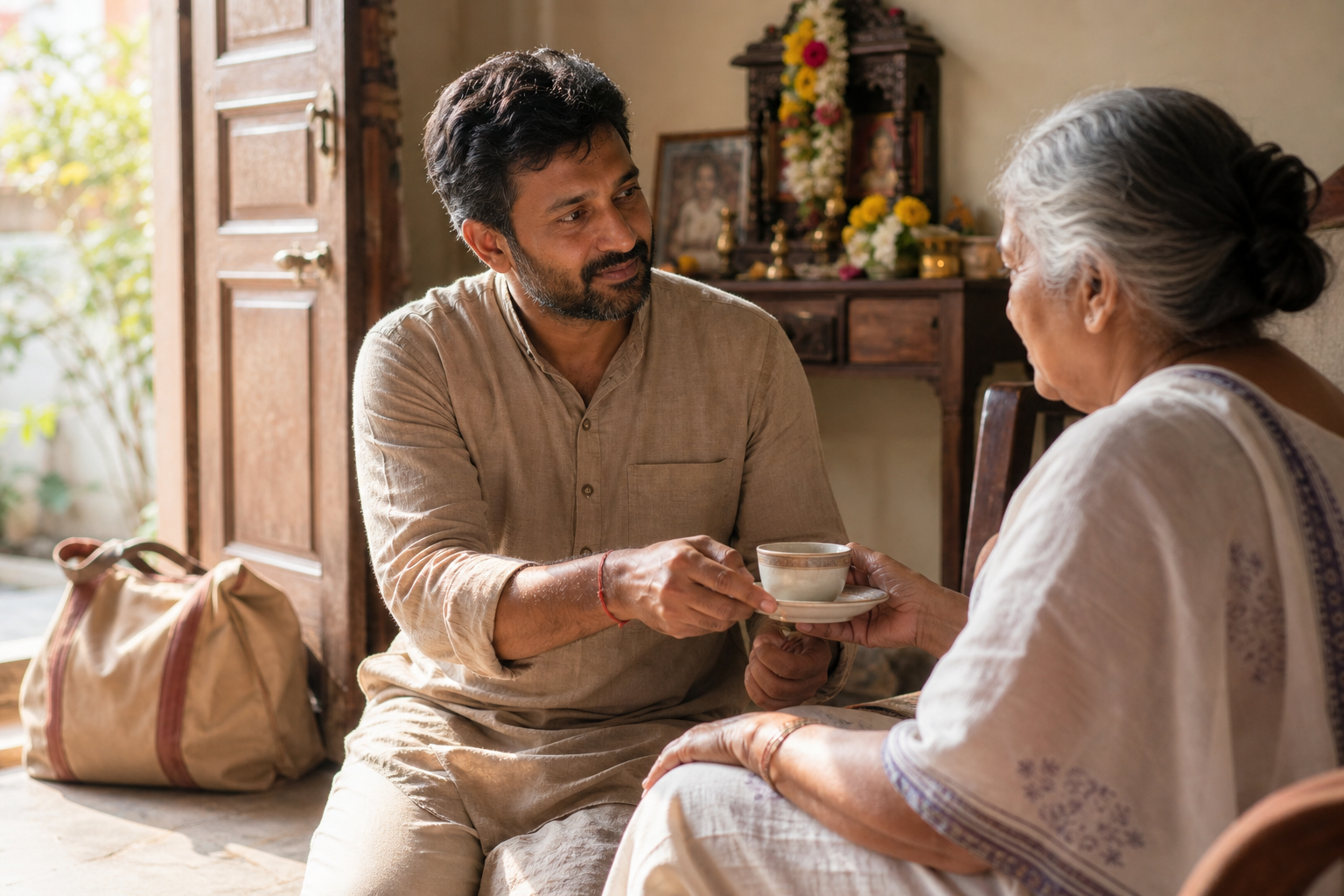
You may feel devotion, silence, tears, wonder, fatigue, irritation, or nothing you can confidently name. None of these reactions, by itself, proves or disproves a spiritual encounter. A powerful feeling can arise from worship, beauty, exhaustion, expectation, relief, or the force of a vast gathering. You do not have to dismiss it, but you also do not have to turn it into a supernatural claim.
The Arunachala narrative itself gives you a better test. Vishnu’s honest admission brings him closer to truth; Brahma’s claim to an attainment he did not possess becomes the failure. When you return, ask whether the pilgrimage has made you more honest about what you know, what you do not know, and what still governs you.
- Truthfulness: Are you less tempted to exaggerate an experience so that it sounds spiritually impressive?
- Attention: Can you return to prayer or inquiry with less bargaining and less demand for immediate results?
- Humility: Has the encounter with the hill loosened the need to place yourself above another devotee, path, or tradition?
- Continuity: Did you bring home one practice that can survive an ordinary day, rather than only a memory of sacred atmosphere?
- Discernment: Can you let an inner impression mature before using it to justify an irreversible decision?
After returning, write brief answers to three questions: What was I asking Arunachala to change? What did the pilgrimage reveal about the person doing the asking? What single practice will I now continue? Keep the answers private until you can state them without embellishment. This protects a genuine insight from being converted too quickly into performance.
Grace need not look like the removal of every problem. It may appear as a cleaner view of the problem, the collapse of a false demand, or the willingness to practise without being promised a dramatic reward. The quiet result is often more usable than the spectacular story.
Key takeaways
- Take one honest intention to Arunachala; do not overload the pilgrimage with competing petitions.
- Give distinct attention to Arunachaleswarar Temple, the hill and Giripradakshina, and the contemplative inheritance of Ramana Maharshi.
- Understand Agni through the story’s central discipline: the infinite cannot be possessed, and honesty matters more than a claim of attainment.
- Treat the approximately fourteen-kilometre circuit as prayer in motion, not an endurance contest or a checklist of eight Lingas.
- Verify current logistics, especially during Karthigai Deepam, and do not override health or safety limits in the name of devotion.
- Measure the pilgrimage afterward by greater truthfulness, steadier attention, humility, and a practice you can sustain at home.
Your preparation can begin before you book anything. Write the one sentence you intend to carry to Arunachala, then remove from it every demand for spectacle and every claim to know how grace must appear. Take that cleaner intention to the temple, the path, and the silence.
References
