
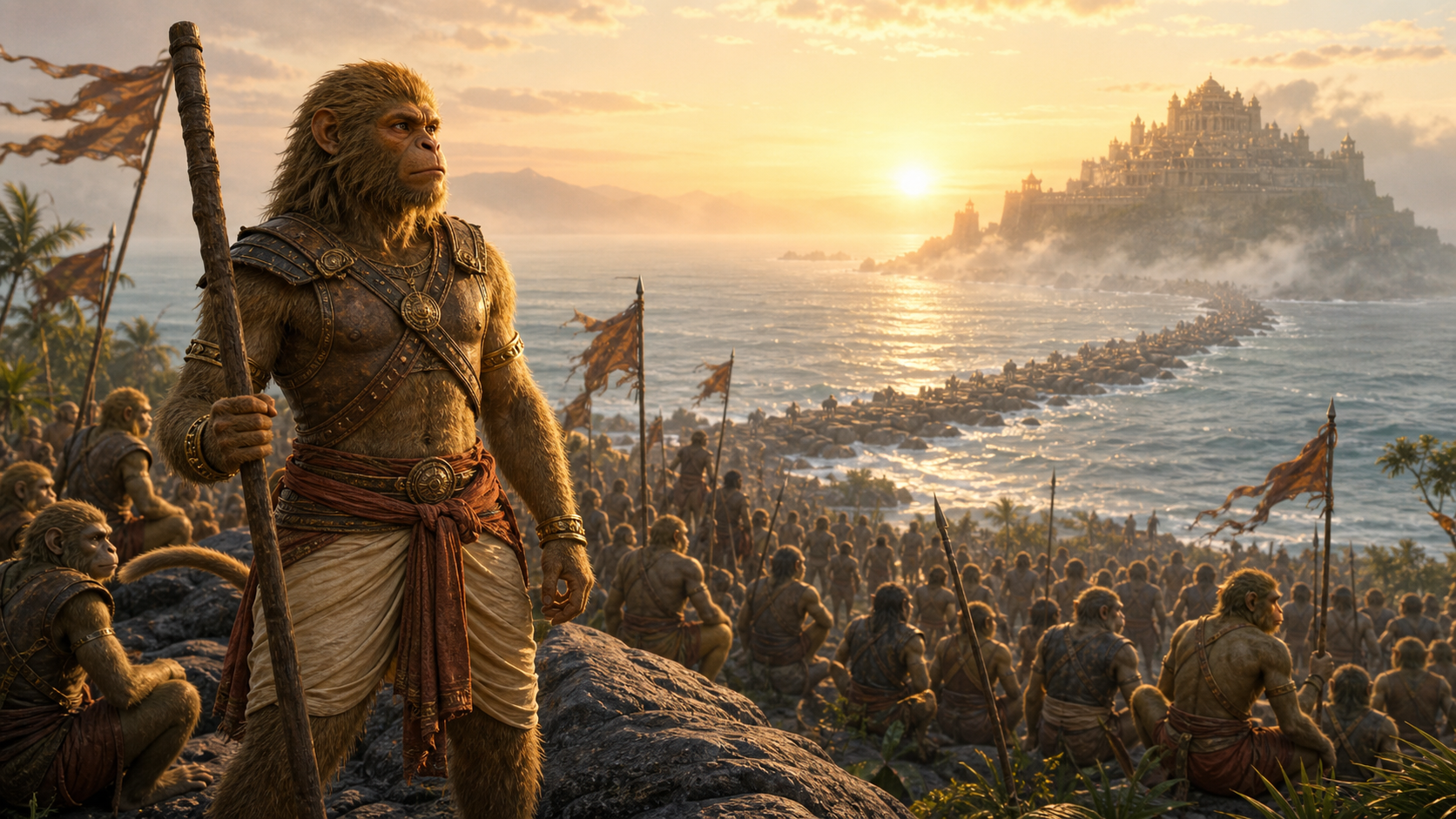
You have encountered Rambha as a vanara general in Sri Rama’s campaign against Lanka, but the familiar lists of commanders do not seem to give him the same place as Hanuman, Sugriva or Angada. Is Rambha truly part of the Ramayana, a later addition, or simply a symbolic character?
The sound answer depends on which Ramayana tradition you mean. Rambha is not prominent among the principal vanara leaders in the Valmiki Ramayana, yet certain regional narrations, popular retellings and strands of oral lore remember him as a courageous commander. You can respect that wider memory without assigning it a textual certainty it does not possess.
The shortest defensible answer
If someone asks whether Rambha appears as a major vanara general in the Valmiki Ramayana, do not answer with an unqualified yes. Rambha is not prominently enumerated there among the principal leaders. Hanuman, Sugriva, Angada, Nala and Nila have much clearer standing in that familiar leadership circle.
If the question concerns the broader Ramayana tradition, however, an unqualified no is also misleading. The Ramayana has been retold, sung and enacted in many cultural settings. Some regional and popular accounts expand the vanara host with additional warriors whose courage expresses the values of the epic. Rambha belongs to that wider field of remembrance.
The careful formulation is therefore simple: Rambha is a vanara commander associated with certain regional and popular Ramayana traditions, but he should not be presented as one of the principal leaders prominently attested in the Valmiki Ramayana.
Key takeaways
- Do not call Rambha a principal Valmiki Ramayana commander unless you can identify a precise passage that supports that claim.
- Do not dismiss him merely because he is absent from the best-known list of vanara leaders; regional narration and oral memory are also real forms of Ramayana reception.
- Keep textual attestation, traditional remembrance and symbolic interpretation separate. They answer different questions.
- Use qualified language such as in certain regional and popular retellings when the particular tradition has not been identified.
- Read Rambha primarily as an image of disciplined courage and martial strength placed in the service of dharma.
One name can carry three different kinds of claim
Most confusion around Rambha comes from treating every statement about an epic character as the same kind of statement. It is not. A name may have a secure place in a particular text, a remembered place in a living tradition, or an interpretive place in religious teaching. Those categories can overlap, but one cannot automatically prove another.
Textual attestation
A textual claim asks a narrow question: does a named version contain this character in a passage that can be located? For Rambha, the responsible starting point is that the Valmiki Ramayana does not prominently place him among its principal vanara leaders. That wording matters. It does not turn limited attestation into a sweeping claim that no occurrence, variant or related name could ever exist. It states only what can safely be maintained about his prominence.
This is also why the word the Ramayana can create trouble. A claim about the Valmiki Ramayana is not automatically a claim about the Kamba Ramayanam, the Ramcharitmanas, regional kathas, folk ballads or dramatic performance. Name the tradition whenever the distinction affects your conclusion.
Traditional remembrance
A traditional claim asks where a community remembers, performs or teaches a character. Certain regional narrations and popular retellings portray Rambha as lion-hearted, steadfast and capable of inspiring confidence in the vanara ranks. That is meaningful evidence of reception, but it is not the same as a verse citation from an early or widely authoritative recension.
Traditional memory does not become worthless when its textual trail is uncertain. Nor does devotion require us to erase the uncertainty. The honest course is to identify the level of the claim: Rambha is remembered in some retellings; the precise distribution of those attestations is not established here.
Symbolic interpretation
An interpretive claim asks what a character helps a community see. Rambha can embody kshatra governed by dharma: courage without lawlessness, strength without vanity, and obedience to a just purpose rather than to personal appetite. This interpretation can be spiritually fruitful even when the character’s place in a particular text remains uncertain.
State that reading as a reading. Saying that Rambha represents disciplined courage is different from claiming that every Ramayana version assigns him a fixed biography, command structure or battlefield episode. The first draws out a moral meaning; the second requires textual evidence.
How to evaluate a claim about Rambha
When you meet a confident assertion about Rambha online, in a discourse or in a retelling, use the following sequence. It lets you remain open to living tradition while avoiding false precision.
- Ask which Ramayana is meant. A claim about Valmiki, Kamban, Tulsidas or an unnamed folk narration must not be treated as interchangeable.
- Look for a locatable passage. A chapter, canto, verse, performance tradition or named regional katha gives you something concrete to examine. A bare assertion supplies only a lead.
- Check what the passage actually establishes. The appearance of a name does not by itself prove that the bearer was a leading general, fought a particular opponent or directed a major operation.
- Separate the inherited account from later explanation. A storyteller may build a rich teaching around a brief name. The teaching may be worthwhile, but its details should not be silently attributed to the earlier text.
- Match your wording to the evidence. Use prominently attested for a clear major role, remembered in certain retellings for a traditional association, and can be read as for symbolism.
This method corrects two opposite errors. The first is overclaiming: treating every popular detail as though it occurs plainly in the Valmiki Ramayana. The second is overcorrection: declaring every character outside a familiar roster to be false. Ramayana traditions have both textual depth and a long life in narration. Careful readers have room for both.
You should be especially cautious when an account supplies an exact rank, battle, opponent or speech without identifying the tradition. Rambha’s broad characterization as a courageous commander is supported within certain retellings; a detailed military biography would require correspondingly detailed evidence.
What Rambha contributes to the Lanka campaign
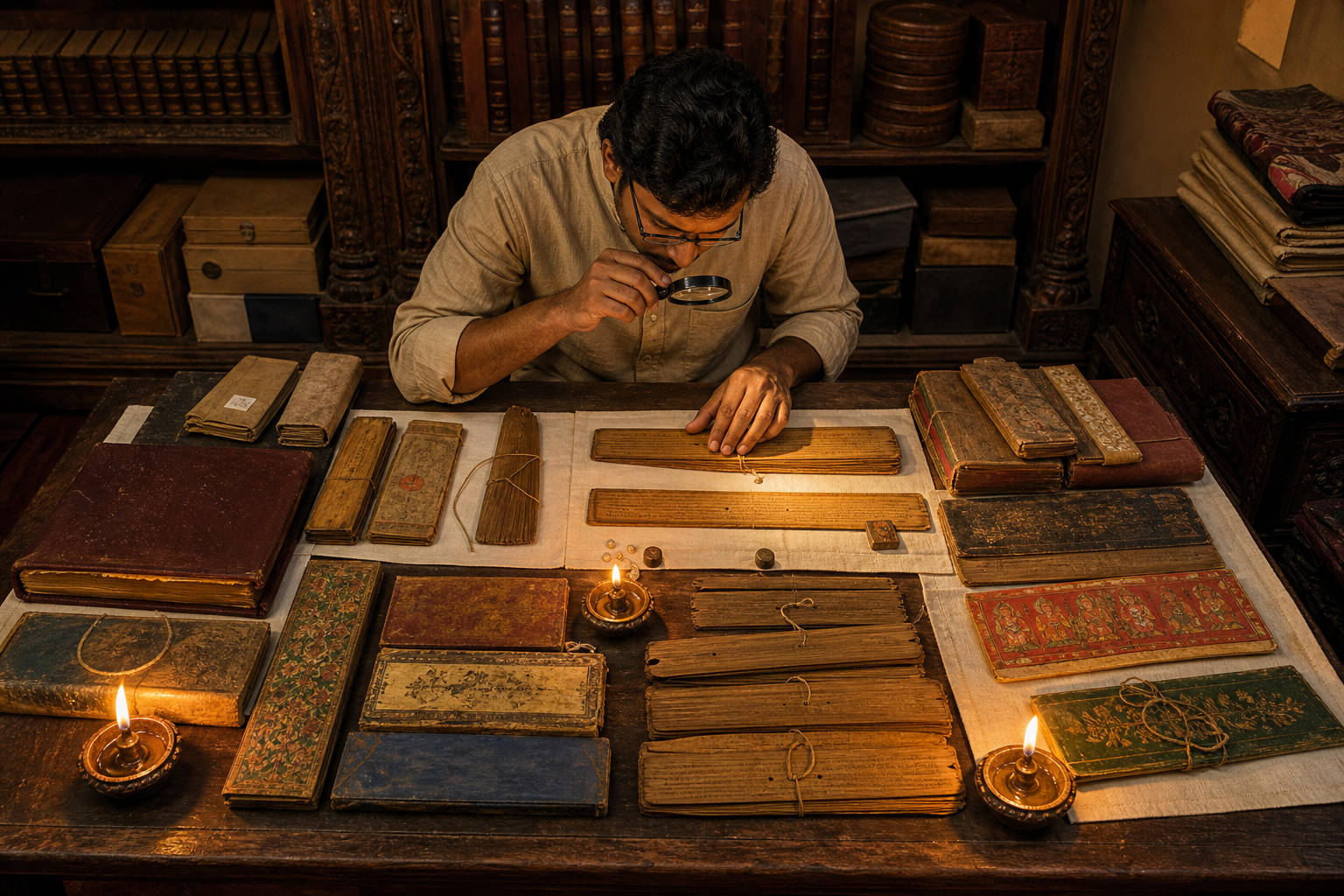
Rambha’s value does not depend on displacing better-attested heroes. His attributed role directs attention to something the fame of individual champions can obscure: a righteous campaign also requires cohesion, command and disciplined service among many participants.
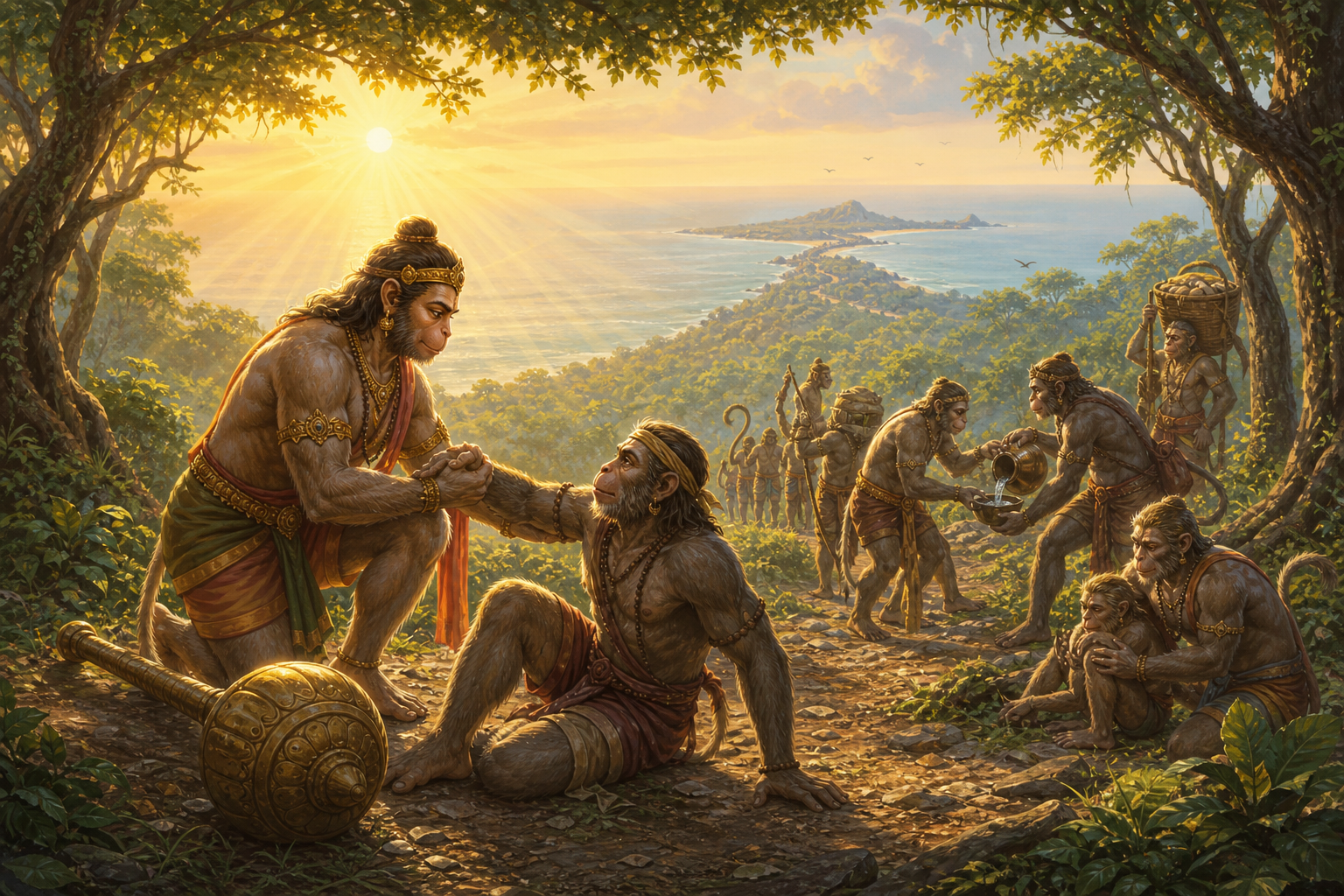
Hanuman’s extraordinary devotion, Sugriva’s kingship, Angada’s princely courage, and the contributions of Nala and Nila occupy recognisable places in the vanara effort. Rambha, as remembered in wider narration, represents the commander who keeps courage collective. His presence suggests ranks that do not dissolve into fear, leaders who coordinate rather than compete, and warriors whose strength remains attached to Sri Rama’s moral purpose.
That distinction turns the Lanka campaign from a spectacle of force into a lesson about force under authority. Ravana possesses power, command and a fortified kingdom. Those things alone do not make his cause righteous. The vanara host becomes morally intelligible because its strength serves the recovery of Sita and resistance to Ravana’s adharma. Within this frame, Lanka’s fall signifies the restoration of moral order rather than conquest for its own sake.
This is the practical lesson to notice when Rambha appears in a katha. Do not look only for the most spectacular blow. Watch how the narrator joins courage to restraint, leadership to service, and victory to a purpose beyond the warrior’s ego. Those relationships reveal whether the martial language is genuinely Dharmic or merely celebratory.
Rambha therefore works best as a secondary exemplar. He does not need an invented catalogue of feats. His significance lies in the kind of military virtue he is made to carry: steadfastness when the ranks face fear, coordination when the task exceeds one hero, and loyalty when personal glory could distract from the cause.
A Dharmic comparison without flattening the traditions
Rambha can also open a conversation across the Dharmic family, provided the comparison remains modest. Hindu, Buddhist, Jain and Sikh traditions do not preserve one shared account of this vanara commander. They offer distinct ethical lenses through which disciplined strength, self-mastery and righteous responsibility can be considered.
| Dharmic lens | What it helps you notice | Boundary to preserve |
|---|---|---|
| Hindu | Kshatra becomes righteous when martial power serves dharma rather than ambition. | Symbolic interpretation should not be mistaken for proof of a passage in every Ramayana. |
| Buddhist | Discipline, compassion and mastery of reactive passions matter more than the display of force alone. | This ethical resonance does not make Rambha a figure of Buddhist narrative tradition. |
| Jain | Ahimsa and victory over the passions challenge readers to examine anger, pride and attachment within any language of battle. | A Jain lens should not be used to erase its demanding critique of violence. |
| Sikh | Dharam yudh places grave ethical responsibility on the use of strength in resistance to injustice. | A comparison of moral themes does not imply that the traditions use identical doctrines or historical settings. |
The common thread is not a claim that all four paths teach the same thing. It is a disciplined question: what makes strength answerable to righteousness? Rambha’s remembered loyalty gives that question a concrete figure. Hindu reflection places him most directly within Sri Rama’s dharma-yuddha, while the other lenses test any easy identification of power with virtue.
This comparison is useful only if it sharpens rather than blurs. If you teach Rambha in an inter-Dharmic setting, name the primary Hindu narrative frame first. Then present Buddhist, Jain and Sikh connections as ethical resonances. Do not imply that those traditions independently attest the same commander.
How to speak about Rambha accurately
If you are preparing a class, temple talk, social-media explanation or family discussion, begin with the strongest claim you can defend. These three formulations cover most situations.
- For textual precision: Rambha is not prominent among the principal vanara commanders of the Valmiki Ramayana.
- For tradition-inclusive narration: Certain regional and popular Ramayana retellings remember Rambha as a courageous vanara commander in Sri Rama’s campaign against Lanka.
- For spiritual interpretation: Rambha can be read as an image of kshatra disciplined by dharma, where courage serves justice rather than personal glory.
Avoid three stronger claims unless you have additional evidence: that Rambha is a major commander in every Ramayana, that Valmiki gives him a detailed battlefield career, or that later remembrance is merely an error. Each assertion collapses a real distinction.
The same discipline should guide your choice of verbs. Appears calls for a text or performance in which the name can be located. Is remembered describes reception. Represents or can be read as marks interpretation. A single verb can tell your reader exactly how much certainty the evidence permits.
Your next step is therefore not to decide whether Rambha is simply real or unreal. Identify the Ramayana tradition in front of you, ask what kind of claim is being made, and preserve that level of certainty when you retell it. That habit honours both textual integrity and the living breadth of the Ramayana.
References
