
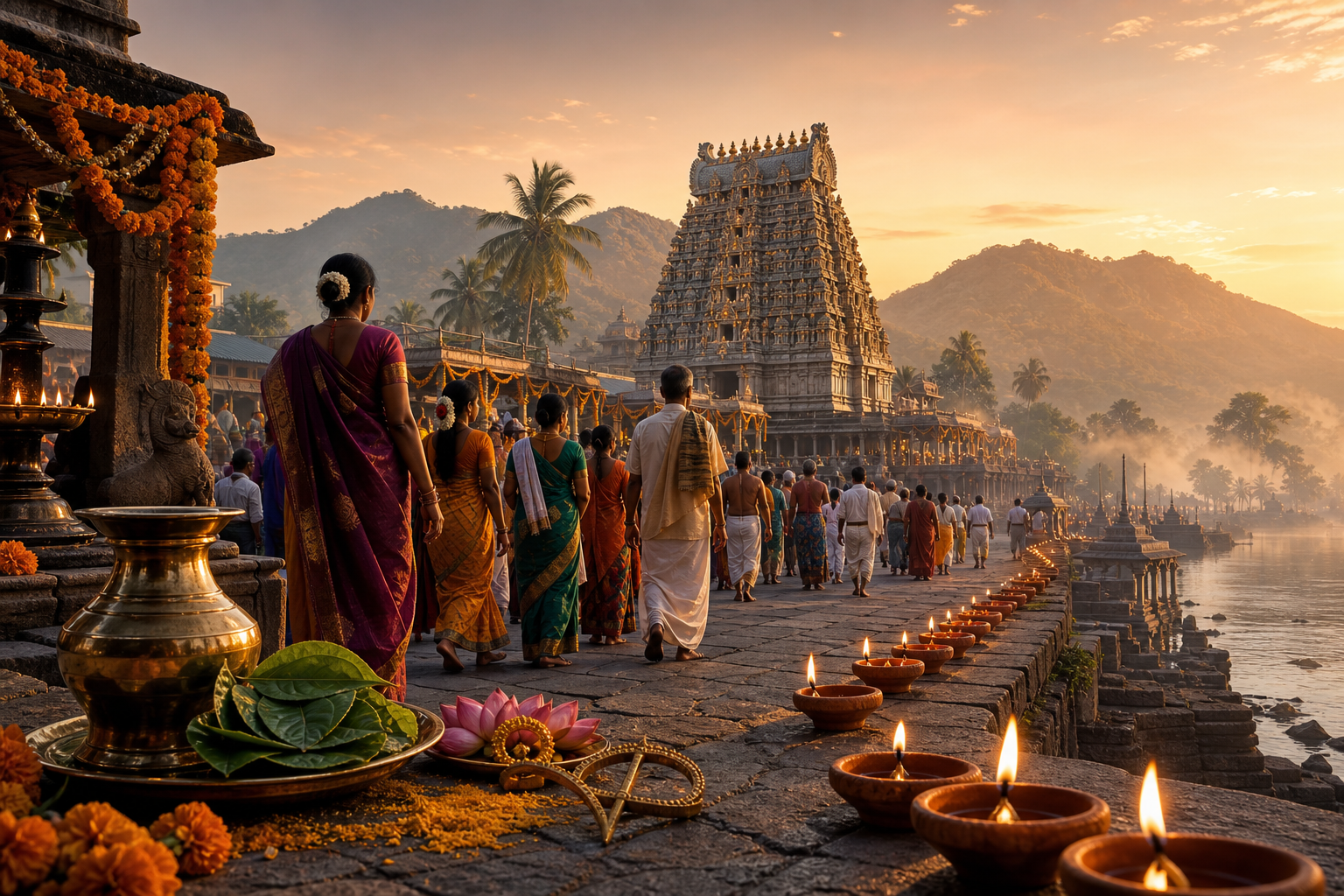
November 2025 has passed, so use this as an archival pilgrimage calendar rather than a live timetable. It records what was scheduled at four important Andhra Pradesh destinations and distinguishes exact timings from details that were never specified.
If you are reconstructing a journey, documenting the Karthika season, or using the month as a model for a future pilgrimage, begin with the observance that mattered most to you. The calendar offered four clear devotional paths: Shiva and Devi worship at Kapileswara, Rama worship at Kodanda Rama Swamy Temple, Padmavathi Ammavari worship in Tiruchanur, and Sathya Sai Baba Jayanti in Puttaparthi.
Key takeaways
- The longest continuous Tirupati observances were the Sri Kamakshi Ammavari Homam from October 30 to November 7 and the Sri Kapileswara Swamy Rudra Homam from November 8 to 18. Daily timings were not supplied.
- November 18 was the strongest single date for a Shaiva pilgrimage: it was the final day of the Rudra Homam, followed by the Sri Parvathi Parameswara Swamy Kalyanotsavam from 6:30 PM onward.
- Every Saturday offered a predictable Rama-centered schedule in Tirupati: Abhishekam at 6:00 AM and an evening procession at 5:30 PM.
- The November 5 Pournami Ashtothara Kalashabhishekam was listed for 9:30, but no AM or PM designation was given. That missing detail should never be guessed.
- At Tiruchanur, November 16 had a confirmed morning Laksha Kumkumarchana, while the evening program was left for a later announcement.
- November 23 was the fixed date for Sathya Sai Baba Jayanti in Puttaparthi, but the event-by-event timetable was not included in the information available for this calendar.
The November 2025 calendar at a glance
| Date | Destination | Observance | Timing and planning status |
|---|---|---|---|
| October 30-November 7 | Sri Kapileswara Swamy Temple, Tirupati | Sri Kamakshi Ammavari Homam, also identified as Chandi Yagam | The observance continued through the first seven days of November; daily times were not specified. |
| November 1, 8, 15, 22 and 29 | Sri Kodanda Rama Swamy Temple, Tirupati | Saturday Abhishekam and procession | Abhishekam at 6:00 AM; procession at 5:30 PM. |
| November 5, Pournami | Sri Kodanda Rama Swamy Temple, Tirupati | Ashtothara Kalashabhishekam | Listed at 9:30; AM or PM was not stated. |
| November 8-18 | Sri Kapileswara Swamy Temple, Tirupati | Eleven-day Sri Kapileswara Swamy Rudra Homam | Date range confirmed; daily timings were not specified. |
| November 11 | Sri Padmavathi Ammavari Temple, Tiruchanur | Koil Alwar Tirumanjanam | Temple sanctification ahead of the major festivities; no time was supplied. |
| November 16, morning | Sri Padmavathi Ammavari Temple, Tiruchanur | Laksha Kumkumarchana | Morning confirmed; no exact starting time was supplied. The evening schedule remained unannounced in the available details. |
| November 18 | Sri Kapileswara Swamy Temple, Tirupati | Sri Parvathi Parameswara Swamy Kalyanotsavam | From 6:30 PM onward; also the concluding date of the Rudra Homam. |
| Karthika season; exact dates not supplied | Sri Padmavathi Ammavari Temple, Tiruchanur | Annual Karthika Brahmotsavams | Processions, alankarams, Vedic recitations and devotional music were associated with the festival, but this calendar does not establish their individual dates or times. |
| November 23 | Prasanthi Nilayam, Puttaparthi | Sathya Sai Baba Jayanti | The Jayanti date was fixed; the detailed program was to be announced closer to the celebration. |
Two overlaps deserve attention. Saturday, November 8 was both a Kodanda Rama Swamy Temple day and the opening date of the Rudra Homam. Saturday, November 15 also fell within the Rudra Homam period. Those dates offered more than one Tirupati observance, but the absence of daily Rudra Homam timings means the calendar alone cannot prove that both could be attended comfortably.
Build the journey around one devotional anchor
A useful pilgrimage plan starts with a spiritual priority, not with the number of events you can fit into a day. Choose the anchor first, then add only those observances whose timings do not compete with it.
- For Shiva and Devi upasana, choose the Kapileswara sequence. The Chandi Yagam occupied the first week of November, and the Rudra Homam followed without a break from November 8 to 18. If you needed one date with a definite public-facing evening time, November 18 was the clearest choice because the Kalyanotsavam began at 6:30 PM.
- For a Rama-centered day, choose a Saturday. November 1, 8, 15, 22 and 29 shared the same structure: Abhishekam at 6:00 AM and a procession at 5:30 PM. This was the only recurring schedule in the month with both morning and evening times stated.
- For Padmavathi Ammavari worship, distinguish ritual certainty from festival expectation. November 11 was assigned to Koil Alwar Tirumanjanam, and November 16 had a morning Laksha Kumkumarchana. The wider Brahmotsavam setting was important, but its unnamed procession dates and the missing November 16 evening timing could not support a minute-by-minute itinerary.
- For Sathya Sai Baba Jayanti, make November 23 the purpose of the Puttaparthi visit. Vedic chanting, nagar sankirtan, community bhajans, prayer at the Maha Samadhi and seva commonly shape the celebration, but these typical elements were not a confirmed 2025 timetable. Puttaparthi should therefore be treated as a separate destination rather than a spare addition to a tightly timed Tirupati day.
This method prevents a common pilgrimage error: treating a date range as though it were a complete daily program. A multiday homam tells you when the observance runs, but it does not automatically tell you when devotees may enter, whether participation arrangements change by day, or how it fits around another temple’s schedule.
Resolve the calendar’s gaps before relying on it
Several dates were firm while their operational details were not. If you were checking an old itinerary, these gaps explain why a second confirmation would have been necessary. If you are using the calendar to plan a comparable future pilgrimage, the same checklist will protect you from building around an assumption.
- Confirm the year first. Temple observances tied to weekdays, Pournami or an annual festival cannot simply be copied from November 2025 into another year.
- Ask whether 9:30 on November 5 meant AM or PM. The time appears without a day-period marker. Treat it as incomplete, even if one interpretation seems customary.
- Obtain the daily timing for each Kapileswara homam. The date ranges are exact, but no start time, completion time or day-specific access arrangement was supplied.
- Separate the November 16 morning rite from the Tiruchanur evening program. Laksha Kumkumarchana was assigned to the morning. The evening schedule was not yet fixed in the details used here, so it should not be filled with an assumed Brahmotsavam event.
- Request the individual Brahmotsavam procession calendar. Knowing that the annual festival includes processions and alankarams does not identify which vehicle, decoration or ceremony belongs to a particular date.
- Obtain the Prasanthi Nilayam program for November 23. The Jayanti date and its devotional character were clear, but a list of customary activities was not a substitute for confirmed starting times.
Early arrival was especially sensible during Karthika masam and on the principal ritual dates, when queues could grow. Pilgrims accompanying elders or children also had reason to arrive before the scheduled start rather than at it. No universal lead time was supplied, however, so an exact arrival margin should come from the relevant temple’s instructions rather than guesswork.
Carry the pilgrimage in a dharmic way
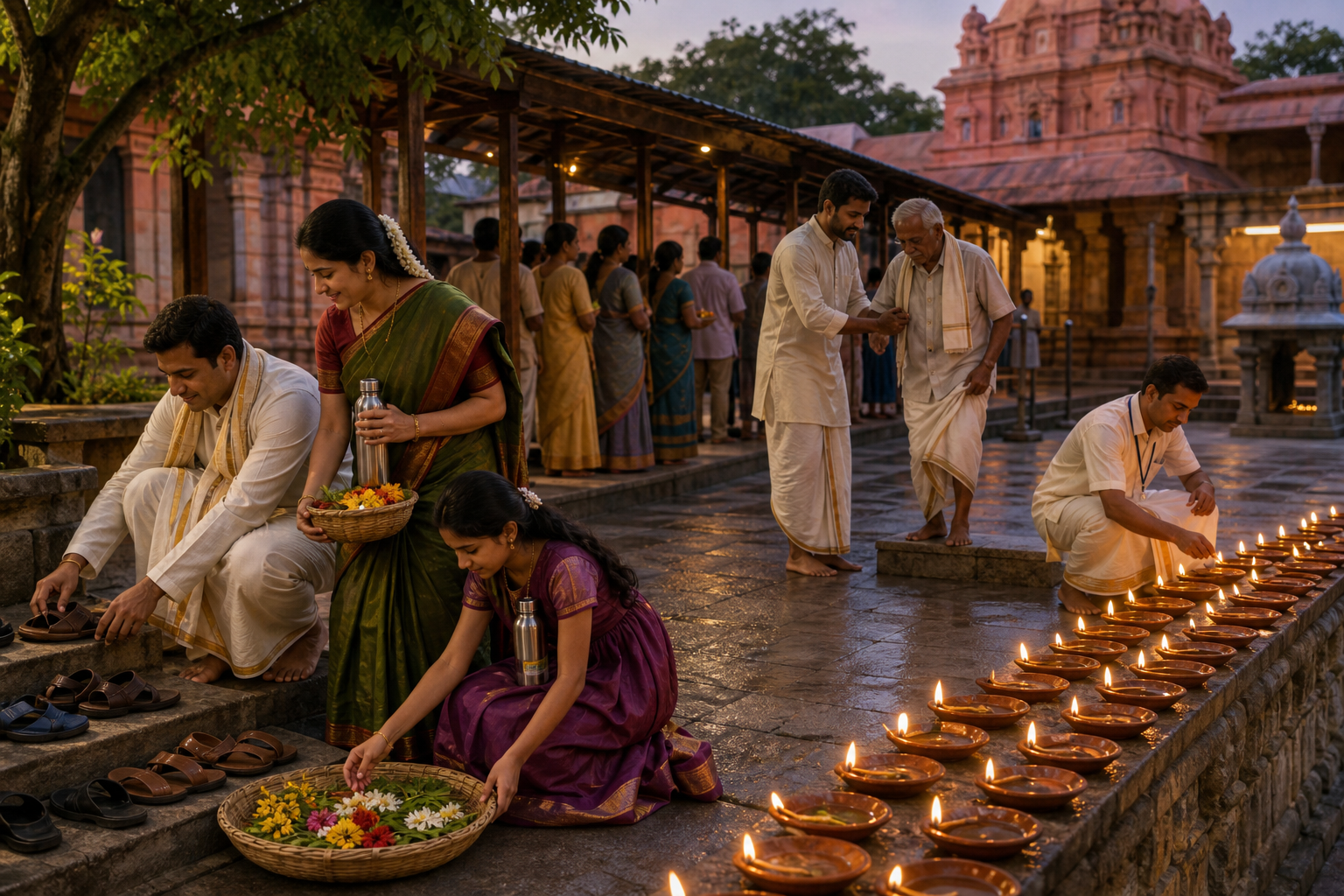
The calendar was varied, but its disciplines were compatible. At Kapileswara, quiet japa, simple offerings and attentive conduct suited the atmosphere of the homams. At Tiruchanur, modest attire, mindful movement and silence during recitations helped preserve the sanctity of the precincts. At Prasanthi Nilayam, seva gave Jayanti devotion a practical form through compassionate action.
You do not need to collapse the traditions into one undifferentiated experience to recognize their shared ethical ground. Self-restraint, compassion, ahimsa, service and respect for sacred space appear through different forms at the Shiva, Rama, Devi and Sai observances. The right response is to honor the distinctive practice of each place while carrying the same disciplined attention from one destination to the next.
If you use this record to plan a commemorative visit or a future Karthika pilgrimage, select the ritual that gives the journey its meaning and then obtain that year’s official timings before arranging the remaining stops. Let the sacred date choose the journey; let confirmed details govern the itinerary.
References
- DharmaRenaissance Blog — Tirupati Kapileswara Temple November 2025: Powerful Homams and Sacred Kalyanotsavam
- DharmaRenaissance Blog — Tiruchanur Padmavathi Ammavari Temple: November 2025 Festivals, Dates & Sacred Highlights
- DharmaRenaissance Blog — Tirupati Sri Kodanda Rama Swamy Temple: Unmissable November 2025 Sevas and Pournami Rituals
- DharmaRenaissance Blog — Sathya Sai Baba Jayanti 2025 in Puttaparthi: Devotional Celebrations, Unity and Seva
