
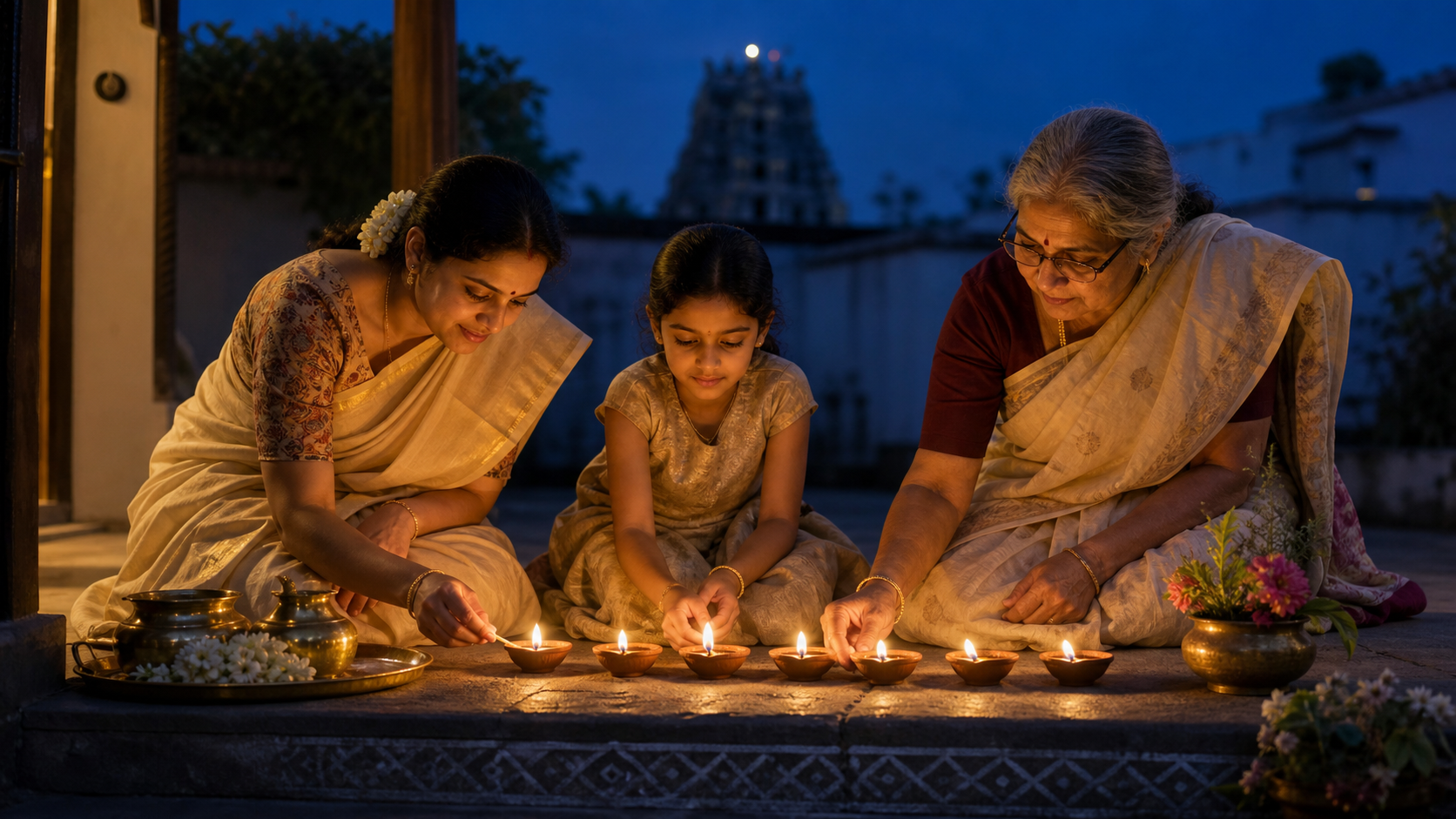
If you came looking for one universal Karthika date or one ritual that every Hindu household should perform, the calendar can quickly become confusing. A Krishna Paksha fast, a Purnima temple rite, and a Kerala festival governed by nakshatra may all belong to the wider Karthika season without falling on the same day.
You don’t need to collect every observance into one overloaded routine. You need to identify the calendar rule behind your family’s tradition, choose a vrata you can complete with integrity, and understand whether a sacred flame belongs in your home, at a temple, or in both settings in different forms.
Read the calendar rule before copying a festival date
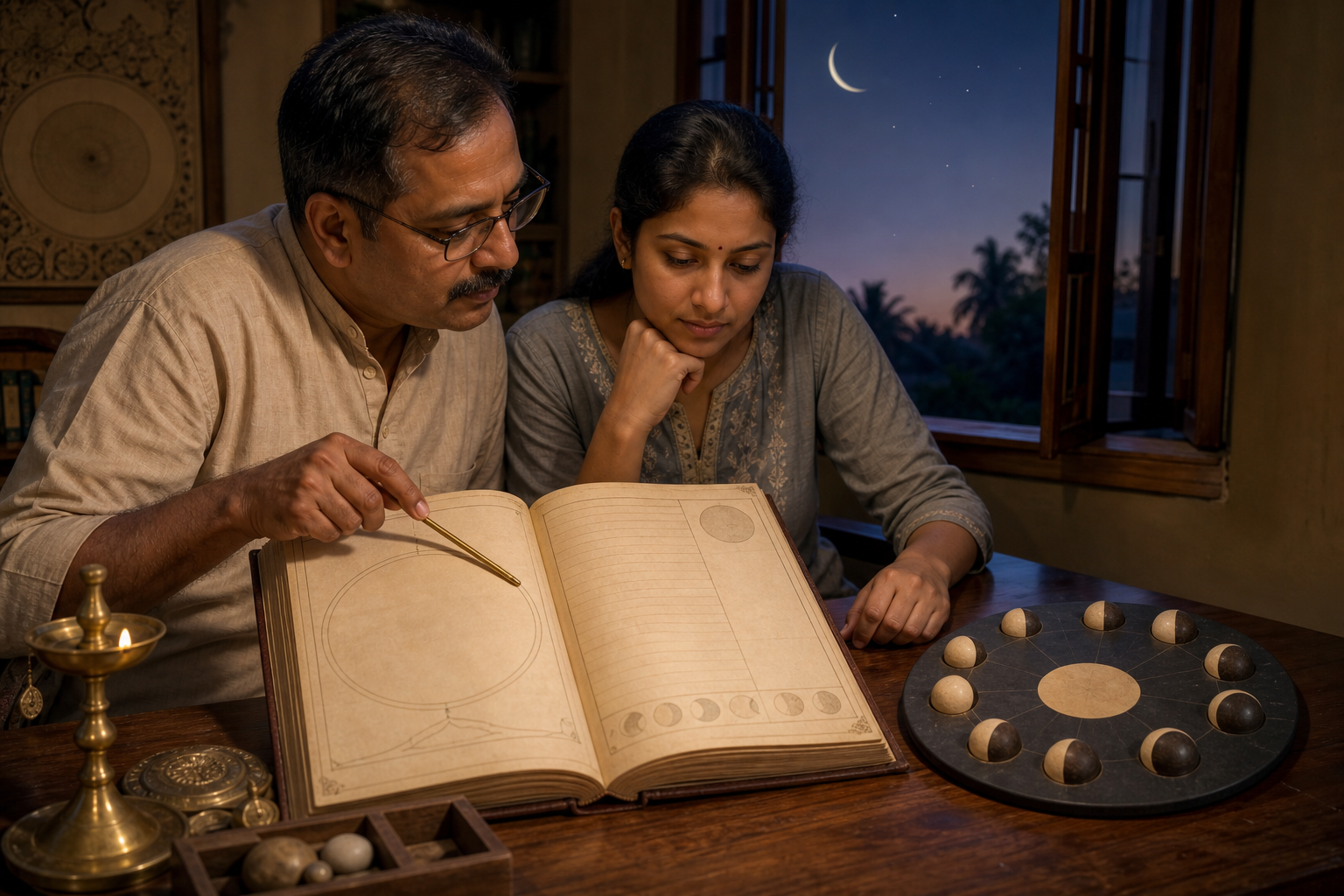
The first question is not simply, “When is Karthika?” Ask what fixes the observance: a tithi, a nakshatra, a local lunar month, moonrise, or a temple program. That distinction explains why a list of apparently conflicting dates can contain several correct entries.
| Observance | Calendrical anchor | Documented 2025 reference point | What you should verify locally |
|---|---|---|---|
| Jwalathoranam | Kartika Purnima and the participating Shiva temple’s program | 5 November, especially in Andhra Pradesh, Telangana, and parts of Karnataka | The temple’s start time, access arrangements, and safety instructions |
| Sankashti Chaturthi | Krishna Paksha Chaturthi, with moonrise relevant to completion of the fast | 8 November; identified with Kartik in the Gujarati Panchang | Local Chaturthi timing and moonrise for your location |
| Paitha Mahakruchcha Vratam | Kartika Krishna Saptami through Ekadashi | 11-15 November, concluding on Utpanna or Utpatti Ekadashi | Your regional Panchang and the sequence followed by your family or temple |
| Kala Bhairava Ashtami | Krishna Ashtami following Kartik Purnima | 12 November; placed in Margashirsha by many regional calendars | The local Ashtami window and Bhairava or Shiva temple schedule |
| Thrikkarthika | Vrischikam and the Kaarthika, Rohini, and Makayiram nakshatras | 4-6 December in Kerala, with 4 December as the principal Thrikkarthika day | Local nakshatra timing and the program of the Bhagavathy or Shiva temple you attend |
Those 2025 dates illustrate the structure; they are not reusable dates for another year. Kartika or Karthika can refer to a regional lunar-month reckoning, while Kerala’s Thrikkarthika is situated in Vrischikam and follows a nakshatra sequence. Kala Bhairava Ashtami can meanwhile be called a Margashirsha observance even though its position is defined in relation to Kartik Purnima.
For the year you intend to observe, use one trusted local Panchang and the schedule of the temple you will actually visit. Do not combine a tithi copied from one region, moonrise from another city, and ritual instructions from a third sampradaya. If family practice differs from a generic calendar listing, ask which calendrical rule and lineage custom the family is following before assuming either is mistaken.
Choose one primary vrata that you can complete honestly
A vrata is not merely a menu restriction. It joins a sankalpa, disciplined conduct, worship, and some form of self-restraint. The most useful choice is usually the observance rooted in your household or chosen temple, not the one with the most demanding-looking austerity.
- For a Ganapati-centered day: Sankashti commonly involves upavasa until moonrise, followed by Ganapati worship and Chandra darshan. Durva grass, red flowers, modaka, Ganesha Atharvashirsha, and Sankashtanashana Ganesha Stotra are established elements from which a family can follow its customary selection.
- For a sustained Vishnu discipline: Paitha Mahakruchcha Vratam gives you a five-day frame rather than a single evening. Daily Vishnu puja, simple living, prayer, seva, charity, reverence toward elders, and measured speech belong to its practical spirit. The important household decision is to reserve a repeatable worship period on all five days before undertaking the sankalpa.
- For Shaiva reflection on time and vigilance: Kala Bhairava Ashtami may include fasting, temple worship, an evening lamp, and recitation of the Kalabhairava Ashtakam. Oil lamps, black sesame, abhishekam, feeding dogs, and anna daan are associated devotional and seva practices.
Before beginning, write a one-sentence sankalpa in language you understand: name the deity or sacred focus, the period you will observe, the restraint you will keep, and the act of seva you will complete. A workable example is: “During this vrata, I will keep my speech measured, perform the prescribed worship, and offer one deliberate act of service.” This is a planning aid, not a replacement for the wording transmitted in your family or sampradaya.
Upavasa should not become a contest in physical severity. If fasting would be unsafe for you or would conflict with medical advice, do not improvise a harsher regimen. Follow your clinician’s guidance, and ask a knowledgeable family elder, acharya, or temple priest how your tradition preserves the vrata through an appropriate modification, prayer, ethical restraint, or seva.
Know what kind of sacred flame you are approaching
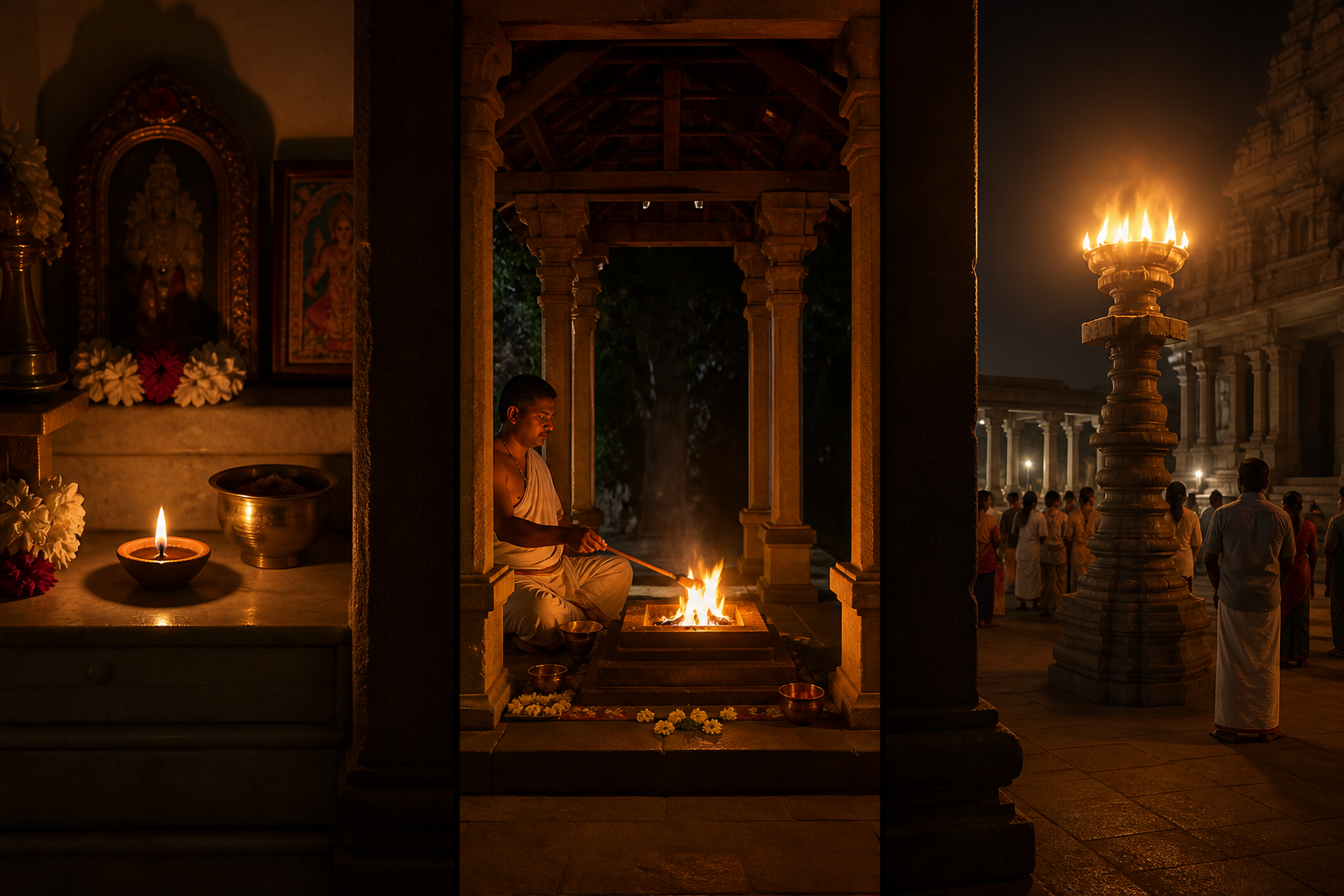
Agni is present across Karthika’s visual landscape, but every flame is not the same ritual. A deepa offered at home, a temple deeparadhana, and Jwalathoranam carry related themes of illumination while retaining different forms and ritual settings. Calling all of them “fire worship” erases the distinctions you need in order to participate properly.
- The household deepa marks sacred attention. During Thrikkarthika, rows of earthen lamps are placed at thresholds, in courtyards, and near household sacred spaces. Cotton wicks and locally customary oils, including sesame or coconut oil, keep the observance connected to familiar Kerala practice.
- The vrata lamp supports a specific devotional commitment. On Kala Bhairava Ashtami, an evening oil lamp accompanies prayer, reflection, and vigilance in conduct. Its purpose is not simply to produce a festive display.
- Jwalathoranam is a temple threshold rite. Its defining form uses two upright wooden logs and a third horizontal beam to make a ceremonial gateway, accompanied by priestly worship, lamps, and communal participation. It should not be reduced to a decorative arch or reproduced casually as a do-it-yourself household fire structure.
The distinction changes what you should do. You can prepare and light household deepams according to family custom. At Jwalathoranam, arrive before dusk if you want to see the preparations, then follow the temple’s route and the instructions of priests and volunteers. Do not touch, cross, or approach the structure merely because others appear to be moving nearby.
Open flame can ignite clothing, paper, garlands, curtains, or unstable decorations. Put each lamp on a firm, heat-tolerant surface; clear the surrounding area; and light only as many lamps as an adult can supervise continuously. Children can help arrange unlit clay lamps and cotton wicks, but an adult should manage the flame. If a large display cannot be watched safely, use fewer lamps. At a temple, maintain the distance set by the organizers rather than moving closer for a photograph or a better view.
Build a Karthika evening your household can repeat
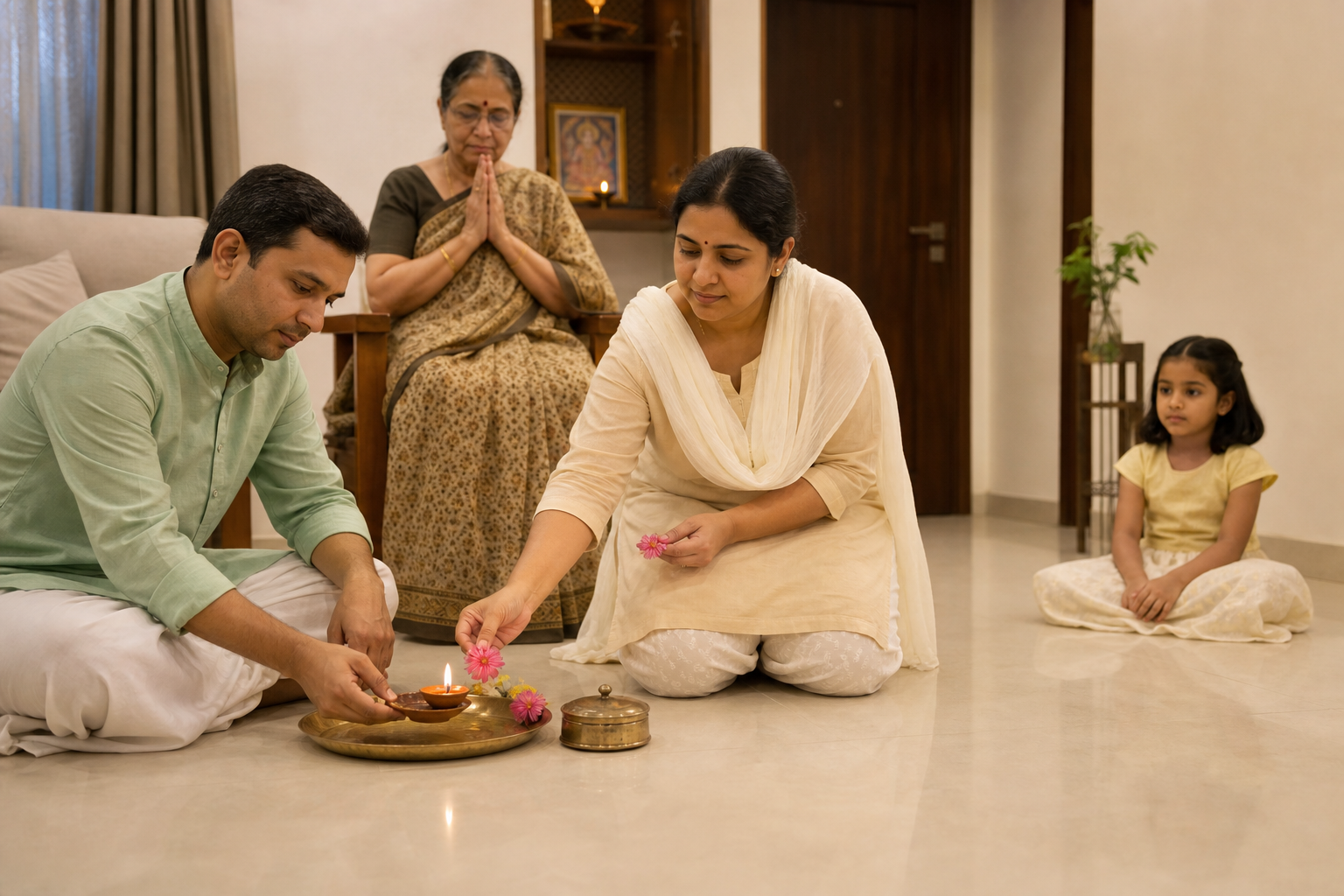
The season becomes formative when worship has a dependable order. A complicated setup performed once with strain usually teaches less than a modest sequence the household can sustain.
- Confirm the anchor. Check the relevant tithi, nakshatra, moonrise, or temple time in the local Panchang. Record the reason for the date, not just the date itself.
- Prepare only what the observance requires. Clean the puja space, arrange the deity’s customary offerings, set out the text you will recite, and place lamps before dusk. Avoid adding objects merely because they appeared in an unrelated regional celebration.
- State the sankalpa. Say what you are observing and what discipline you are accepting. Include conduct: mindful speech, ahimsa, simplicity, gratitude, or restraint from a habit that scatters your attention.
- Perform the deity-specific worship. Keep Ganapati, Vishnu, Shiva, Bhairava, or Bhagavathy practice in its proper sequence. If you do not know that sequence, follow your family elder or temple rather than assembling one from fragments.
- Give each family member a real role. An elder can explain why the date was selected, a child can arrange unlit lamps or offerings, and an adult can manage fire and lead the recitation. This turns cultural memory into participation rather than a lecture.
- Carry the vrata beyond the shrine. Complete the chosen seva, charity, respectful care for elders, anna daan, or compassionate act. The restraint should remain visible in your speech and behavior after the lamp is extinguished.
Karthika’s language of light also creates a point of recognition among Dharmic traditions. Hindu, Buddhist, Jain, and Sikh paths each value disciplined conduct, compassion, service, and movement from ignorance toward clarity, but that kinship does not make their ritual forms interchangeable. You can affirm a shared civilizational ethic without relabeling another tradition’s practice or flattening a distinct Hindu vrata into generic spirituality.
When explaining the observance to a child or guest, keep the connection concrete: the lamp makes clarity visible, the vrata trains disciplined choice, and seva tests whether worship changes how we treat others. That explanation preserves both the sacred symbol and its ethical demand.
Key takeaways
- Identify whether your observance follows tithi, nakshatra, moonrise, a regional month, or a temple schedule before selecting the date.
- Do not reuse a previous year’s festival dates; verify the intended year in a local Panchang and with the temple you will attend.
- Choose one primary vrata and define its worship, restraint, and seva before taking the sankalpa.
- Treat household deepams, temple deeparadhana, and Jwalathoranam as related but distinct sacred forms.
- Keep open flames continuously supervised, and leave structural fire rites to the temples and trained organizers who conduct them.
- Measure the vrata by steadiness of conduct, not by how many observances or austerities you accumulate.
Before your next Karthika observance, open the Panchang used in your community, mark one calendrical anchor, write your sankalpa, and set aside only the materials that practice requires. A durable season of sadhana begins with a promise you can understand and keep.
References
- DharmaRenaissance Blog — Paitha Mahakruchcha Vratam 2025: Complete Guide to Five-Day Vishnu Puja in Karthika Masam
- DharmaRenaissance Blog — Sankashti Chaturthi on 8 November 2025: Sacred Ganesha Puja, Fasting, and Devotional Insights
- DharmaRenaissance Blog — Thrikkarthika 2025 (Karthika Deepam): Sacred Kerala Festival of Light—Dates, Rituals, Significance
- DharmaRenaissance Blog — Jwalathoranam 2025 (Jwala Thoranotsavam): Sacred Date, Ritual Meaning, and Temple Guide
- DharmaRenaissance Blog — Kaal Bhairav Jayanti 2025: Auspicious Date, Rituals, and Deeper Meaning for Devotees
