
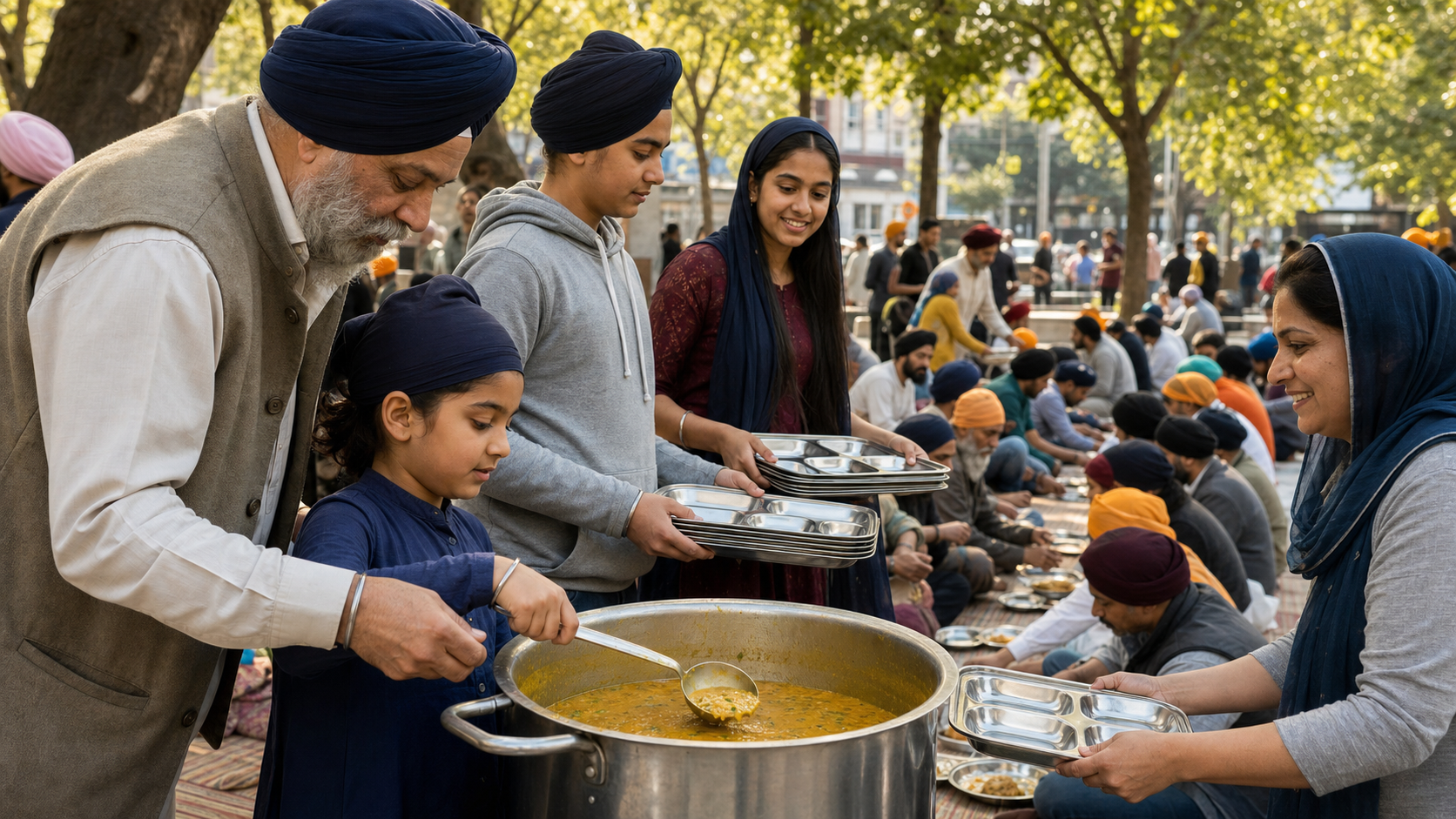
You’ve been asked to help younger families connect with Sikh heritage. The hall fills on important days and phones fill with photographs, yet many children still leave without knowing why seva, sangat, or langar should shape the rest of their week. The problem isn’t a lack of pride. Heritage has been presented as something to observe when it must also become something they can do.
Your goal is continuity: a child, newcomer, or neighbour should be able to move from recognizing a Sikh symbol to understanding its meaning, accepting a role, and carrying the practice forward. That requires more than commemorative events. It requires institutions, memory, disciplined participation, and public interpretation working together.
Heritage fails at the handoff between meaning and participation
A display can preserve the appearance of heritage while losing the inheritance itself. A photograph of langar does not teach someone how shared work sustains it. A recording of kirtan does not create a listener who understands its place in congregational life. A Gatka performance can impress an audience without transmitting discipline, vocabulary, or responsibility.
Living heritage needs a chain of transmission. Someone names the practice, explains its purpose, demonstrates it faithfully, gives the learner an appropriate role, and remains present while that learner grows into responsibility. If any link is missing, culture gradually becomes either spectacle or nostalgia.
This matters especially with concepts such as Naam, Seva, Sangat, Hukam, and Ik Onkar. They shouldn’t be reduced to inspirational words on a poster. Naam points toward disciplined remembrance. Seva takes form through service. Sangat places spiritual development within fellowship. Hukam gives people a way to meet circumstance with humility and responsibility. Ik Onkar provides a unifying spiritual affirmation. Each concept becomes intelligible through practice, not translation alone.
When you assess a program, family custom, exhibition, or class, ask three practical questions. What does this mean within Sikh life? Who currently carries it? What can the learner actually do next? If you can answer only the first question, you have interpretation without transmission. If you can answer only the second, knowledge may remain locked inside an ageing circle. If you can answer only the third, participation may become busywork without spiritual or historical depth.
Key takeaways
- Preserve Sikh vocabulary and the practices that give it meaning together.
- Give learners real, bounded roles instead of treating them only as an audience.
- Record provenance, pronunciation, context, and permission alongside photographs and files.
- Use different stewardship methods for objects, places, embodied practices, and institutions.
- Explain Sikh identity clearly in public before drawing connections with wider Dharmic values.
Make the gurdwara a school of responsibility, not a ceremonial backdrop
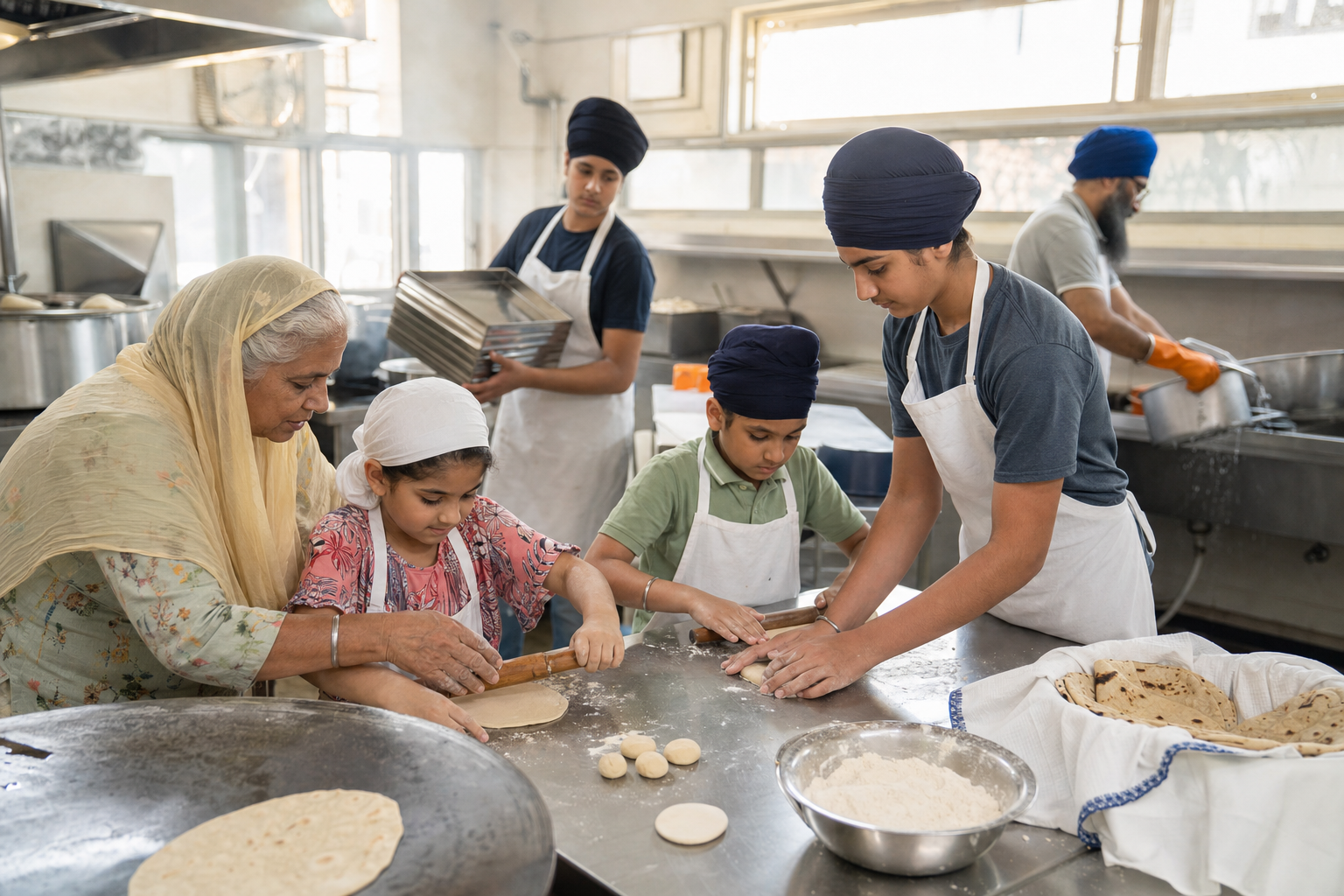
The gurdwara is where Sikh heritage can remain devotional, social, intergenerational, and public at the same time. Kirtan, ardas, langar, and seva aren’t separate attractions on a program. Their relationship forms a pattern of remembrance, congregation, service, equality, and responsibility. A functioning gurdwara can therefore offer something no exhibition can reproduce: entry into a living sangat.
That potential is clearest when the gurdwara operates as a spiritual home, community anchor, and place of neighbourly encounter. But simply opening the building does not guarantee meaningful access. Newcomers may not know what is happening, young people may be present without being entrusted, and regular volunteers may carry so much tacit knowledge that nobody realizes it needs to be taught.
Build participation as a visible pathway:
- Orient. Before asking someone to join, name the practice and explain why it matters. Use the Sikh term first and then a plain-language gloss. Local etiquette and institutional expectations should come from the gurdwara itself, not from improvised assumptions.
- Offer a bounded role. Give the learner a task that has a clear steward, beginning, and handoff. The point is to experience responsibility without being abandoned inside it.
- Connect action to principle. If the role is part of langar, explain how shared preparation, serving, eating, and cleaning express dignity and collective responsibility. Don’t let the work appear to be generic event catering.
- Invite reflection. After participation, ask what the learner noticed about attention, equality, cooperation, or humility. Reflection turns activity into understood experience.
- Create a return path. Tell the person when and how the role happens again, who can answer questions, and what greater responsibility could follow. A single appearance creates a memory; repeated service forms a bearer of tradition.
You can test the institution by imagining someone entering without family connections. Is there a person who can receive them? Can they understand the purpose of what they see without interrupting worship? Can they find a legitimate way to help? Do youth encounter only stage performances and classroom explanations, or are they trusted with recurring work under guidance? These questions reveal whether welcome is merely verbal or built into the institution.
Intergenerational continuity also depends on succession. The person who remembers how a recurring activity works should identify another person who can perform it, explain it, and eventually teach it. Record the purpose of the role as carefully as its procedure. Otherwise, the next volunteer may reproduce the visible task while losing the value it was meant to embody.
Create a community memory record that can outlive a phone
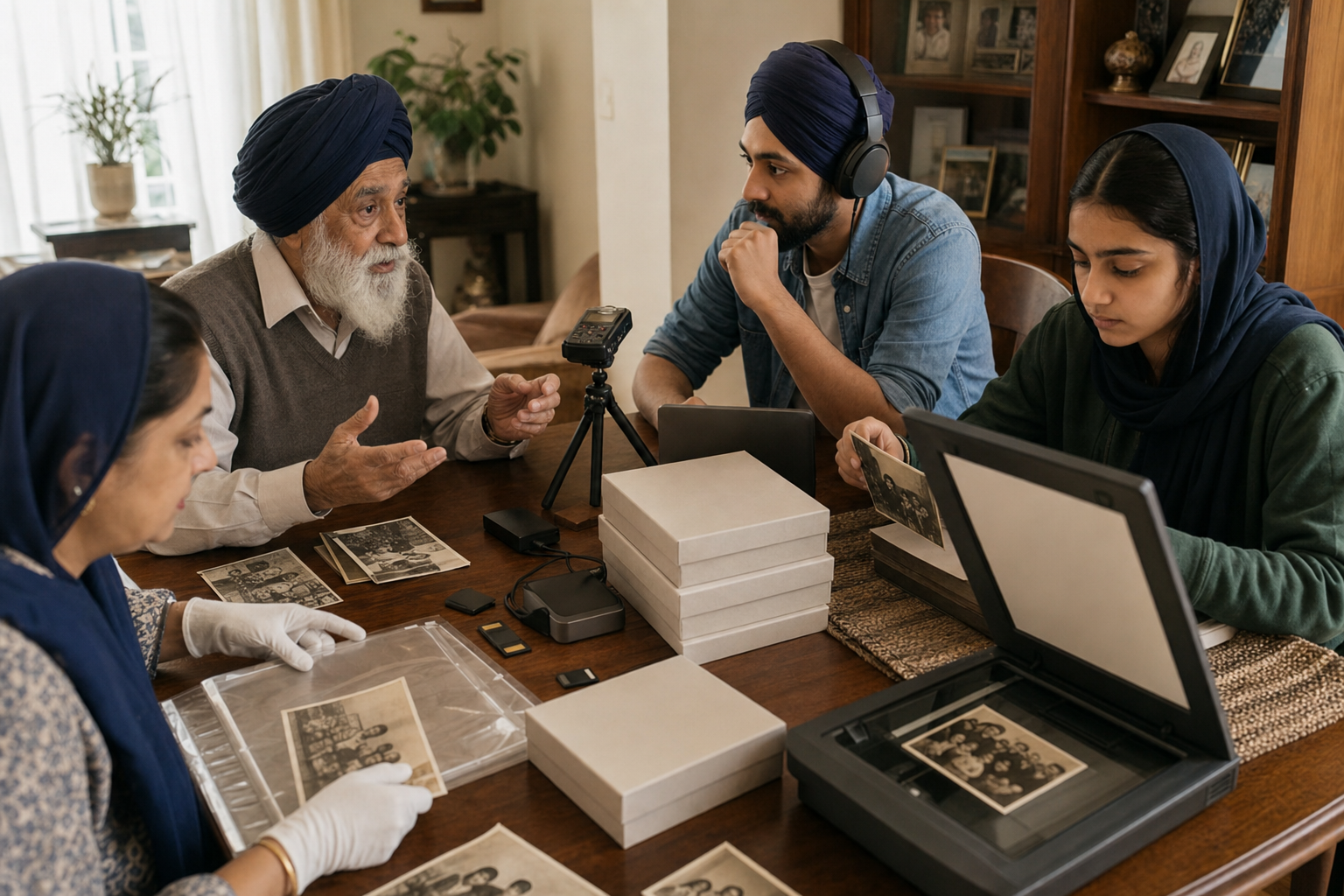
Digital preservation begins easily and fails quietly. Families scan photographs, record an elder, or collect images from an event. The files remain on one person’s phone, names are omitted, permissions are unclear, and the next person cannot tell what the material means. The image survives while its context disappears.
A useful archive is not just a folder of files. It joins material with provenance: who created or held it, where it came from, what it was used for, how it entered the collection, and who may view or republish it. Responsible digital heritage also requires contextual metadata, accessible interpretation, community participation, and long-term preservation. These practices make cultural memory discoverable without separating it from the people who understand it.
Start with a small, complete record rather than a large, unexplained upload:
- Select one meaningful item or memory. It might be a photograph, textile, handwritten text, everyday object, recording, or recollection connected to family or institutional life.
- Capture its identity. Record the names, place, approximate context, language, ownership, and relationship to the community. Preserve original spellings where they are known rather than silently normalizing them.
- Record the human explanation. Ask the knowledgeable person what the item did, when it appeared in community life, what words were used around it, and what a younger viewer would otherwise misunderstand.
- Clarify permission. Separate permission to preserve from permission to publish. Living people may consent to a family or gurdwara archive without consenting to open internet distribution. Record restrictions beside the file so they don’t become detached.
- Add an accessible interpretation. Supply a short description, a transcription where needed, and a translation or glossary that retains the Sikh terminology. Access means being able to understand the record, not merely being able to open it.
- Return the record to its community. Give contributors a usable copy and a way to correct names or context. Community knowledge should not be extracted and then made inaccessible to the people who supplied it.
Multilingual access is especially important. A translation can help a learner enter the material, but it should sit beside the original term, script, or voice rather than replace it. Pronunciation recordings can preserve something a text label cannot. A short contextual note can also prevent a family-specific practice from being presented as universal Sikh practice.
Don’t publish sensitive material by default. Family histories may contain personal information, grief, conflict, or details about living people. Ask what belongs in an open exhibit, what should remain within the sangat or family, and what should be closed for the time being. Cultural preservation does not cancel consent.
Objects, places, and embodied practices need different stewardship
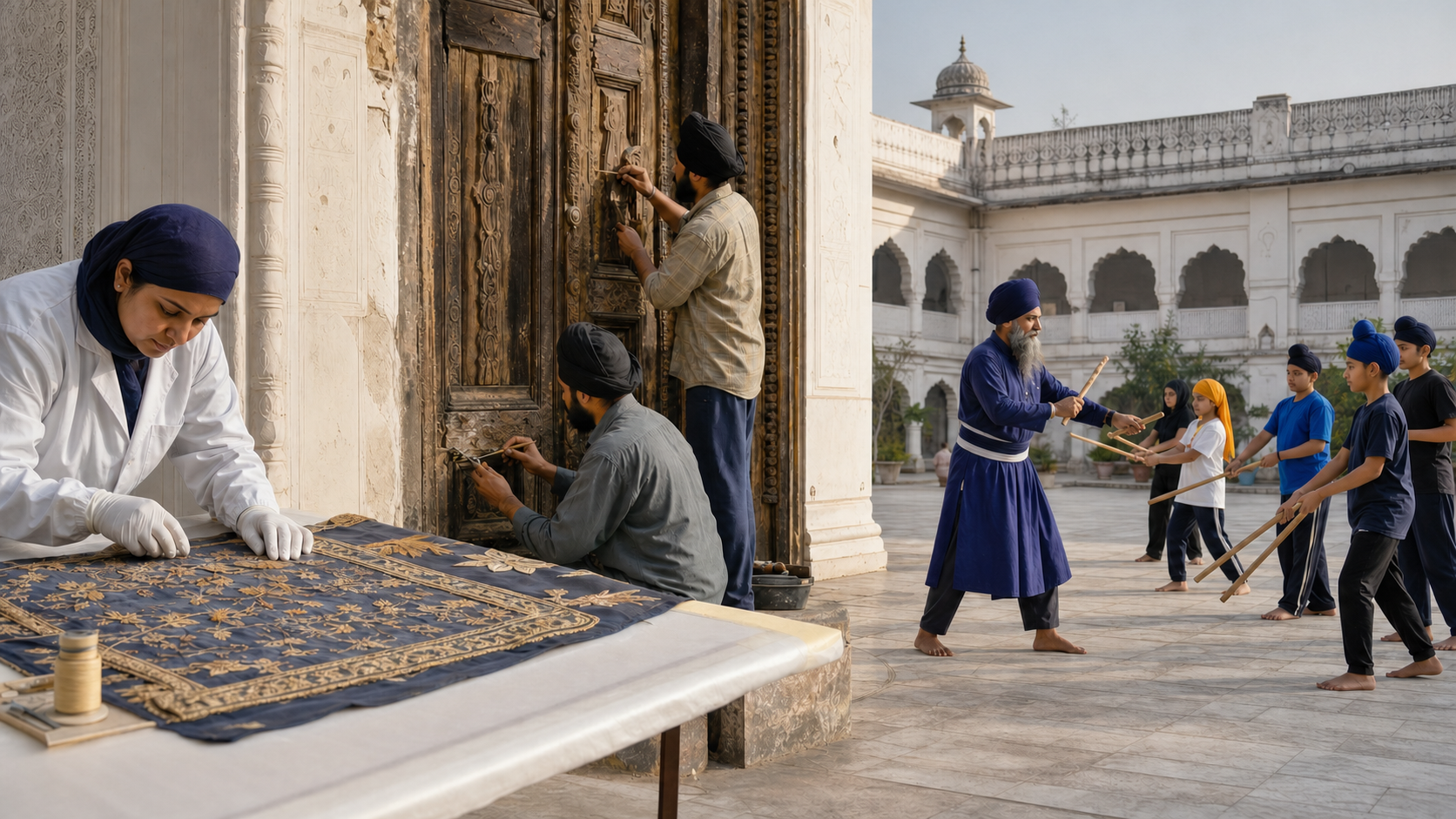
Heritage work goes wrong when every cultural form is treated like a museum object. A sundial can be documented and conserved. Gatka must be practised through bodies, teaching relationships, discipline, and safety. Langar depends on an institution and recurring collective work. An oral memory remains connected to a person and may carry privacy obligations. Each form has a different failure point.
| Heritage form | Main risk | What to record | What keeps it living |
|---|---|---|---|
| Historic or sacred object | Damage or removal from context | Provenance, material, location, condition, use, and associated meanings | Appropriate conservation, contextual interpretation, and careful access |
| Embodied practice | Reduction to spectacle or loss of teaching knowledge | Practitioner-approved terminology, sequence, ethics, teacher relationships, and safety context | Supervised instruction, repetition, and a community of practitioners |
| Institutional routine | Dependence on a few people and weak succession | Purpose, roles, handoffs, local norms, and responsible contacts | Recurring participation, mentorship, and visible entry points |
| Oral or family memory | Loss of context or violation of privacy | Voice, pronunciation, relationships, provenance, and permissions | Consent, family or community access, correction, and retelling |
Gatka shows why embodied heritage cannot be preserved by video alone. Its footwork, coordinated movement, controlled weapon training, focus, and ethical discipline develop through guided practice. A recording can document a form or help a practitioner reflect, but an observer cannot safely reconstruct weapon work from footage. Demonstrations should distinguish performance from instruction, and practice belongs under qualified supervision with the safety rules of the responsible organization.
Documentation of Gatka should therefore include more than the most dramatic movement. Record foundational vocabulary, how instruction progresses, who is authorized to teach, how equipment is handled, what discipline is expected, and how protective responsibility is explained. Without that context, public display can detach martial skill from the self-mastery and duty that make it culturally intelligible.
The historic sundial at the Darbar Sahib complex illustrates the different demands of material heritage. Its gnomon, alignment, and moving shadow can open a conversation about solar time, architecture, communal routines, scientific observation, and India’s wider astronomical inheritance. A label that says only “historic sundial” identifies the object but does not interpret it. A useful explanation helps a visitor notice how light becomes measurement and why empirical knowledge belongs within the history of a living sacred place.
Material stewardship also requires restraint. Don’t clean, repaint, reposition, or repair a historic object simply because it appears neglected. An apparently helpful intervention can remove original material or evidence. Record its condition and seek appropriate conservation judgment before making an irreversible change. Interpretation can be improved without physically altering the object.
Take Sikh identity into public life without sanding off its edges
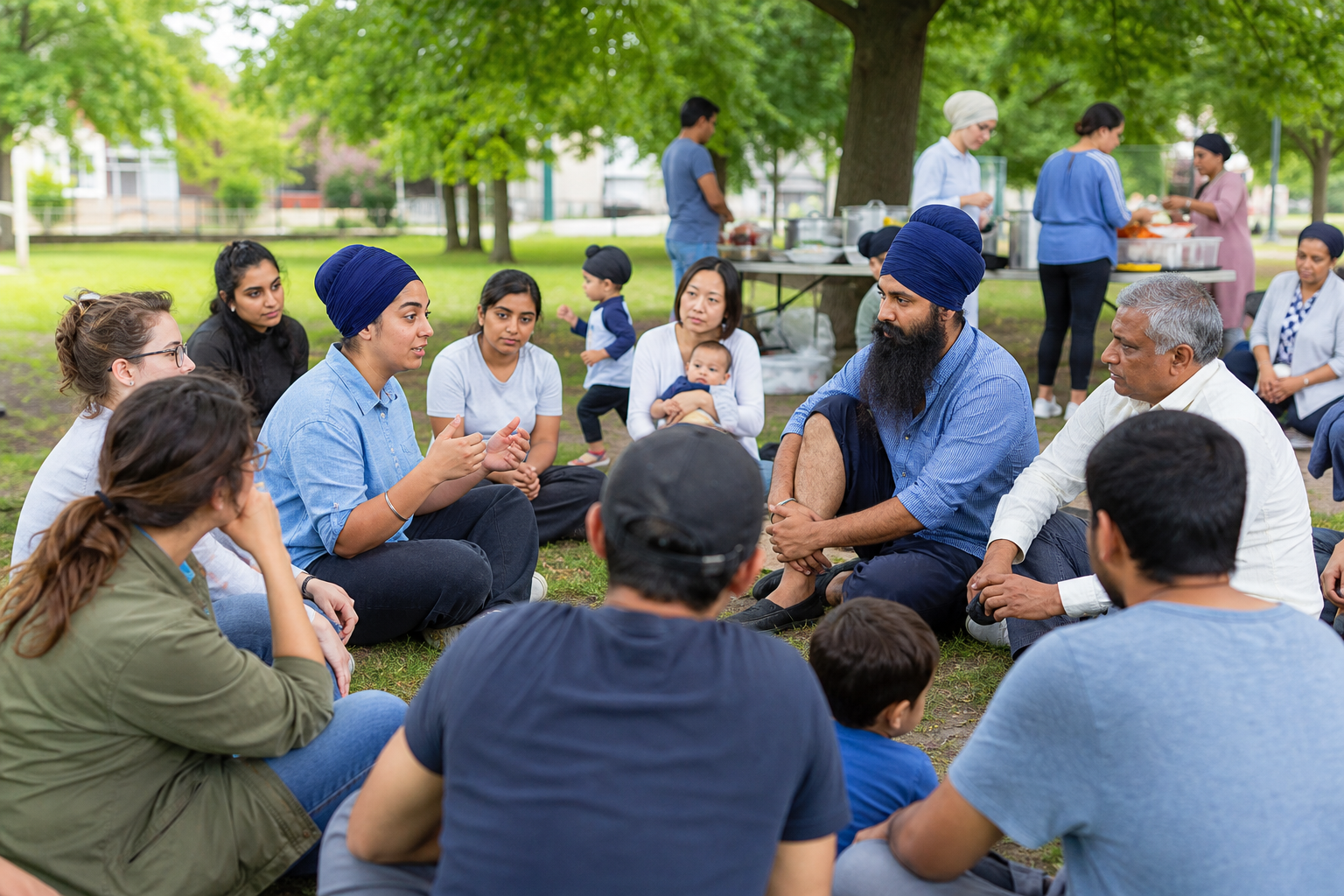
Public culture is what neighbours, schools, civic institutions, and other Dharmic communities encounter. It can take the form of a gurdwara visit, langar, a martial demonstration, an exhibition, a classroom resource, or a community conversation. The challenge is to be accessible without turning Sikh tradition into generic spirituality or colourful performance.
Begin with Sikh vocabulary. Say seva before reducing it to volunteering, sangat before reducing it to an audience, and langar before describing it as a free meal. The plain-language explanation should open the term rather than replace it. Then show the practice in relation to the institution and the people who sustain it.
A strong public program follows a clear interpretive sequence:
- Name it accurately. Use the term by which the community knows the practice, object, or place.
- Locate it in lived Sikh life. Explain who carries it, where it occurs, and what responsibilities surround it.
- Show its ethical meaning through action. Let service, disciplined attention, shared work, or hospitality make the principle visible.
- State the boundary of participation. Tell visitors what they may join, what requires preparation or supervision, and what should be observed respectfully.
- Draw wider connections after establishing identity. Shared Dharmic commitments such as compassion, self-mastery, non-harm, service, and responsibility can support dialogue without claiming that Hindu, Buddhist, Jain, and Sikh teachings are interchangeable.
- Offer a next step. Give the visitor a way to return, learn, serve, attend, or explore a properly contextualized resource.
Langar is especially powerful when its full social grammar remains visible. If outsiders encounter only food distribution, they may miss the shared preparation, service, eating, and cleaning through which dignity and responsibility are enacted. Explain the work and invite appropriate participation. The public meaning lies not only in what is given but also in how people stand in relation to one another while giving and receiving.
Interfaith dialogue works the same way. Start with what is genuinely Sikh, then identify common ethical ground. The ideal of sarbat da bhala, the welfare of all, can support neighbourly cooperation without erasing theological differences. Dharmic kinship becomes more credible when every tradition is allowed its own vocabulary, memory, institutions, and account of the sacred.
Don’t judge public success only by attendance or photographs. Ask whether a newcomer can now explain the practice without caricaturing it. Ask whether a young Sikh moved from performing identity to carrying responsibility. Ask whether community members retained control over how their memories were represented. Ask whether visitors know how to return. These outcomes reveal transmission more clearly than visibility alone.
We’d begin where participation currently stops. Choose one practice that people recognize but do not yet carry. Name its steward. Explain its meaning. Give learners a bounded role. Record the context with consent. Then make the path back visible. You don’t need a larger archive before you do this; you need to restore the human handoff that lets heritage move from memory into conduct.
References
- DharmaRenaissance Blog — Mystic Echoes Review: Luminous Sikh Stories Bridging Dharmic Wisdom and Daily Life
- DharmaRenaissance Blog — Sikh Museum Initiative at 10: A Decade of Digital Heritage Innovation and Dharmic Unity
- DharmaRenaissance Blog — Dharamsal Gurudwara San Antonio Turns 10 in 2025: Celebrating Seva, Community, and Peace
- DharmaRenaissance Blog — Bengaluru to Host a Thrilling Three-Day Gatka Showcase from Nov 7, Celebrating Dharmic Unity
- DharmaRenaissance Blog — Darbar Sahib’s Historic Sundial: What It Reveals About Sikh Science and India’s Astronomical Legacy
