

If you are considering changing your religion in Rajasthan, the first practical question is not which ceremony to arrange. It is how the law classifies what you intend to do. Adopting a new religion requires prior government permission, while returning to your original religion through ghar wapsi is exempt from that requirement.
That distinction must be settled before you act, not explained away afterwards. If your ceremony is imminent, your status is disputed, or an official has given you only an oral answer, consult a lawyer practising in Rajasthan. A general explanation cannot determine how the operative law and rules apply to your facts.
What the prior-permission rule changes for you

Prior permission is more than notification. Notification tells an authority that something has happened or will happen; prior permission makes approval a step that must come before the proposed conversion. Treating the requirement as paperwork that can be completed after a ceremony is therefore a risky misreading. Do not assume a later filing will cure a missing approval unless qualified legal advice confirms that it can.
The high-level rule leaves you with practical details that must be confirmed from the current operative text and official procedure. You need to know which authority handles the request, what form and supporting records are required, whether the individual must appear personally, how a decision is communicated, and what remedy exists if no decision arrives. Do not let an organiser, relative, or social-media message fill those gaps.
Before committing to a ceremony, travel, public announcement, or community gathering, obtain the applicable procedure in writing. Preserve copies of everything submitted and ask for an acknowledgement bearing a date or reference number. If an official gives an important instruction orally, send a written request asking the office to confirm it. A clear paper trail will not guarantee approval, but it can prevent disagreement about what you asked and when you asked it.
Most importantly, permission from the state is not permission from your family or religious organisation. The decision belongs to the person whose faith is changing. Community representatives may explain doctrine or help locate official information, but they should not choose the answer, hold the records, or speak in place of that person.
Why ghar wapsi must be classified carefully
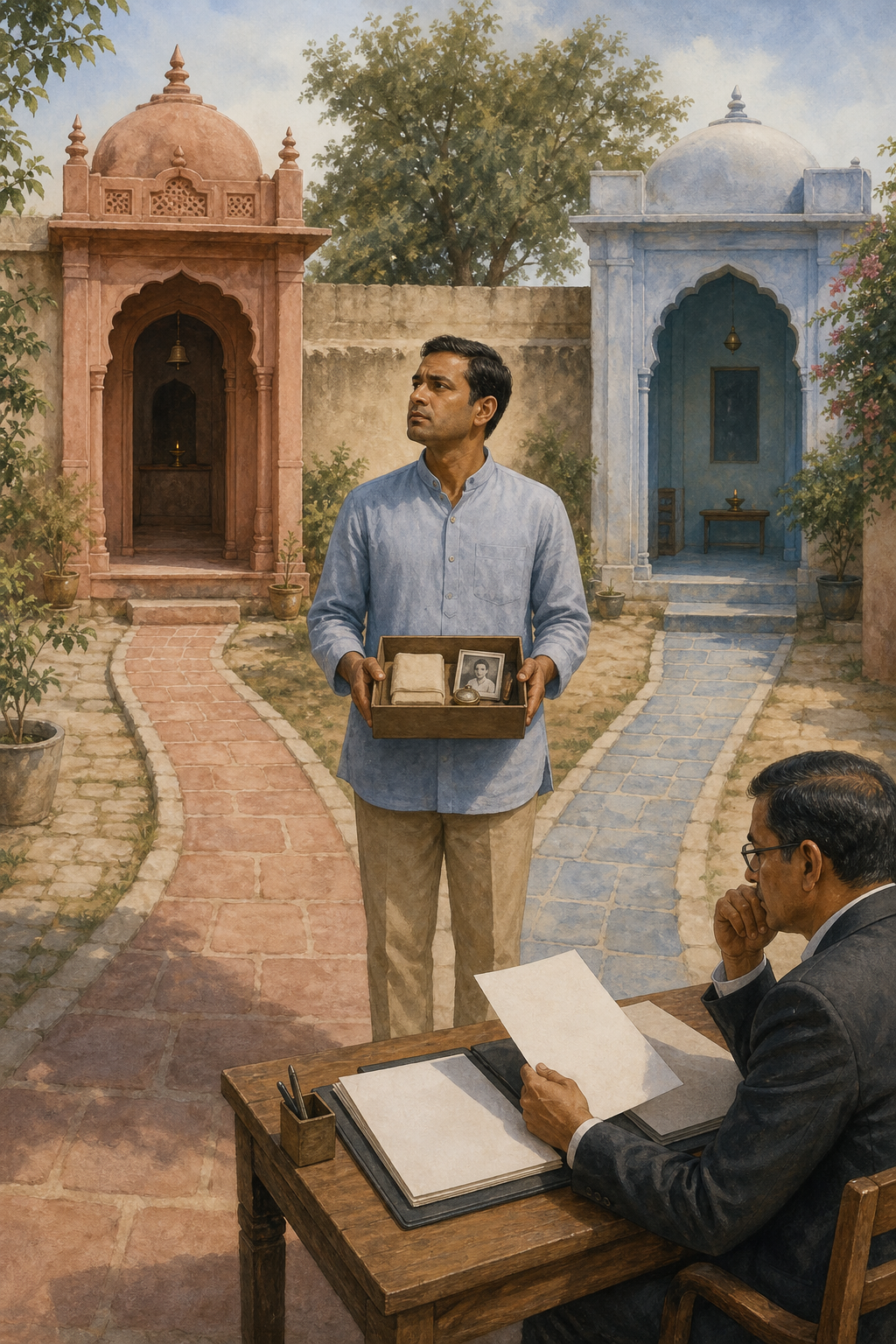
The ghar wapsi exemption treats a return to one’s original religion as continuity rather than a new conversion. Within a Dharmic understanding, that can reflect enduring ties to inherited practice, family memory, and civilisational identity. Legally, however, a meaningful cultural description is not automatically a sufficient classification.
Do not assume that calling an event ghar wapsi settles the matter. Ask how the operative rules define original religion. Does the relevant test concern the individual’s own previously recorded religion, an ancestral tradition, family affiliation, or another legal criterion? If the person’s history contains more than one affiliation, or if official records and family memory point in different directions, obtain advice before relying on the exemption.
The exemption described here concerns the prior-permission requirement. It should not be treated as a blanket answer to every question involving identity documents, marriage, inheritance, institutional membership, or another legal status. Those consequences depend on their own rules. A lawyer should review them if they matter in your situation.
A sensible ghar wapsi record should answer three factual questions without slogans: what tradition the person previously followed, what tradition the person now intends to follow, and why the event is being treated as a return. Supporting material should be genuine and obtained lawfully. Do not create convenient declarations, coach witnesses, or pressure someone to describe a complex history more neatly than the facts allow.
Religious freedom requires two protections at once

Debate about conversion law often collapses into a false choice. One side stresses coercion; the other stresses conscience. A sound approach must protect both. A person should not be pushed into changing faith through force or organised pressure, and the state or community should not obstruct a voluntary decision merely because others dislike it.
Supporters of prior permission see it as a way to deter coercion and create transparency. Critics worry that administrative burdens or delay can themselves interfere with religious choice. Both concerns appear in responses to Rajasthan’s framework. Neither concern can be answered by a label alone; implementation determines whether the process acts as a safeguard or an obstacle.
You can assess an actual case through two tests:
- Voluntariness: Can the person explain the decision independently, without a relative, religious worker, or political group supplying the answer? Is there evidence of threats, dependency, manipulation, or pressure that requires closer scrutiny?
- Administrative fairness: Is the procedure understandable and accessible? Are comparable cases handled consistently? Is the decision recorded, and can an error or unreasonable delay be challenged through a lawful route?
Dharmic confidence is compatible with both tests. Hindu, Buddhist, Jain, and Sikh traditions do not become stronger when personal conscience is ignored. Institutions can honour the continuity represented by ghar wapsi while insisting that every return be voluntary and that people choosing another path receive fair treatment under the applicable law.
A practical checklist before any conversion event

Use this sequence before fixing a date or allowing an organisation to announce the event:
- Describe the intended change in one sentence. Name the person’s present affiliation and intended affiliation without using campaign language. This exposes whether the case appears to be a new adoption or a claimed return.
- Verify the law that is actually operative. Obtain the current statutory text, rules, official orders, and prescribed procedure. Online summaries are useful for orientation, but they are not a substitute for the controlling text.
- Confirm the legal classification. If relying on ghar wapsi, ask the competent authority or a Rajasthan lawyer whether the person’s documented history meets the applicable meaning of original religion. Seek a written answer where possible.
- Identify the correct authority and filing requirements. Confirm the office, form, supporting documents, manner of submission, and method by which permission is issued. Do not send sensitive personal records to an unofficial intermediary.
- Record voluntary intent independently. The person should be able to state the decision in their own words, away from people who may benefit from the outcome. A voluntary statement can support clarity, but it does not replace any permission the law requires.
- Preserve a complete file. Keep the request, attachments, acknowledgement, written instructions, and final decision together. Record submission and receipt dates accurately.
- Pause when the facts are contested. A disputed religious history, family pressure, threats, inconsistent records, an imminent ceremony without approval, or conflicting official instructions warrants individual legal advice before proceeding.
This sequence protects more than compliance. It separates a person’s spiritual decision from the interests of organisers, creates evidence of free intent, and gives officials a clear record on which to act. It also reduces the chance that a disagreement about classification will erupt only after a public event has taken place.
Key takeaways
- Rajasthan’s framework requires prior government permission for adopting a new religion.
- Ghar wapsi, understood as a return to one’s original religion, is exempt from that prior-permission requirement.
- The word return should not be treated as self-proving; confirm how original religion applies to the individual’s documented history.
- Prior permission must be addressed before the proposed conversion. Do not rely on the assumption that later paperwork will be enough.
- Protection from coercion and protection of voluntary conscience are complementary duties, not competing freedoms.
- When the classification, procedure, or consequences are uncertain, obtain advice from a lawyer practising in Rajasthan before any ceremony or public announcement.
Your next step is simple: write down the present affiliation, intended affiliation, and reason the change is or is not ghar wapsi. Take that precise description to the competent office or a Rajasthan lawyer, verify the operative procedure, and act only after the legal position is clear.
References
