
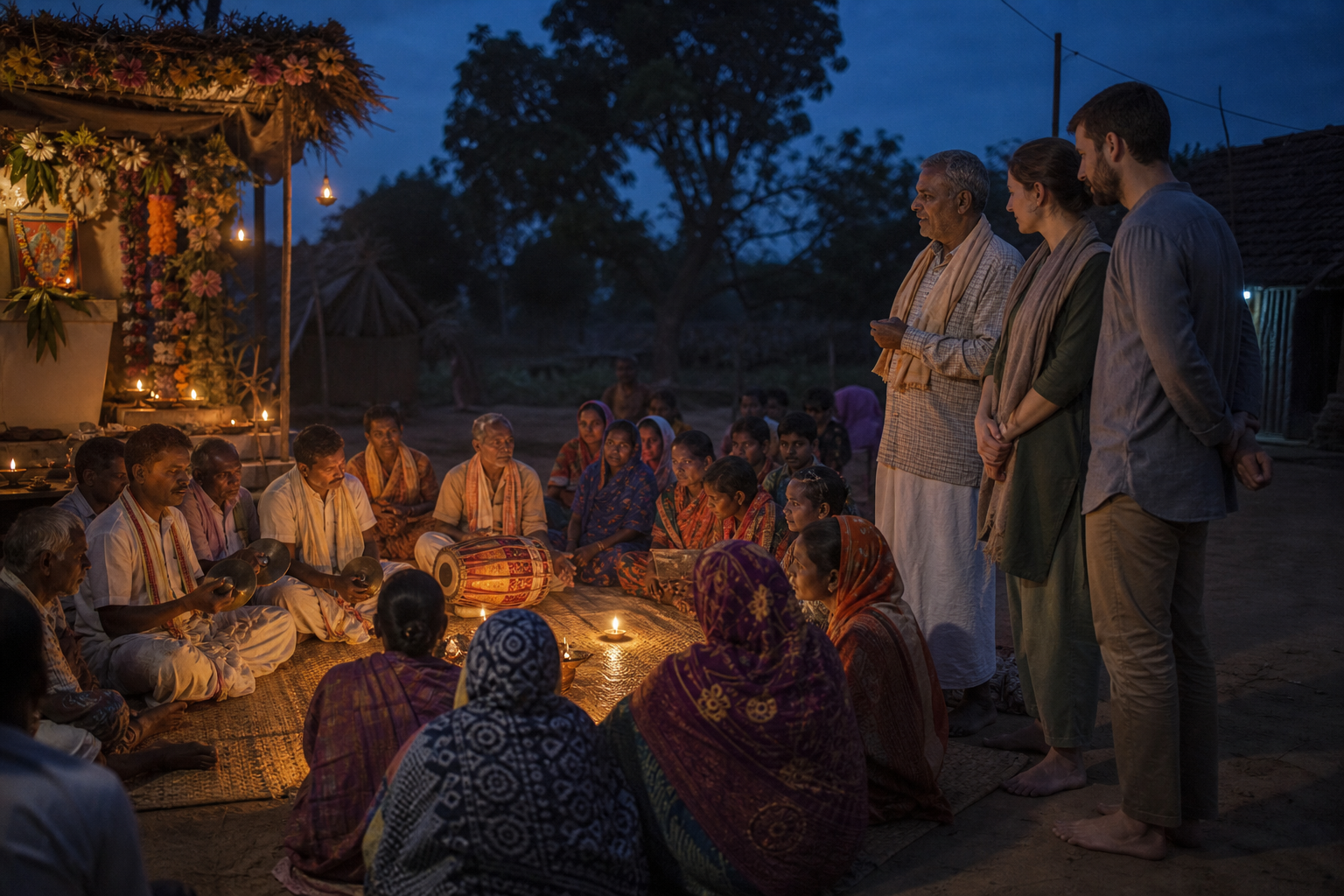
If you are preparing to attend a Trinath Mela, the practical questions come first: When should you arrive? What should you bring? May you join the singing? Is photography acceptable? The answer is not a universal script. Local custom governs the mela, and respectful participation begins by learning that custom.
You do not need to know every ritual in advance. You do need to understand what the gathering honors, watch how the community conducts its worship, and avoid treating a living devotional tradition as either a spectacle or a standardized festival package.
Begin with the local host, not a universal timetable
Odisha is the heartland of Trinath Mela, while communities in Bengal and Assam maintain their own expressions of it. Dates and venues are usually determined through local calendars and community needs, not one date observed identically across every region. A mela may take place in a temple courtyard, village square, or market ground.
This flexibility is not evidence that the observance is casual or undefined. It means authority remains close to the community conducting the worship. The local sequence of prayers, songs, offerings, and public activities may be well understood by participants even when it differs from the sequence followed in another district.
Before travelling, ask a local organizer, temple representative, host family, or community member five precise questions:
- What is the exact date, venue, and gathering time for this particular mela?
- When does the devotional observance begin, as distinct from the wider public gathering?
- Are visitors expected to bring an offering, and what does this community ordinarily accept?
- Are there local rules about clothing, footwear, seating, or entry into the worship area?
- When is photography permitted, and whom should you ask before photographing people?
These questions will tell you more than a generic festival calendar can. They also prevent a common mistake: importing the practice of one village into another and then assuming the local community is doing its own tradition incorrectly.
Understand what Trinath means before reading the ritual
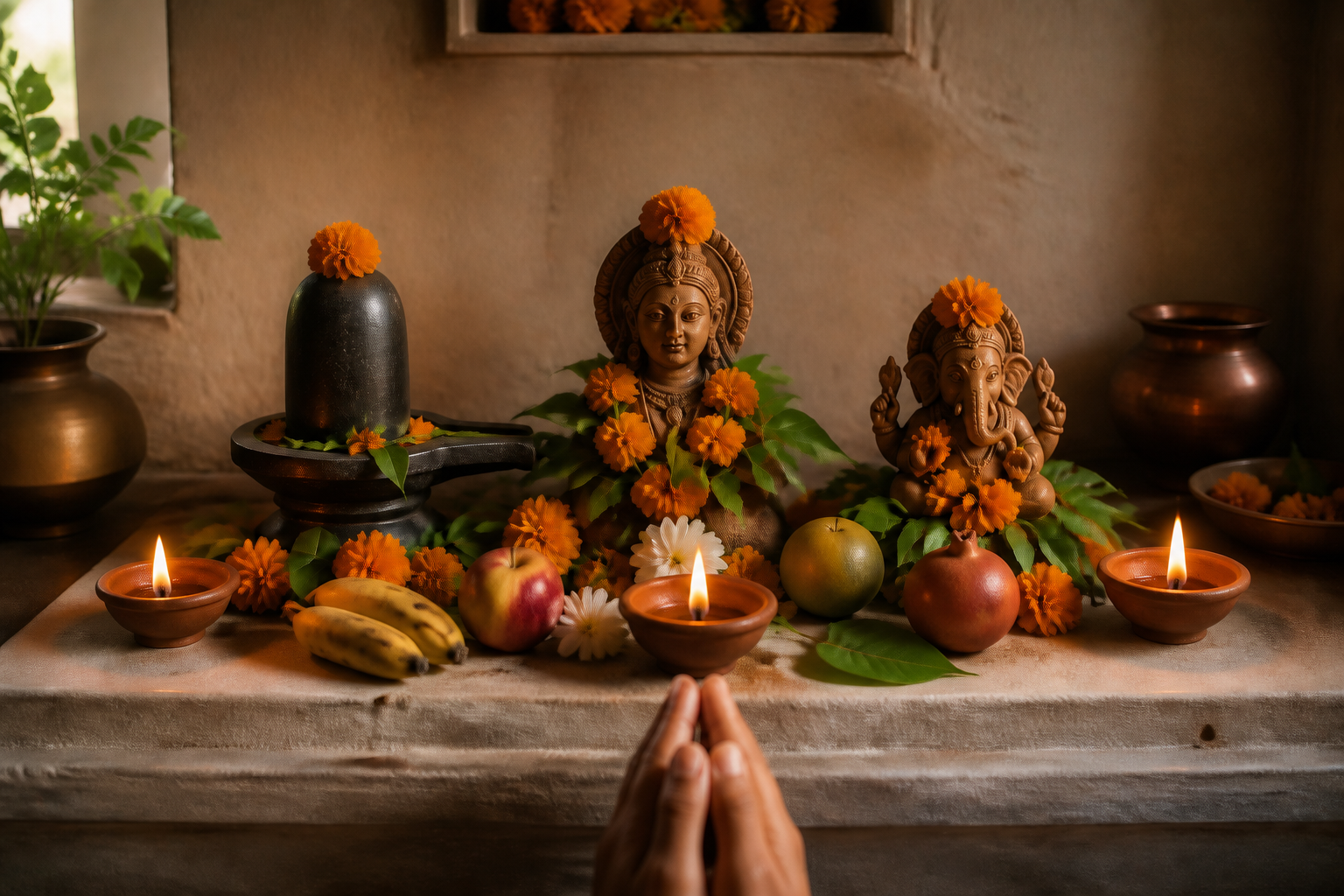
The name Trinath means the “lord of the three.” In the devotional setting of the mela, it refers to Brahma, Vishnu, and Shiva, or to their unity within the divine. The three forms remain recognizable, yet worship does not require the devotee to treat them as rival powers competing for allegiance.
This gives you the right lens for the gathering. Trinath Mela is not merely a public fair with a religious name attached. Its music, lamps, prayers, offerings, and shared food gather around a theological intuition familiar within Sanatana Dharma: different forms and approaches need not destroy an underlying unity.
That unity should not be exaggerated into sameness. Hindu, Buddhist, Jain, and Sikh traditions retain their own teachings, disciplines, and identities. The broader Dharmic resonance lies in values such as ethical conduct, compassion, non-harm, service, and respect across difference. Likewise, the welcome extended to neighbors does not erase the Hindu devotional center of Trinath worship.
When you hear different songs or see different forms of offering, therefore, do not search anxiously for one supposedly pure version that invalidates all others. First ask what remains constant: reverence for Trinath, collective devotion, and the community’s intention to uphold dharma through worship and shared responsibility.
Follow the devotional rhythm without inventing a fixed order
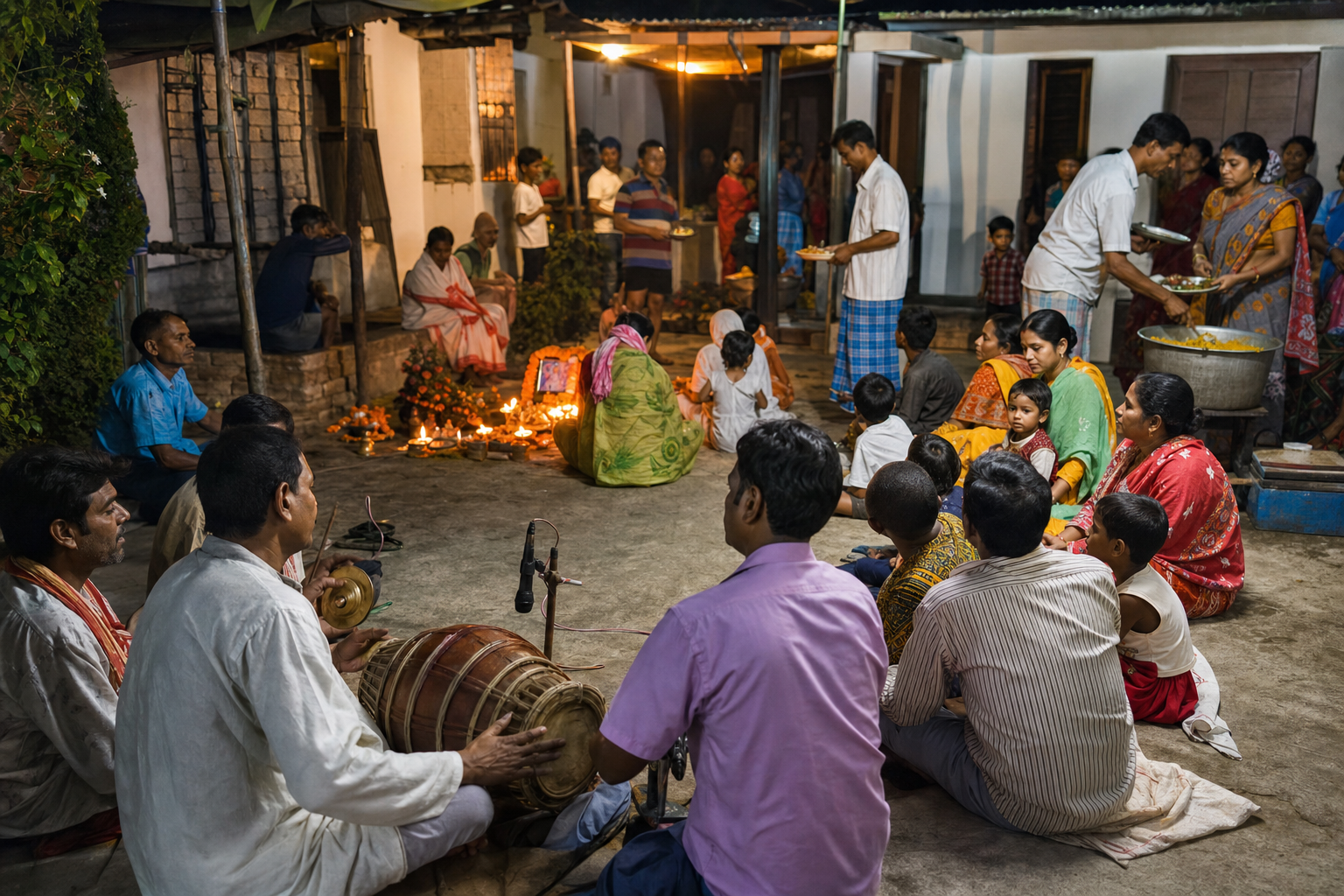
A Trinath Mela commonly brings together kirtan, folk music, collective recitation, rhythmic drumming, and the lighting of lamps. Some celebrations also include processional activity, devotional storytelling, and a communal kitchen. Not every gathering will contain every element, and their order can change from place to place.
Music is part of the worship, not background entertainment. The public character of kirtan allows people to listen and, where appropriate, join. If you do not know the words or rhythm, stand or sit where the host directs, listen to the lead singers, and enter only when the response becomes clear. Quiet attention is better than conspicuous imitation.
The same principle applies to recitation and lamp worship. Watch who is leading, notice how participants approach the sacred area, and wait for an invitation or an obvious public cue. You are not required to copy every gesture. Sincere restraint honors the occasion more than performing actions whose meaning you do not understand.
If a procession or storytelling segment occurs, allow the community to establish the pace and space. Do not block a route for a photograph or speak over a narration because the surrounding fair remains noisy. The mela joins sacred observance with social gathering, but the social atmosphere does not make every moment interchangeable.
Photography requires particular care. Ask before photographing rituals, sacred objects, cooks, musicians, or families. During prayer, put the camera away if you have not received clear permission. If photography is welcomed, take a few unobtrusive images rather than repeatedly stepping into the worship space. The test is simple: your documentation should not alter the devotion you came to witness.
Let local offerings teach you how the mela joins bhakti and place
Offerings at Trinath Mela do not always resemble what a visitor expects from a more formal or standardized temple observance. Communities may present seasonal produce, locally available materials, or handcrafted articles. Such choices reflect local ecology, livelihoods, and the practical resources through which devotion is expressed.
Do not rank these offerings by how closely they match an outside idea of orthodoxy. Within the mela, the devotional intention matters more than imposing uniformity across regions. A locally sourced offering can carry the labor, gratitude, and identity of the household presenting it.
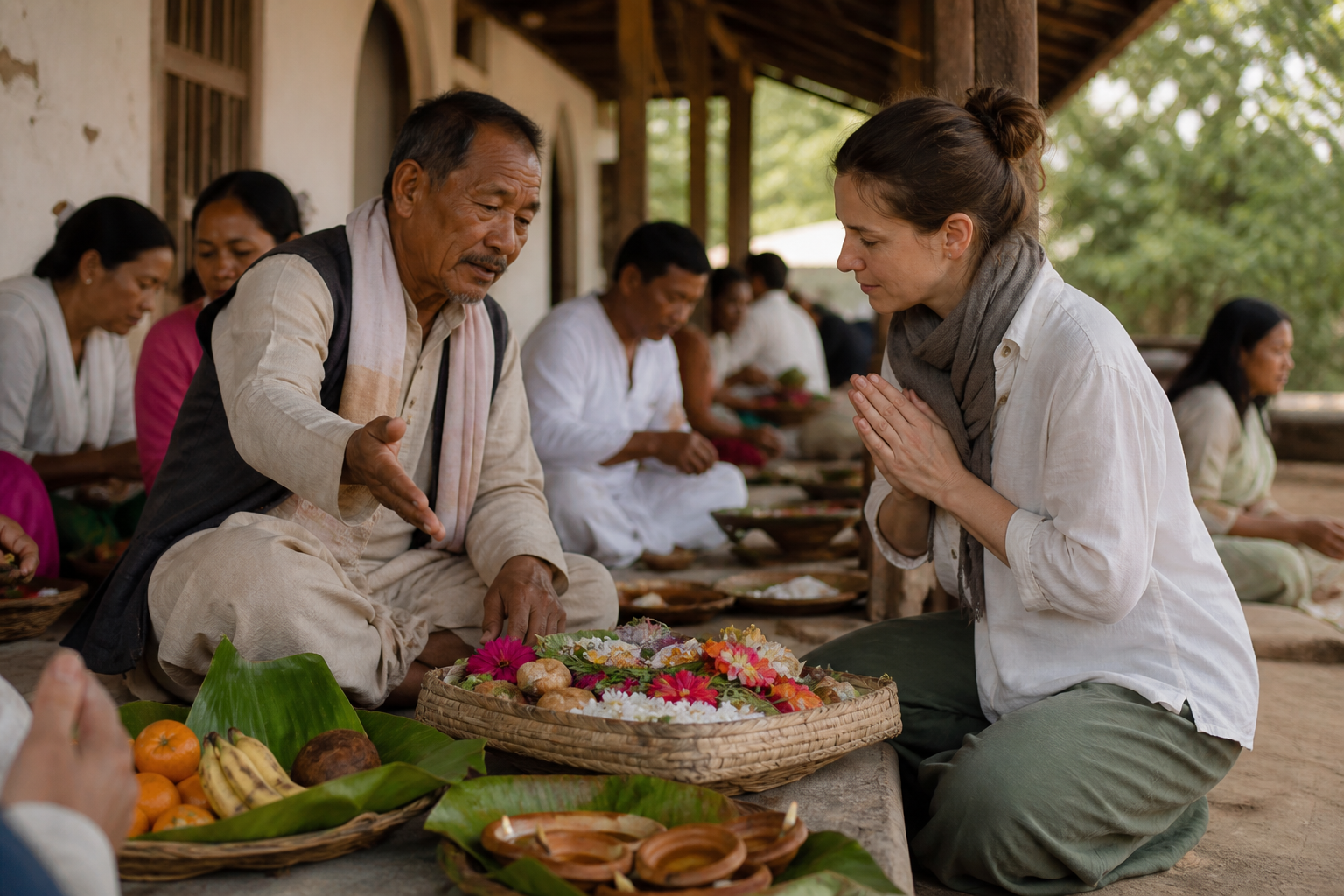
If you want to make an offering, ask what is suitable before buying or carrying anything. Use the channel the organizers provide, and do not place an object near the shrine simply because it seems religiously appropriate to you. This small act of consultation protects both ritual order and the meaning of your contribution.
Prasad and communal food reveal another dimension of the gathering. Shared preparation connects worship with cooperation among households. Receive what is offered without pushing ahead or treating distribution as a commercial food stall. If you cannot accept something, decline or explain quietly rather than making the refusal a public judgment on the community’s practice.
Service can be an honorable form of participation, but useful service is coordinated service. Ask whether help is needed before entering a kitchen, rearranging seats, moving ritual objects, or directing other visitors. The people responsible for the mela know where an extra pair of hands will help and where it will interrupt established work.
Key takeaways for a respectful visit
- Confirm locally: Trinath Mela does not follow one compulsory date, venue, or ritual sequence across Odisha, Bengal, and Assam.
- Keep the devotional center in view: The gathering honors Trinath through Brahma, Vishnu, and Shiva, or through recognition of their divine unity.
- Observe before joining: Follow local leaders during kirtan, recitation, lamp worship, processions, and prasad distribution.
- Ask about offerings: Locally accepted produce or handcrafted items may be more appropriate than an offering chosen from outside assumptions.
- Photograph with permission: Do not obstruct worship, processions, musicians, cooks, or families to obtain an image.
- Describe the local form accurately: If you later share what you saw, identify it as one community’s Trinath Mela rather than presenting it as the only authentic version.
Your best preparation is one local contact and a willingness to watch before acting. Confirm the details, arrive with modest expectations, and let the host community show you how its devotion is practiced. You will leave with more than festival images: you will have encountered a tradition on its own terms and helped preserve the trust that allows visitors to be welcomed.
References
