
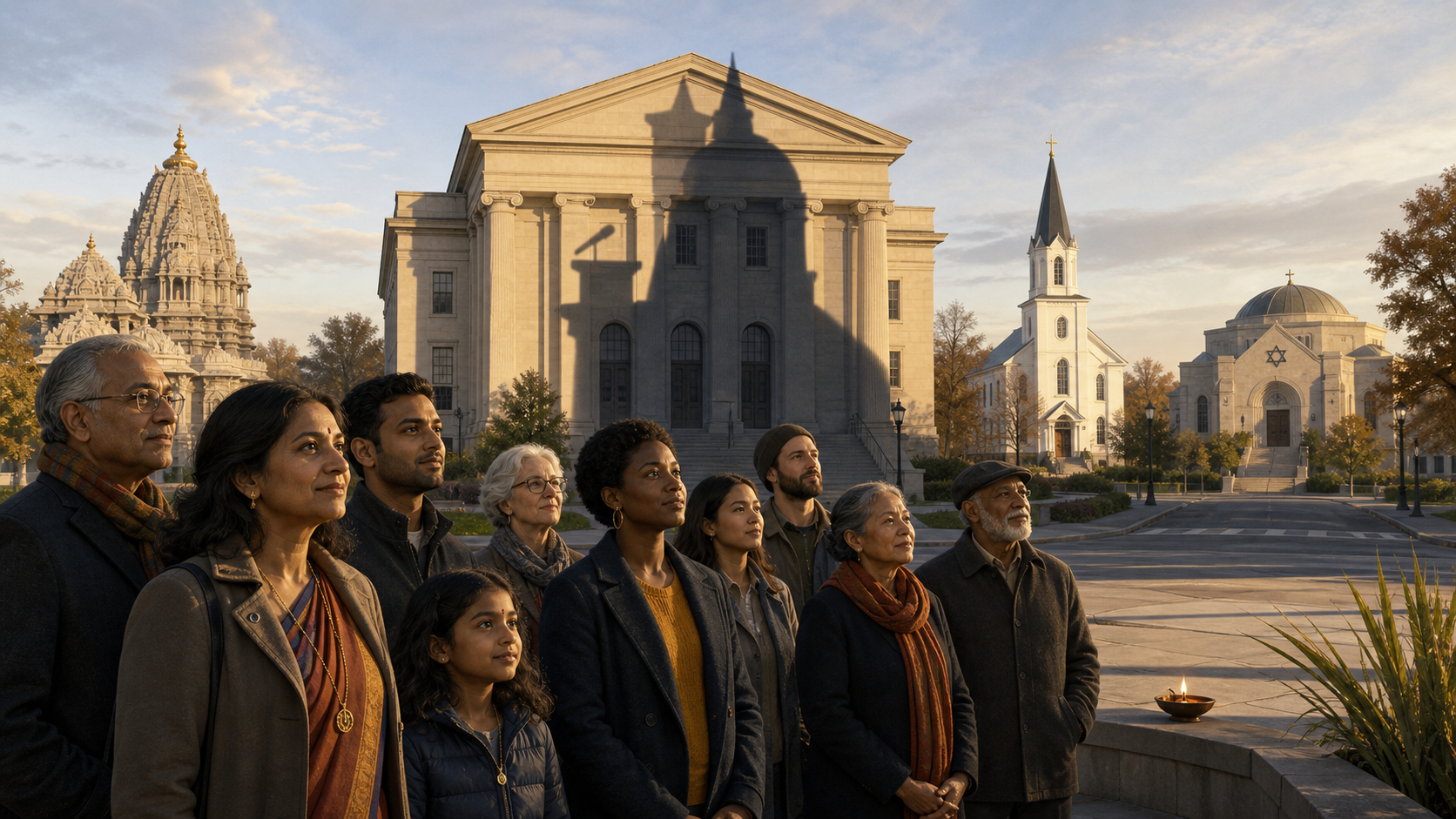
If you are a Hindu American trying to decide whether a hostile remark, a classroom dispute, or a religious policy is merely offensive or part of a deeper exclusionary pattern, begin with conduct. Ask who wants institutional power, what rule they want enforced, and whether they would accept that rule when the faith in question is yours.
That test helps you respond firmly without treating every Christian as an adversary or every criticism of Hinduism as persecution. It also keeps genuine Hinduphobia from being dismissed as a vague complaint. You can identify the precise double standard, preserve evidence, request a measurable remedy, and defend religious freedom on a principle broad enough to protect everyone.
Separate Christian faith from Christian nationalism

Christian nationalism is not Christianity practiced openly. It is a political ideology that treats Christianity as the normative faith of the nation and seeks privileged standing for it in public institutions. A Christian may believe that another religion is theologically mistaken without demanding that a school, legislature, or government office place non-Christians below Christian citizens. The civic danger begins when exclusivist theology becomes a claim to unequal public power.
Hinduphobia is related but distinct. It includes hostility, stereotyping, contempt, or discrimination directed at Hindus, Hindu traditions, deities, institutions, or symbols. It can appear in a Christian nationalist sermon, but it can also appear in a university discussion, a media narrative, a school curriculum, or vandalism with no demonstrated connection to Christian nationalism. Use the narrower term that the evidence supports.
The two overlap when Hindu traditions are called demonic, pagan, or inherently un-American and that rhetoric is used to justify unequal treatment. A pastor’s doctrinal objection to murti puja is not by itself a government policy. A campaign to make the pastor’s theology the standard for public education is another matter.
America’s secular constitutional order was shaped by awareness of the devastation caused when sectarian conflict and state power reinforce one another. The memory of Europe’s religious wars, including the Thirty Years’ War, remains relevant because neutrality is not hostility to Christianity. It protects Christians from rival Christian establishments just as it protects Hindus, Buddhists, Jains, Sikhs, Jews, Muslims, and people with no religion.
When you evaluate a controversy, apply three questions:
- Is the speaker expressing a personal religious conviction, or trying to turn that conviction into an institutional rule?
- Would the proposed rule treat a cross, Bible class, or Christian ceremony the same way it treats a diya, murti, yoga practice, or Hindu observance?
- Is the criticism aimed at a defined belief or political proposal, or does it assign moral suspicion to Hindus as a people?
If the rule changes when the religious symbol changes, you have identified the double standard. State it plainly. That is usually stronger than beginning with a broad accusation about motive.
Recognize the movement from rhetoric to unequal treatment

Not every offensive statement carries the same consequence. The useful question is whether a pattern is moving from contempt, to institutional preference, to coercion or physical harm. Each stage calls for a different response.
- Rhetorical hostility includes describing Hinduism as demonic, reducing its philosophical diversity to idolatry, or presenting yoga as a spiritual threat merely because of its dharmic roots. The immediate response is accurate public correction, not a demand that every insulting opinion be prohibited.
- Institutional asymmetry appears when Christian expression is described as heritage or morality while Hindu expression is treated as foreign, dangerous, or improperly religious. Here you should identify the policy, decision-maker, and unequal comparison, then ask for the same rule to be applied across traditions.
- Material harm includes threats, vandalism, exclusion from a public benefit, or adverse treatment connected to religious identity. Preserve evidence and use the relevant institutional, security, or legal reporting channel rather than allowing the incident to remain an online argument.
Public celebrations provide a clear symmetry test. Donald Trump gave logistical assistance to the Jagannath Rathayatra carts in New York City in 1976 and later hosted Diwali at the White House. Yet prominent Christian nationalist voices denounced a White House Diwali celebration as pagan. The central issue is not whether you support the politician involved. It is whether public recognition of Christianity is defended as national tradition while recognition of Hinduism is condemned as contamination.
The political constituency is substantial. Roughly 80 percent of White Evangelicals supported Trump in both 2016 and 2020, while leaders within that world often presented him as a defender of Christian heritage. That voting pattern shows political influence; it does not prove that an individual evangelical voter is anti-Hindu. Collective statistics should help you understand power, not become a pretext for collective guilt.
Policy proposals deserve the same disciplined reading. Campaigns in Republican-led states have sought Ten Commandments displays in classrooms, expanded Bible instruction in public schools, and fewer restrictions on political activity by clergy. Supporters may describe these measures as moral restoration. The dharmic question is concrete: would the institution give comparable standing to the Bhagavad Gita, Guru Granth Sahib, Dhammapada, Agamas, or Jain teachings, and would families be free from participation in another community’s religious formation? If not, the policy is privilege rather than pluralism.
Physical incidents belong in a more urgent category. Hindu temples in Texas, California, and New York have faced vandalism, while federal data indicate an increase in anti-Hindu incidents from a low baseline. A low baseline does not make an incident trivial, but it does require care with sweeping claims. Record what happened, distinguish a confirmed bias indicator from an assumed motive, and avoid presenting incomplete counts as a complete measure of Hindu life in America.
The swastika requires special literacy. Hindu, Buddhist, and Jain communities preserved it as an ancient auspicious symbol long before its appropriation by the Nazis. When hostile graffiti invokes Nazi imagery against a Hindu institution, educators and journalists should not collapse the sacred symbol and the Nazi emblem into one meaning. Ask them to identify orientation, context, intention, and tradition rather than teaching Hindu children that their inherited symbol is itself hateful.
Document an incident so an institution can act on it

A strong response starts with a usable record. An angry social-media thread may draw attention, but administrators, security teams, journalists, and lawyers need dates, exact words, images, witnesses, policies, and requested remedies. Build that record before public argument changes or deletes the evidence.
- Protect people first. If there is an immediate threat, move away from danger and contact local emergency services. Do not confront a suspected vandal merely to obtain a recording.
- Preserve the original evidence. Save the full message, page, URL, date, time, account name, and surrounding context. Photograph damage from several useful angles before cleanup, subject to instructions from the property owner or authorities. Keep an unedited copy even if you later redact addresses, children’s names, or other private information for public sharing.
- Describe conduct before assigning motive. Write down the exact words or symbols, what happened, where it occurred, who witnessed it, and what practical effect followed. Use labels such as Hinduphobia or Christian nationalism only after showing the facts that support them.
- Identify the responsible channel. A private theological insult may call for dialogue or public correction. Unequal treatment at work or school belongs in the institution’s written complaint process. Threats and vandalism require security or law-enforcement reporting as well as notification of the affected temple or community body. Case-specific rights, filing deadlines, and legal options should be discussed with qualified local counsel.
- Request a measurable remedy. Depending on the incident, that may mean repair or removal, preservation of security footage, equal access under the existing rule, a written correction, review of curriculum, protection against retaliation, or a public explanation of how the policy will be applied in future.
- Keep a case file until the remedy is complete. Record every submission, acknowledgement, meeting, decision, and follow-up date. If an institution closes the matter without addressing the unequal treatment, your organized record makes escalation more credible.
Do not let urgency destroy accuracy. A cropped clip may hide relevant context; a viral accusation may expose a family or employee to retaliation; and naming an unconfirmed suspect can cause serious harm. Preserve the full record privately, publish only what is necessary, and correct errors openly if new facts change the case.
It also helps to separate the remedy from the desired moral verdict. An institution may refuse to declare an ideology hateful while still agreeing to remove vandalism, enforce equal-access rules, revise a misleading lesson, or protect a student. Secure the concrete remedy while continuing the larger public argument on its own merits.
Challenge education without asking for immunity from criticism
Hinduism should not be exempt from serious examination. Caste, gender, political movements, social conflict, and internal reform are legitimate subjects. The problem arises when a tradition containing the Rig Veda, Upanishads, multiple philosophical schools, devotional lineages, temple cultures, and regional practices is taught almost entirely as a catalogue of oppression, or when mockery of deities substitutes for analysis.
When you question a lesson, syllabus, public lecture, or institutional statement, do not ask for praise. Ask for intellectual parity:
- Request the learning objective, definitions, assigned materials, and evidentiary standard. A precise request is harder to dismiss than a general claim that the treatment felt negative.
- Check whether Hindu practitioners and primary traditions appear as thinking subjects, or only as objects interpreted through caste and colonial categories.
- Ask whether diversity within Hindu thought is represented. A claim about one text, sect, region, or period should not silently become a claim about every Hindu.
- Require contested political terms such as Hindutva to be defined in context. Hindu identity, Indian government policy, and a particular political ideology are related topics, not interchangeable labels.
- Ask whether histories of persecution receive the same seriousness as histories of Hindu social hierarchy. Relevant memories include the Goa Inquisition, temple destruction and discriminatory taxation under Aurangzeb, and the mass violence and displacement of Partition.
- Document ridicule or selective standards with exact examples. Compare how similar language, sacred images, and internal disputes are handled when the subject is another religion.
Some Hindu organizations have criticized university scholars for dismissing Hinduphobia, mocking deities, or framing Hinduism primarily through caste and oppression. Those concerns deserve review, but a disagreement with a scholar does not by itself establish prejudice. The strongest case demonstrates asymmetry: unsupported generalization, demeaning treatment that would not be accepted for another community, erasure of relevant evidence, or the conflation of a student’s faith with political extremism.
This approach protects both academic freedom and Hindu dignity. You are asking an institution to improve its methods, disclose its definitions, and apply a consistent standard. That is more defensible than attempting to replace one orthodoxy with another.
Build dharmic civic capacity before the next controversy

A temple should not have to invent an incident-response system after its walls are vandalized. A parent should not have to assemble an entire curriculum argument alone. Temples, gurdwaras, viharas, and derasars can prepare shared civic infrastructure while preserving their theological differences.
- Create a common incident form that captures the date, location, exact conduct, witnesses, evidence, institutional response, safety concerns, and requested remedy.
- Maintain a current contact tree for religious leaders, parent volunteers, communications leads, security coordinators, and qualified local counsel. Decide who may speak for the institution before a crisis.
- Prepare short educational materials on Hindu symbols, dharmic traditions, religious freedom, and frequently distorted political terms. Each claim should be narrow enough to verify and revise.
- Establish relationships with neighboring churches, synagogues, mosques, and secular civic bodies through service and education. An ally who already understands a community can respond faster when dehumanizing rhetoric appears.
- Support scholarship, journalism, documentary work, and curricula that present dharmic communities as historically complex rather than flawless or uniquely suspect.
- Agree on a non-sectarian public principle: no community should receive state privilege, and no community should be treated as foreign because of its theology, ancestry, dress, name, or sacred symbols.
Dharmic unity does not require pretending that Hinduism, Buddhism, Jainism, and Sikhism are identical. It means cooperating where interests genuinely meet: freedom of conscience, protection of places of worship, historical literacy, nonviolent civic action, and equal treatment. The coalition becomes credible when it also defends a Christian, Muslim, Jewish, or nonreligious neighbor facing the same kind of exclusion.
Historical memory should sharpen judgment, not produce inherited guilt. The destruction of older European spiritualities, the Goa Inquisition, Mughal-era persecution, and Partition help explain why dharmic families react strongly to words such as heathen or demonic. They do not make a present-day Christian neighbor personally responsible for those histories. Name continuity in the ideology or method when evidence supports it, but judge living people by their conduct.
The same discipline applies to geopolitics. Washington’s tilt toward Pakistan during the 1971 Bangladesh war, despite mass atrocities, and later engagement with Pakistan amid terrorist safe havens created lasting distrust among Indian and Hindu observers. That history belongs in policy debate. It should not be used as automatic proof that every American official, Christian organization, or domestic disagreement is anti-Hindu. Keep a foreign-policy grievance, a theological attack, and a local civil-rights problem analytically separate unless evidence connects them.
Key takeaways
- Christian nationalism is a claim to privileged political status for Christianity; it is not a synonym for Christian belief or public worship.
- Call conduct Hinduphobic when the evidence shows hostility, stereotyping, or unequal treatment directed at Hindus or Hindu traditions. Do not use the label as a substitute for evidence.
- Apply the symmetry test: ask whether the same institution would use the same rule for a Christian symbol, scripture, ceremony, or student.
- For a serious incident, protect people, preserve the complete record, identify the responsible channel, request a measurable remedy, and document follow-through.
- Dharmic cooperation is strongest when it defends equal citizenship for everyone and refuses collective blame against Christians or any other religious community.
Your next useful step is modest and concrete: take one policy, lesson, incident, or public claim that concerns you and write down the exact words, the unequal comparison, the responsible decision-maker, and the remedy you want. That turns unease into accountable civic action while keeping dharma on the side of truth, restraint, and equal freedom.
References
