
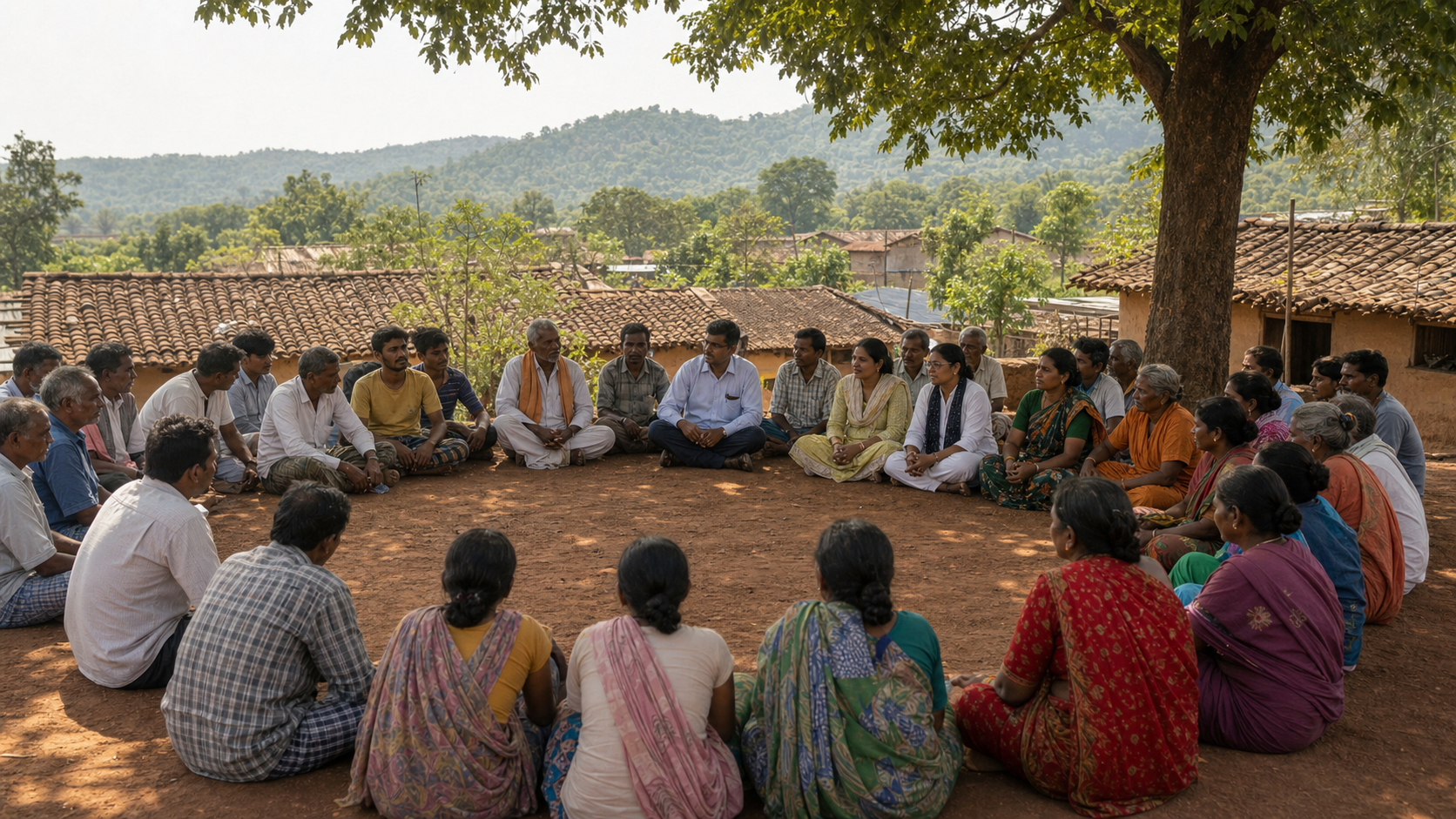
A pastor-entry sign in a tribal village can turn a real concern into a false choice within hours: either protect Adivasi traditions or protect religious liberty. You do not have to accept that choice. The sound position is firmer. No one should be pushed into, or forcibly kept within, a religion; nor should a community have to tolerate conversion through force, fraud, or material inducement.
If you are a gram sabha member, village elder, faith worker, administrator, or concerned resident, your first task is to separate the allegation, the evidence, and the remedy. That prevents a genuine complaint from being buried in communal argument. It also prevents concern for culture from becoming a blanket penalty against a religious identity.
Hold the legal line: conscience is protected, coercion is not
Under Article 25, freedom of conscience sits alongside the liberty to profess, practise, and propagate a faith. Those liberties remain subject to public order, health, and morality. State laws in India also regulate conversion obtained through force, fraud, or inducement, although the applicable statutory language and legal definitions must be checked in any actual case.
This produces a line that both sides of the controversy must respect. Peaceful religious expression cannot be treated as wrongdoing merely because neighbours dislike it. At the same time, calling an activity charity or seva does not make coercion acceptable when assistance, fear, deception, or pressure is being used to influence a person’s religious choice.
For community fact-finding, keep four terms separate. These are working descriptions, not substitutes for the definitions in the applicable law:
- Force: an alleged threat, intimidation, or pressure that prevents a genuinely free choice.
- Fraud: an alleged deception material to the religious decision being sought.
- Inducement: an alleged material benefit offered or withheld in connection with changing religion.
- Propagation: peaceful communication of religious beliefs, without coercing the listener to accept them.
Do not label every act of service an inducement. Ask what was offered, who offered it, what condition was attached, and what evidence supports that connection. Apply the same discipline to claims of force or fraud. Suspicion may justify a fair inquiry; it does not establish guilt.
Because enforcement can affect liberty and create legal exposure, a village body should obtain advice from a lawyer qualified in Indian law before imposing an entry restriction, punishment, expulsion, or other coercive measure. Concern about conversion does not give a crowd authority to decide criminal guilt.
Read the 2025 High Court development narrowly
On 3 November 2025, the Chhattisgarh High Court was reported to have declined to interfere with village hoardings restricting pastor entry. The signs were presented locally as protection against forced conversion among tribal communities.
That development should not be inflated into a sweeping declaration that every village in Chhattisgarh may ban pastors, Christians, or members of another faith. Without the complete official order, the court’s precise reasoning, the facts it accepted, the relief requested, and the limits of its decision remain uncertain.
When someone cites the case to justify a local restriction, ask for four things before accepting the claim:
- The complete official order and the identifying details of the case.
- The exact relief the petitioner asked the court to grant.
- The precise wording, location, issuing authority, and practical enforcement of the disputed signs.
- Whether the court decided the constitutional merits or declined intervention on a narrower factual or procedural ground.
Until those details are available, the responsible formulation is limited: judicial non-interference with particular village hoardings was reported, but a general constitutional licence for identity-based village exclusion should not be assumed. This distinction matters because a headline can travel much farther than the legal reasoning beneath it.
If your village already has such a sign, preserve its exact wording and have it reviewed rather than paraphrasing what the High Court supposedly authorised. A rule aimed at force, fraud, inducement, intimidation, or intrusive conduct presents a different constitutional question from a rule excluding every person who holds a particular religious office.
Make tribal autonomy and personal conscience reinforce each other
Adivasi communities are not empty spaces awaiting an outside identity. Religious practice may be woven into festivals, family memory, relations with the land, mourning customs, and obligations between generations. Unsolicited proselytising during a festival, bereavement, illness, or another period of distress can therefore feel less like an exchange of ideas and more like an intrusion into a vulnerable moment.
The constitutional setting of Scheduled Areas and the ethos of local self-government place cultural continuity and gram sabha deliberation at the centre of decisions affecting tribal communities. That gives communities a legitimate reason to define respectful conduct in shared spaces. It does not erase the conscience of the individual living within the community.
Community consent and personal consent answer different questions. The community can deliberate on how organised outsiders engage with common village life, subject to constitutional and legal limits. The individual decides what he or she believes. A gram sabha cannot manufacture personal faith by resolution, just as an outside worker cannot treat social distress as an opening for religious pressure.
When a conversion is disputed, ask questions that reveal whether consent was real:
- Did the person know the religious purpose of the interaction from the beginning?
- Could the person refuse without fearing the loss of assistance, safety, dignity, or community standing?
- Was any material help expressly or implicitly tied to religious change?
- Were the person’s existing deities, ancestors, customs, or traditions denigrated as part of the appeal?
- Did organised outreach continue after a clear request to stop?
- Is the person now being threatened or ostracised for accepting or rejecting a faith?
Do not let an elder, activist, relative, pastor, or political representative speak over the person whose conscience is at issue. Where pressure is alleged, that person should be heard privately, without leading questions, through a neutral process sensitive to language and local culture. If intimidation or retaliation is possible, confidentiality and witness protection are more important than a public village confrontation.
A Dharmic response should be recognisable by its methods. Ahimsa rules out intimidation. Seva cannot be turned into a transaction for belief. Mutual respect prohibits the humiliation of another tradition. Protection of Dharma and tribal heritage is strongest when it refuses to imitate the coercion it condemns.
Replace an identity ban with a village conduct charter
A sign saying that pastors are not allowed targets an identity. A charter saying that no person may use force, fraud, threats, material inducement, or denigration targets conduct. The second approach is a more defensible and less polarising starting point, although no model wording guarantees legal validity.
A gram sabha developing such a charter should include the following elements:
- State the protected interests. Name both freedom of conscience and the preservation of Adivasi cultural life. Leaving either one out makes the charter easier to misuse.
- Define prohibited conduct. List force, fraud, threats, material inducement, persistent contact after refusal, and deliberate denigration. Avoid vague phrases such as “suspicious activity” that can mean whatever an enforcer wants them to mean.
- Apply one rule to everyone. The same standards should govern Christian, Hindu, Buddhist, Jain, Sikh, and other religious organisations, as well as secular groups attempting to influence belief or cultural practice.
- Separate organised outreach from private conscience. A code for organised activity in community spaces must not become a system for licensing private belief, worship, family conversations, or peaceful personal relationships.
- Use transparent visitor procedures where lawful and appropriate. An organised outreach group can be asked to identify its representatives, purpose, planned activity, and local contact. Prior notice should be a neutral transparency measure, not discretionary permission granted only to favoured faiths.
- Create a written complaint route. Identify who receives a complaint, how the other side may answer, how confidential information will be protected, and when an allegation must be referred to lawful authorities.
- Set a review date. Do not let an emergency measure become permanent by inertia. Record when the charter and any related signage will be reconsidered.
- Establish a representative mediation council. Include tribal elders, women and other affected residents, along with Hindu, Buddhist, Jain, Sikh, Christian, and other locally relevant representatives. No accused organisation should control the forum hearing its own case.
Model language to adapt, not copy blindly
Model wording: This village respects freedom of conscience and its Adivasi cultural inheritance. No person or organisation may use force, fraud, threats, material inducements, or denigration to seek religious change. Organised outreach in community spaces should give prior notice to the designated village contact where lawful and applicable. Complaints will be documented, heard fairly, and referred to the appropriate lawful authority. This code applies equally to every faith and organisation and will be reviewed on a stated date.
Have a qualified lawyer review the final wording and the gram sabha’s authority before adoption or enforcement. Neutral language is only the first test. Enforcement must also be neutral: equivalent conduct needs equivalent evidence, procedure, and consequences regardless of the faith involved.
Handle allegations without creating a second injustice
A credible allegation of forced conversion deserves prompt attention. It does not justify assault, public humiliation, collective punishment, destruction of property, or the expulsion of a family. Those acts endanger people, damage evidence, and replace lawful scrutiny with retaliation.
- Address immediate danger first. Separate people if pressure or violence is occurring and seek appropriate lawful assistance. Do not conduct a public interrogation.
- Record the allegation precisely. Note who allegedly did what, when and where it occurred, the exact words or offer described, the people present, and what the complainant wants to happen next.
- Hear the affected person privately. Use a neutral interviewer and, where needed, language support. Ask open questions. Do not demand a public declaration of faith as proof of loyalty to either side.
- Preserve evidence and confidentiality. Retain original notices, communications, names of witnesses, and other relevant material. Avoid circulating an untested accusation through social media or public meetings.
- Choose the right forum. Credible allegations of force, fraud, inducement, threats, or retaliation belong with lawful authorities and qualified counsel, with attention to due process and witness protection. Complaints about intrusive timing, disparagement, or repeated unwanted contact may also benefit from structured mediation. An identity-based denial of peaceful religious activity may require a grievance process or judicial remedy.
- Issue a written, limited outcome. Record what was established, what remains disputed, which conduct rule applies, who is responsible for follow-up, and when the decision will be reviewed. Do not treat a mediated agreement as proof of a criminal offence.
Mediation can settle future conduct: where an organised event may occur, who receives notice, how refusals will be respected, or how an offensive statement will be addressed. It cannot replace investigation when force, fraud, intimidation, or material inducement is credibly alleged. Nor can a village committee finally decide a constitutional dispute over religious liberty.
Key takeaways
- Opposing coercive conversion and defending religious freedom are not contradictory. Both protect conscience.
- Regulate conduct such as force, fraud, inducement, threats, and persistent intrusion; do not presume guilt from religious identity alone.
- Treat the reported 2025 High Court development as limited until the complete official order and its factual context are available.
- Give tribal cultural autonomy practical force through transparent gram sabha rules, while preserving each person’s freedom to believe, decline, or change belief.
- Use mediation for remediable community friction, lawful investigation for alleged offences, and qualified legal review for entry restrictions or constitutional claims.
Your next useful move is not another slogan. Put three documents on the next gram sabha agenda: the exact existing sign, a one-page conduct charter, and a one-page complaint process naming the responsible contact and review date. Test every clause with two questions: does it protect someone from coercion, and would we enforce it in the same way if the religious identities were reversed?



References
