
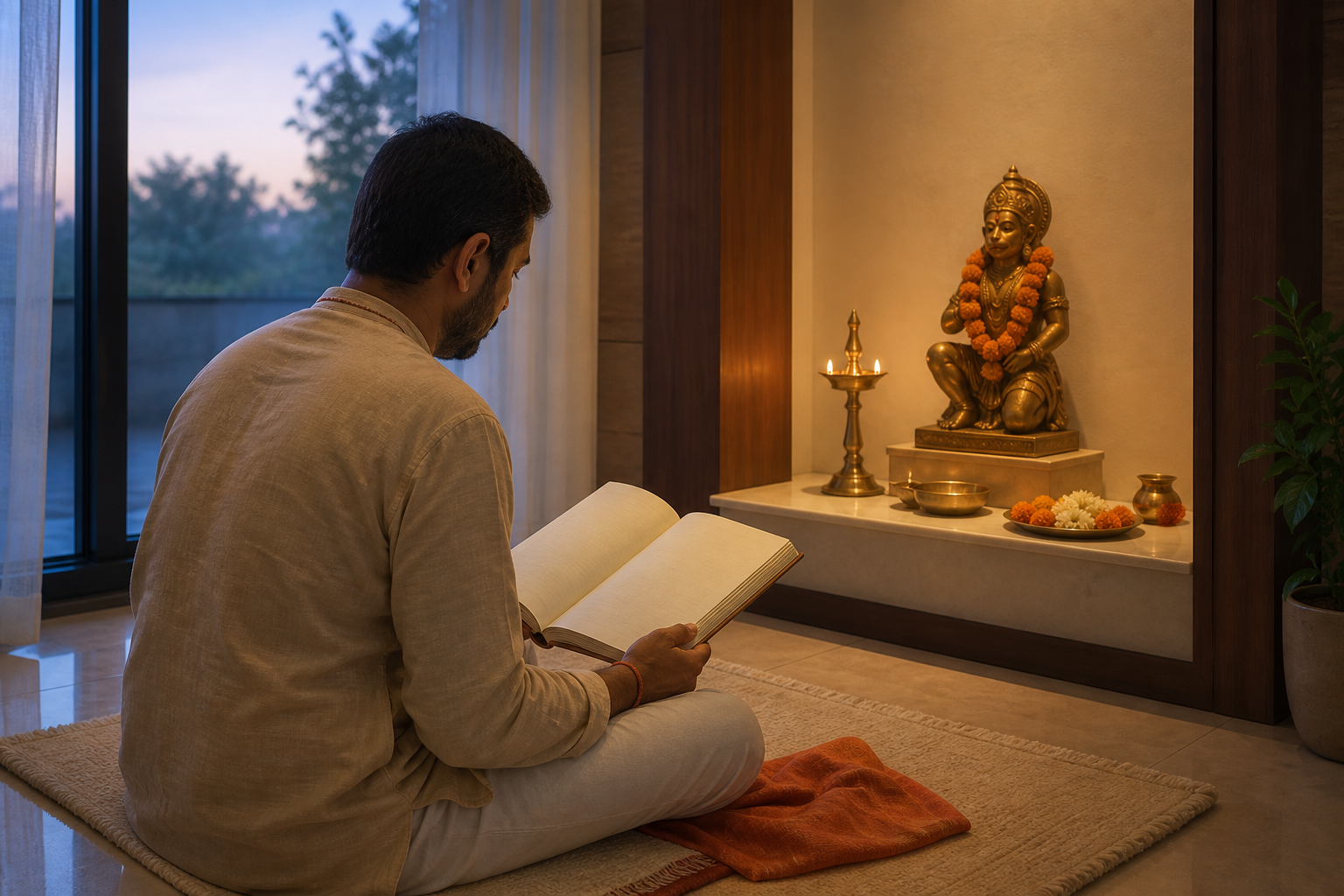
You want to begin Sundarakanda Parayana, but the practical questions can stall you: Must you finish it in one day? Do you need perfect Sanskrit? What happens if work, illness, travel, or family duties interrupt the observance?
A sound home practice is simpler than many people assume. Choose a schedule you can honestly sustain, prepare a clean place, read each sarga with attention, and close every sitting properly. The discipline matters, but it should lead you toward Hanuman’s courage, humility, discernment, and service rather than anxiety about ritual perfection.
Make a promise you can keep
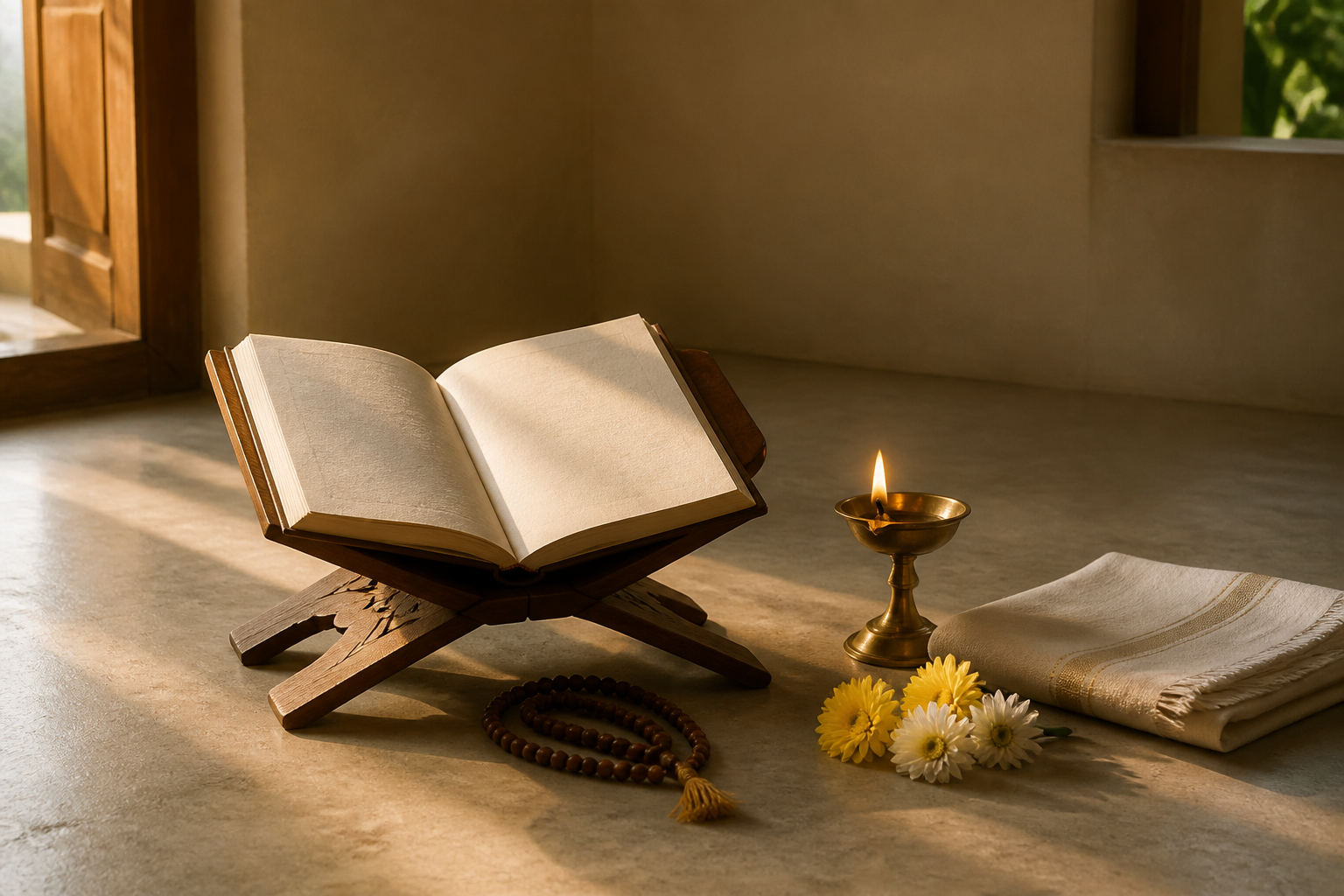
Parayana is not casual reading stopped wherever the clock happens to run out. It is an intentional reading of a sacred text through to completion. Sundara Kanda is the fifth book of Valmiki’s Ramayana, and a complete parayana covers all 68 sargas.
Your first decision is therefore not, “How ambitious can I be?” It is, “What rhythm can I protect until the final sarga?” A one-day reading may be appropriate for an experienced reader or a coordinated group. If you are new to the text, have limited stamina, or manage an unpredictable household, a longer schedule usually supports greater attention.
| Completion period | Suggested reading rhythm | When it fits |
|---|---|---|
| 1 day | All 68 sargas in one sitting | Experienced readers or an organized group able to preserve a composed pace |
| 3 days | Day 1: 1-20; Day 2: 21-45; Day 3: 46-68 | A concentrated observance with three substantial sessions |
| 5 days | About 13-14 sargas daily | A compact plan with a more balanced daily load |
| 7 days | About 9-10 sargas daily | An unhurried week-long observance |
| 9 days | About 7-8 sargas daily | Shorter daily sittings with steady continuity |
| 11 days | Around 6 sargas daily, adjusted to complete all 68 | A gentler rhythm without making the observance very long |
| 21 days | About 3-4 sargas daily | A sustained vrata with room for reflection |
| 41 days | About 1-2 sargas daily | A long discipline built around small daily readings |
These are working divisions, not rigid mathematical rules. Sargas differ in length, reading speeds differ, and group recitation adds transitions between readers. Adjust the daily allocation before you begin so that every sitting ends at a sarga boundary and the final day completes the text.
If you do not know your pace, read one sarga before fixing the schedule. Use the same language, volume, and pronunciation standard you expect to maintain during the observance. That small trial tells you more than an optimistic guess based only on the number of chapters.
Then state a clear sankalpa. You do not need to invent an elaborate Sanskrit formula. Unless your family tradition prescribes one, a plain statement can identify the practice, the period, and the intention:
With reverence to Sita-Rama and Hanuman, I undertake the complete reading of Sundara Kanda over seven days for clarity, courage, the welfare of my family, peace in the community, and the good of all beings.
A simple sankalpa template, not a prescribed mantra
Replace seven days with your chosen period and keep the intention truthful. A sankalpa can include a personal concern, but it need not become a private bargain for a particular result. Let it also direct you toward conduct worthy of the prayer.
Prepare the space, text, and daily rhythm
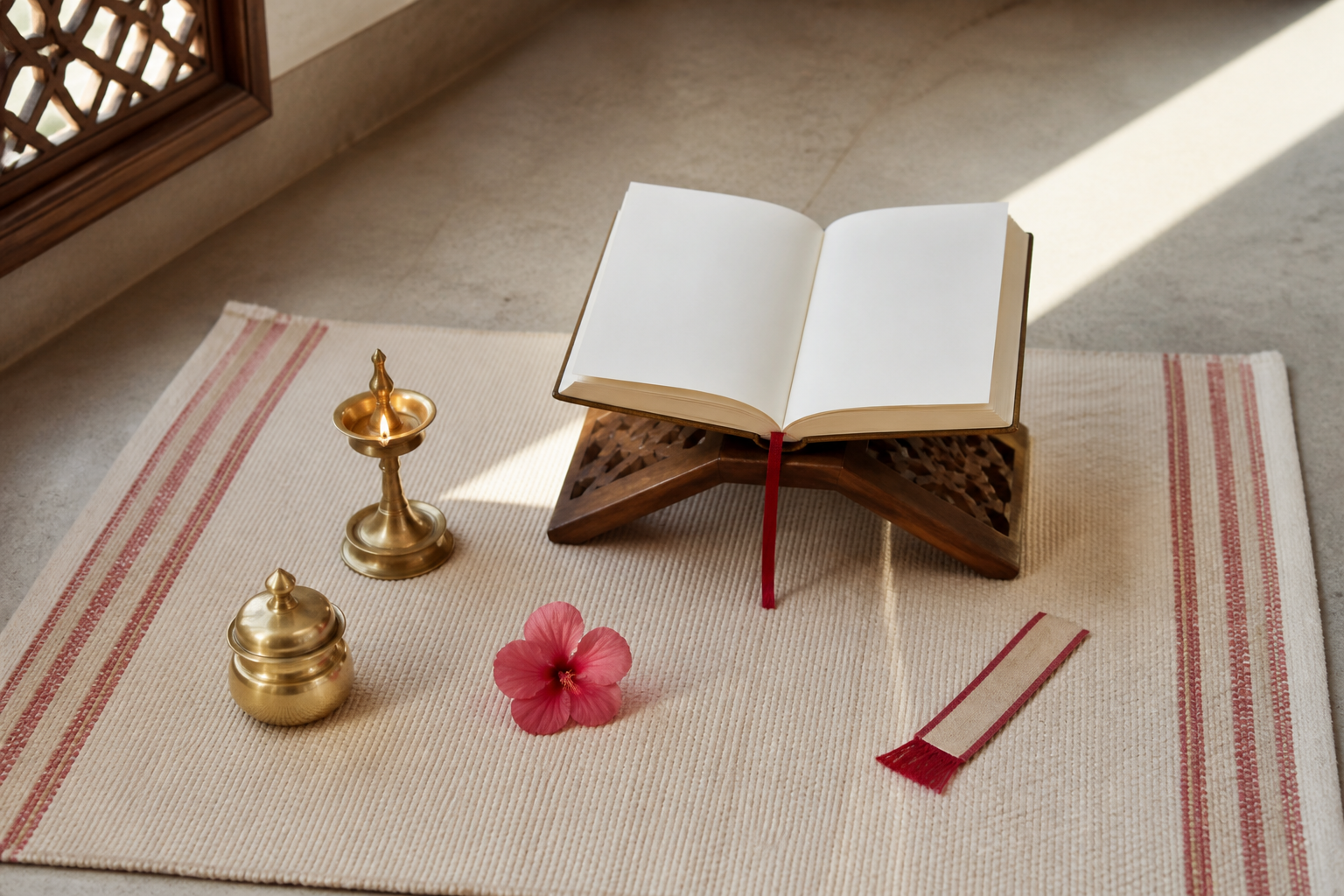
You do not need an elaborate altar or costly offerings. You do need a place that tells the mind, “This time is set apart.” Prepare it before the first day so that each session begins with recollection rather than a search for matches, flowers, or the correct page.
- A clean, quiet place: Choose a spot where ordinary household movement is least likely to break the reading.
- A stable copy of the text: Use Sanskrit, a faithful regional-language edition, or a reliable translation. Keep the same edition throughout so that sarga numbering remains consistent.
- A lamp: Place an oil lamp or diya safely where it can remain undisturbed.
- Fresh water and flowers: Offer what is readily available. Simplicity is preferable to delaying the practice because every item is not perfect.
- An image or murti: If you keep images of Sita-Rama and Hanuman, place them where your attention can rest naturally.
- Simple naivedyam: Fruit, jaggery, or sattvik cooked food can be offered according to household custom. Food prepared without onion and garlic is commonly chosen during the observance.
- A tracker and bookmark: Record the date and the last completed sarga immediately after each sitting. This prevents confusion when several family members share the reading.
Choose a repeatable time rather than waiting for an ideal mood. Morning may be calm in one home; evening may be the only protected period in another. Consistency is more useful than selecting a devotional hour that you cannot actually maintain.
Tuesdays and Saturdays are common commencement days, but neither is compulsory. If beginning on one of those days strengthens your resolve, use it. If waiting would create avoidable delay or conflict, begin on a day you can sustain.
Upavasa is also optional. Do not turn fasting into a test of devotion or impose it on another participant. Choose food in a way that supports clarity and moderation, and place health needs ahead of austerity. A steady reading completed with reverence is better than an observance made unstable by unnecessary physical strain.
Use the same clear sequence at every sitting
A consistent opening and closing keep the reading from becoming merely another item on a checklist. The following order is sufficiently complete for a simple household parayana while leaving room for family sampradaya.
- Enter the space deliberately. Wash as appropriate to your household practice, silence avoidable distractions, and place the text and offerings within reach.
- Light the lamp and sit steadily. Use a posture you can maintain without repeatedly shifting. Physical strain does not improve attention.
- Settle the mind. Perform a brief achamana according to your custom and take a few quiet breaths. This transition matters especially when the session follows work, travel, or household activity.
- Recall the sankalpa. State it fully on the first day. On later days, briefly remember the same intention rather than creating a new one each time.
- Offer the preliminary prayers. Pray to Sri Ganesha for the removal of obstacles, perform guru vandana, and bow mentally to Sita-Rama and Hanuman.
- Read the assigned sargas. Pronounce as clearly as you can, keep an even pace, and resist the urge to hurry near the end. Complete the planned sarga before stopping.
- Close with humility. Offer kshama-prarthana for mistakes, perform a short aarti, and include any customary concluding prayer.
- Offer and distribute prasad. Mark the last completed sarga on your tracker before returning the text to its place.
Optional concluding practices include a Hanuman stotra, Rama-nama japa, or the phala-sruti supplied in your edition. Treat these as supports to the central undertaking, not as additions that make an already difficult schedule impossible to maintain.
During the reading, clarity matters more than speed. If you mispronounce a word, correct it calmly when you can and continue. Kshama-prarthana exists precisely because human recitation is imperfect. Repeatedly restarting a passage out of fear can replace devotion with agitation.
If Sanskrit pronunciation is still developing, keep a trustworthy regional translation beside the Sanskrit text or read the translation itself. Understanding the movement of the narrative helps you notice what Hanuman’s example asks of you: courage joined to discernment, strength governed by devotion, and action offered as service.
Keep the observance livable in a real household
When a day is interrupted
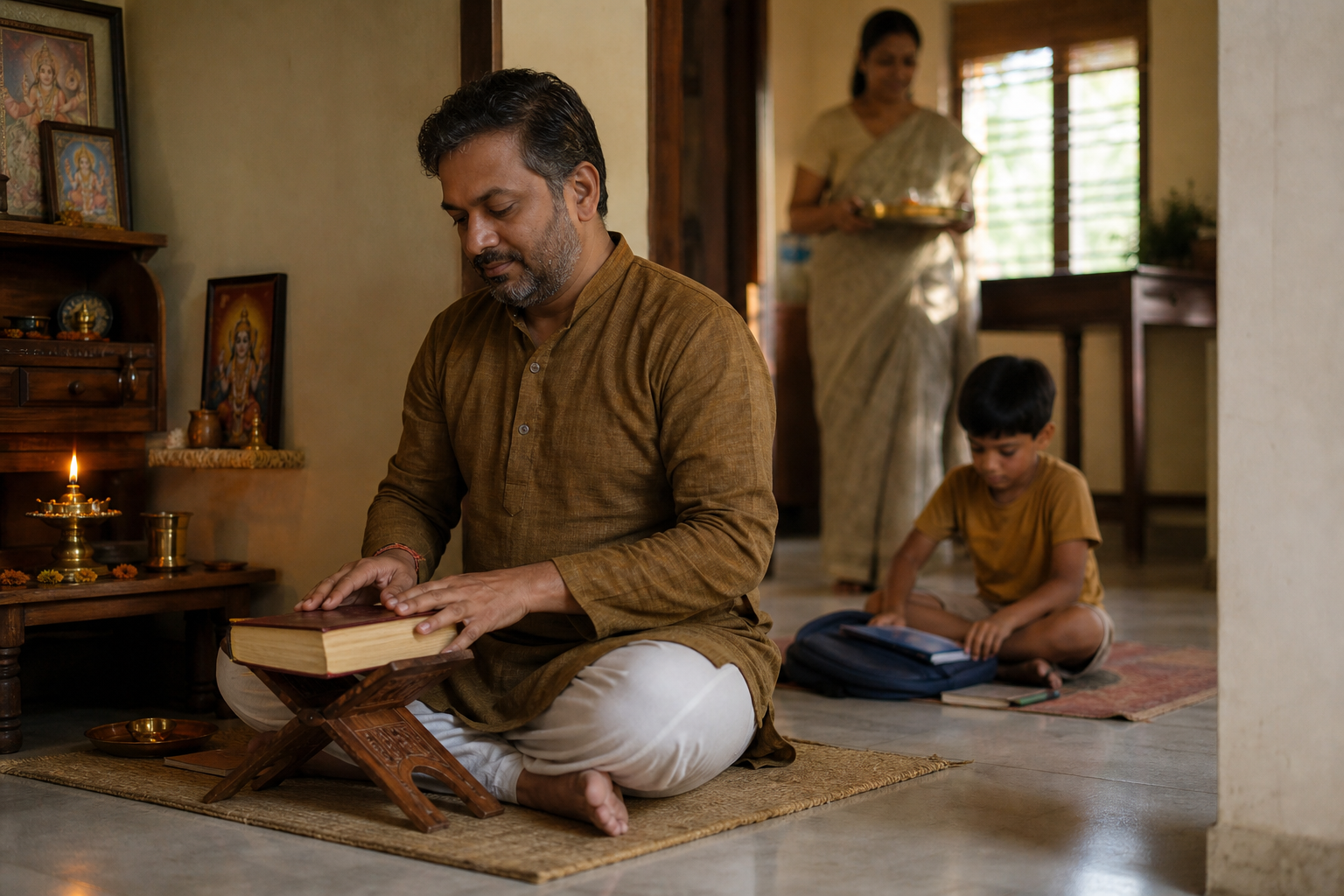
An unavoidable interruption does not require panic or abandonment. Note the last sarga you completed and resume at the next reasonable opportunity. If you can redistribute the missed portion without rushing later sessions, revise the remaining plan. If not, extend the completion date and finish with attention.
Distinguish an ordinary home parayana from a formal vrata governed by a specific family or temple tradition. For the latter, ask a trusted priest, guru, or knowledgeable elder how an interrupted day is handled in that tradition. Do not invent a severe penance from fragments of advice gathered elsewhere.
When the family reads together
A family or community group can divide the text by sarga or assign different days to different readers. Decide the rotation before beginning, give everyone the same edition, and appoint one person to maintain the tracker. Those three decisions prevent most confusion.
Do not turn differences in pronunciation or fluency into public correction during the recitation. If guidance is needed, offer it gently before the next session. Elders, younger readers, and beginners can all participate meaningfully when the shared discipline remains more important than individual performance.
Let conduct carry the recitation beyond the altar
The daily reading is only part of the observance. Watch your speech, moderate food and avoidable indulgence, and make room for an act of service. If you finish several sargas and then spend the day speaking harshly, the tension between recitation and conduct deserves attention.
This is where Sundarakanda Parayana becomes more than textual completion. When anxiety rises, return to the next duty without drama. When strength is available, use it for service rather than display. When a difficult decision appears, seek clarity before action. Those choices bring Hanuman’s virtues into the situations for which you made the sankalpa.
Regional practices concerning menstruation are not uniform. Some households pause formal observances; many contemporary households continue with privacy and comfort. If your family has an inherited custom, discuss it without humiliation or coercion. Reverence cannot be strengthened by treating a family member’s body as a cause for shame.
Practical questions before you begin
Do I have to recite Sundara Kanda in Sanskrit?
No. You may read Sanskrit or a faithful regional-language translation. Choose a text you can follow with attention. If you are learning Sanskrit, a bilingual edition lets pronunciation practice and understanding develop together without making fluency a condition for beginning.
Must I fast during the entire parayana?
No. Light fasting is observed by some practitioners, but it is not essential to the home procedure. Sattvik food, moderation, and a mind fit for recitation are sufficient. Do not fast when doing so would conflict with health needs.
Is a Tuesday or Saturday start mandatory?
No. Both days are commonly chosen, but a consistent and workable start matters more. Pick a day that allows you to establish the reading rhythm immediately.
What should I expect from the practice?
Approach the parayana as disciplined bhakti, not a guaranteed mechanism for obtaining a specific outcome. Devotees undertake it for courage, steadiness, grace, family harmony, peace, and renewed purpose. Its most dependable demand is the one it places on you: return each day, read attentively, govern your conduct, and translate devotion into service.
Your next step is concrete. Select the shortest schedule you can complete without haste, mark the first and final dates, obtain the text, and prepare the reading place. When the chosen time arrives, light the lamp and begin with the first sarga. Let consistency, rather than complexity, carry you forward.
References
