

If you have absorbed the idea that spiritual freedom requires dismissing the body, the mind, or the visible world as unreal, ordinary life can begin to look like an obstacle. Why care for nature, discipline thought, or act responsibly if material existence has no real standing?
Vishishtadvaita gives you a different starting point. Your body, mental life, possessions, tools, and environment are real, but none is independent of Ishvara. Your task is neither to worship material existence nor to reject it. It is to engage Prakriti without mistaking it for the self, the highest good, or a self-governing reality.
Real does not mean independent
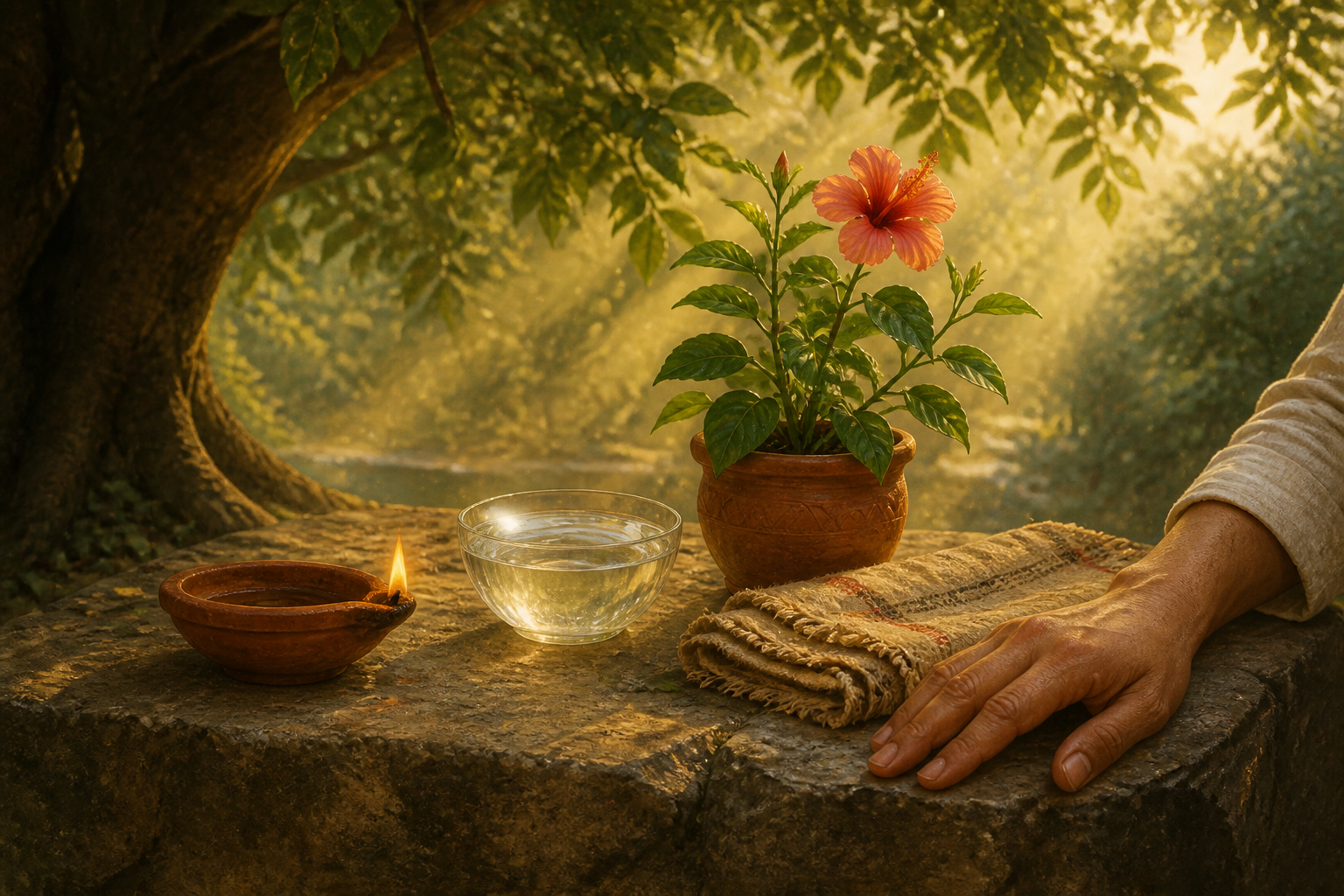
Vishishtadvaita recognizes three eternally real entities: Ishvara, the jiva, and Prakriti. Ishvara is Brahman or Narayana, the sovereign ground and support. The jiva is the individual self. Prakriti is the insentient material field in which embodied experience and action occur.
Eternally real does not mean equally sovereign. Prakriti never becomes a second, self-sufficient absolute alongside Ishvara. It exists as a dependent mode of ultimate reality and operates within divine order. The universe is therefore meaningful and governed, not an accident outside the reach of the divine.
This gives you a necessary double correction. You should not dismiss the material world as a worthless phantom, because actions within it have real consequences for living beings. You should not treat it as ultimate either, because its forms, powers, and purposes remain dependent on Ishvara. Reverence without attachment is the balance to seek.
This distinction also matters when you compare Dharmic traditions. Hindu, Buddhist, Jain, and Sikh paths share serious concerns about ethical responsibility, compassion, disciplined conduct, and freedom from bondage. Their explanations of self, matter, and ultimate reality are not interchangeable, however. In Vishishtadvaita, the decisive claim is that Prakriti is real, insentient, and inseparable from divine governance.
Your mind and body belong to the same material field
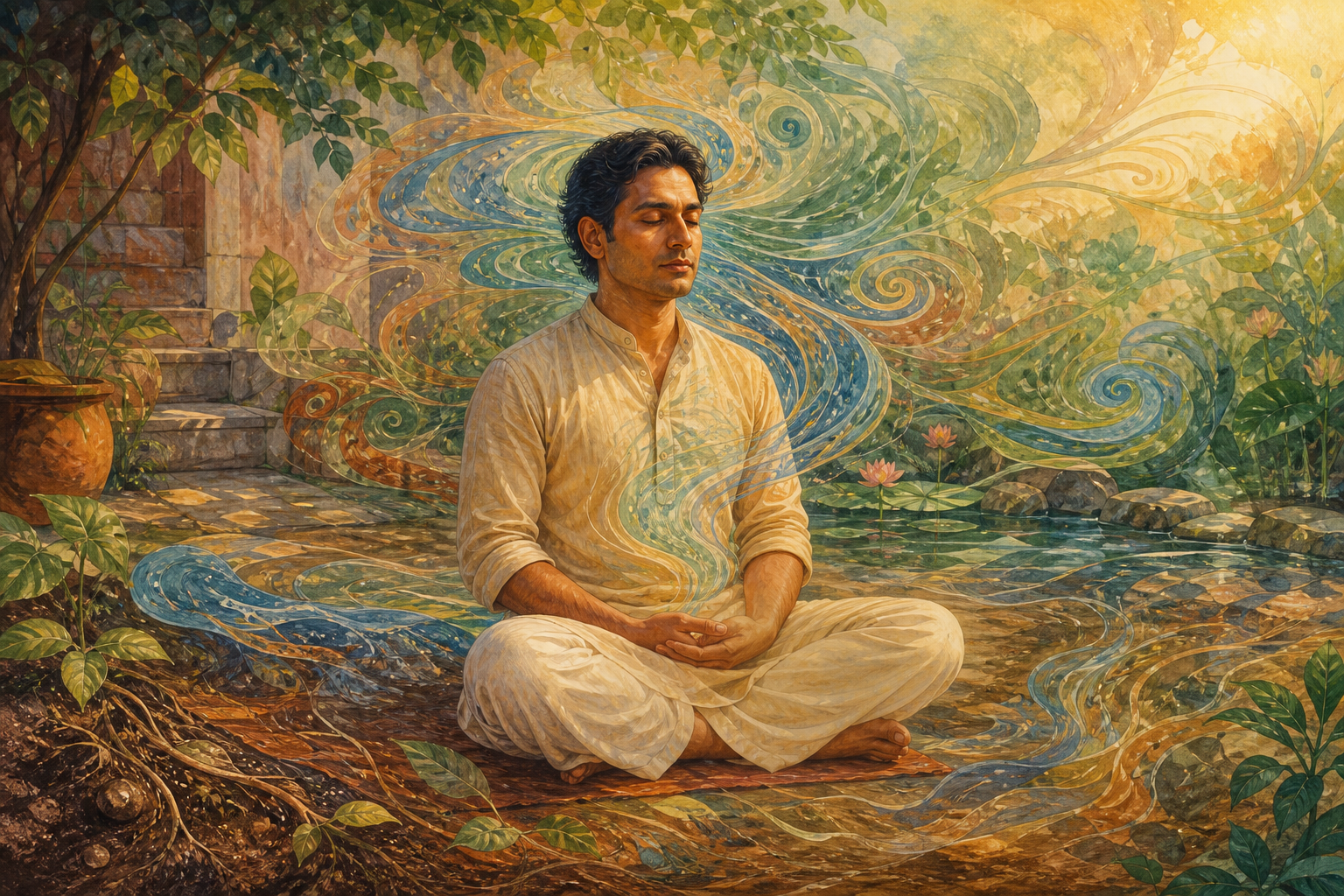
A common mistake is to place the physical body on the material side and the mind on the spiritual side. Vishishtadvaita draws the line elsewhere. Prakriti includes both sthula and sukshma forms.
Sthula means the gross or physically perceptible dimension: your body, water, air, trees, mountains, built surroundings, tools, and technologies. Sukshma means the subtle dimension. Manas, or mind; buddhi, or intellect; and ahamkara, or ego, all belong to Prakriti as well. They are real instruments of experience, cognition, and action, but they are not conscious selves in their own right.
This distinction changes how you read your inner life. A restless mind is not the complete truth about the jiva. A forceful movement of ahamkara does not become authoritative merely because it speaks in the language of I and mine. Even buddhi, valuable as it is for discernment, remains an instrument that can be conditioned and refined.
You can apply this without denying what you experience. Instead of turning anger, anxiety, pride, or confusion into a final identity, notice that a changing condition is present in the subtle material instrument. Then ask what dharma requires before you speak or act. The condition is real, but it does not deserve unquestioned command.
The same logic protects bodily care from two extremes. The body is not the jiva, so appearance, comfort, strength, or decline cannot define the self’s ultimate worth. Yet the body is real and serves as an instrument of action, so neglect is not spiritual insight. Care for it as something entrusted to you, without making it the centre of your identity.
The gunas explain change without making nature autonomous

Prakriti is not a motionless stock of matter. Its transformations are conditioned by the interplay of sattva, rajas, and tamas. Under Ishvara’s guidance, this dynamic material basis unfolds in cycles of srishti, or creation, and returns through pralaya, or dissolution.
The important point is not merely that forms change. It is that real material processes and divine governance belong in the same explanation. Vishishtadvaita does not force you to choose between an intelligible material order and Ishvara’s sovereignty. Prakriti has genuine causal continuity without becoming autonomous.
Do not turn guna language into a fixed identity label. The gunas condition Prakriti, including the body and subtle instruments; they do not define the eternal worth of the jiva. It is more useful to ask whether a habit cultivates sattva than to declare that you are permanently one guna or another. The first question opens a path of discipline. The second can become an excuse.
Divine governance is not an excuse for passivity either. The jiva acts and learns within Prakriti. Choices therefore matter. Disciplined action can refine your engagement with body and mind, while careless action can deepen attachment and confusion. At the cosmic scale, srishti and pralaya show that a form can arise and dissolve without having been unreal. At the personal scale, your changing body and mind can be real without being your final identity.
Use Prakriti as a field of dharma, not a rival to moksha

When a choice is tangled, we would begin with a simple examination: What part of Prakriti is moving here? What does dharma require from the jiva using that body, mind, possession, or tool? How can the response express dependence on Ishvara rather than egoic ownership?
| Situation | What to notice | What to do differently |
|---|---|---|
| A strong mental reaction | Manas, buddhi, and ahamkara are subtle Prakriti, not the whole jiva. | Pause before identifying with the reaction. Let buddhi examine what dharma requires before speech or action. |
| Concern with the body | The physical body is gross Prakriti: real, useful, changing, and not the self. | Maintain it as an instrument of service and discipline without making comfort or appearance your measure of worth. |
| Work or technology | Tools and technologies also belong to Prakriti. Novelty does not make them spiritually pure or impure. | Judge their use by purpose, consequences, restraint, and whether they support dharmic action. |
| Possessions and the natural world | Matter is real and situated within divine order, not merely raw material for unlimited possession. | Use what is needed carefully, resist wasteful ownership, and treat the environment with reverence. |
Cultivating sattva is part of this work because the material instruments through which you perceive and act can be refined. Dharma gives action its ethical direction. Bhakti and prapatti give it its proper orientation toward Ishvara. These are not techniques for making Prakriti independent or permanently satisfying; they teach the jiva to live within it without forgetting the source of its order and purpose.
Moksha therefore does not require you to claim that the world never existed. It frees the jiva from bondage to the limiting conditions of material existence while preserving the jiva’s dependence on Ishvara. Spiritual detachment should not be confused with neglect. Detachment concerns bondage and false ultimacy, not the denial of real consequences.
Key takeaways
- Prakriti is real, but it is never independent of Ishvara.
- Both the physical world and the subtle instruments of mind, intellect, and ego belong to Prakriti.
- The jiva is not identical with a bodily condition, mental movement, intellectual judgment, or ego reaction.
- Sattva, rajas, and tamas condition changing Prakriti; they should not be used as permanent labels for the jiva.
- Dharma disciplines your use of the material world, while bhakti and prapatti orient that life toward Ishvara.
- Moksha releases the jiva from material bondage; it does not depend on declaring Prakriti unreal.
At your next difficult moment, resist asking whether ordinary material life is spiritual enough. Name the part of Prakriti involved, distinguish it from the jiva, let dharma govern your response, and direct the action toward Ishvara. That is how a real world becomes a field of practice rather than a rival to liberation.
References
