
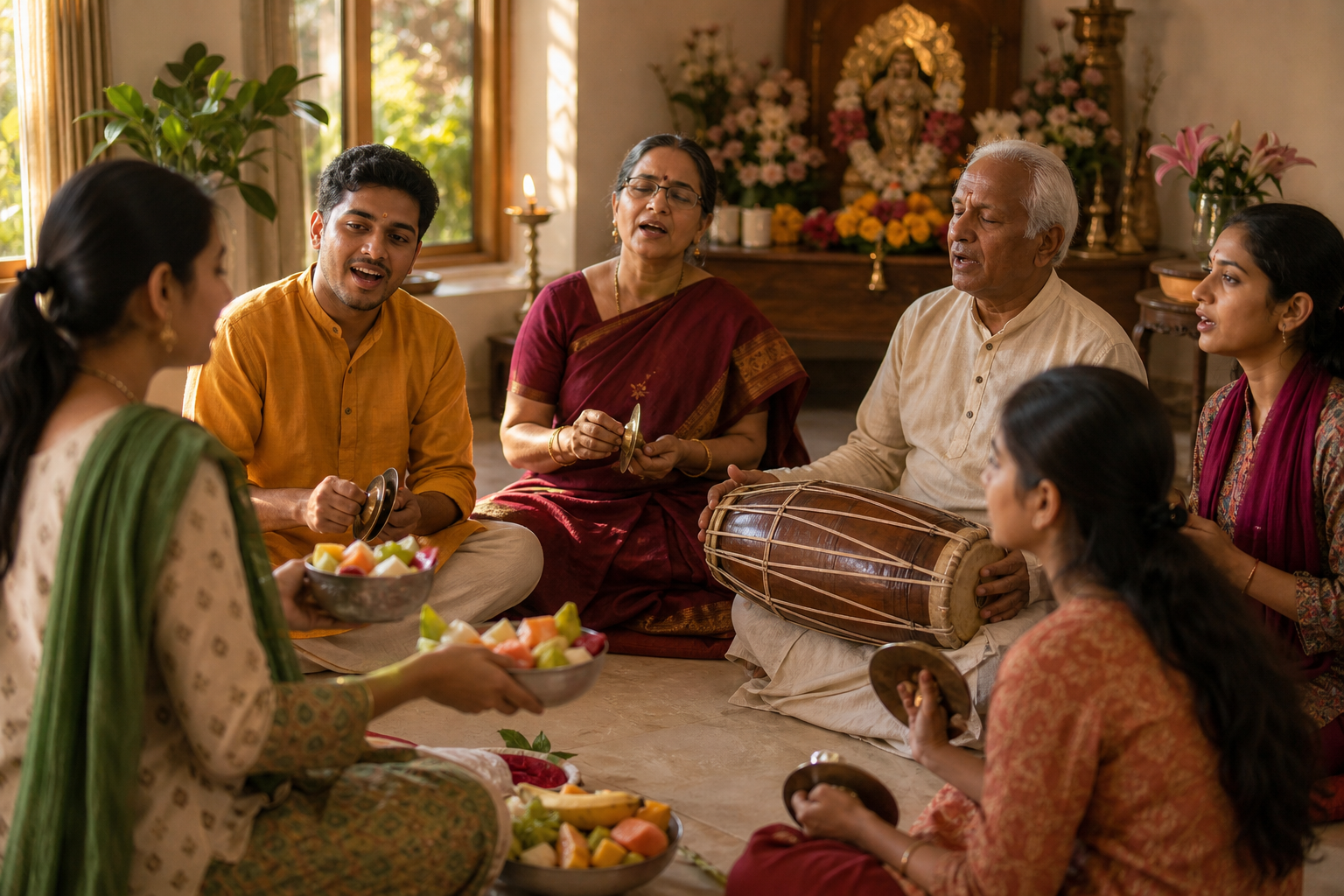
Your bhakti may feel natural during a festival, retreat or especially nourishing satsanga. Then work becomes crowded, family needs increase, the gathering ends, and practices that felt indispensable become optional.
Do not wait for the devotional mood to return on its own. Give your practice two dependable supports: association that turns you back toward Bhagavan, and seva that makes remembrance concrete. You do not need a busier religious life. You need a rhythm that still works when enthusiasm is weak.
Bhakti becomes firm through relationship, not private willpower
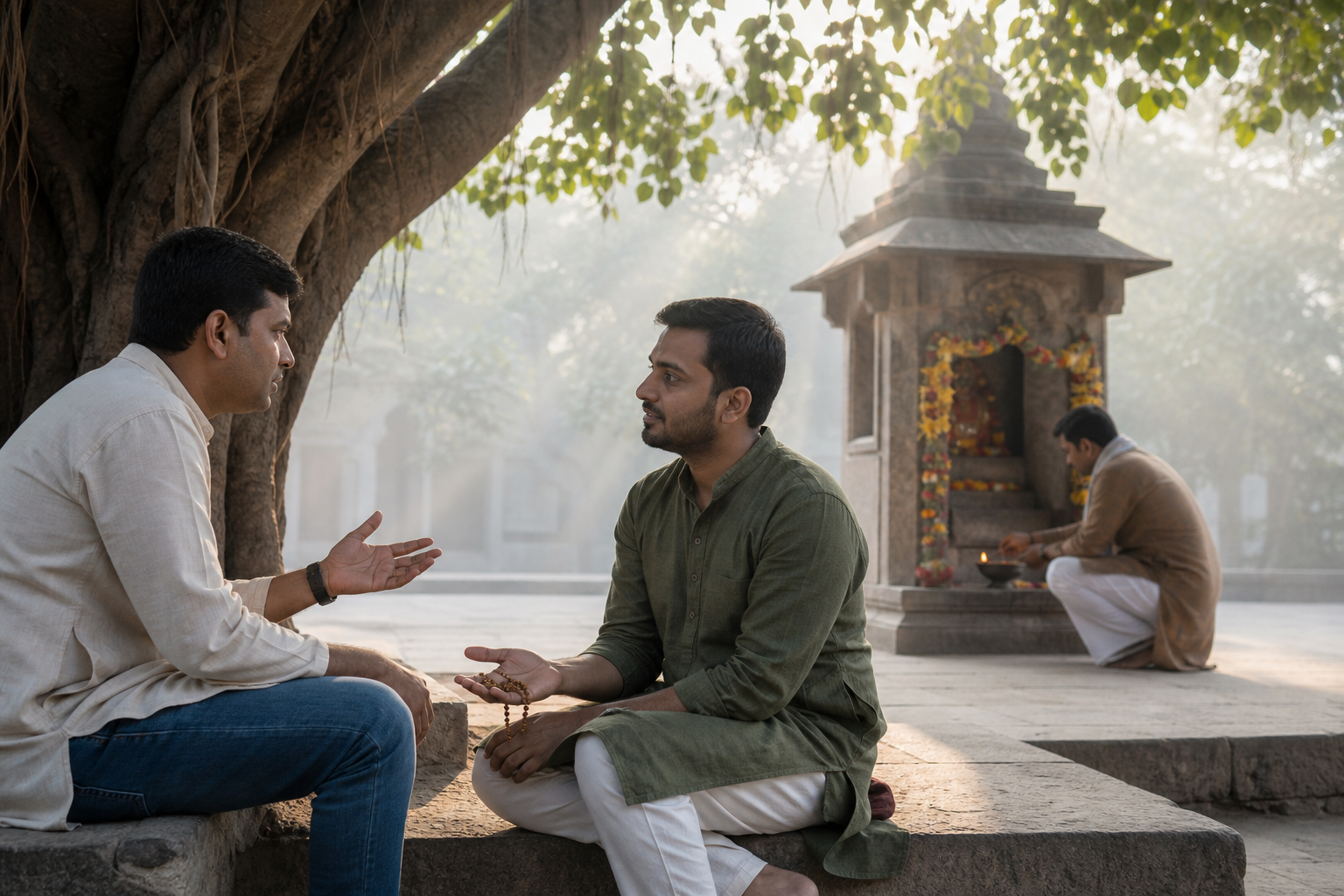
Śrīmad-Bhāgavatam 1.2.18 identifies a progression rather than a sudden spiritual breakthrough. Through nityaṁ bhāgavata-sevayā, regular association and service connected with the Bhāgavata, obstructing tendencies gradually lose their hold and bhakti becomes steady.
The practice has two complementary forms. The book Bhāgavata gives you śāstra: a standard by which to examine your beliefs, motives and choices. The devotee Bhāgavata gives you living association: someone whose conduct shows how those teachings enter speech, family life, worship, conflict and service.
Keeping both together protects you from two common drifts. Without scripture, a devotional circle can begin revolving around personalities, preferences or social status. Without mature practitioners, reading can remain intellectual and leave your habits untouched. The text corrects the community, and good association helps the text correct you.
Association therefore means more than being near religious people. Ask a practical question: after spending time with this person or group, what is your next choice? Do you remember the holy name more readily, speak more carefully at home, keep your commitments and become more willing to serve? If nothing changes beyond your social calendar, proximity has not yet become transformative satsanga.
This principle appears in distinct forms across Dharmic traditions: noble friendship in Buddhism, satsanga in Jain practice and sadhsangat in Sikh tradition all recognize that uplifting company protects remembrance and ethical steadiness. Their theologies and disciplines should not be flattened into one system. The shared practical insight is simpler: the people you repeatedly hear and serve with influence the person you are becoming.
Build a three-anchor rhythm for an ordinary week

A sustainable devotional life needs a daily return point, regular human association and a recurring responsibility. Make each one specific enough to appear on your calendar.
- Set one daily return point. Attach a modest practice to a cue that already happens: after bathing, before breakfast, on returning from work or before the household sleeps. Read a passage, chant japa, practise simran, sing a short kīrtana, make a simple offering or sit in remembrance. Choose the form appropriate to your sampradāya and commitments.
- Set one regular point of association. Join a Bhāgavatam class, study circle, kīrtana, temple gathering or scheduled conversation with a mature practitioner. Do not attend only as a spectator. Bring one sincere question, listen carefully, and leave with one teaching to apply before the next meeting.
- Accept one recurring seva. Choose a defined responsibility with a clear next occasion: preparing prasāda, arranging the worship space, helping with a reading group, supporting go-seva, teaching children, welcoming newcomers or serving a genuine need in your neighborhood. Someone besides you should know that you have accepted it.
Give the daily anchor a minimum form for pressured days. It should be small enough that you can keep it without pretending that exhaustion, illness or family emergencies do not exist. Your fuller sādhana remains the norm; the minimum keeps the relationship intact when the day is unusually constrained.
If you miss the practice, resume at the next established cue. Do not turn one lapse into a private trial about whether you are sincere enough. The useful question is not, “How do I repay yesterday?” It is, “What is the next act of remembrance already available to me?”
Festivals and vratas can intensify this rhythm, but they should leave something behind. After a sacred season, retain one practice that can survive the return to ordinary duties. Continuing a fixed time for japa or simran, a simple offering, scriptural reading or local seva allows special observance to mature into daily devotion instead of becoming an isolated spiritual peak.
Choose association by its fruit, not its prestige
A famous speaker, large gathering or warm social atmosphere may help, but none of these alone proves that an association will steady your bhakti. Look for fruit over repeated contact.
- Remembrance stays central. Conversation repeatedly returns to Bhagavan, nāma, śāstra, character and service rather than gossip, faction or status.
- Questions are treated seriously. You can ask for clarification without being mocked, pressured to perform certainty or made dependent on one personality.
- Your duties are respected. Guidance helps you spiritualize legitimate responsibilities rather than using devotional intensity as a reason to neglect family, livelihood or promises already made.
- Character matters as much as expression. Eloquence, emotion and ritual expertise are accompanied by truthfulness, restraint, compassion and reliability.
- Service is accountable. Responsibilities, decisions and resources are handled transparently, and leadership behaves as service rather than entitlement.
Notice what occupies your mind after the gathering. Healthy association can challenge you, but the challenge should direct attention toward honest self-examination and constructive practice. If repeated contact mainly makes you preoccupied with rank, access, rivalry or the faults of outsiders, reduce the noise and seek association that restores the purpose of bhakti.
You also do not need unrestricted access to an advanced practitioner. A regular class, a dependable study circle and occasional thoughtful guidance can be more formative than constantly moving among events. For diaspora families and geographically scattered practitioners, consistent study, kīrtana, family participation and service teams can turn an occasional gathering into a real community of practice.
Make seva a devotional engine rather than another burden
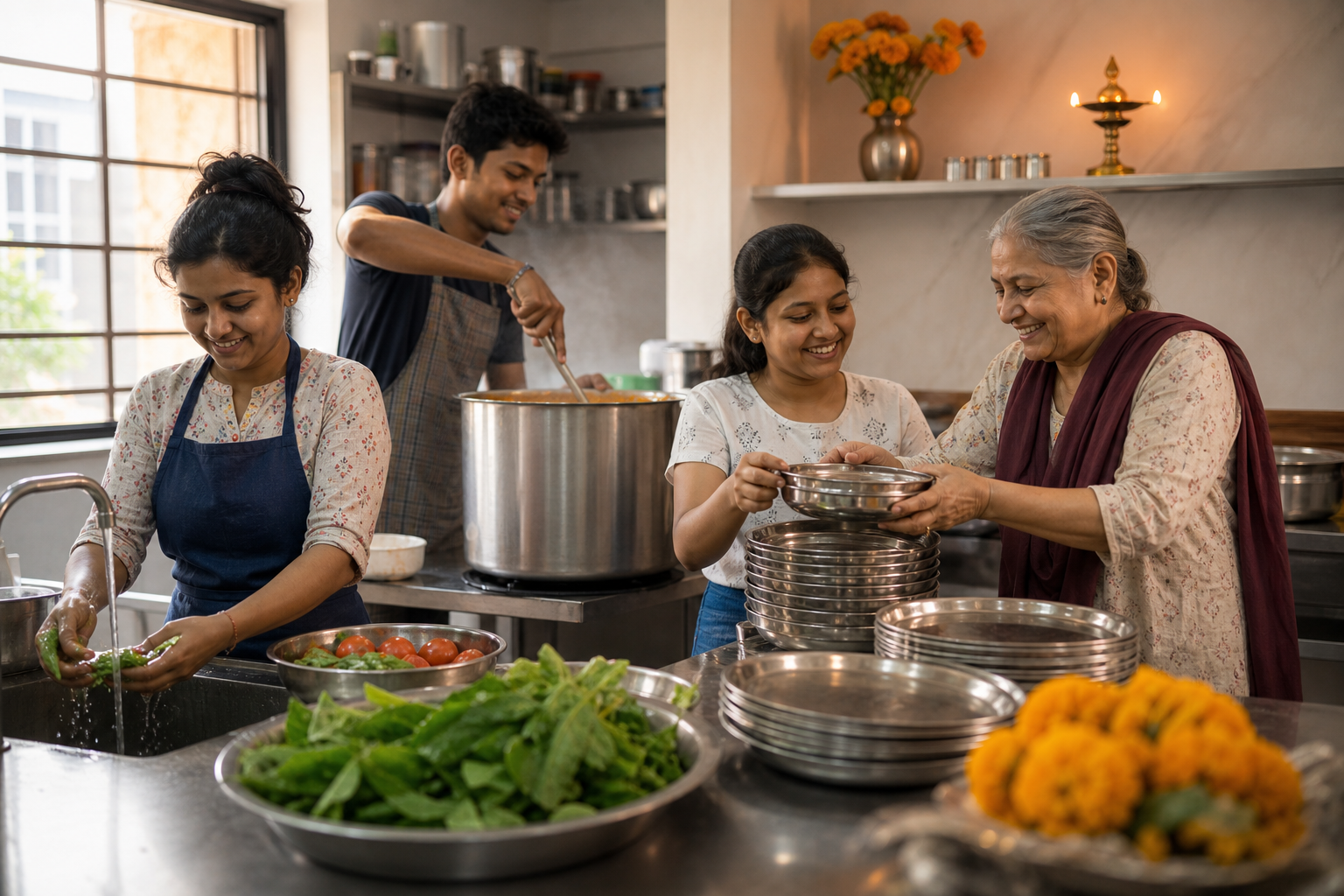
Seva sustains bhakti because it gives devotion an object beyond your changing mood. Another person is waiting for the meal, the class needs to be prepared, the animals require care, or the worship space must be made ready. A defined responsibility can carry you through a dry period when private inspiration is unreliable.
Volunteer activity does not automatically become devotional seva, however. Connect the work consciously to remembrance. Begin with a clear intention to serve rather than impress. Perform the task attentively. When it is complete, offer the result instead of measuring your worth by whether anyone noticed.
Before accepting a role, use four tests:
- Is it genuinely needed? Choose a real need, not merely a role that gives visibility.
- Can you repeat it? A bounded commitment that fits your duties is usually more useful than an ambitious promise followed by withdrawal.
- Is responsibility clear? Know what you own, when it is due, whom you coordinate with and how to hand it over if circumstances change.
- Does it deepen devotional character? The service should train attentiveness, humility, compassion, steadiness or cooperation rather than feeding resentment and self-importance.
Match the seva to your present capacity. If you have limited time, take a narrow task and do it reliably. If you can serve as a family, choose work that allows children and elders to participate meaningfully. If you have organizational ability, create a rota or a clear handoff so that the same few people do not carry every recurring duty.
Go-seva, prasāda preparation, study circles, outreach and youth education can join compassion to communal belonging. They work best inside a culture of servant leadership, distributed responsibility, local participation and transparent governance. Accountability is not separate from spirituality; it protects trust and lets people serve without guessing who decides, who is responsible or whether their contribution matters.
Review your seva when it begins displacing the practices it was meant to support. Chronic irritation, hidden competition and repeated neglect of sādhana are signals to adjust the role, clarify expectations or ask for help. The answer is not necessarily to abandon service. It may be to make the commitment smaller, share it properly and restore conscious remembrance to the work.
Key takeaways
- Keep the book Bhāgavata and the devotee Bhāgavata together: one gives the standard, and the other demonstrates its application.
- Put three anchors on your calendar: a daily return point, regular satsanga and one recurring seva.
- Create a minimum practice for unusually pressured days, then return to your fuller sādhana when the pressure passes.
- Judge association by its effect on remembrance, conduct, duties and willingness to serve, not by prestige or emotional intensity alone.
- Choose seva that is needed, repeatable, accountable and compatible with your actual responsibilities.
- After a lapse, resume at the next available cue instead of waiting to feel spiritually ready.
Before the next day ends, make the structure visible. Fix one daily cue, contact one trustworthy satsanga, and accept or clarify one bounded act of seva. Bhakti becomes durable through the next faithful return, then the one after that.
References
- DharmaRenaissance Blog — Kartika Never Ends: Living Devotion Beyond One Month with Dharmic Unity and Grace
- DharmaRenaissance Blog — Sat Sanga Dubai: Go-seva, Community Building, and GBC Leadership with HH Krishna Kshetra Swami
- DharmaRenaissance Blog — SB 1.2.18: Purify the Heart with Bhagavata Association—From Obstacles to Steadfast Bhakti
