
You can finish an asana session with looser muscles and still feel internally braced. Your jaw stays tight, your breathing remains shallow, and the next notification pulls you straight back into urgency. Adding harder postures usually misses the problem. Your body, breath, voice, and attention need to receive the same message.
If you want Hatha Yoga and mantra to help you settle, use Hatha as preparation, mantra as an anchor, and quiet observation as the test. The aim is not to suppress emotion or manufacture bliss. It is to become less governed by automatic tension and more able to choose your next response.
Regulation begins with order, not intensity
Hatha Yoga is sometimes treated as a collection of stretches followed by a few calming breaths. Its classical logic is more deliberate. The gross prepares the subtle: first make the body steady, then refine the breath and senses, and only then ask the mind to rest.
Within the Gheranda Samhita’s sevenfold path, practice moves through shatkarma, asana, mudra and bandha, pratyahara, pranayama, dhyana, and samadhi. You do not need to perform every limb during a daily stress-regulation practice. The useful principle is the progression: prepare, stabilize, refine, turn inward, and observe.
This order matters when you are already overstimulated. Strong breath manipulation can become another demand. Rapid posture changes can keep attention outside the body. Repeating a mantra while simultaneously checking messages turns sacred sound into background noise. A simpler sequence gives each practice a clear job.
- Asana establishes a tolerable, steady base. You should not have to fight the posture to remain in it.
- Easy breathing reduces unnecessary effort. The breath is observed and allowed to deepen, not conquered.
- Mantra gathers scattered attention. Sound, repetition, and meaning point the mind in one direction.
- Silence reveals the result. You notice whether the practice produced steadiness, numbness, agitation, or strain.
Before going deeper, ask three practical questions: Is your position stable? Can you breathe without strain? Can you stay with one sound without becoming more agitated? If the answer to any of them is no, simplify the practice instead of pushing through.
A complete practice you can repeat without forcing calm
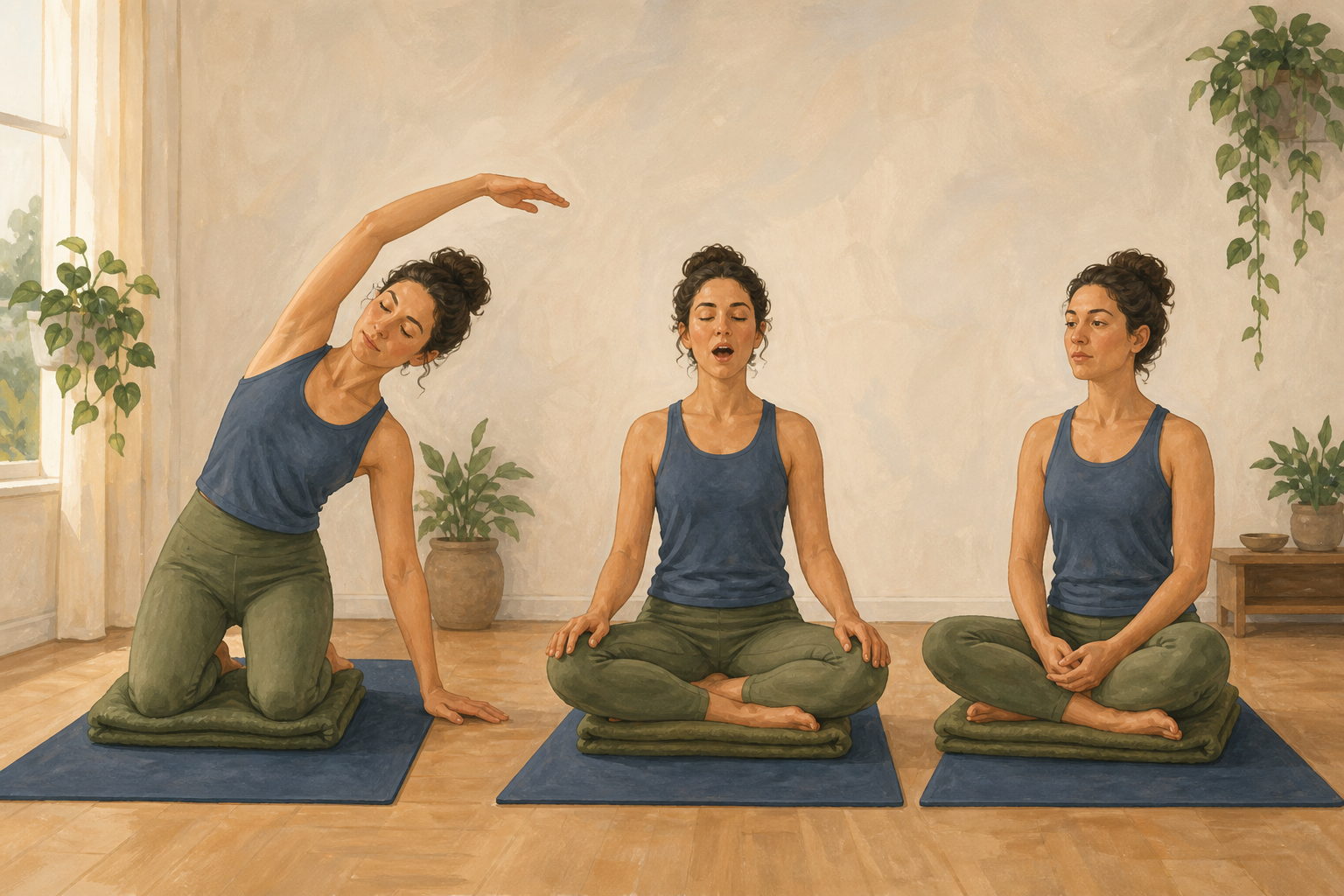
Use the following sequence as a framework, not a performance target. Move slowly enough to notice what each stage changes. On a difficult day, staying with the earlier stages may be the wiser practice.
- Notice your starting state. Feel the jaw, shoulders, hands, abdomen, and pace of thought. Notice where the breath moves easily and where it feels restricted. Do not correct anything yet. This gives you a real baseline rather than an assumption that you should feel calm.
- Choose a sustainable asana. Sit on a chair or cushion, use a supported posture, or lie down if that is what allows steadiness. Gentle movement can come first when the body is restless. Finish in a position you can maintain without gripping the face, holding the abdomen, or repeatedly adjusting.
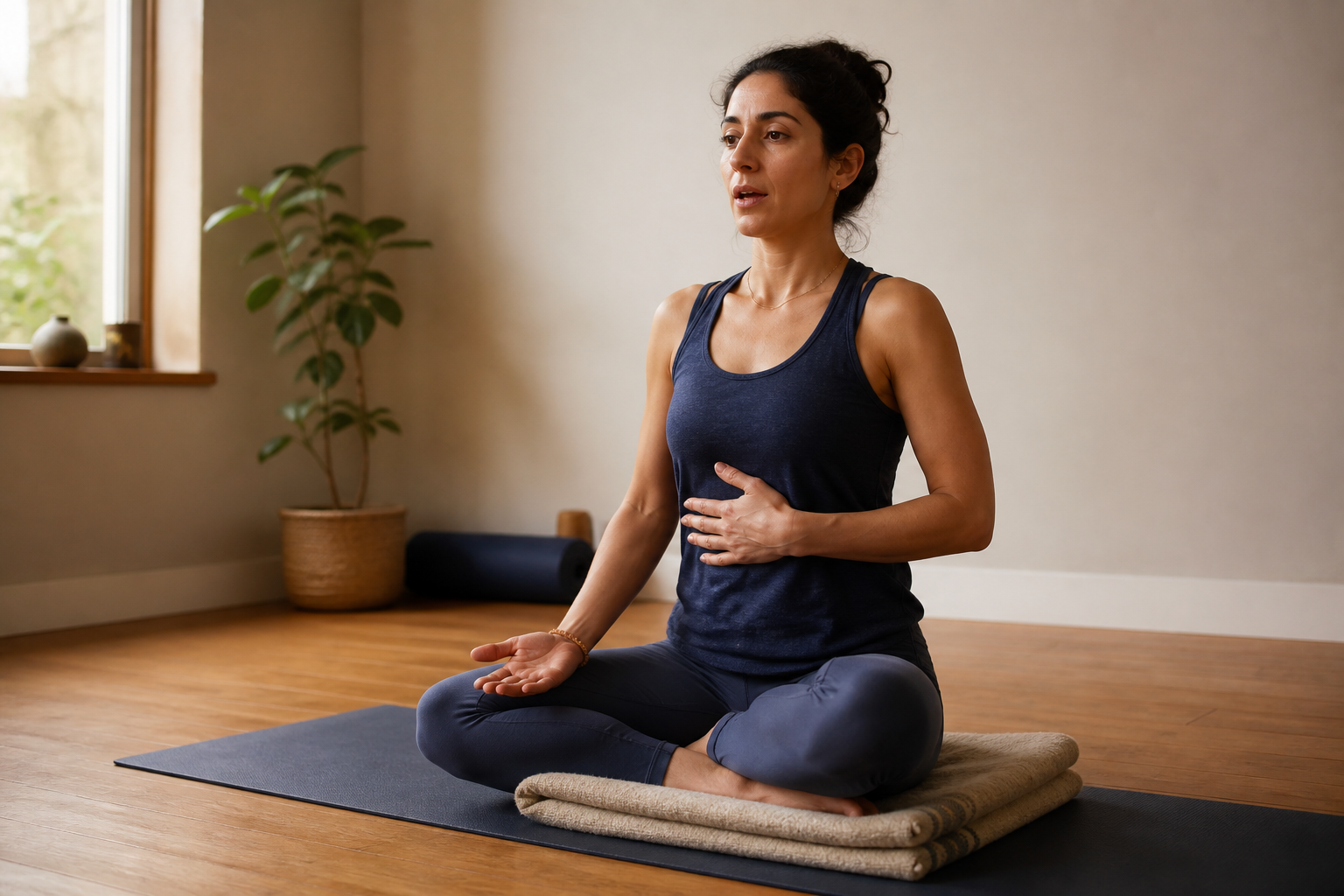
- Allow uncomplicated diaphragmatic breathing. Rest a hand near the lower ribs or abdomen if touch helps you notice movement. Let the inhalation arrive comfortably and let the exhalation finish without squeezing it out. Slow diaphragmatic breathing can support parasympathetic activation and interoceptive awareness, but more effort is not more regulation. No breath retention or demanding ratio is required for this introductory sequence.
- Add a mantra you can hold respectfully. Use a sacred name, verse, or phrase you already know and understand. Repeat it aloud, softly, or mentally. Keep the breath natural; fit the mantra to the available breath rather than stretching the breath to accommodate a long phrase. If your throat tightens or the breathing becomes clipped, lower the volume, shorten the recitation, or return to mental repetition.
- Let the sound end. After repetition, stop producing the mantra and listen. Notice the fading resonance, surrounding sounds, bodily sensations, and the urge to resume mental activity. This is a practical doorway into pratyahara and dhyana: attention becomes less captive to incoming stimulation without requiring you to become numb to the world.
- Integrate before standing up. Write a short response to these prompts: What softened? What remained guarded? What should I carry into the next part of the day? Immediate reflection can help turn a passing contemplative state into a usable intention.
Do not grade the session by whether all thoughts disappeared. Compare the same markers you noticed at the beginning: jaw pressure, shoulder effort, breath restriction, mental speed, and your ability to remain present. A small shift in any of them is useful information. If you end more restless than you began, shorten the next session and spend more time establishing physical support before adding breath or sound.
Use mantra as a relationship, not an audio effect

Mantra is not merely a pleasant vibration. Its regulating value comes partly from giving attention a repeatable form. Sound, meaning, and repetition can steady attention and cultivate presence. That can be valuable without claiming that every frequency produces a guaranteed therapeutic result.
Your choice of mantra affects the quality of the practice. Work with these criteria:
- Meaning: Know what you are invoking or remembering. When the words carry ethical or devotional meaning for you, attention has somewhere deeper to return than sound alone.
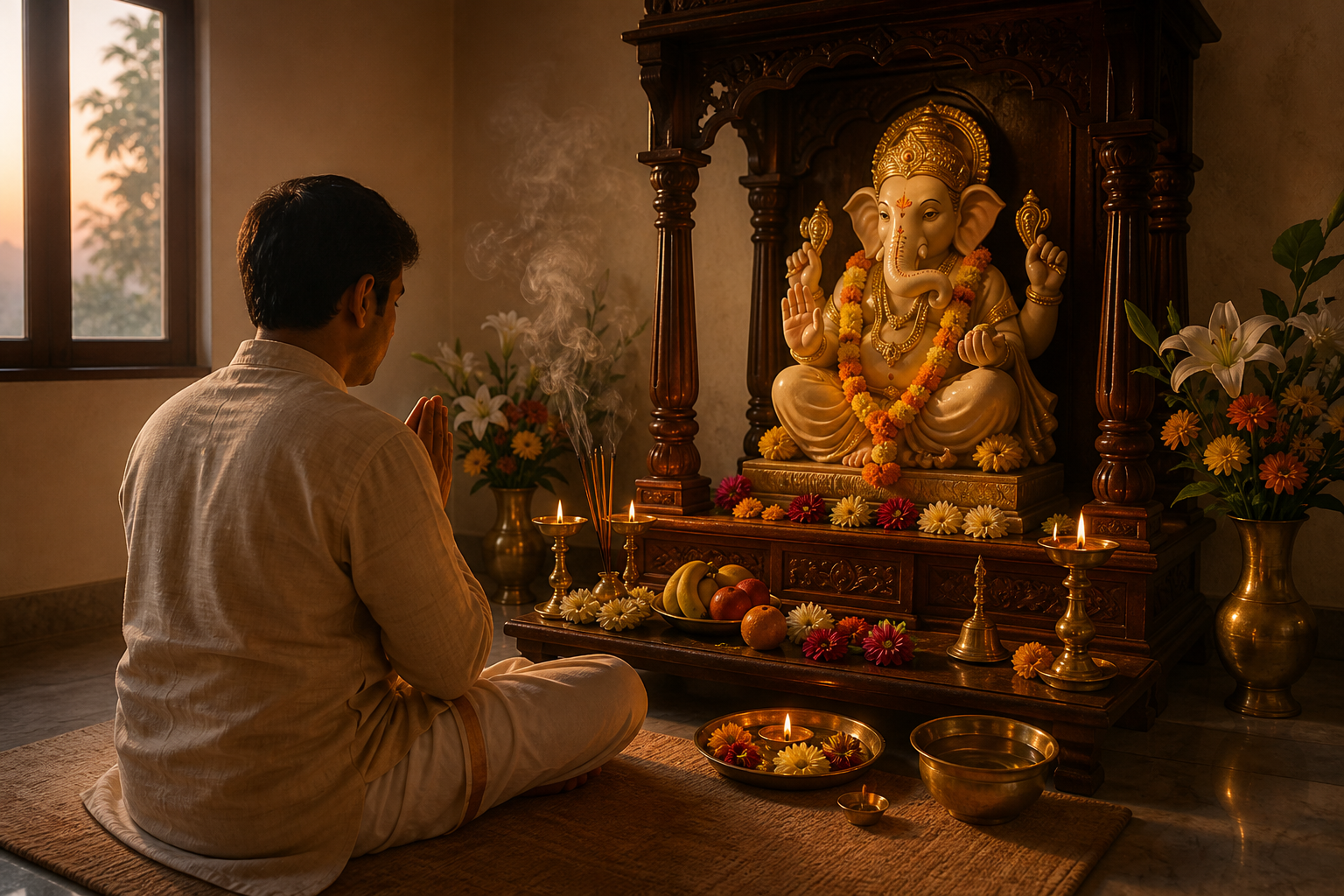
- Relationship: Prefer a mantra received through your family, sampradaya, teacher, or established practice. If a mantra is initiation-bound, learn and use it within that discipline rather than treating it as a generic wellness tool.
- Pronunciation: If the practice depends on a Sanskrit or other liturgical form, learn carefully from a trustworthy teacher or recording connected to the tradition. Until then, gentle mental repetition is better than speed and display.
- Mode: Audible recitation can help when the mind is scattered; softer or mental repetition may suit a quieter state. Choose the mode that improves steadiness without creating vocal or respiratory strain.
- Pace: Let repetition remain even and unhurried. If keeping pace makes you gasp, compress the exhalation, or rush the words, the pace is working against the purpose.
Hinduism, Buddhism, Jainism, and Sikhism all preserve disciplined relationships with contemplative sound, breath, and inward attention. These shared dharmic practices can support stillness, compassion, and ahimsa, but common ground does not make every theology, mantra, or ritual interchangeable. Dharmic unity is strengthened by precision and respect, not by flattening distinct paths into a single wellness vocabulary.
If mantra makes you chase an unusual sensation, return to its meaning. If it becomes mechanical, slow down and listen to each repetition. If it strengthens agitation, stop reciting and orient yourself through ordinary sight, touch, and unforced breathing. The mantra should help attention become more coherent; it should not become another demand you feel compelled to satisfy.
Know the difference between settling, shutdown, and strain
Nervous-system regulation does not mean remaining relaxed at all times. It means gaining more capacity to notice activation and return toward a workable state. The result may be modest: a fuller natural exhalation, less muscular gripping, slower mental momentum, or a little more space before reacting. Experiences vary, and relaxed awareness cannot be guaranteed or prescribed.
Continue when awareness becomes clearer
A useful practice generally leaves you more able to feel the body, hear the environment, and make a choice. Sleepiness may occur, especially when you are tired, but complete dullness is not the only sign of success. If your posture grows easier, breathing becomes less defended, and attention remains available, continue gently.
Simplify when effort begins to dominate
Open your eyes and return to ordinary breathing if repetition makes you feel trapped, breathless, unreal, or increasingly agitated. Feel the support beneath you. Look at familiar objects in the room. Move your hands and feet. You can omit mantra, breath regulation, or stillness and retain only the part of the practice that feels steady. Ahimsa applies to the method as well as the intention.
Stop when symptoms signal possible harm
Stop breathwork or physical practice if you develop faintness, chest pain, severe shortness of breath, or pain that feels sharp or alarming. Seek appropriate medical care rather than trying to breathe through those symptoms. If stillness, breath attention, or mantra repeatedly triggers panic, dissociation, or traumatic memories, a licensed mental-health professional familiar with contemplative practice is a safer partner than self-directed intensification.
Gentle Hatha and mantra can support self-regulation, but they are not substitutes for medical or psychological treatment. Advanced shatkarma, forceful pranayama, breath retention, and precise bandha practice should not be added casually to a stress routine. The traditional movement from purification and stability toward subtler practices is itself a reminder to proceed with preparation and qualified guidance.
Key takeaways for your next practice
- Begin by noticing your actual state. Calm is an outcome you may approach, not a mood you must imitate.
- Use asana to create steadiness before asking breath, mantra, or meditation to become subtle.
- Keep the breath comfortable. Strain, retention, and complicated ratios are unnecessary for a gentle introductory practice.
- Choose mantra through meaning and relationship, not because a sound is marketed as a guaranteed cure.
- Let silence follow recitation so you can observe what changed instead of immediately seeking another stimulus.
- Measure progress through greater awareness and choice, not dramatic sensations or the total disappearance of thought.
- Practice ahimsa by simplifying when the body resists and seeking qualified help when symptoms exceed the scope of self-care.
At your next session, note a clear bodily signal before you begin and check it again after the silence. Keep the parts that increase steadiness. Reduce whatever creates force. Repeated with abhyasa and discernment, that honest adjustment is more valuable than an impressive routine you cannot safely inhabit.
References
- DharmaRenaissance Blog — Sound as Medicine: Calm the Nervous System, Restore Balance, and Honor Dharmic Unity
- DharmaRenaissance Blog — Gheranda Samhita: Timeless Hatha Yoga Wisdom for Purification, Power, and Inner Calm
