

If you are trying to discover which authority stands behind a Sama Veda wedding, naming ceremony, initiation, or ancestral observance, “a Hindu ritual manual” is too broad an answer. Gobhila Rishi matters because his legacy belongs to the domestic sphere of Vedic practice: the moments when a household marks a life transition, maintains recurring duties, and remembers those who came before.
That distinction can save you from two common errors. One is treating the Sama Veda as though its relevance ended with chant. The other is treating every inherited Hindu ceremony as interchangeable. To use Gobhila responsibly, you need to know what kind of authority his name represents, which Sama Veda traditions particularly value it, and where textual study must give way to living instruction.
Why Gobhila matters to a Sama Veda household
Gobhila stands within the early Vedic tradition as an authoritative teacher associated with the Sama Veda. Practitioners connected with the Kauthuma and Ranayaniya schools have especially regarded his ritual teaching as a dependable basis for domestic observance. If your family identifies with either school, that connection is not incidental; it is one of the first facts to establish before preparing a rite.
If your family follows another Vedic lineage, you can still study Gobhila to understand Sama Veda household religion. You should not, however, quietly replace your own transmitted procedure with a different school’s rules and then describe the result as ancestral continuity. Ask a narrower question: “What does my family’s Vedic affiliation require for this particular samskara?” That question is far more useful than asking what Hindus in general do.
The domestic field associated with Gobhila is broad. It includes life-cycle ceremonies connected with birth, naming, first feeding, initiation, and marriage, as well as daily and seasonal observances. It also reaches into the ethical life of the householder and the remembrance of ancestors. The household therefore appears not as a place where religion is diluted, but as one of the places where dharma acquires rhythm, responsibility, and continuity.
This Vedic specificity should not be dissolved into a generic pan-Dharmic ritual identity. Hinduism, Buddhism, Jainism, and Sikhism do not share one domestic ritual manual. They can nevertheless meet around an ethos of reverence, service, mindful conduct, and care across generations. Shared values create conversation; they do not erase the integrity of distinct lineages.
Separate the three parts of Gobhila’s legacy
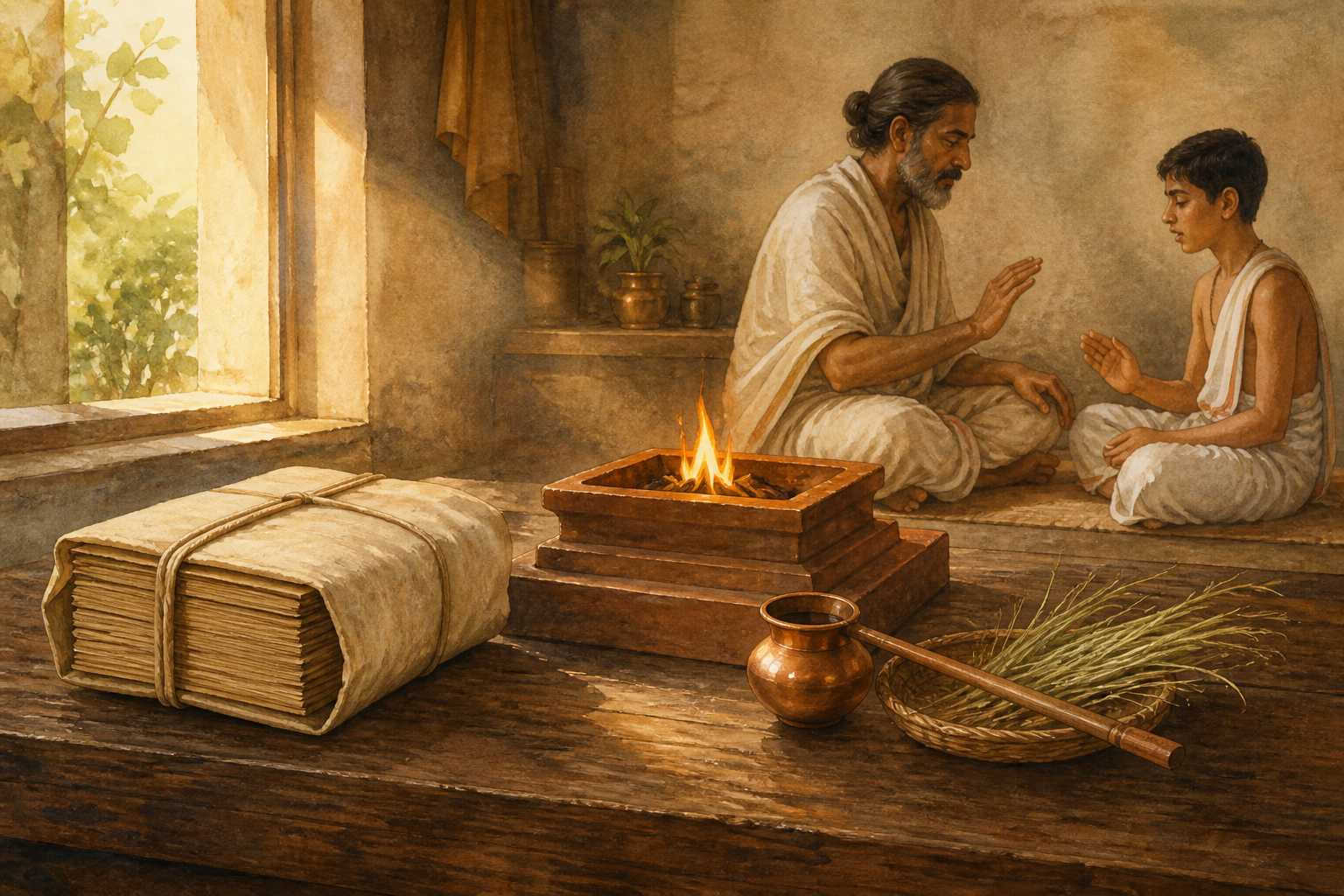
You will get clearer answers when you separate three different parts of the legacy attributed to Gobhila. They do not perform the same function, and treating them as interchangeable leads to confused practice.
Gobhila Grihya Sutra: what the household does
When your question concerns the performance of a domestic rite, begin with the ritual domain represented by the Gobhila Grihya Sutra. Through it, you encounter carefully ordered observances for important transitions and recurring duties. Mantras, offerings, the family fire, and the sequence of actions belong to that ritual world; they are not decorative additions placed around an otherwise complete social event.
The progression from one act to another deserves particular attention. A family may be tempted to extract the most visible moment of a ceremony while ignoring its preparation, order, and accompanying obligations. Gobhila’s domestic vision points in the opposite direction: the rite becomes intelligible through its sequence. If you are studying a ceremony, map the whole progression before choosing which parts seem convenient.
Gobhila Smriti: how the householder conducts life
When the question shifts from ceremonial procedure to conduct, the Smriti dimension becomes important. Within the Gobhila Smriti, norms for householders and communities connected with the Sama Veda milieu complement ritual prescription. This ethical layer prevents technical correctness from being mistaken for the whole of dharma.
A precise ceremony cannot compensate for neglect of family duty, elders, ancestors, or social responsibility. Conversely, sincere feeling does not make inherited ritual form irrelevant. Gobhila’s legacy holds correct action, right intention, and responsible conduct together. Use those three measures when assessing whether a household observance is merely impressive or genuinely dharmic.
Gobhiliya Shraddhakalpa: what the surviving memory permits
Only references preserve the memory of the Gobhiliya Shraddhakalpa, a work associated with ancestral rites. That survival limit matters. It supports a careful conclusion that śrāddha and ancestral duty occupied a meaningful place in Gobhila’s ritual horizon. It does not permit anyone to invent the lost work’s exact wording or procedure.
If you encounter a modern claim that presents a complete practice as a direct reconstruction of this lost material, ask what actually survives and what comes from another transmitted authority. Acknowledging a gap is not disrespectful to tradition. It is more faithful than filling the gap with unsupported detail.
Ritual sequence carries an ethical purpose
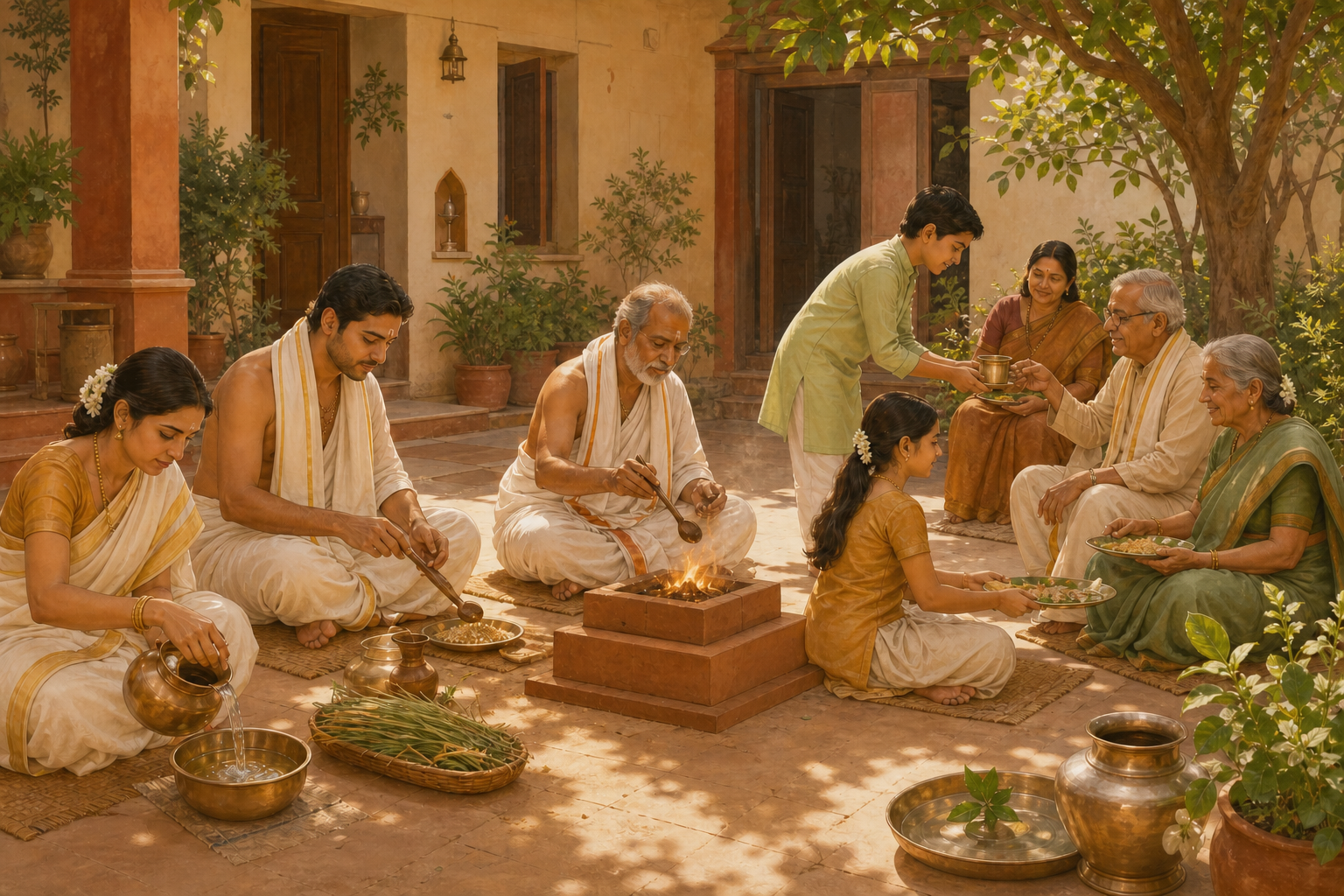
Modern readers sometimes set precision and meaning against each other: either a rite follows exact form or it expresses heartfelt intention. Gobhila’s domestic framework gives you little reason to accept that choice. Procedure disciplines attention, while intention and duty keep procedure from becoming empty display.
At a birth-related observance, naming, first feeding, initiation, or marriage, the family is doing more than celebrating an event. It is giving a transition an inherited form and locating the individual within relationships and responsibilities. During daily and seasonal rites, repetition teaches steadiness rather than dependence on occasional enthusiasm. In ancestral remembrance, gratitude becomes a duty carried across generations rather than a passing private feeling.
This is why apparently small details matter. A mantra is not merely an auspicious sound effect. An offering at the family fire is not merely visual symbolism. An ordered series of acts is not simply event choreography. Within the intimate ritual life of the Vedic home, form trains the participants to become attentive to time, relationship, memory, and obligation.
You can therefore test your preparation with three questions. What is to be done, and in what order? What duty or intention gives those actions meaning? What responsibility should remain after the ceremony ends? If the last question has no answer, the household may be planning a performance while missing the ethical work of a samskara.
How to study or prepare a Gobhila-based rite
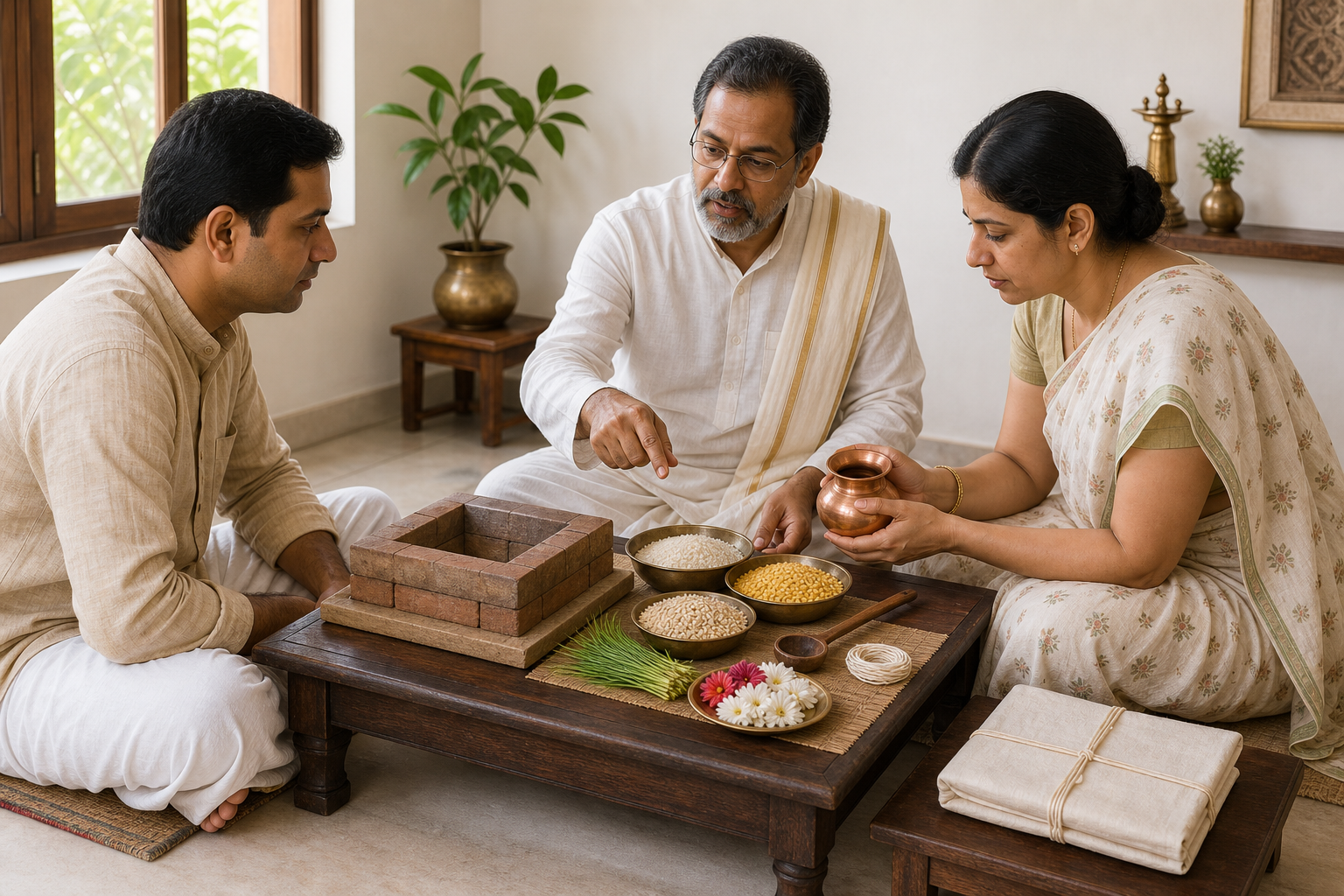
You do not need to become a textual specialist before asking intelligent questions. You do need to distinguish orientation from performance. A broad account can help you locate the relevant authority; it cannot supply every mantra, action, or lineage-specific rule required to conduct a ceremony.
- Name the exact occasion. Identify whether you are dealing with birth, naming, first feeding, initiation, marriage, a daily or seasonal observance, or ancestral duty. Do not begin with the undifferentiated label “Vedic ritual.”
- Identify the kind of answer you need. Turn to the Grihya domain for domestic procedure, the Smriti domain for conduct, and surviving lineage instruction for actual performance. Do not treat the title of the lost Shraddhakalpa as if it supplied recoverable directions.
- Verify the family’s Vedic affiliation. Ask whether the household has a known connection with the Sama Veda and, more specifically, with the Kauthuma or Ranayaniya school. If the answer is unknown, record that uncertainty instead of guessing.
- Build a sequence sheet. For each stage, note the required action, mantra or chant, offering, relation to the household fire, responsible participant, and any unresolved question. This exposes gaps before the ceremony and prevents the most visible act from replacing the full rite.
- Review the sequence with a competent transmitter of Sama Veda practice. Give special attention to recitation, offerings, fire procedure, and ordering. These are precisely the areas where a general description is least able to substitute for instruction.
- Label adaptations honestly. Distinguish what comes from inherited authority, what belongs to a particular living lineage, and what your family has adapted to present circumstances. Honest labels preserve continuity better than calling every local choice ancient.
If you are studying rather than preparing a ceremony, apply the same discipline to your notes. Mark each claim as an extant Grihya prescription, a Smriti norm, a reference to a lost work, or a current customary practice. That simple separation prevents later practice from being projected backward and incomplete evidence from being made artificially complete.
A family that is not ready to perform a rite can still recover part of Gobhila’s domestic orientation. Prepare major transitions deliberately. Keep gratitude to ancestors from becoming an afterthought. Treat care for elders and responsible conduct as part of religious life. Build steadiness through recurring observance rather than waiting for rare ceremonial occasions. These disciplines do not replace samskaras, but they help create the kind of household in which samskaras make sense.
Key takeaways
- Gobhila Rishi is a specifically Sama Veda authority on domestic ritual, with particular importance for the Kauthuma and Ranayaniya schools.
- Birth-related rites, naming, first feeding, initiation, marriage, daily observances, seasonal rites, conduct, and ancestral duty belong within the scope of his remembered legacy.
- The Grihya, Smriti, and lost Shraddhakalpa dimensions answer different questions and should not be treated as interchangeable.
- Correct sequence, right intention, and social responsibility belong together; none is a complete substitute for the others.
- A general explanation can orient you, but exact mantras, offerings, fire procedures, and lineage rules require competent transmission.
Your next move is simple: write down the exact rite you are considering and everything you know about your family’s Vedic affiliation. Take those two facts, rather than a generic request for “a Hindu ceremony,” to someone who transmits Sama Veda practice. That is where respect for Gobhila becomes living continuity.
References
