
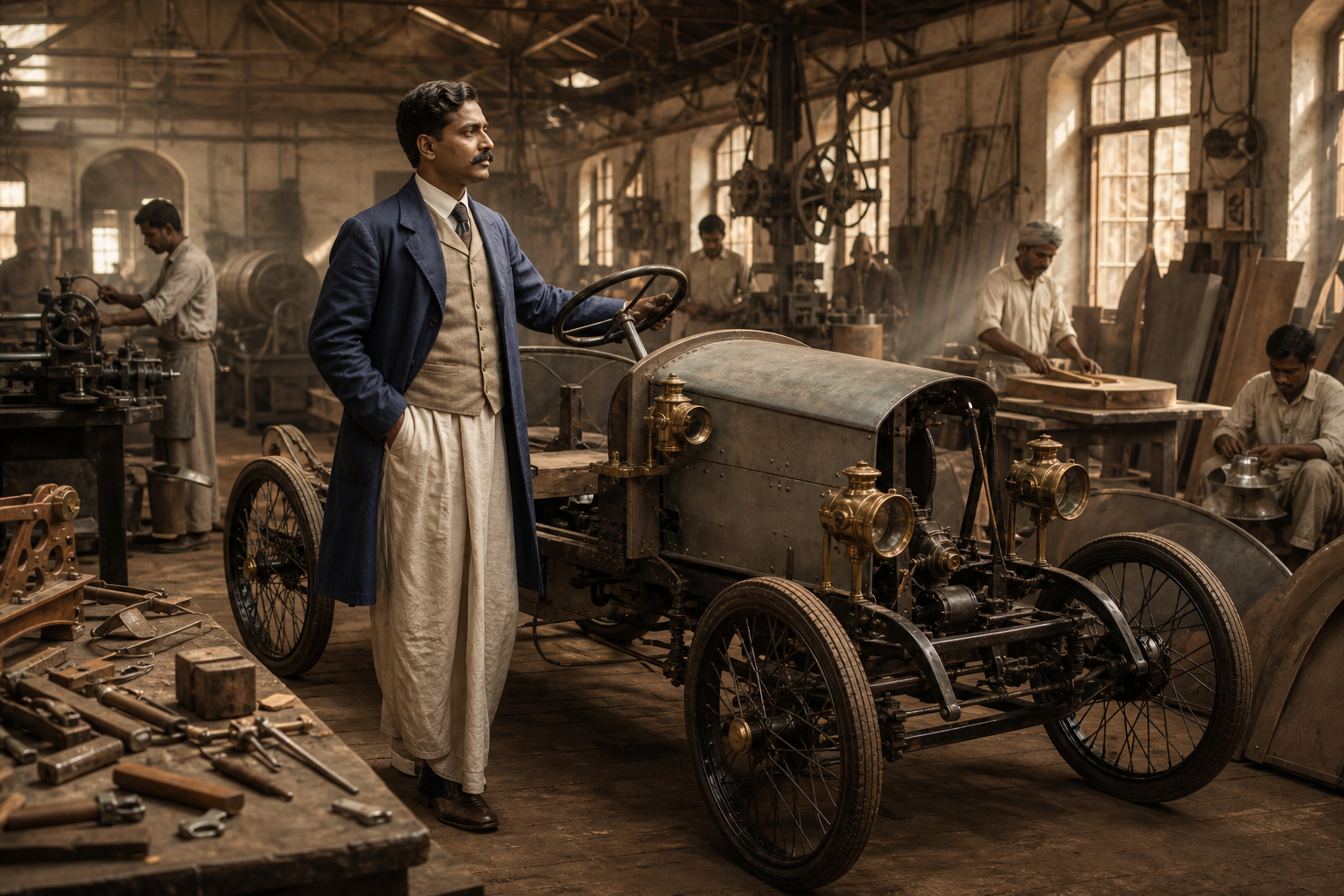
If you are deciding whether to repeat the line “Bepin Behari Das built India’s first indigenous motor car,” do not force the evidence into a simple yes or no. Keep Das in the history, but keep the qualification beside his name.
Das is remembered as an early-twentieth-century Swadeshi innovator credited with building India’s first indigenous car. The documentation attached to that claim, however, remains fragmentary. The most responsible wording is therefore: Bepin Behari Das is credited in under-documented accounts with building an early indigenous Indian motor car; absolute priority and completely domestic manufacture have not yet been demonstrated. That formulation honours the maker without asking the evidence to carry more than it can.
Why the familiar claim is really several claims
“India’s first indigenous car” sounds precise. It is not. Before you use the phrase in a classroom, exhibition, video, family history or social-media caption, separate the questions hidden inside it.
- Was there a completed motor car, rather than a design, an unfinished machine or a workshop experiment?
- What was Das’s role: designer, fabricator, project leader, owner, patron or assembler?
- Which parts were designed and made in India?
- Did the project use imported components within an Indian-designed or Indian-fabricated vehicle?
- What establishes chronological priority over every other plausible claimant?
Each question requires a different kind of proof. Evidence that Das participated in building a car would not, by itself, establish that every major component was indigenous. Evidence of substantial Indian fabrication would not, by itself, prove that the vehicle was the first. A dated mention would help establish chronology, but it would still need to be compared with other early Indian experiments.
The word “first” carries the heaviest burden. It is a comparative claim about the entire field, not merely a description of one achievement. You must identify the relevant competitors, apply the same definition to each and show why one project precedes the rest. Until that work is done, “credited with” is not evasive language. It is the historically accurate marker for an attribution that deserves investigation but is not yet conclusive.
How to test the claim without erasing the pioneer
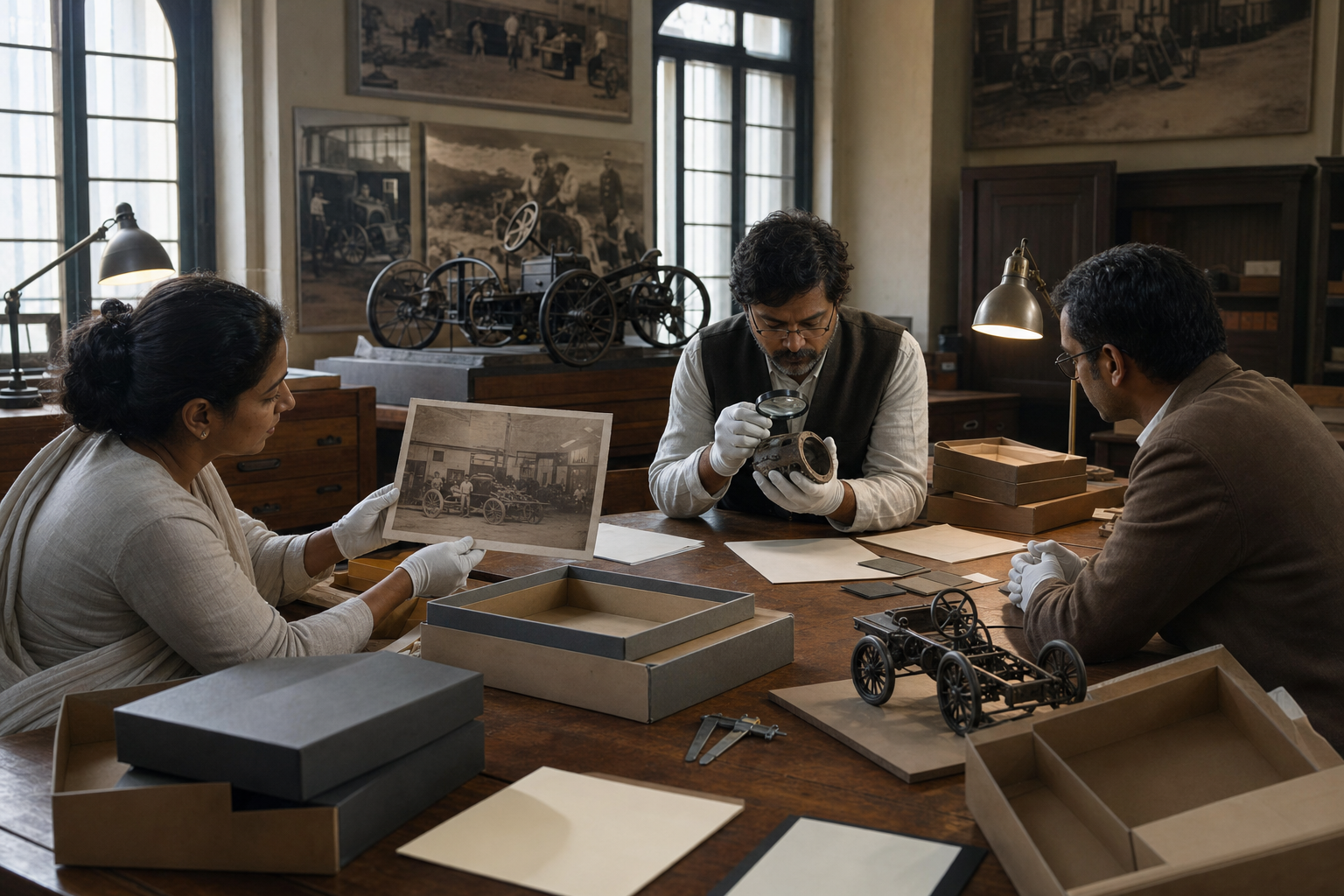
A serious inquiry should begin with a claim ledger. Write down each proposition separately, place the evidence beside it and mark what remains unknown. This prevents a modest fact from silently expanding into a much stronger conclusion as it passes from one retelling to another.
| Question | Evidence that would strengthen it | Safe wording while the gap remains |
|---|---|---|
| Did Das build or direct the building of a car? | Workshop records, correspondence, contemporary reporting, attributed photographs or consistent oral histories | “Das is credited with building an early Indian motor car” |
| How indigenous was the machine? | Parts lists, workshop accounts, drawings and records identifying the origin of the chassis, powertrain and other major components | Name the documented Indian work and leave the rest unspecified |
| Was the vehicle operational? | A dated record of completion, demonstration, road use or technical inspection | “Motor-car project” or “experimental vehicle” if completion is not established |
| Was it India’s first? | A comparative chronology using the same definition for every contender | “Credited as an early pioneer” rather than an unqualified “first” |
| Who else made it possible? | Payrolls, workshop rosters, suppliers’ records, family testimony and named technical credits | Acknowledge the wider workshop community and avoid presenting engineering as solitary work |
Start close to the event. Regional newspapers may preserve demonstrations, workshop openings, public appearances or local descriptions that never entered later national histories. Workshop records can reveal who fabricated what. Oral histories can recover names and locations, but they should be recorded with the narrator, date and chain of transmission so that later researchers can distinguish memory from contemporary documentation.
Next, reconstruct the machine as a machine. A motor car is not one indivisible invention. The chassis, body, steering, braking, power transmission, engine and other assemblies may have different origins. Ask who designed, fabricated, modified and assembled each major system. If the available evidence reaches only the chassis or body, say so. Do not let certainty about one component become certainty about the whole vehicle.
Finally, keep three columns in your notes: verified fact, reasonable inference and unresolved question. Publish those distinctions. A transparent gap invites someone to bring forward a newspaper clipping, workshop notebook or family recollection. A polished but overconfident legend gives that person no indication of what historians still need.
A hybrid vehicle could still be a Swadeshi achievement
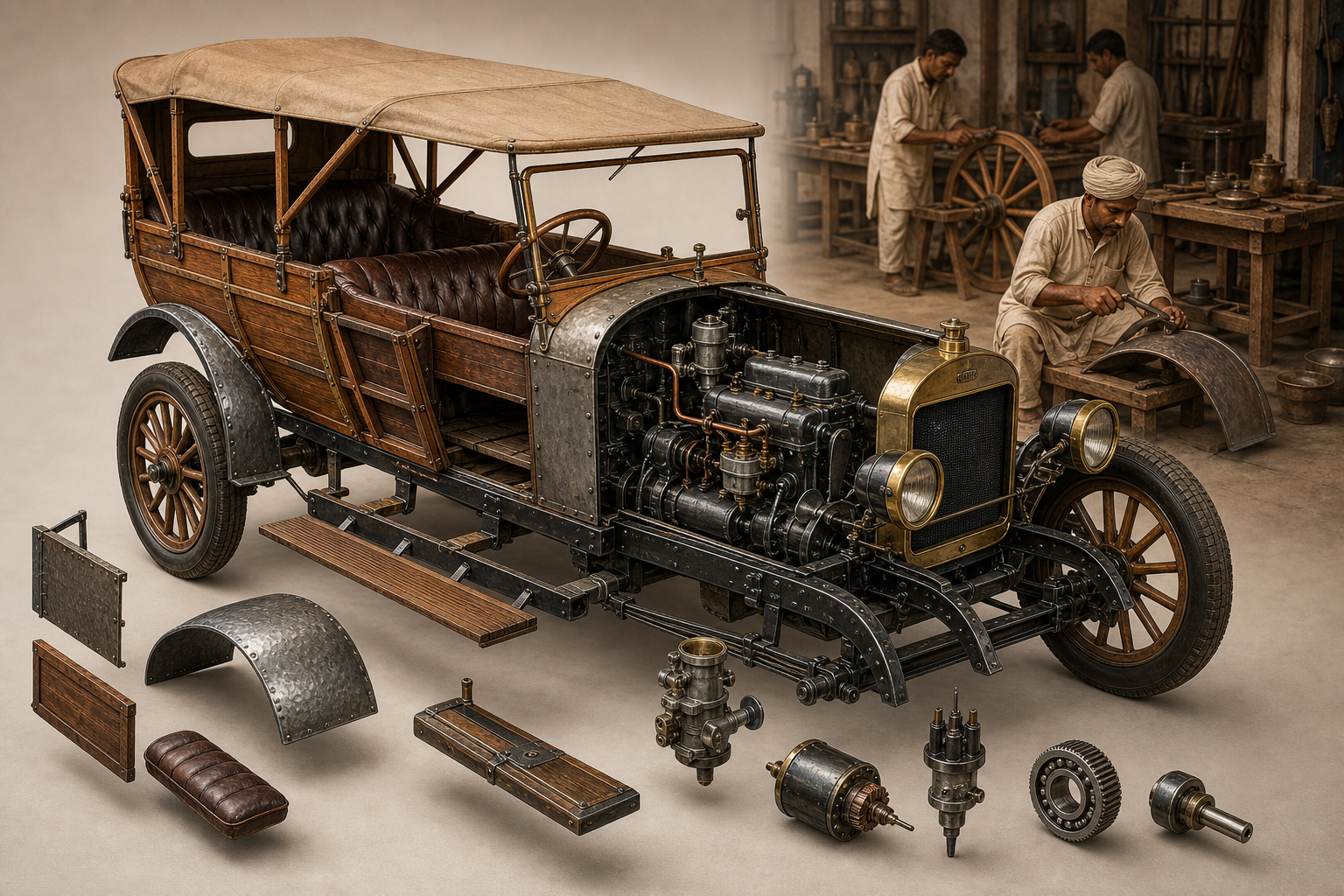
The strongest version of the story imagines a car made entirely from Indian parts. That possibility should neither be assumed nor dismissed without component-level evidence. More importantly, it is not the only form of indigenous technical achievement worth remembering.
In an era when imported technologies dominated much of urban life, an Indian workshop could exercise substantial engineering agency even while using an imported subsystem. Designing or fabricating a chassis, integrating components, adapting a vehicle to local roads, working with available materials and solving failures through repeated workshop effort all require real technical judgement. Systems integration is engineering, not a clerical act.
This distinction protects both historical accuracy and the meaning of Swadeshi. Swadeshi was not merely a purity test applied to a finished object. It was also a practical movement toward Indian capacity: learning to design, make, repair, adapt and eventually control more of the technological chain. A hybrid machine can occupy an important place in that process, even if it cannot honestly be called fully indigenous.
- Use “built in India” when the location of construction is established but the origin of the components is mixed or unknown.
- Use “Indian-designed” only for the systems whose design responsibility can be traced.
- Use “locally fabricated” for parts actually made in an Indian workshop.
- Use “adapted in India” when imported technology was materially modified for Indian conditions.
- Use “indigenous” only after explaining what the term covers in that particular claim.
- Treat “fully indigenous” as a much stronger assertion requiring detailed provenance for the vehicle’s major systems.
These labels are not competing verdicts. One vehicle may be Indian-designed in one system, locally fabricated in another and dependent on an imported component elsewhere. Describe that mixture directly. The result is usually more impressive than a vague superlative because the reader can see the actual work.
What a Dharmic remembrance should preserve
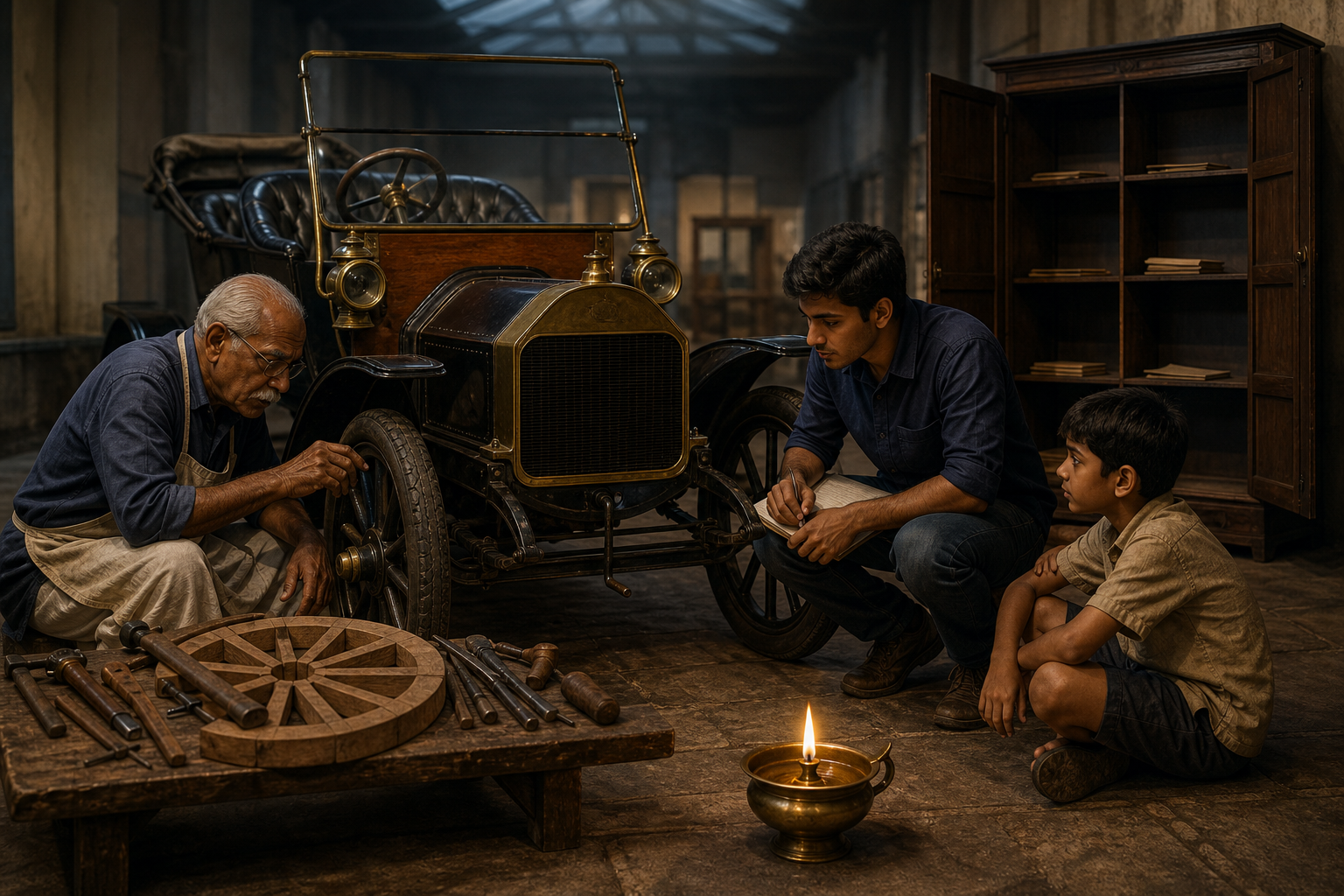
Das has been described through the archetype of the “forgotten Vishwakarma.” The phrase places skill, design and the dignity of labour within a Hindu civilizational vocabulary. It asks us to see making not as a lesser activity beneath intellectual life, but as disciplined knowledge expressed through the hand, tool and workshop.
That description should widen the frame rather than turn one man into a solitary genius. A motor car requires coordinated labour. Machinists, metalworkers, pattern-makers, mechanics and suppliers convert an idea into a functioning system. Even when their names have disappeared, we should not write as if their work did not exist. Recovering Das should become a doorway to recovering the technical community around such projects.
The broader Dharmic lesson is not that every Hindu, Buddhist, Jain and Sikh tradition uses identical language for technology. They do not. The shared ground lies in the moral seriousness accorded to ethical labour, restraint, responsibility and service. Seva expressed through competent work is still seva. A well-made tool, vehicle or public system can serve collective well-being just as surely as a more visibly religious act.
Historical truthfulness belongs inside that ethic. Inflating an uncertain claim may feel like cultural defence, especially when colonial narratives treated Indians as consumers rather than creators of modern technology. In practice, exaggeration makes a pioneer easier to dismiss. A qualified claim backed by a visible trail of evidence is harder to erase and easier to strengthen.
If you are preparing a commemorative plaque, lesson or public caption, divide it into three parts: what is documented, what is attributed and what remains to be established. Invite families, local historians, technical institutes and archives to help fill the third part. Digitise records with dates, provenance and descriptive notes rather than circulating isolated images whose origins will soon be lost.
Key takeaways
- Bepin Behari Das deserves recognition as an under-documented figure associated with early Swadeshi motor-car engineering.
- “First,” “Indian-built,” “Indian-designed” and “fully indigenous” are different claims and must not be used interchangeably.
- The safest present formulation is that Das is credited with building an early indigenous Indian motor car; absolute priority remains unproven in the fragmentary record.
- Use component-level evidence to distinguish local design, fabrication, adaptation, assembly and imported content.
- A vehicle with mixed component origins could still represent a meaningful advance in Indian engineering capacity.
- Honouring the Vishwakarma spirit means crediting skilled workshop labour and being exact about what the evidence can support.
If you repeat Das’s name, attach a precise qualifier and a practical invitation: seek, date and preserve oral histories, workshop records and regional newspaper material. That turns remembrance into historical recovery. Each newly authenticated record can then strengthen, refine or correct the claim without requiring us to choose between civilizational confidence and intellectual honesty.
References
