
If you are trying to decide whether Sunday, November 16, 2025 should be treated as Ekadashi or Dwadashi, the answer changes during the early morning. The date begins in Krishna Paksha Ekadashi, but most of the civil day falls under Krishna Paksha Dwadashi.
The practical question is not merely which tithi appears beside the date. You need to distinguish the tithi transition from the permitted time for parana, then confirm that timing for your location and sampradaya.
The November 16 tithi transition at a glance
For most regions, Krishna Paksha Ekadashi lasts until 4:23 AM on November 16. Krishna Paksha Dwadashi begins at 4:23 AM and continues through the remainder of the day.
This is why two descriptions of November 16 can sound different without necessarily contradicting each other. One may identify the tithi present when the civil date begins; another may emphasize Dwadashi because it occupies the day after 4:23 AM. A tithi follows the lunar calendar and does not have to begin or end at midnight.
Key takeaways
- November 16, 2025 is a Sunday.
- Krishna Paksha Ekadashi remains in effect until 4:23 AM in most regions.
- Krishna Paksha Dwadashi begins at 4:23 AM.
- The 4:23 AM boundary identifies the tithi change; it is not, by itself, a complete parana instruction.
- Your actual parana window should come from a reliable local Panchang or a trusted temple advisory aligned with your tradition.
Do not mistake 4:23 AM for an automatic parana time

The most consequential mistake is to read “Ekadashi ends at 4:23 AM” and conclude that everyone should break the fast at exactly 4:23 AM. The tithi boundary tells you when Dwadashi begins. Parana is performed on Dwadashi within a prescribed window, and determining that window requires more than the boundary time alone.
Locality matters because Panchang calculations depend on astronomical conditions for a particular place. Longitude, latitude and the calculation method used by the almanac can affect the applicable schedule. Community and sampradaya rules can also shape how the observance is completed. A time copied from another city, country or tradition should therefore not be treated as universal.
This distinction is especially important when a household follows a temple calendar. If a generic calendar entry and your temple’s instruction differ, do not combine the tithi boundary from one with the parana window from the other. Use one coherent, locally appropriate authority for the ritual decision.
How to confirm your parana plan

You can avoid most timing confusion by checking five items before the observance:
- Set the location. Use the city where you will actually observe and complete the vrata, not a familiar city in another time zone.
- Confirm the tithi sequence. Your local Panchang should show Ekadashi ending and Dwadashi beginning for that location.
- Look for a stated parana window. Do not substitute the Ekadashi end time when the almanac provides a separate interval for breaking the fast.
- Apply your sampradaya’s rule. Vaishnava, regional, temple and household practices are not always interchangeable, even when they refer to the same tithi.
- Coordinate the household. Write down the agreed window so that different family members are not working from unrelated calendars or forwarded messages.
If no trustworthy local parana window is available, the responsible next step is to contact the temple, priest or established community authority you normally follow. Guessing from 4:23 AM creates false precision: the number is precise, but it answers only the tithi question.
What belongs in the Ekadashi-Dwadashi observance
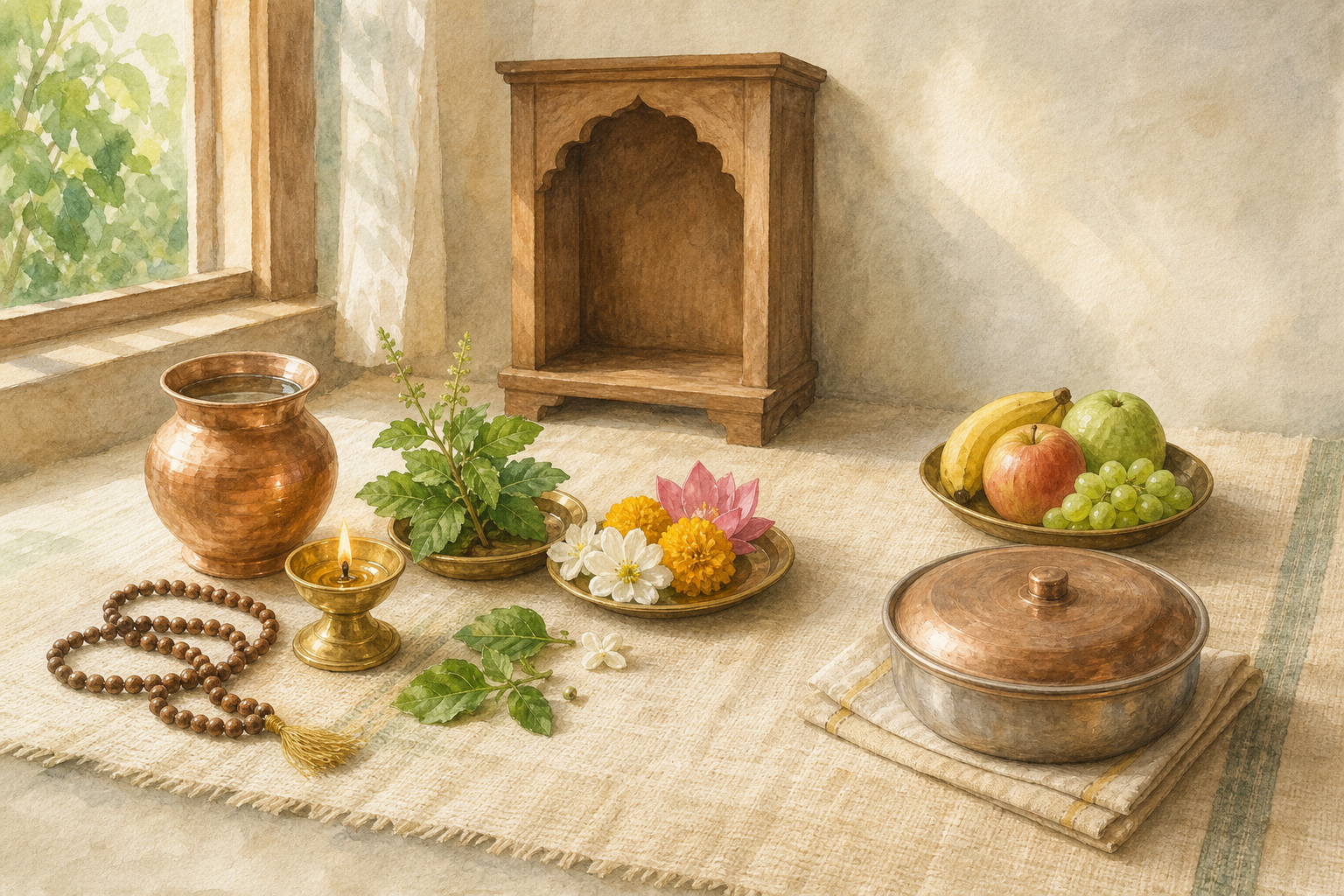
Ekadashi is commonly set apart for upavasa, japa and sattvic living. If you are keeping the vrata, let the discipline extend beyond the food rule. Reduce avoidable distraction, choose a manageable japa commitment, and keep the household atmosphere suited to prayer and reflection. Dwadashi then brings the observance to its proper completion through parana according to the applicable rule.
If a food fast raises a health concern for you, do not force it on the strength of a general calendar entry. Seek individualized clinical guidance and ask your religious authority how japa, prayer, study, restraint or seva may be emphasized within your circumstances. Devotional seriousness is not measured by ignoring a genuine health risk.
The transition also gives the day a useful rhythm. Ekadashi directs attention toward restraint and inward steadiness; Dwadashi asks you to complete that discipline correctly rather than abandoning it casually. Parana is therefore not merely the moment when eating resumes. It is the ordered conclusion of the vrata.
Keep location-specific details separate from the core tithi
The Ekadashi-to-Dwadashi sequence does not supply every other Panchang detail for November 16. Nakshatra, Rashi and auspicious muhurta information must be checked for the locality in which it will be used. Do not attach a “good time” found for another place to this tithi entry and assume that the combined result is valid.
This matters when planning a puja, temple visit or community activity. First decide whether the activity depends only on the broad devotional character of Dwadashi or requires an exact muhurta. If exact timing matters, obtain a complete local Panchang calculation rather than assembling isolated details from several calendars.
Recognize shared dharmic values without merging distinct practices
The disciplines associated with Ekadashi have meaningful resonances across the dharmic family. Buddhist Uposatha, Jain upavasa, and Sikh commitments to simran and seva each express forms of restraint, contemplation and compassionate conduct. Those resonances can deepen mutual respect, but they do not make the calendars or ritual rules identical.
In an inter-dharmic household or community gathering, name each practice accurately. Share the values that genuinely meet – self-restraint, remembrance, reflection and service – while allowing each tradition to retain its own authority and method. A Hindu parana calculation should not be imposed as though it governed Buddhist, Jain or Sikh observance.
For November 16, write down three things together: your location, the local parana window, and the sampradaya or temple rule you are following. That small record turns a general calendar entry into a clear observance plan and prevents the 4:23 AM transition from being used for a decision it cannot settle on its own.
References
