
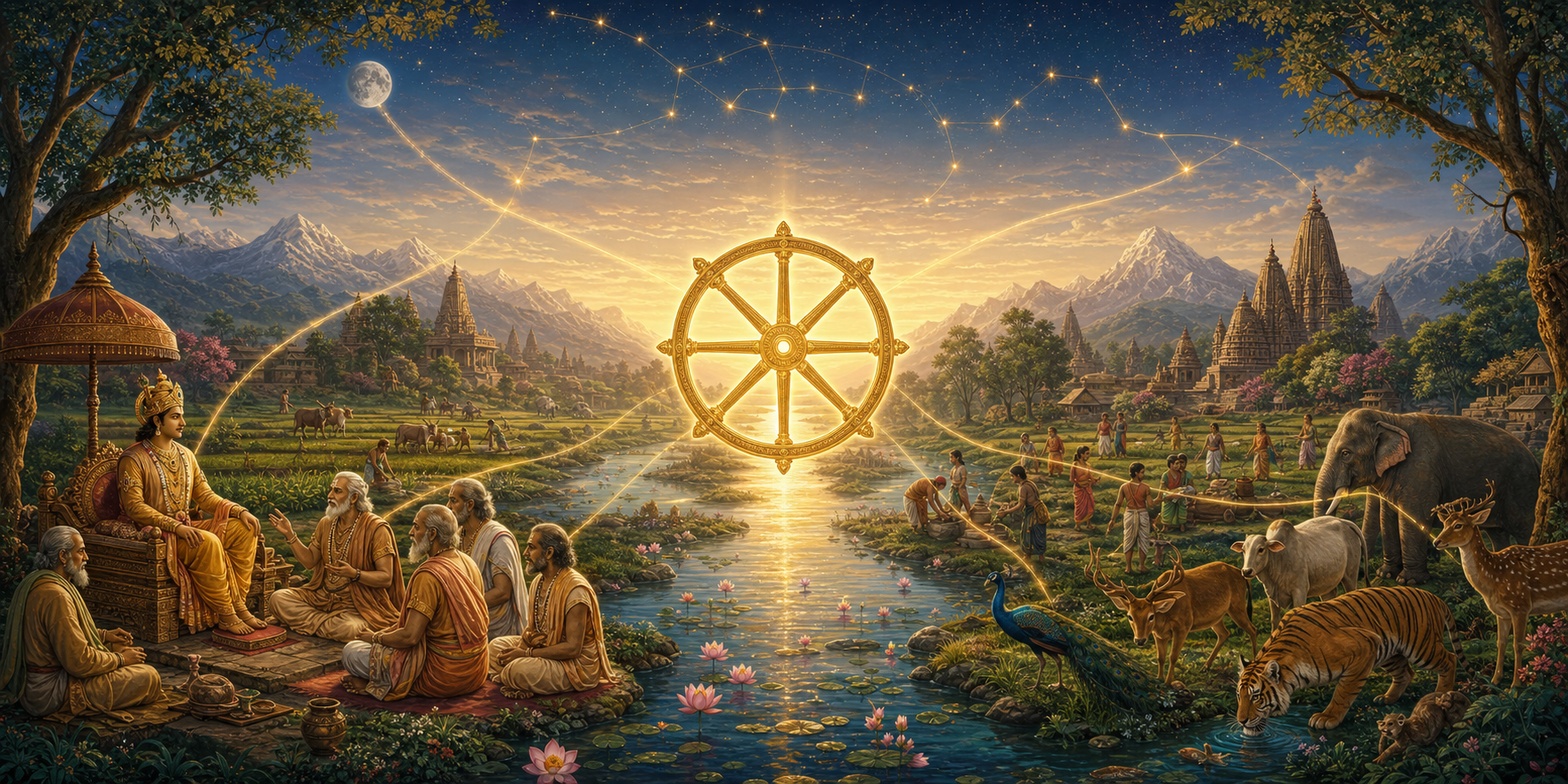
A leader demands loyalty, a plan promises prosperity, or your own ambition asks you to ignore a boundary. How do you tell whether the action is merely possible or actually dharmic?
Three narratives from the Brahma Purana give you a practical test. Prithu shows how authority becomes legitimate through stewardship. Daksha and Narada show why responsibility must be preceded by understanding. Trishanku shows why spiritual or political power cannot make every desire rightful. Read together, they turn cosmic order from a remote idea into a way of judging decisions.
Cosmic order is sustained through right relationships
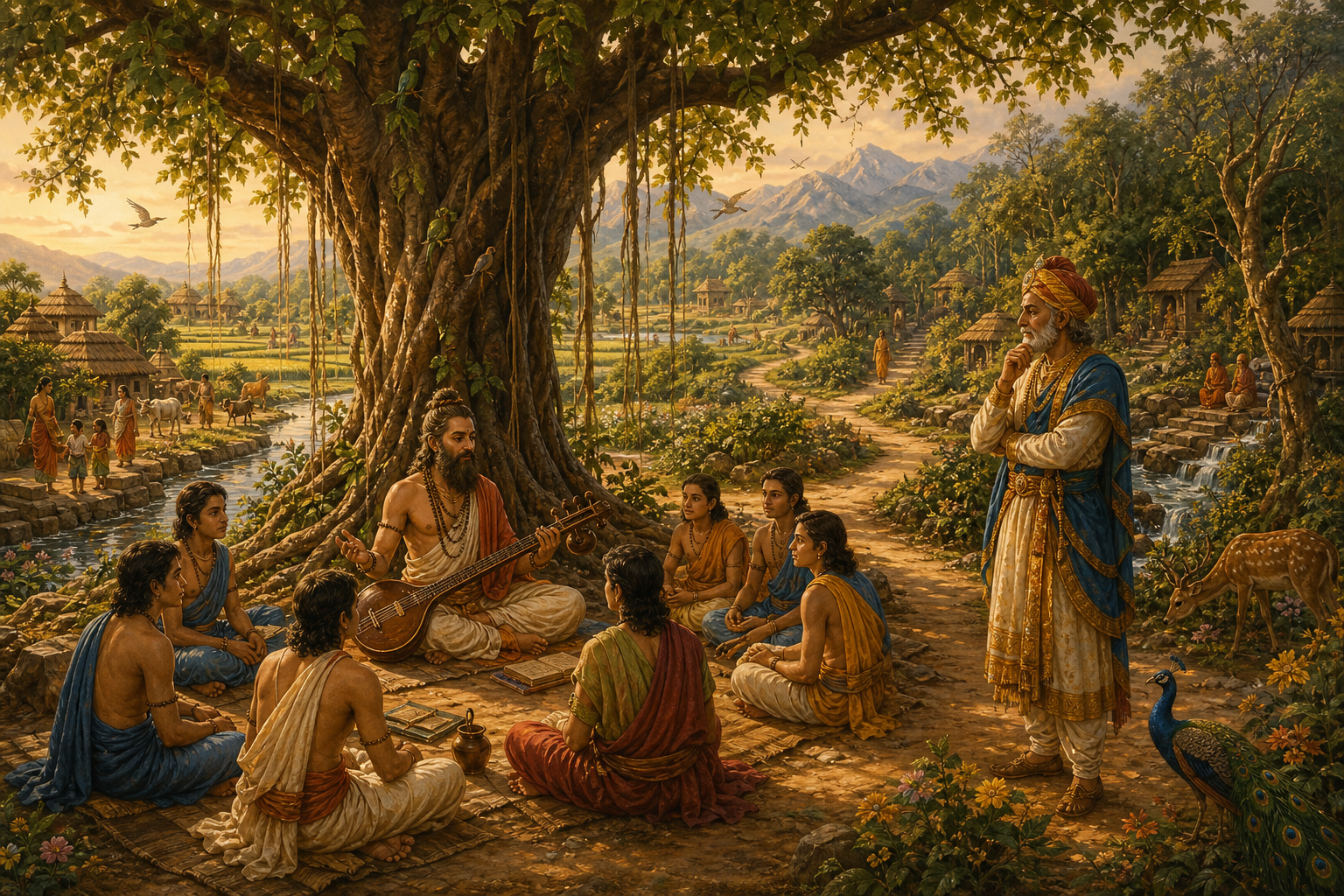
Dharma in these narratives is more than compliance with a rule. It is the conduct appropriate to a role, a relationship, and a larger order. A king has obligations to the realm. A prospective ruler must understand what he proposes to govern. A seeker must respect limits that do not disappear simply because he possesses an intense desire.
This is why disorder begins when someone treats a relationship as possession. Vena treats rule as personal power. Daksha expects his sons to continue creation without first confronting what such responsibility requires. Trishanku treats heaven as a destination that determination and ritual force should be able to secure. In each case, the crisis reveals a missing relationship: ruler and people, governor and realm, desire and moral limit.
When you read a Puranic conflict, ask four questions before deciding who appears victorious:
- What role does each person occupy? A king, rishi, parent, disciple, and guardian of cosmic order do not carry identical duties.
- Which relationship has been neglected? Look for ignored counsel, exploited land, misunderstood subjects, or a boundary treated as an inconvenience.
- Who bears the cost of the action? Dharma cannot be assessed only by the satisfaction of the most powerful participant.
- What restores reciprocity? Lasting order usually returns through a compact, a difficult question, a refusal, or another act that restrains one-sided will.
These questions keep you from reducing the narratives to a contest between a hero and a villain. They direct your attention to the damaged bond and the form of repair.
Prithu shows that legitimate power must nourish
The movement from King Anga to Vena and then Prithu begins with a sharp warning about inheritance. A righteous father does not guarantee a righteous son. Vena fails to preserve dharma, and the sages intervene for the welfare of the realm. They neutralize his tyranny and symbolically churn his body, first producing a being associated with the Nishada lineage and ultimately bringing forth Prithu. The transition from Vena’s adharma to Prithu’s righteous kingship presents political repair as a work of purification guided by wisdom.
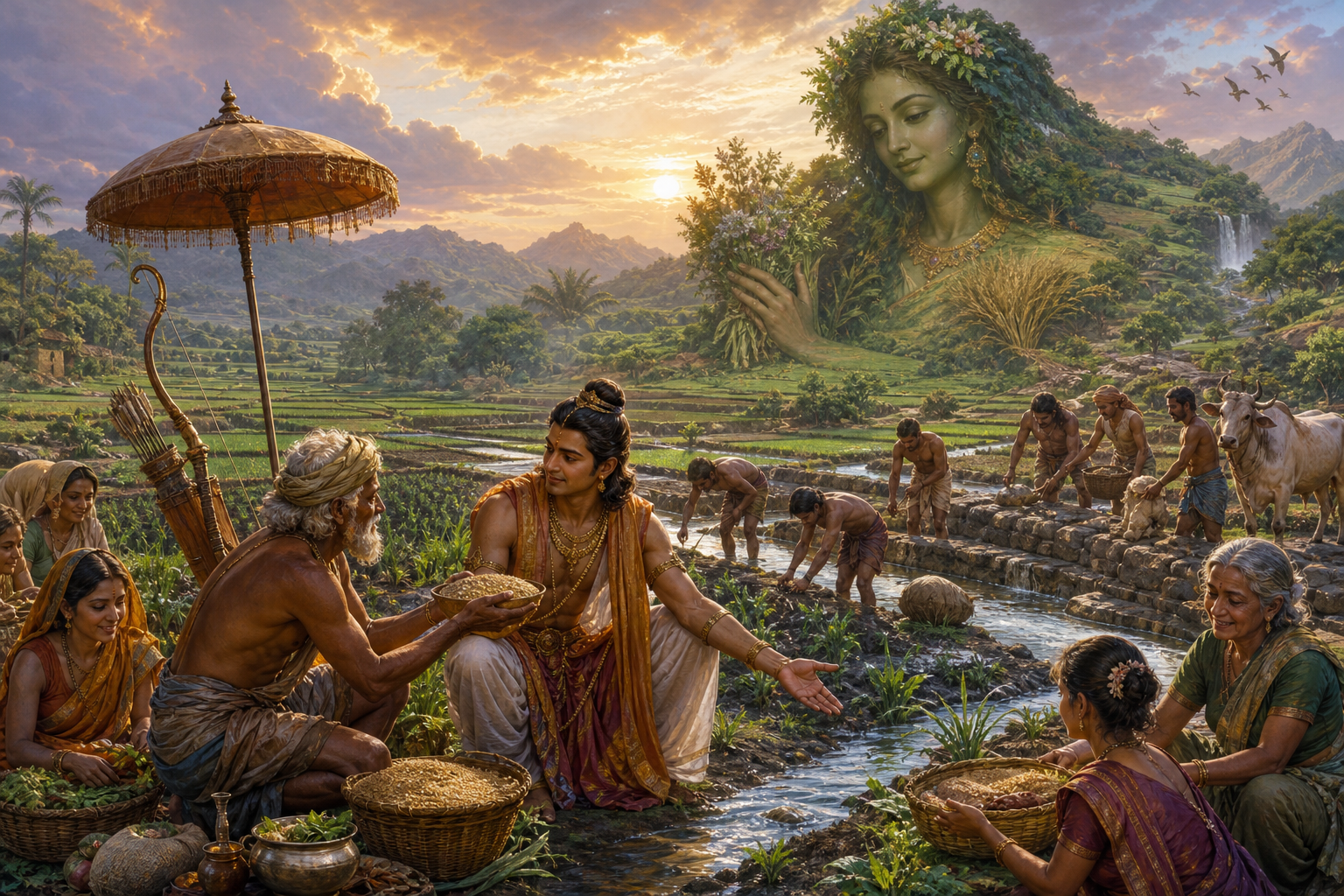
The crucial point is not that the sages replace one strong ruler with another. Prithu’s legitimacy has to be demonstrated by the relationship he establishes with Earth. Prithvi appears as a cow and does not yield her abundance automatically. The encounter becomes a compact: prosperity may be drawn from Earth when the process is lawful, careful, and ordered toward the nourishment of life.
The image of milking matters. A cow can nourish repeatedly when she is protected, but she can also be harmed by greed. The symbol therefore holds production and restraint together. It rejects two easy conclusions: that resources must never be used, or that human need justifies unlimited taking. Dharmic stewardship asks what may be taken, by what method, for whose benefit, and under what continuing obligation of care.
Prithu’s coronation completes the argument. Rivers and oceans bring their waters for his abhisheka. Nature does not appear as scenery around the throne; the waters participate in sanctioning it. The scene joins political authority to sacred geography, ecological balance, and the welfare of the realm. A crown by itself does not create rightful sovereignty. Alignment does.
You can use Prithu’s example to examine a leader, institution, or development proposal through three tests:
<!– wp:list {