
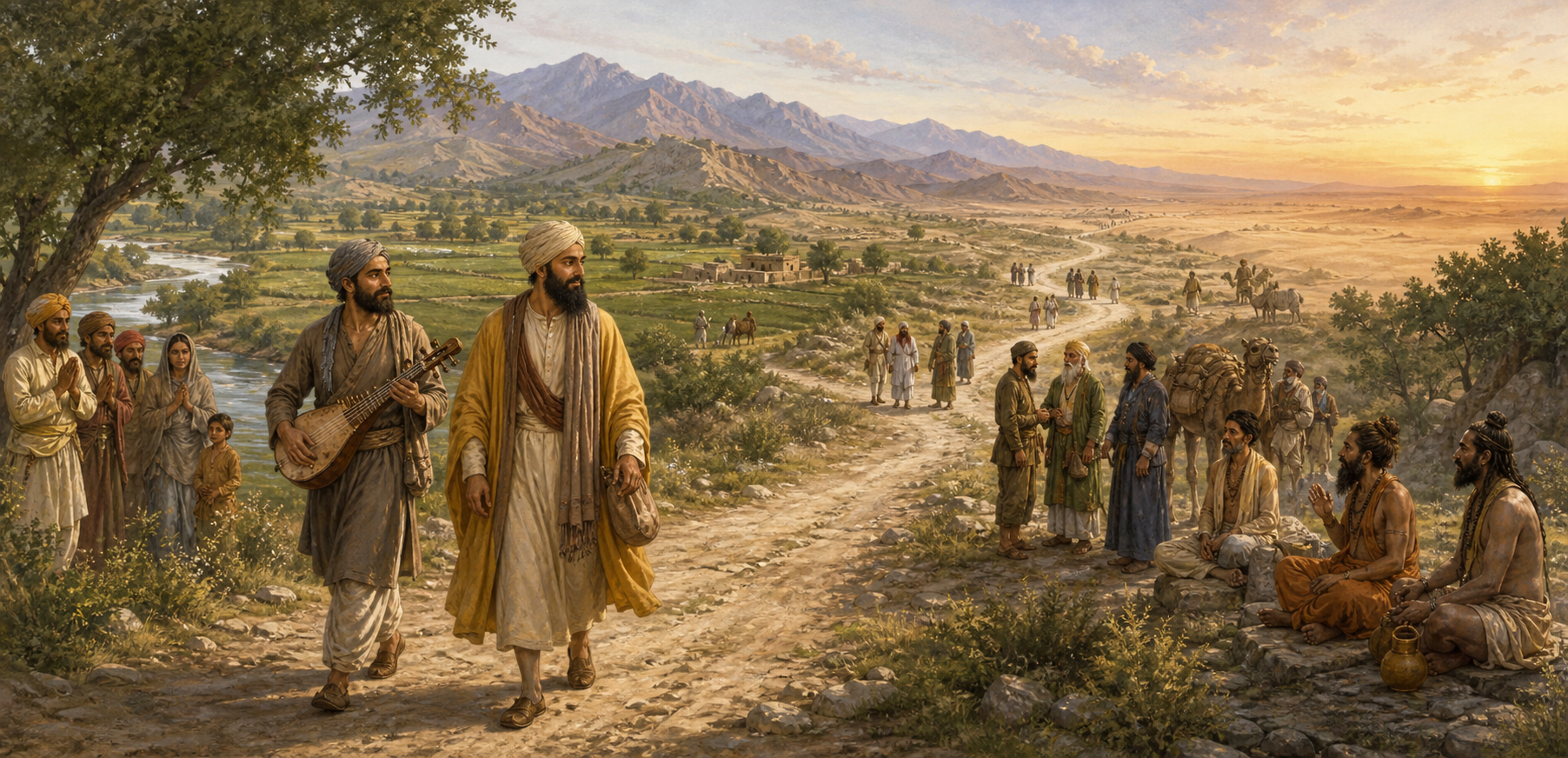
Perhaps you have seen a map of Guru Nanak’s travels that reaches from sacred cities in Bharat to Mecca, Baghdad, Kufa, or Sri Lanka, and wondered how much of it you are expected to accept as literal history. The harder question follows quickly: if some routes or miracles cannot be verified in modern historical terms, do the encounters still teach us anything reliable?
You do not have to choose between believing every waypoint uncritically and dismissing the udasis as legend. Read each encounter on three levels: the historical claim being made, the spiritual truth being communicated, and the ethical response being asked of you. That approach preserves both discernment and reverence.
The evidence has layers, so the map needs labels

Guru Nanak’s journeys unfolded in the late fifteenth and early sixteenth centuries, amid active trade routes and cosmopolitan centres of learning. Sikh memory calls these journeys the udasis. Their details come largely through janamsakhi traditions, which combine remembered biography, devotional teaching, dialogue, and hagiography. That makes them spiritually rich, but it also means that a route drawn from them should not be treated like a modern travel record.
The responsible way to read the geography is to distinguish levels of confidence. Guru Nanak’s life as a travelling teacher, his companionship with Bhai Mardana, and the dialogical purpose of the journeys provide a strong thematic foundation. Sikh tradition repeatedly associates him with places such as Sultanpur Lodhi, Kurukshetra, Haridwar, and Varanasi. Wider memories extend through the Himalayan foothills, eastern plains, western regions, southern coasts, and lands beyond Bharat.
Not every distant waypoint carries the same historical weight. Baghdad has a firmer place in Sikh memory of Guru Nanak’s western journey, while Kufa belongs to later hagiographic references and regional oral traditions. Sri Lanka and some other far-reaching destinations also require caution. Caution does not prove that a visit was impossible; it means that the available tradition does not justify presenting every stop with equal certainty.
When you encounter a dramatic journey claim, ask three questions. Is this a broadly grounded biographical claim, a place preserved primarily in community memory, or a theological parable placed within a journey? Then choose your language accordingly: travelled, is remembered as visiting, or is depicted in a traditional narrative. Those verbs prevent both exaggeration and needless dismissal.
A miracle narrative may be weak evidence for reconstructing a road but powerful evidence for understanding what a community believes about the Divine. Confusing those two functions produces sterile arguments. Separating them lets you examine history honestly while still hearing the teaching.
The udasis were moving classrooms, not a tour of monuments
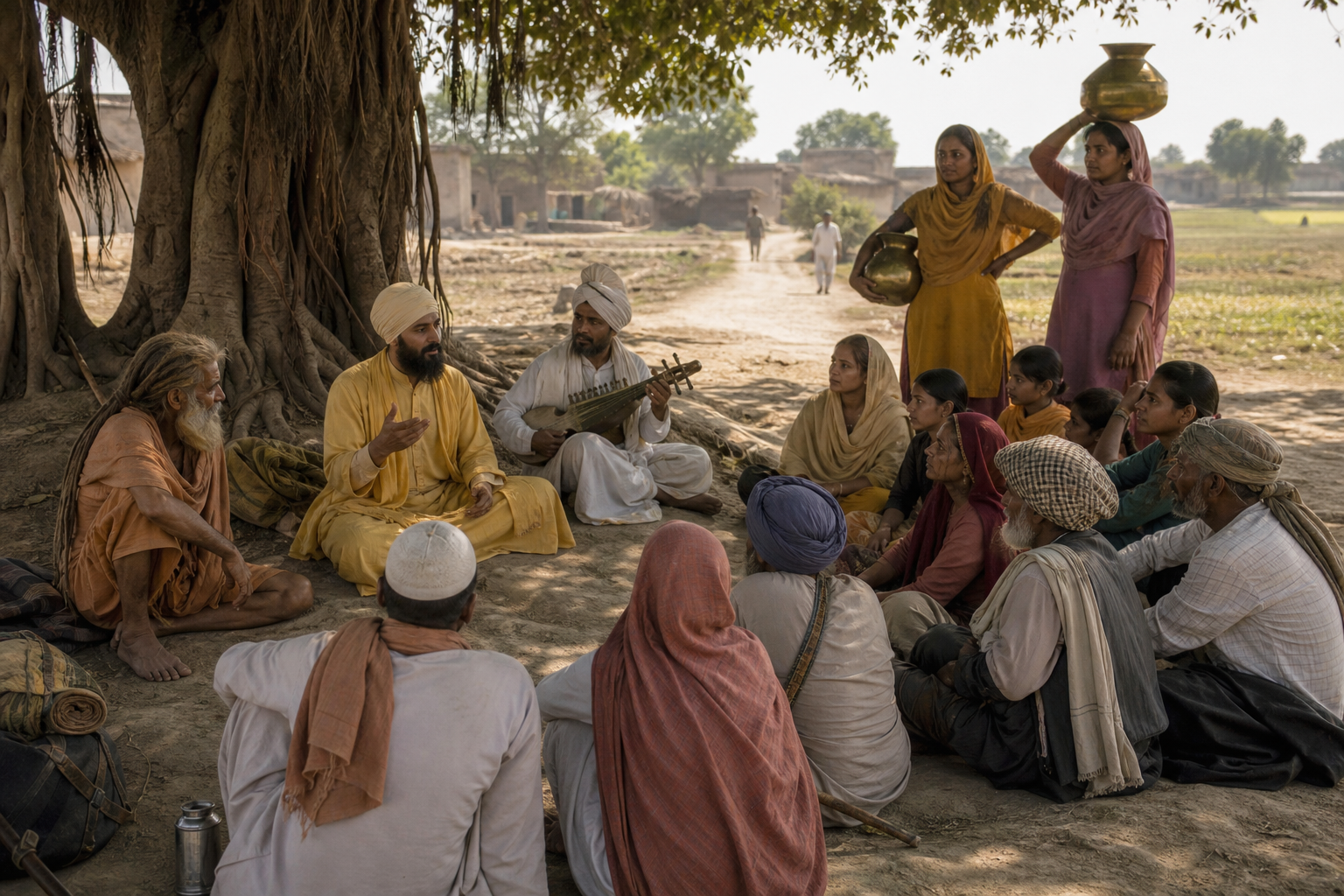
The most revealing fact about Guru Nanak’s interfaith method is not a distant destination. It is the person walking beside him. Bhai Mardana was a Muslim, a close companion, and a rabab player. Interfaith fellowship was therefore not merely a subject Guru Nanak discussed with strangers. It was present in the daily companionship, music, fatigue, hospitality, and dependence of the road.
That companionship changes how you should imagine the encounters. Guru Nanak did not arrive only as a solitary lecturer delivering conclusions. With Mardana’s rabab and the singing of sacred compositions, a place of shared attention could form wherever they stopped. Music did not require participants to settle every doctrinal question before listening together. It opened a space in which identity remained visible but hostility did not have to control the exchange.
This is why kirtan matters to the journey tradition. It turns dialogue from an exchange of religious labels into a disciplined act of listening. You hear words, melody, longing, and remembrance before deciding whether the person opposite you belongs inside or outside a boundary. That does not erase theology. It changes the human conditions under which theology is discussed.
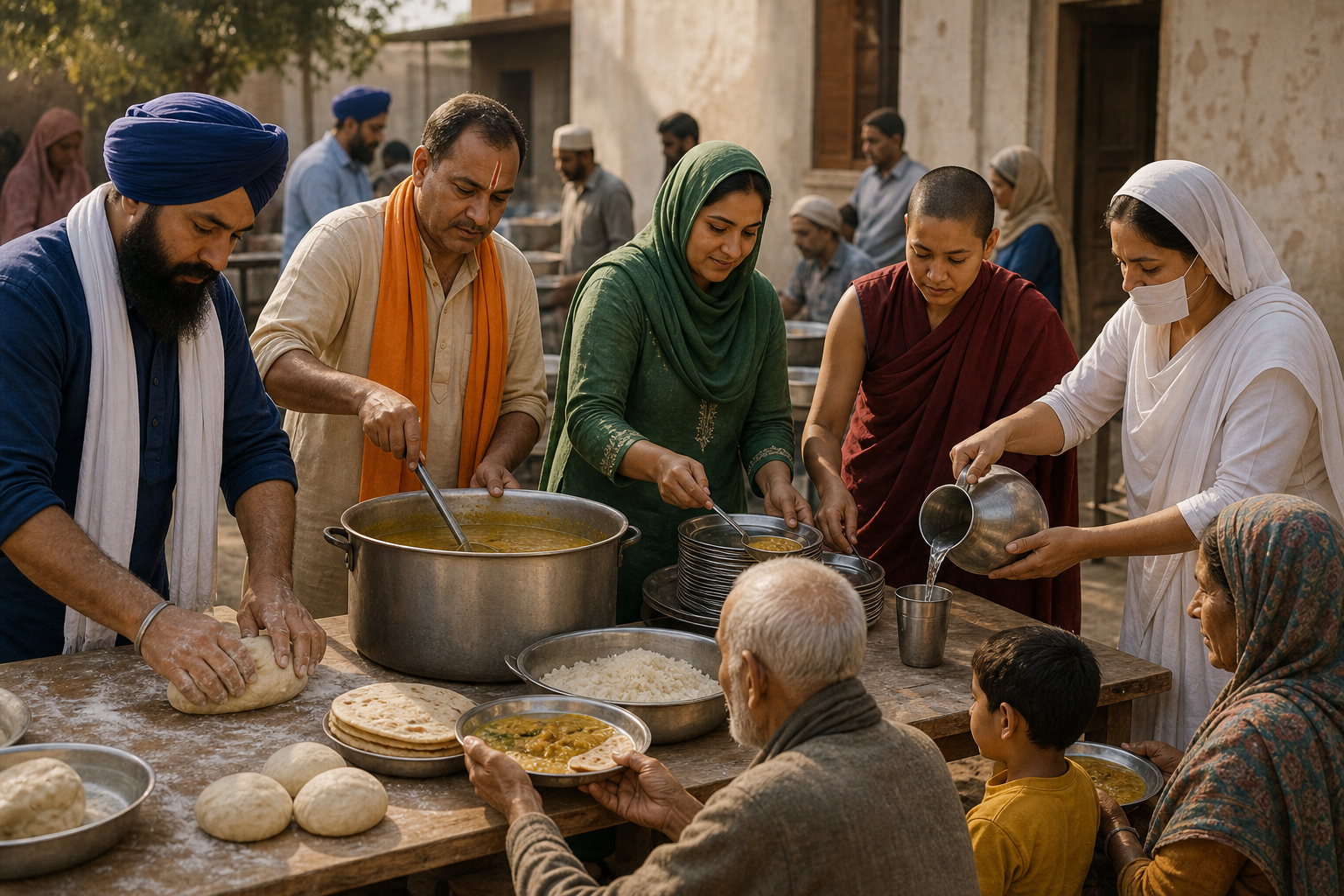
The social logic of the journeys also becomes concrete in langar. People who would ordinarily be separated by caste, creed, or status sit together and eat. The meal does not merely announce equality; it makes participants practise equality with their bodies. Seating, serving, receiving, and cleaning become part of the teaching. The connection between devotion, honest work, sharing, and common service keeps interfaith respect from remaining a polite sentiment.
If you are arranging an interfaith gathering now, the order matters. Do not begin by asking participants to defend entire religions in front of one another. Begin with a bounded shared practice: attentive music, a period of reflection, preparing food, or serving people together. Let each community explain its own practice in its own terms. Move to difficult questions only after everyone has had to listen, contribute, and receive.
Guru Nanak’s practical triad offers a useful test after the event: Naam-simran, remembrance of the Divine; kirat karo, honest work; and vand chhako, sharing with others. Ask whether the encounter deepened attention, encouraged truthful conduct, and produced actual generosity. If it achieved none of those, cordial photographs and broad declarations of unity are not enough.
Three famous encounters teach three different disciplines
At Haridwar, question the gap between action and intention
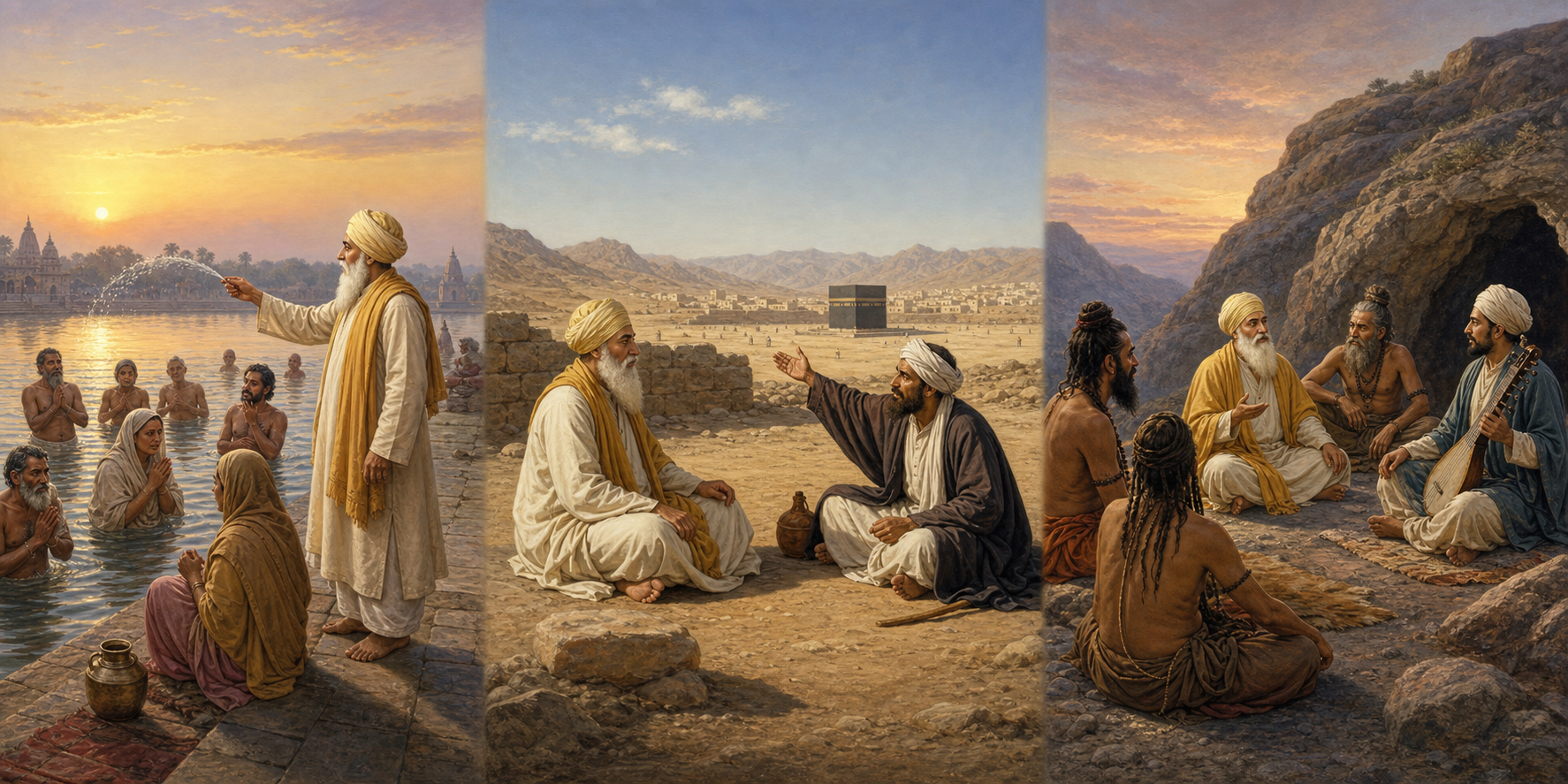
The Haridwar episode places Guru Nanak among people offering water eastward toward the sun. His response turns attention back to the meaning and consequence of the act. The lasting lesson is not that every ritual is empty or that Hindu worship deserves ridicule. Such a reading would merely replace ritual pride with sectarian pride.
The sharper lesson is that an outer act should be examined in relation to bhava, the intention animating it, and to the life that follows it. A ritual can concentrate attention, express gratitude, preserve sacred memory, or discipline the self. It can also become mechanical when its performer no longer asks what it is doing to the heart or to conduct. Guru Nanak’s challenge is directed at that separation between gesture and transformation.
You can apply the same test without mocking another person’s observance. Ask: What truth is this act meant to remember? What quality should it cultivate? Where should that quality become visible after the rite is complete? These questions can be asked of puja, kirtan, pilgrimage, meditation, fasting, recitation, or charity. Begin with your own practice before using them on someone else’s.
At Mecca, do not confine omnipresence to a direction
In the well-known Mecca narrative, Guru Nanak is challenged over the direction of his feet, and the Kaaba is said to turn when they are moved. The story is most responsibly read as a parable of Divine omnipresence, not as a miracle that must be established before its teaching can be understood. Its question is simple and unsettling: if the Divine is everywhere, which direction could finally be devoid of the Divine?
That does not make sacred orientation meaningless. Human beings use places, directions, forms, and disciplines to gather a wandering mind. The warning is against confusing a means of reverence with a boundary around the One who is revered. A sacred centre can focus devotion without becoming a jurisdiction that limits the Divine.
If you retell this encounter, do not use it as a victory story against Islam. Say plainly that Sikh tradition uses the episode to teach omnipresence. Then invite the listener to consider the teaching rather than demanding assent to the miracle. A parable meant to loosen religious arrogance is betrayed when it becomes ammunition for religious arrogance.
In Iraq, match confidence to evidence
Guru Nanak’s remembered presence in Baghdad places his mission within a wider world of Islamic learning and Sufi spirituality. Kufa carries a related symbolic importance as a centre of juristic and spiritual discussion, but its association with Guru Nanak is less firmly grounded. The difference is not an inconvenience to hide. It teaches a discipline essential to sincere dialogue: do not make your case stronger than your evidence.
Kufa can still matter as part of regional memory. It evokes the possibility of a Sikh teacher entering a learned Islamic environment with questions about Divine unity, ethical life, and spiritual humility. What it cannot responsibly provide is a detailed transcript of a conversation that the surviving tradition does not establish.
Use calibrated language whenever you teach these journeys. Say that Baghdad is more firmly remembered, that Kufa is traditionally associated with the wider Iraqi journey, and that the exact itinerary remains debated. This does more than protect historical accuracy. It demonstrates respect to the people with whom you are speaking. Trust grows when you acknowledge the limits of your own evidence before pointing to weaknesses in someone else’s claims.
Shared dharmic ethics do not make the traditions interchangeable
Guru Nanak’s encounters are sometimes reduced to the slogan that all religions are the same. That conclusion is too easy and not especially respectful. Traditions that use different accounts of the Divine, self, liberation, authority, discipline, and community cannot be honoured by pretending those differences are decorative.
Ik Onkar affirms the oneness of the Divine and gives Guru Nanak’s engagements their theological centre. Naam directs the seeker toward remembrance. Sarbat da bhala extends concern toward the welfare of all. These ideas can enter fruitful conversation with Hindu teachings on dharma and daya, Buddhist cultivation of karuna, and Jain commitment to ahimsa. The resonance lies in disciplined compassion, truthful living, restraint of ego, and regard for life. The terms are related in ethical direction, but they are not synonyms and should not be detached from their own traditions.
A sound comparison therefore has four movements. First, name the teaching in its own vocabulary. Second, let its home tradition define what it asks of a practitioner. Third, identify a precise ethical or contemplative resonance with another path. Fourth, state where the comparison stops. This method gives you common ground without claiming doctrinal identity.
For example, ahimsa and karuna can illuminate the compassionate horizon of sarbat da bhala, but neither term is a replacement for it. Ik Onkar can be discussed beside Hindu reflections on Divine unity or Sufi contemplation of the One, yet the concepts should not be collapsed into a single formula. Comparison is most useful when it increases your ability to notice both kinship and distinction.
This is the deeper dharmic value of the udasis. Guru Nanak could encounter sadhus, Sufi mystics, Buddhist bhikkhus, Jain munis, scholars, householders, and ritual communities without assuming that openness required loss of conviction. His teaching remained centred even as the conversation widened. For a plural society, that balance matters: a weak identity fears every encounter, while an arrogant identity learns nothing from one.
Key takeaways: practise the journey where you live
- Label the claim before debating it. Decide whether an episode is being presented as grounded biography, sacred memory, or theological parable. Do not demand the same kind of proof from all three, and do not pass one kind off as another.
- Choose one question, not an entire religion. A useful gathering might ask how remembrance changes conduct toward a stranger. Asking participants to explain Hinduism, Sikhism, Buddhism, Jainism, or Islam in full almost guarantees slogans.
- Begin with shared attention. Use music, silence, a meal, or service to create the conditions for listening. Let every tradition retain the right to describe its own practice.
- Question consistency rather than dignity. Ask whether an observance produces the compassion, truthfulness, or discipline it claims to cultivate. Apply the question to your own community first.
- Write down both resonance and difference. For every shared value you identify, record one doctrinal or practical distinction that should not be erased. This keeps unity from becoming vagueness.
- End with something that can be done. Share food, pool resources for a defined need, or agree on one act that advances the welfare of others. Interfaith dialogue becomes credible when someone beyond the meeting benefits from it.
The next time you hear a dramatic story from Guru Nanak’s travels, pause before either defending or attacking it. Name the kind of claim, draw out the spiritual teaching, and ask what conduct it requires from you. Then take the smallest real step: listen without caricature, speak without exaggeration, and share something of value. That is how an ancient journey continues without anyone needing to reproduce its map.
References
- SikhNet – News – Guru Nanak’s Transformative Journeys: Across Lands, Uniting Hearts and Dharmic Traditions
- SikhNet – News – Guru Nanak Sahib in Kufa: A Historic Moment of Interfaith Dialogue and Dharmic Unity
