
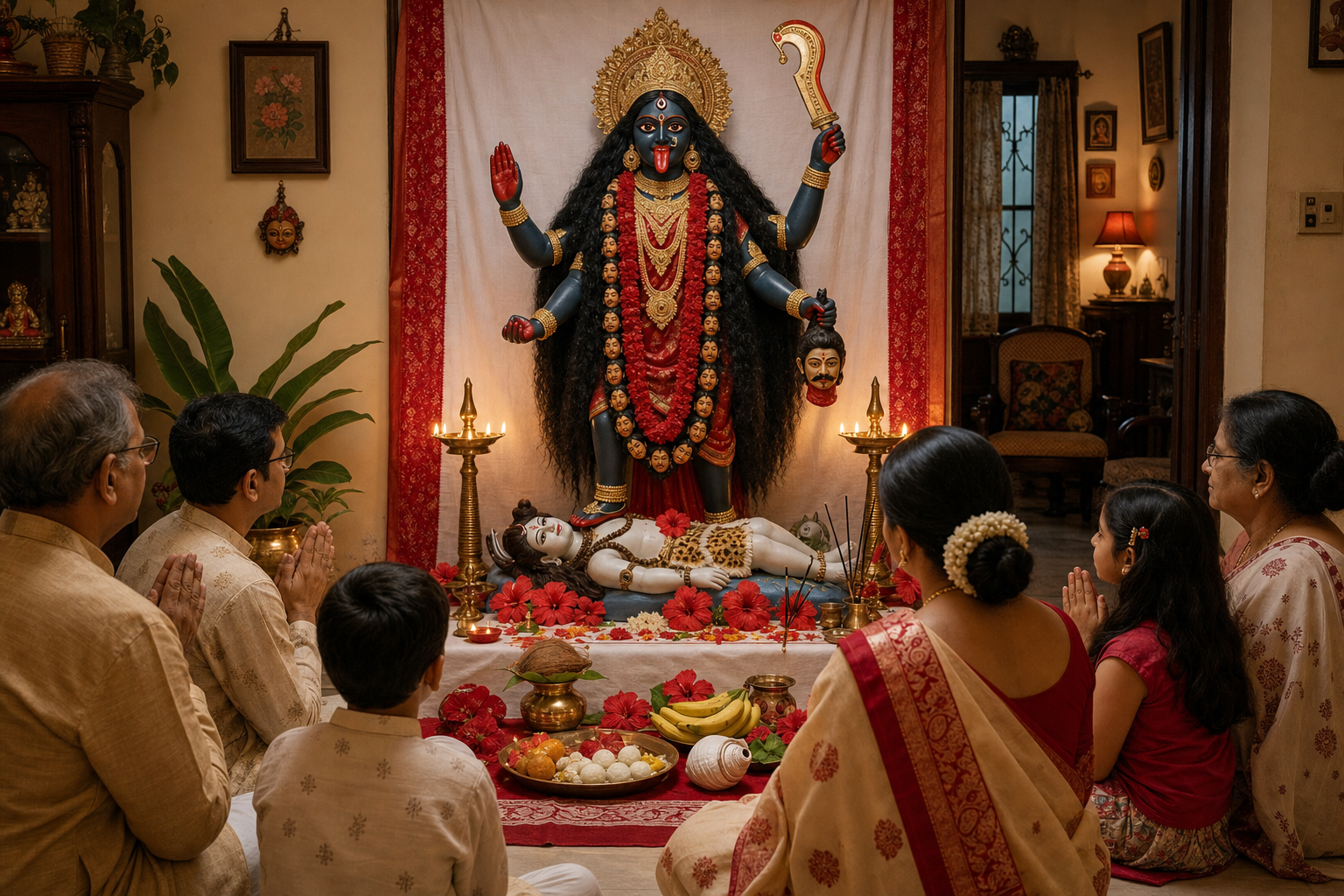
You may feel drawn to Dakshina Kali yet hesitate to place her image in your home. Her sword, severed head, dark form, and place upon Shiva can look too fierce for a family shrine. In Bengali devotion, however, that apparent contradiction is precisely the point: the power that destroys adharma can also protect, reassure, and guide a household.
You do not need an elaborate ritual system to approach her. Bengali domestic devotion has long made room for lamps, flowers, fruit, sweets, prayer, song, and quiet contemplation. The essential work is to understand whom you are worshipping, begin within the limits of your family tradition, and let devotion shape your conduct beyond the shrine.
Key takeaways
- Dakshina Kali is worshipped in Bengali homes as a protective and compassionate Mother, not merely as a terrifying battlefield deity.
- Her whole image must be read together: destruction of ignorance appears alongside fearlessness, generosity, and auspiciousness.
- A beginner’s domestic practice can remain simple: prepare a clean place, light a lamp safely, make a modest offering, pray, and sit quietly.
- Family instructions should take priority over a generic routine. Specialist tantric practice is not required for ordinary household devotion.
- Amavasya and Kali Puja can deepen the household rhythm through collective prayer, storytelling, and remembrance.
Why a fierce Kali belongs in a family home
The first appearance of Kali in the Devi Mahatmya of the Markandeya Purana is not domestic or mild. She emerges through Durga’s wrath to overcome adharma. This origin matters because it prevents us from reducing her maternal character to mere sweetness. The Mother protects because she has the power to confront what threatens dharma.
Bengal did not discard that force when it welcomed Kali into the household. It learned to encounter the same force relationally. Shakta Tantra during the Pala and Sena periods helped establish the religious environment in which Kali worship flourished. In the early modern period, devotion increasingly addressed her as an approachable Mother rather than as a distant power confined to battlefields, forests, cremation grounds, or major temples.
Ramprasad Sen’s devotional songs were especially important to this change of relationship. They allowed devotees to speak to Kali with the intimacy, complaint, dependence, trust, and affection of a child addressing a mother. Later, affordable images from Kalighat workshops and vernacular printing made it easier for families to bring that devotional vision into ordinary living spaces during the eighteenth and nineteenth centuries.
This history answers a practical concern. Keeping Dakshina Kali at home is not a denial of her fierce nature, nor is it simply a modern attempt to make an uncomfortable deity more acceptable. Bengali household worship holds fierceness and tenderness together. You approach the Mother who cuts through ignorance precisely because you trust that her power is directed toward protection and liberation.
Read the entire image, not only its frightening details
If you judge Dakshina Kali by the sword or severed head alone, you miss half the theology. Her four arms place apparently opposite truths within one form. The sword and severed head are presented alongside gestures of fearlessness and boon-giving. Dissolution and grace are not competing messages here. The Mother removes ignorance and also gives the devotee courage and aid.
The gesture of fearlessness, or abhaya, tells you how to stand before the image. You are not meant to cultivate panic. You are invited to face what is false, harmful, or cowardly without pretending it is harmless. The boon-giving gesture keeps that confrontation from becoming bleak: spiritual discipline is accompanied by compassion.
The position of the feet is also significant. In the iconographic distinction associated with Dakshina Kali, her right foot rests upon Shiva. This marks a gentler and more auspicious disposition than the terrifying form commonly distinguished as Smashana Kali. If you are selecting an image specifically for Dakshina Kali devotion, look at the feet and the complete arrangement of the four hands rather than relying on a shop label or on the expression of the face alone.
Shiva’s presence also stops the image from becoming a simple picture of violence. Kali’s dynamic force appears in relation to Shiva, not as uncontrolled destruction floating without spiritual context. For domestic worship, this complete composition helps you remember that divine power is not permission for anger, aggression, or domination. Its work is the defeat of adharma and ignorance.
Begin with a simple domestic practice you can sustain
If your family has an established sequence, follow it. Instructions received from a trusted guru, elder, or family priest should also take priority. The routine below is for simple household devotion; it is not a substitute for initiation into specialist tantric practice.
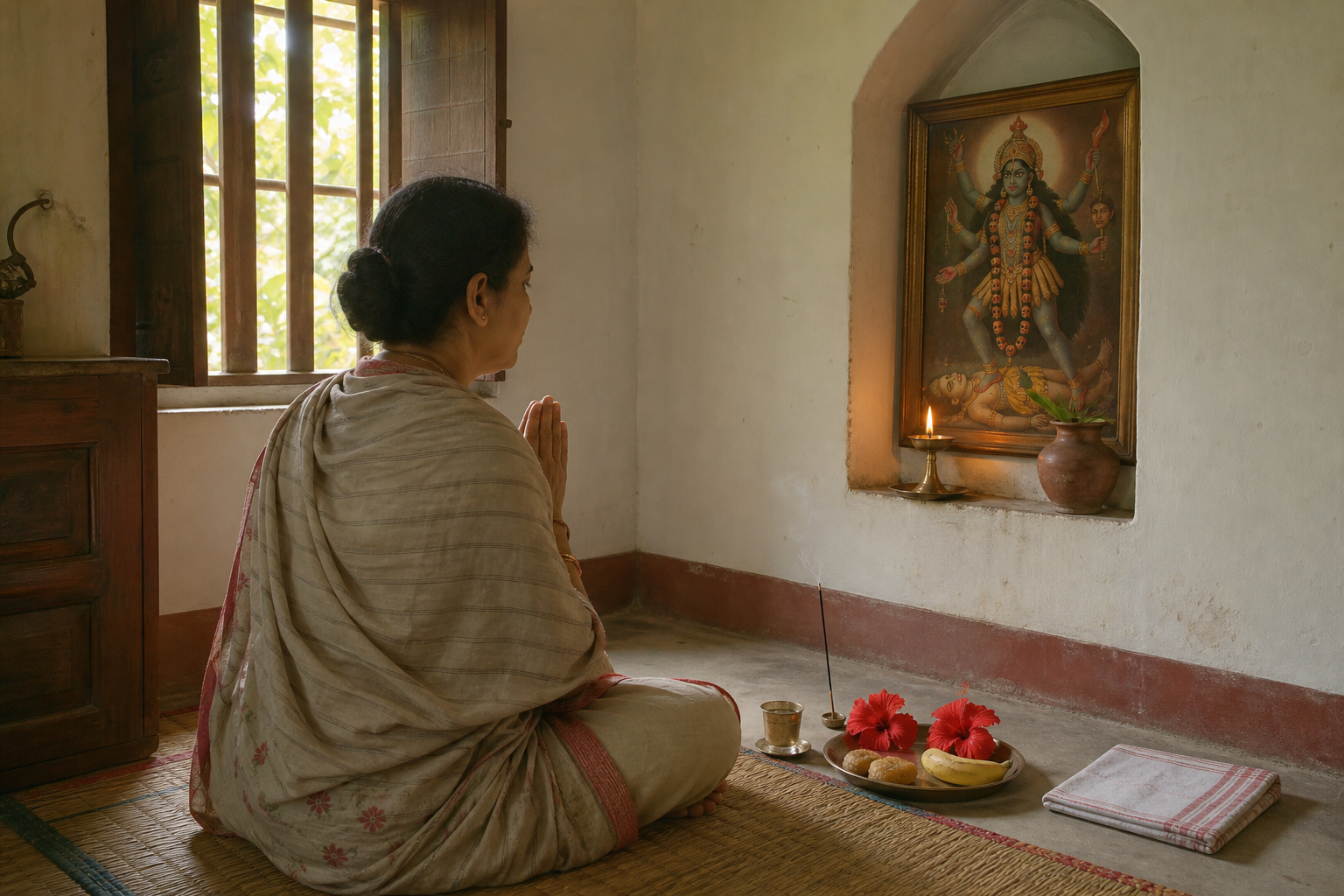
- Choose a settled place for the image. Keep the area clean and treat it consistently as a shrine rather than as ordinary decoration.
- Prepare only what you can offer attentively. Bengali homes commonly use a lamp, flowers, sweets, and seasonal fruit, adapting the details to family custom and dietary practice.
- Light the lamp safely. Set it on a stable, heat-resistant surface, keep flammable material away, and never leave an open flame unattended.
- Offer the flower or food without turning simplicity into a cause for embarrassment. A modest offering made regularly is more workable for domestic life than a display you cannot sustain.
- Recite a stotra or devotional song already known in your family. If you do not have one, offer a plain prayer to the Mother for fearlessness, discernment, protection, and the strength to act according to dharma.
- Sit quietly for a short period. Bring to mind one form of confusion, fear, or harmful conduct that needs to be cut away, and one dharmic action you are prepared to take.
- Close according to household custom. Keep the shrine orderly and handle any food offering in the manner your family follows.
The practical test is not whether the ritual looks impressive. Ask whether you can return to it with attention. Domestic devotion grows through rhythm: the same lamp, the same place, a familiar hymn, and a few minutes in which the family remembers what it serves. Complexity can be added under proper guidance; reverence cannot be replaced by complexity.
Do not imitate an esoteric rite merely because it appears more powerful. Dakshina Kali’s established place in Bengali homes means you need not manufacture a dramatic atmosphere to make the worship authentic. Begin with bhakti, cleanliness, an appropriate offering, and honest self-examination.
Let Amavasya and Kali Puja deepen the family rhythm
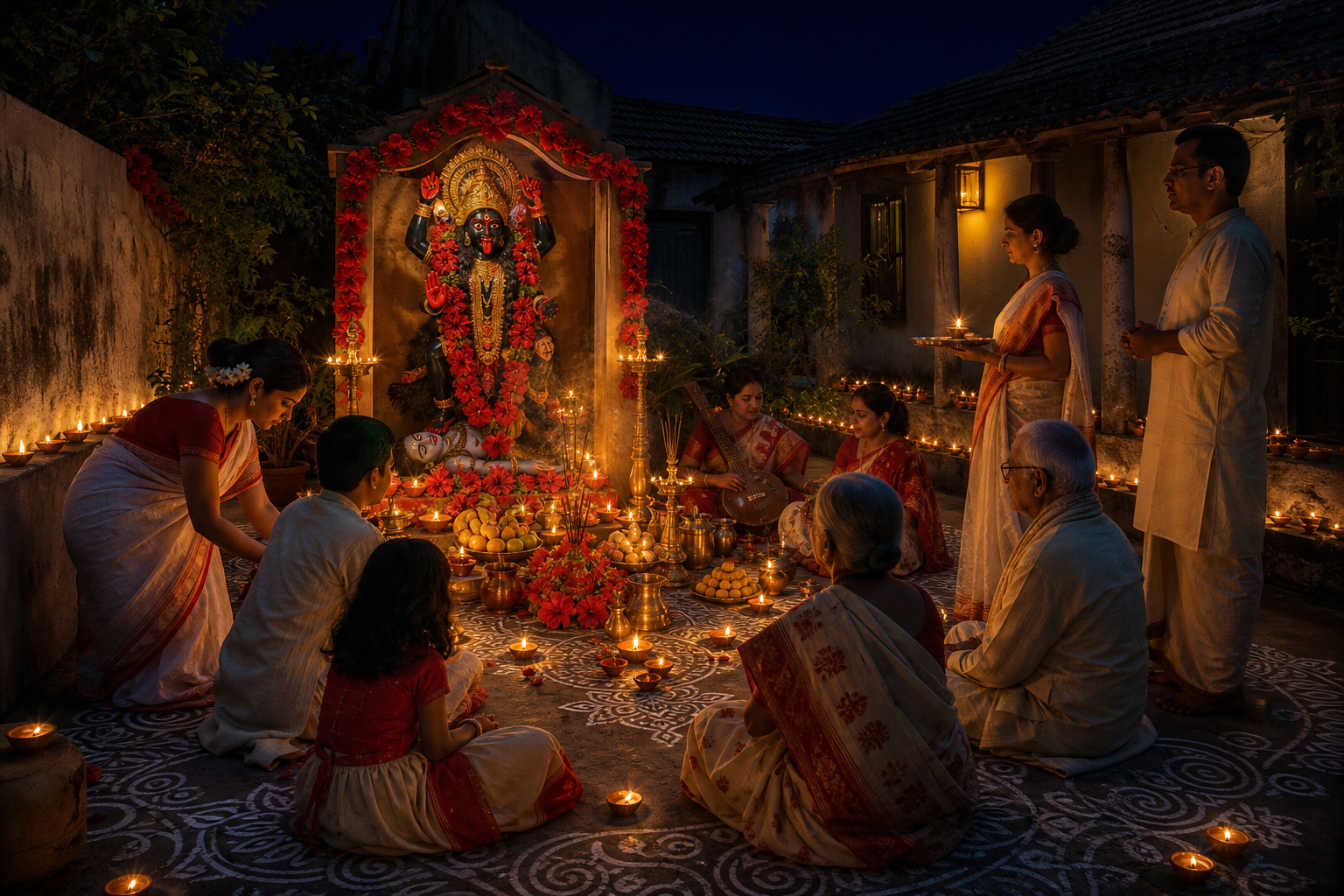
A daily or occasional lamp can sustain ordinary devotion, while Amavasya offers a natural point for a more deliberate evening. Bengali families have marked Amavasya, especially Kali Puja, with alpona, offerings, collective recitation, contemplation, and intergenerational storytelling. Kali Puja’s coincidence with Deepavali places the Mother within a wider festival season while preserving Bengal’s distinctive Shakta emphasis.
You can make that observance meaningful without trying to reproduce a temple ceremony. Clean and arrange the shrine earlier in the day. Decide which family member will prepare the lamp and offerings. In the evening, recite what the household actually knows, then invite an elder to explain a remembered song, custom, pilgrimage, or earlier family observance. This turns inherited practice into understood practice.
Kalighat and the Dakshineswar Kali Temple have strongly shaped Bengali ideas of Kali devotion. A pilgrimage to either place may deepen your household practice, but a home shrine is not a miniature public temple. Notice the temple’s devotional orientation and carry home what fits domestic life: attentiveness, regularity, reverence, and awareness of the Mother as a living presence.
If Kali’s appearance still produces unease, approach her through Bengali bhakti. Ramprasad Sen’s songs teach the emotional language of the child and Mother. Sri Ramakrishna’s spiritual life at Dakshineswar presents Kali as the Mother of the universe, while Swami Vivekananda’s interpretation holds together her terrible confrontation with ignorance and her limitless compassion. These are not methods for explaining away the frightening image. They teach you how to remain before it long enough to understand what its power is for.
Carry the worship from the shrine into your conduct
Dakshina Kali should not become a decorative promise that the family will be protected regardless of how its members behave. Her symbols demand ethical attention. If the sword represents the destruction of ignorance, devotion should make you more willing to correct a falsehood, restrain a harmful impulse, keep a commitment, or defend someone treated unjustly. If abhaya offers fearlessness, your prayer should help you act with courage rather than merely ask to feel secure.
This is where domestic Kali worship meets a wider dharmic horizon. Compassion, ethical living, service, inner discipline, and the effort to overcome suffering are not ornaments added after puja. They are the household consequences of taking divine protection seriously. The shrine becomes a living sanctuary when the people around it become more truthful, dependable, and considerate.
Begin at the scale of your actual life. Place the image carefully, offer one flower or a little seasonal fruit, light a lamp safely, and ask the Mother to show you what must be faced. Then choose one action that makes the prayer visible in your home. Let the practice become steady before you make it elaborate.

References
