

If you are trying to decide what to believe about Andhra Pradesh’s temple-governance controversy, party loyalty is a poor shortcut. The useful question is narrower: what records would show whether a temple has been governed faithfully, transparently, and in the interests of its devotees?
You do not need to ignore politics to answer that question. You need to separate political charges from verified findings, temple administration from unrelated regulatory disputes, and general promises from remedies that can be measured.
Start with the distinction between a charge, proof, and a remedy

The immediate dispute arose from a public YSRCP allegation made in Hyderabad on 19 November 2025. The party accused the TDP-BJP government in Andhra Pradesh of neglecting Hindu interests, disrupting temple-governance structures, and enabling irregularities connected with beef exports.
Those are allegations, not findings established merely by repetition. That distinction does not make the concerns trivial. It tells you what evidence must come next. A serious claim about temple governance should identify the decision in dispute, the person or body responsible, the rule or duty allegedly breached, the records supporting the charge, and the corrective action being sought.
- State the charge precisely. Was the complaint about a board appointment, control of an endowment, expenditure of devotee contributions, continuity of worship, protection of temple property, or failure to answer grievances?
- Ask what would prove or disprove it. Appointment orders, conflict declarations, audited accounts, meeting records, service reports, and dated grievance outcomes are more useful than slogans.
- Match the remedy to the alleged failure. A questionable appointment calls for a transparent selection review. Unclear expenditure calls for an independent financial audit. Disrupted religious practice calls for consultation with competent religious authorities and restoration of the affected observance.
This three-part test also protects devotees from selective outrage. A governing party should not be allowed to answer a request for accounts with a speech about development. An opposition party should not be allowed to turn an unspecified suspicion into an established scandal. Both must meet the same evidentiary standard.
Test temple governance through four public records

A temple is not an ordinary government office. Its administration affects worship calendars, family ceremonies, charitable networks, sacred property, and the continuity of a living tradition. Financial competence matters, but it is only one part of faithful stewardship.
You can evaluate a temple board or endowments administration through four distinct records:
- Appointment record: Who was appointed to the board, what qualifications or representative role did each person bring, what selection criteria were used, and were relevant conflicts disclosed? Publication of names alone is not transparency; the reasons and safeguards behind the appointments matter.
- Financial record: What income did the temple receive, what was budgeted, what was spent, and for what purpose? Temple-specific statements should distinguish administration, worship, maintenance, charitable work, capital projects, and other material uses. Audit observations should appear beside the action taken to correct them.
- Religious and service record: Were the temple’s established calendar, rituals, festivals, and charitable functions maintained? Were those responsible for Agamic and ritual continuity consulted before decisions affecting worship? Better bookkeeping cannot compensate for damage to the religious purpose for which the institution exists.
- Grievance record: Can a devotee submit a complaint, receive an acknowledgement, see which office owns the matter, obtain a time-bound answer, and use an escalation route when no answer arrives? A privacy-safe dashboard can show how many matters are pending and whether promised responses are being delivered.
A dashboard and an audit perform different jobs. The dashboard gives devotees routine visibility into income, expenditure, appointments, projects, and grievances. An independent audit tests whether the underlying information is complete and reliable. Andhra Pradesh needs both if trust is to survive changes of government.
Watch for statewide totals that conceal temple-level decisions. A broad figure may show the size of an endowments system while revealing nothing about how one temple’s offerings were used. When your concern is local, ask for records tied to the named temple, the disputed decision, and the relevant period.
Community accountability must have defined powers
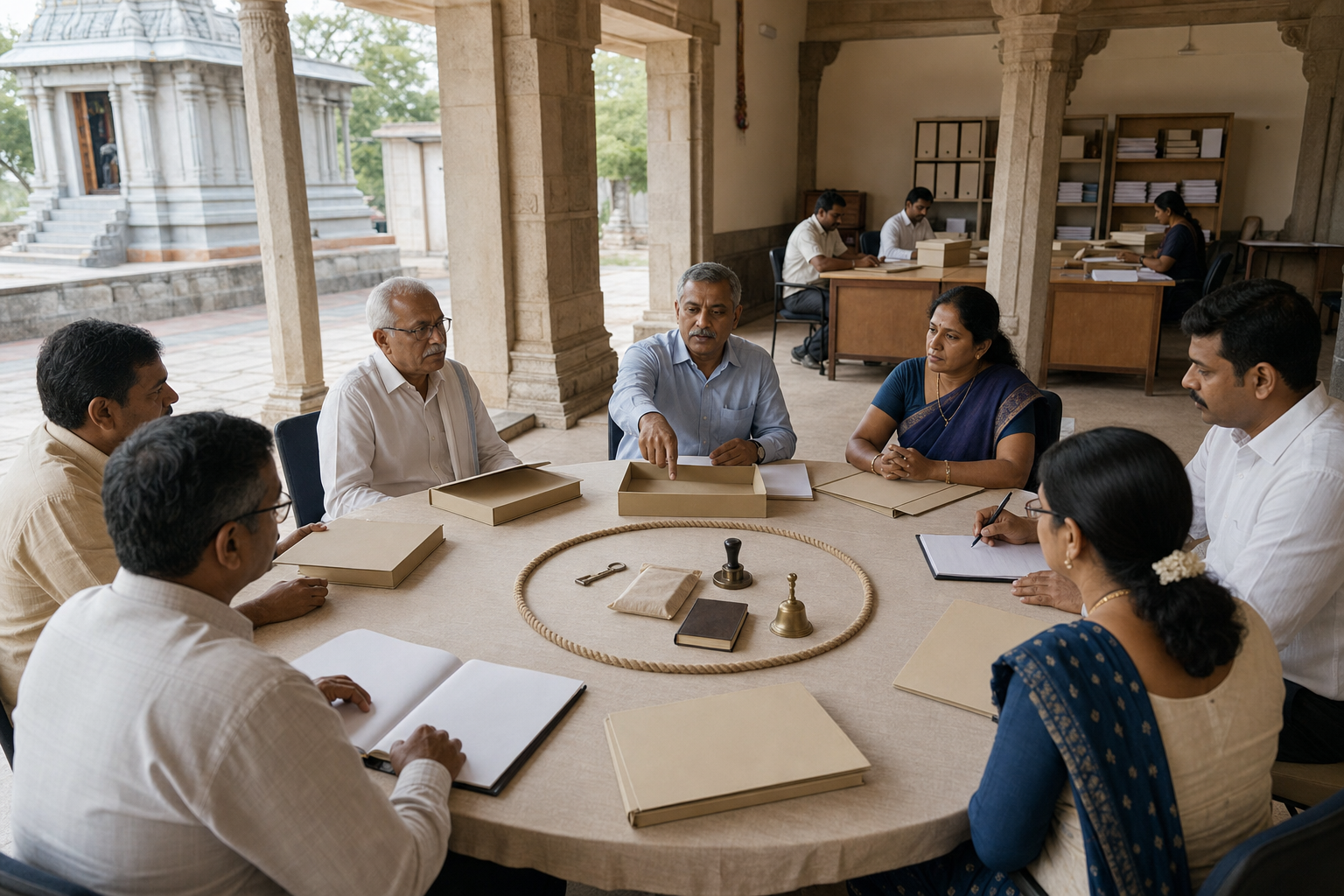
Calls for community participation sound attractive, but the word community can hide more than it clarifies. Devotees, donors, hereditary or traditional stakeholders, archakas, Agama-competent authorities, charitable beneficiaries, and residents living around a temple may have different knowledge and interests. Political nomination is not a substitute for representing them honestly.
A consultative council becomes useful only when its remit is written down. It could review appointment criteria, proposed changes affecting worship, unresolved audit findings, major uses of devotee funds, charitable obligations, and patterns in grievances. Its agenda, recommendations, recusals, and the administration’s response should be published. Otherwise consultation can become ceremonial approval after decisions have already been made.
Representation should also respect competence. Financial auditors can examine accounts; they do not determine Agamic correctness. Religious authorities can advise on ritual continuity; they do not receive a blank cheque to excuse financial opacity. Devotees should insist that each question be answered by people qualified for that question, with the final decision and its reasons placed on record.
Hindu, Buddhist, Jain, and Sikh traditions can stand together for honest stewardship of sacred institutions, protection of charitable assets, ahimsa, and social harmony. That solidarity is strongest when it respects the distinctive practices and authority structures of each tradition. A general appeal to Dharmic unity must never be used to override the specific religious character of a Hindu temple.
Keep the beef-export allegation on a separate evidence track

The YSRCP statement also alleged irregularities connected with beef-export policy and enforcement. Cultural sensitivity, animal welfare, ahimsa, trade compliance, and alleged illegality can all matter. They are not, however, evidence that a temple board was improperly appointed or that temple funds were misused.
Combining the two disputes into one emotional charge makes both harder to investigate. Temple governance is tested through appointment, financial, religious-service, and grievance records. An export-related allegation requires identification of the conduct in question, the responsible entity, the applicable rule, the compliance or enforcement record, and the status of any audit or official finding.
- If the claim is illegality, ask which rule was allegedly breached and what evidence connects a named act to that breach.
- If the concern is animal welfare, ask what compliance records exist and what corrective action followed any failure.
- If the objection is grounded in ahimsa or Hindu cultural sensitivity, state that moral case directly instead of disguising it as a proven legal conclusion.
- If an inquiry is incomplete, describe the matter as an allegation under examination rather than a settled fact.
This separation is not a concession to indifference. It prevents a weakly supported claim in one area from discrediting a well-supported concern in another. It also forces every political party to produce evidence proportionate to the seriousness of its accusation.
Key takeaways for devotees and voters
- Do not treat a party allegation, government denial, audit observation, and final finding as interchangeable.
- Ask for temple-specific appointment, financial, religious-service, and grievance records.
- Demand both a public information dashboard and an independent audit; neither replaces the other.
- Require community representatives to have defined roles, published recommendations, conflict safeguards, and recorded administrative responses.
- Keep temple-governance claims separate from beef-export allegations because the two require different evidence.
- Judge every party by whether it publishes verifiable records and corrects documented failures, not by how often it invokes Dharma.
Your most effective next step is concrete: choose the temple or decision you care about, write down the exact record needed to assess it, and ask for that record in a form other devotees can examine. A controversy becomes accountable governance only when appointments have reasons, contributions have traceable uses, rituals have informed protection, and grievances have visible outcomes.
References
