
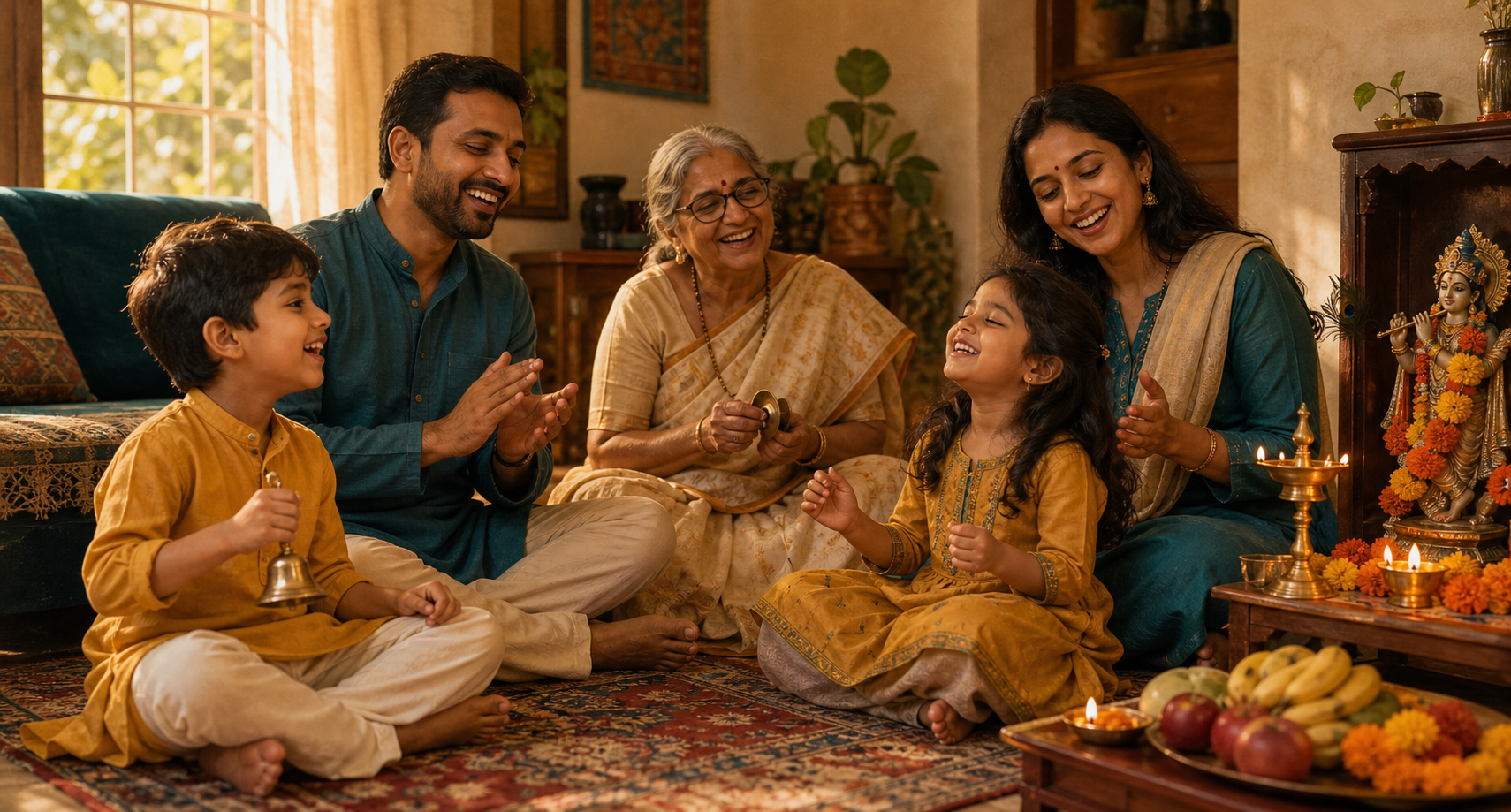
You want your child to feel at home in dharma, not merely comply when an adult is watching. Yet a family puja, story, or bhajan can quickly become a stream of corrections: sit properly, stop fidgeting, repeat this, remember that. When sacred time is measured mainly by outward behaviour, a child may learn to perform spirituality without learning to love it.
A better starting point is to make dharma part of the emotional texture of home: a warm welcome, a shared song, a thoughtful question, a small act of care, and an unforced moment of stillness. Singing, movement, simple games, stories, laughter, breath awareness, and seva can introduce attention and compassion without turning family life into a classroom.
Make belonging the child’s first spiritual lesson
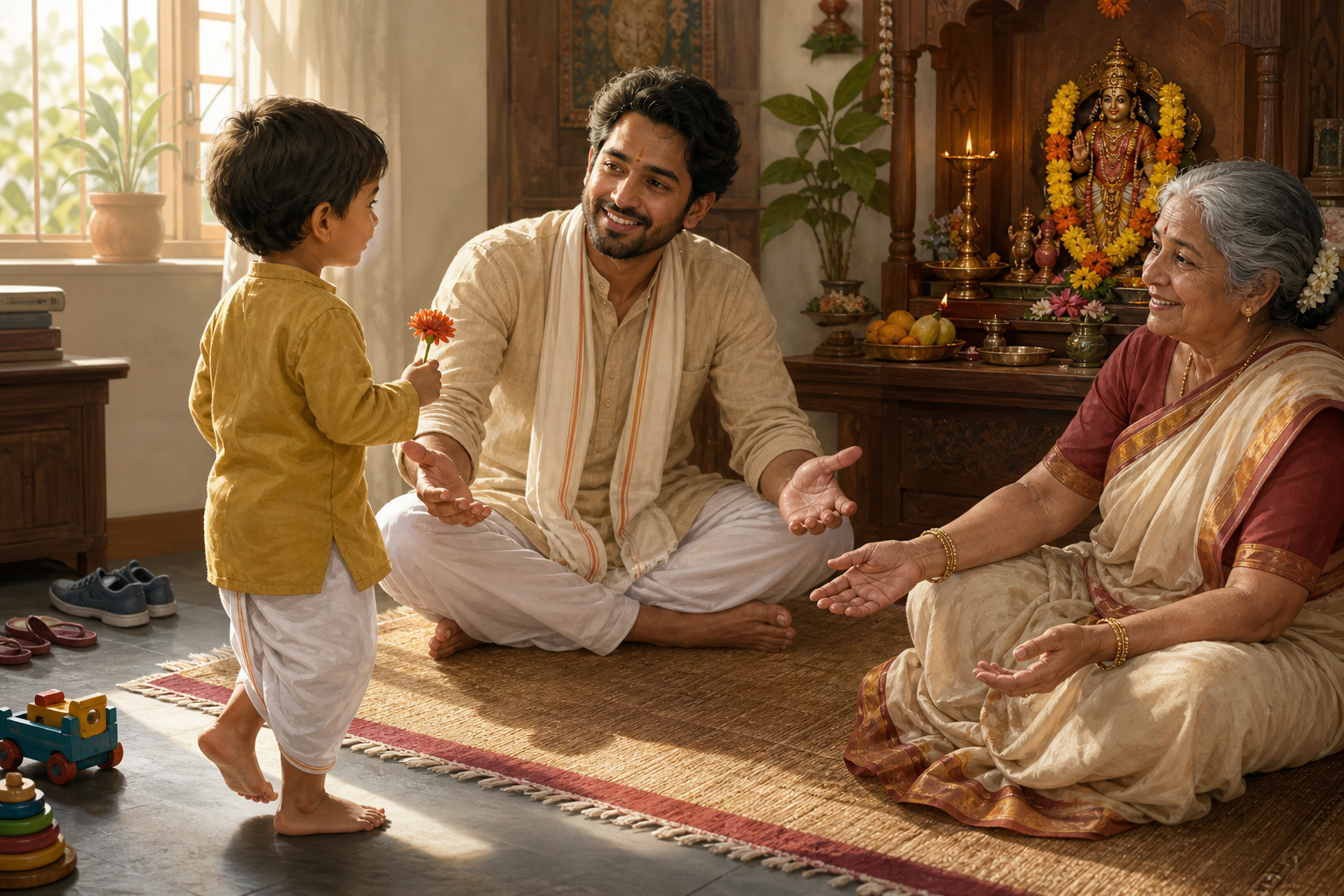
The first thing a child encounters in a family ritual is not its theology. It is its atmosphere. Before understanding the meaning of a mantra, a child notices whether the adult chanting it is patient. Before remembering the lesson of a sacred story, the child notices whether questions are welcomed. Before learning a formal practice, the child learns whether sacred time feels like belonging or inspection.
This is why a small reunion ritual can matter more than another lecture. When you return home, pause before asking about homework, unfinished chores, or behaviour. Offer a familiar smile, clap a short rhythm, make a playful sound, or use a family greeting. Let the child answer with a clap, a word, a movement, a laugh, or simply their presence. Then allow the energy to settle into one easy breath or a brief silence.
The sequence quietly carries several Dharmic values. The welcome says, “You belong.” The shared rhythm asks for attention without demanding it. The pause introduces stillness without making stillness a punishment. Such affectionate family rituals can remain meaningful long after childhood because the child remembers how home felt, not only what an adult said.
Do not require cheerfulness in return. A child who is tired, angry, embarrassed, or sad should not have to hide that feeling to participate in spiritual life. Joy is not compulsory smiling. It is the security of knowing that difficult emotions do not cancel one’s place in the family or before the sacred. Listening without humiliation is itself ahimsa in speech.
Keep correction separate from welcome whenever possible. If a real problem must be addressed, greet the child first and discuss the problem clearly afterward. Otherwise, the greeting becomes a disguised inspection, and the child soon learns to guard against it.
Place small practices inside routines you already have
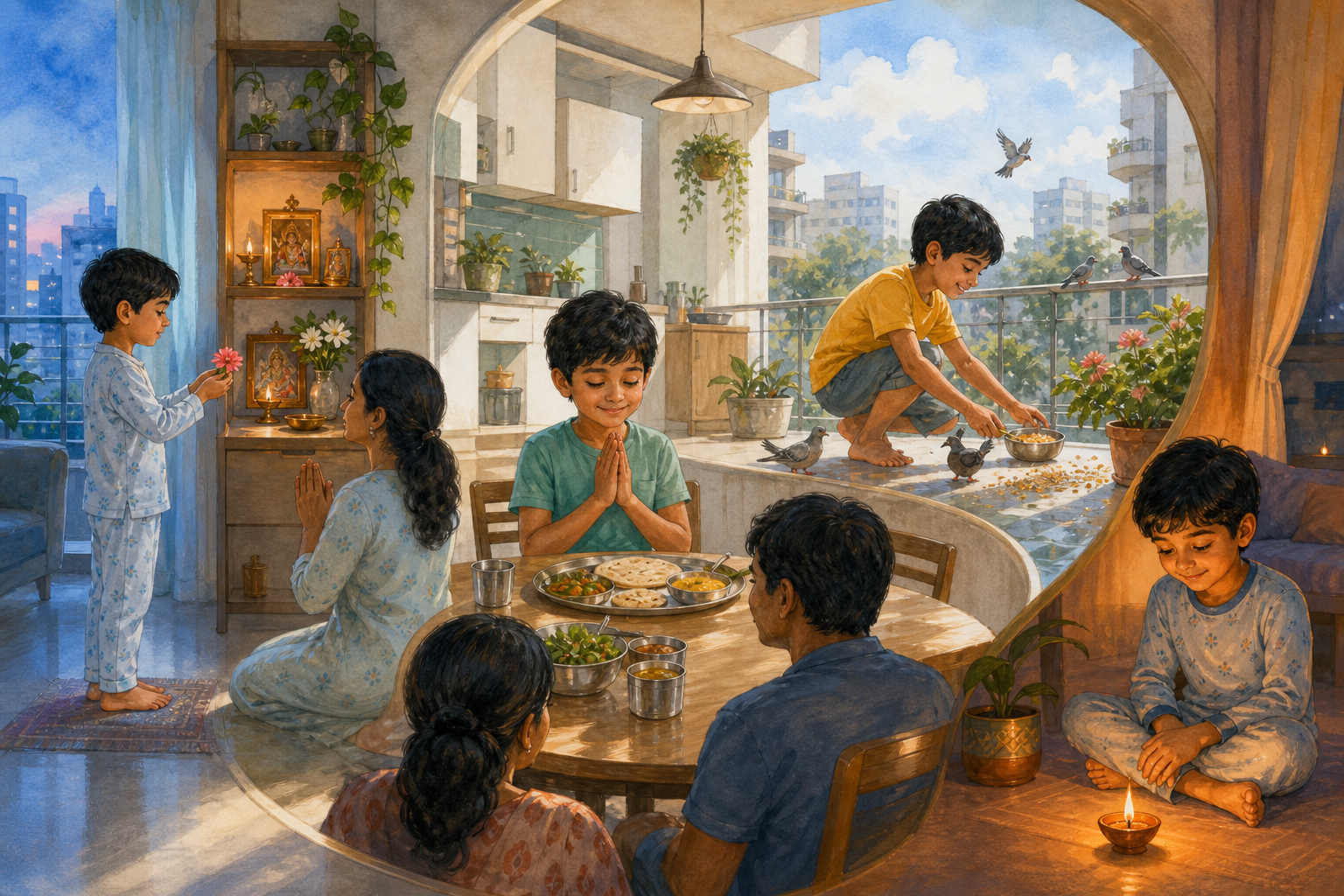
A family does not need to manufacture a large programme of spiritual education. Ordinary transitions already provide useful places for practice. Choose one or two that suit your household, repeat them gently, and let familiarity do the teaching.
- Before a meal, pause playfully. Invite everyone to notice one natural breath, the aroma of the food, or the hands that helped prepare it. Add a short prayer or expression of gratitude from your tradition. The aim is not perfect silence. It is the movement from rushing to receiving.
- At story time, ask before explaining. Read or retell an episode from the Puranas, a Jataka tale, a Jain moral parable, or a Sikh sakhi. Before supplying the moral, ask: “What did you notice?” “Who acted with care?” “What other choice was possible?” A child’s answer may reveal attention that a memorised response would conceal.
- Let music include the body. During a bhajan or kirtan, permit clapping, swaying, simple gestures, and gentle movement. A child does not need to imitate an adult’s posture to participate sincerely. End by noticing the last sound fade. Activity followed by quiet makes stillness easier to encounter naturally.
- Use a nature walk for attention, not a lecture. Let the child choose a tree, bird, flower, stone, cloud, or sound to observe. Ask what changed, what remained still, or what deserves care. Wonder can be a doorway to reverence when an adult does not rush to fill it with explanation.
- Give seva a visible purpose. Invite the child to set a place, carry something manageable, share food, water a plant, tidy a common area, or help someone at home. Name who benefits from the act. Seva becomes meaningful when the child can see that care has moved from intention into action.
These practices work best as invitations held within a dependable family rhythm. A child may choose the song, story, greeting, or act of service while the adult maintains the practice itself. This gives the child real participation without making every family value negotiable.
End while the practice still has life. Repeating an enjoyable song on another day is better than extending it until everyone is restless. If the child only watches, let watching count as participation. If a question takes the family away from the planned lesson, follow the question when you reasonably can. Curiosity is not an interruption to spiritual education; it is one of its clearest openings.
Breath awareness should remain easy and unforced. Invite the child to notice breathing or coordinate a natural breath with a gentle movement, but do not turn it into a contest, demand breath-holding, or praise the child for enduring discomfort. The spiritual purpose here is attention, not technical performance.
Respect questions without abandoning adult guidance
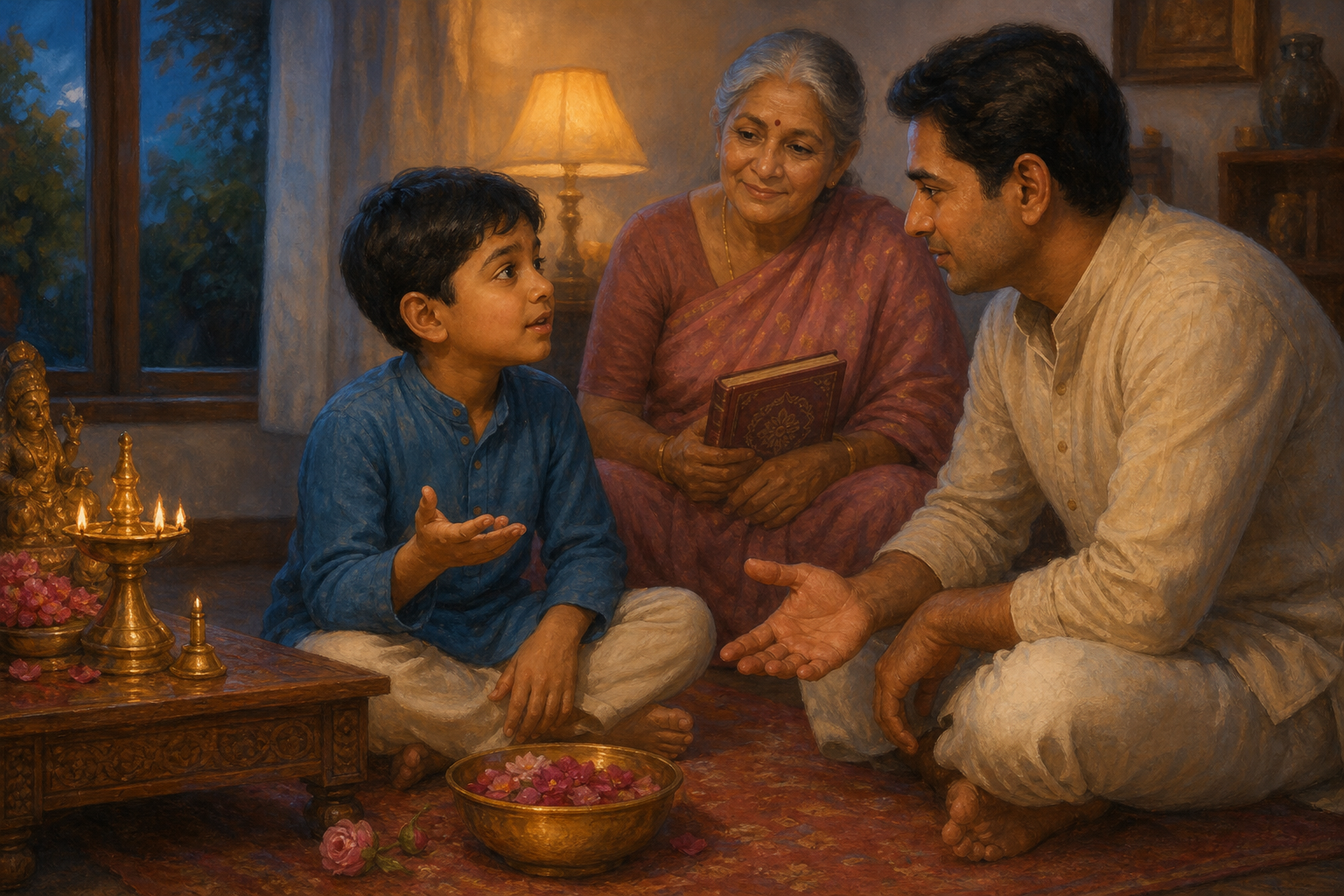
Respecting a child’s inner life does not require the adult to pretend that every answer is equally sound. It means treating the question, emotion, and questioner with dignity. The Guru-Shishya relationship is not served by humiliation. A teacher can carry knowledge and authority while still observing carefully, listening honestly, and learning from the student’s way of seeing.
When a child asks a difficult question about a deity, ritual, story, or moral choice, use a simple response pattern:
- Receive the question. Say, “That is worth asking,” instead of treating doubt as disrespect.
- Discover what the child means. Ask, “What made you wonder about that?” The apparent question may be hiding a concern about fairness, fear, death, identity, or belonging.
- Let the child think. Ask, “What do you think is happening?” Listen before correcting.
- Place the family tradition clearly. Say, “In our family, we understand or practise it this way.” This is more honest than presenting one household’s interpretation as the only Dharmic view.
- Admit what you do not know. “I do not know yet; let us ask or look carefully” protects trust better than an improvised certainty.
- Return the idea to life. Connect the answer to a story, a relationship, a choice, or an act of seva. Dharma becomes intelligible when the child can see what it asks a person to do.
Avoid using karma, divine displeasure, or family honour as threats for ordinary misbehaviour. Fear may produce quick compliance, but it also teaches the child to associate sacred language with adult anger. State the household boundary directly: “You may be angry, but you may not hit,” or “We will care for this space together.” Then address the behaviour without pretending that every domestic conflict is a cosmic judgement.
The same respect applies when a child resists a ritual. First determine what the resistance concerns. The child may dislike being watched, corrected, compared, made to sit beyond their capacity, or asked to recite words they do not understand. Change the obstacle before concluding that the child rejects dharma. Participation might begin with lighting supervision appropriate to the household, choosing a flower, carrying a book, sounding a bell, selecting a story, or joining only the closing prayer.
Joyful spirituality is not entertainment on demand, and respect is not the absence of structure. Children still need adults to preserve a rhythm, explain boundaries, and embody the values they teach. The crucial distinction is between guidance and control: guidance helps the child enter a practice; control makes the child’s outward performance the adult’s proof of success.
Keep each tradition clear, then look for shared values
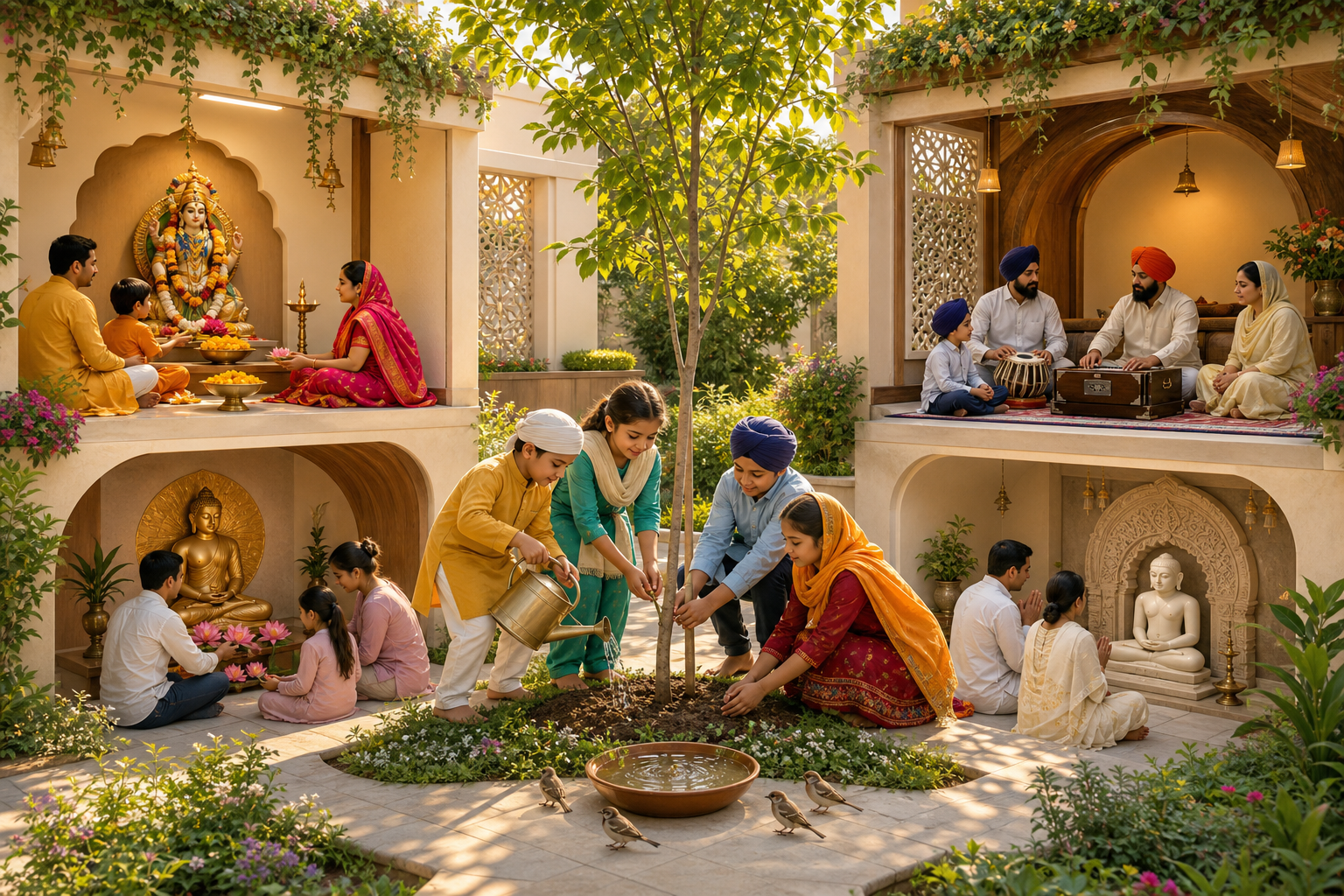
Hinduism, Buddhism, Jainism, and Sikhism can meet within a family conversation without being collapsed into one indistinct system. Their stories, forms of practice, histories, and teachings should be named accurately. When telling a Jataka tale, identify it as Buddhist. When sharing a Jain parable or Sikh sakhi, say where it belongs. When narrating from the Puranas, give the child that Hindu setting. Respectful pluralism begins with truthful naming.
Your household can have a clear spiritual home while recognising values that travel across Dharmic traditions: compassion, mindful attention, restraint from harm, service, gratitude, ethical responsibility, and reverence for life. The point is not to tell a child that every tradition is identical. It is to help the child notice how distinct traditions can call human beings toward care and clarity.
Let the home tradition provide continuity. Its prayers, language, sacred names, festivals, and practices give the child something concrete to inhabit. Introduce neighbouring Dharmic traditions with the same courtesy you would want others to show your own. This combination avoids two common failures: isolation that treats every difference as a threat, and vagueness that leaves the child with no tradition they can actually recognise.
Measure growth by roots, not display. A child who cannot recite a long passage may still be learning to pause before acting. A child who moves during kirtan may be listening closely. A child who challenges a story may be wrestling seriously with justice. Look for signs such as spontaneous questions, voluntary participation in one part of a ritual, care for another person, willingness to help, delight in a sacred story, or a brief return to quiet after movement.
Also notice what your method is producing. If family practice is dominated by correction, comparison, bargaining, or dread, change the method before blaming the child. Remove the quiz. Shorten the gathering. Restore music or story. Offer one meaningful responsibility. Let the next encounter with dharma contain something the child can enter with dignity.
Key takeaways
- Let the child’s first experience of dharma be belonging, warmth, and trustworthy adult conduct.
- Attach small practices to existing moments such as reunions, meals, stories, music, nature walks, and household seva.
- Use movement and play to open attention, then allow quiet to arise without forcing it.
- Treat questions and emotions with dignity while keeping family boundaries and traditions clear.
- Name Hindu, Buddhist, Jain, and Sikh teachings accurately; honour shared values without erasing real distinctions.
- Watch for curiosity, care, participation, and ethical action rather than using recitation or stillness as the only measures of growth.
Choose one small anchor tonight. Greet your child warmly before correcting anything, share one song with movement, ask one honest question after a story, or do one useful task together as seva. Repeat the gesture gently enough that it becomes part of home. A living relationship with dharma is more likely to grow from that dependable rhythm than from another demand to appear spiritual.
References
