
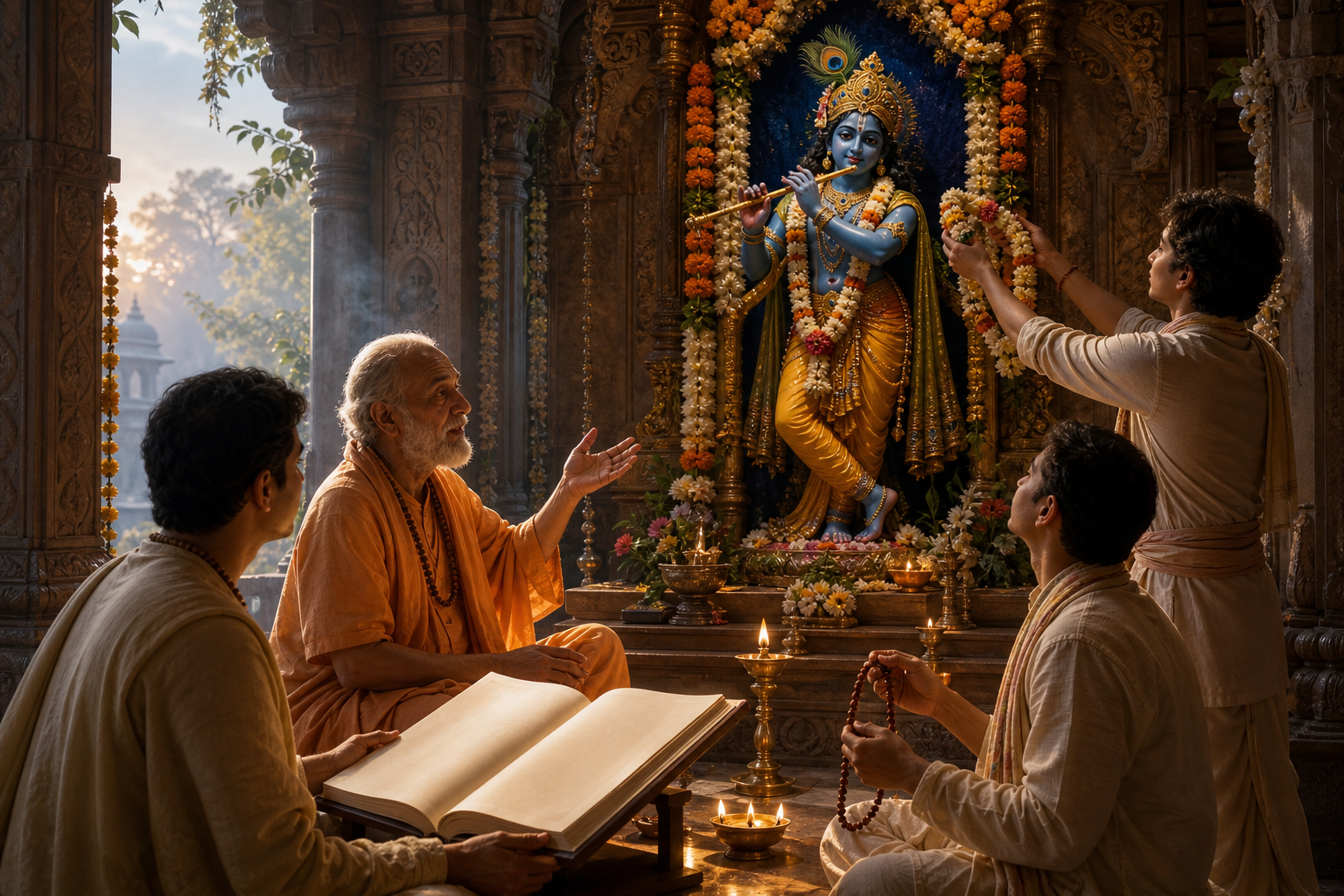
You may already read a verse, hear an occasional discourse, chant japa, and visit a Krishna temple. Yet the practices can remain strangely separate: the reading stays in your notebook, the discourse fades by the next day, and the tenderness of darshan disappears when ordinary pressures return.
The answer is usually not to add more devotional activities. It is to connect the ones you already have. Scripture shows you whom you are approaching, sound teaching corrects how you understand that encounter, and temple life trains you to live as though Krishna is present rather than merely remembered.
Let scripture give your devotion something definite to see

Devotional reading becomes thin when you treat scripture as information to finish. A better question is: what truth about Krishna must become visible in the way I live?
In Srimad Bhagavatam 10.86.31, read through Srila Visvanatha Cakravarti’s commentary, Bahulashva glorifies Krishna as the animating Soul of life and consciousness, the inner inspirer who can awaken even an unrefined mind, and the witness of pious and impious conduct. Those are not three decorative titles. Together they establish a practical devotional stance.
- Krishna gives consciousness its life. You therefore approach practice as a recipient, not as someone manufacturing spirituality by personal force.
- Krishna can awaken a resistant mind. Distraction is a reason to return humbly, not proof that you are disqualified from bhakti.
- Krishna witnesses conduct. Remembrance must reach speech, work, family duties, money, appetite, and treatment of other beings. Otherwise it remains an idea about devotion rather than devotional life.
This also corrects two common distortions. Humility is not self-contempt. Bahulashva’s humility acknowledges dependence on grace while remaining open to transformation. Accountability is not anxious self-surveillance. The divine witness sees wrongdoing, but the same divine presence awakens the heart and makes return possible. Bhakti holds honesty and hope together.
Use a simple reading method whenever you open the Bhagavatam or another text within your sampradaya:
- Name the revelation. Complete the sentence: This passage reveals Krishna as…
- Locate the resistance. Ask which habit, fear, attachment, or excuse keeps you from living in light of that revelation.
- Carry one idea into japa. Before chanting, recall the divine quality you just studied. When attention wanders, return to the name with that quality in mind.
- Choose a visible consequence. Decide what will change in your next conversation, duty, meal, purchase, or act of service.
- Review without theatre. At the end of the day, ask where you remembered the witness and where you behaved as though no one saw.
This method keeps svadhyaya from becoming accumulation. You do not need to finish a large quantity for a passage to work on you. A small section that changes one act has entered your life more deeply than many pages that leave your conduct untouched.
Use teaching to turn a text into a present decision
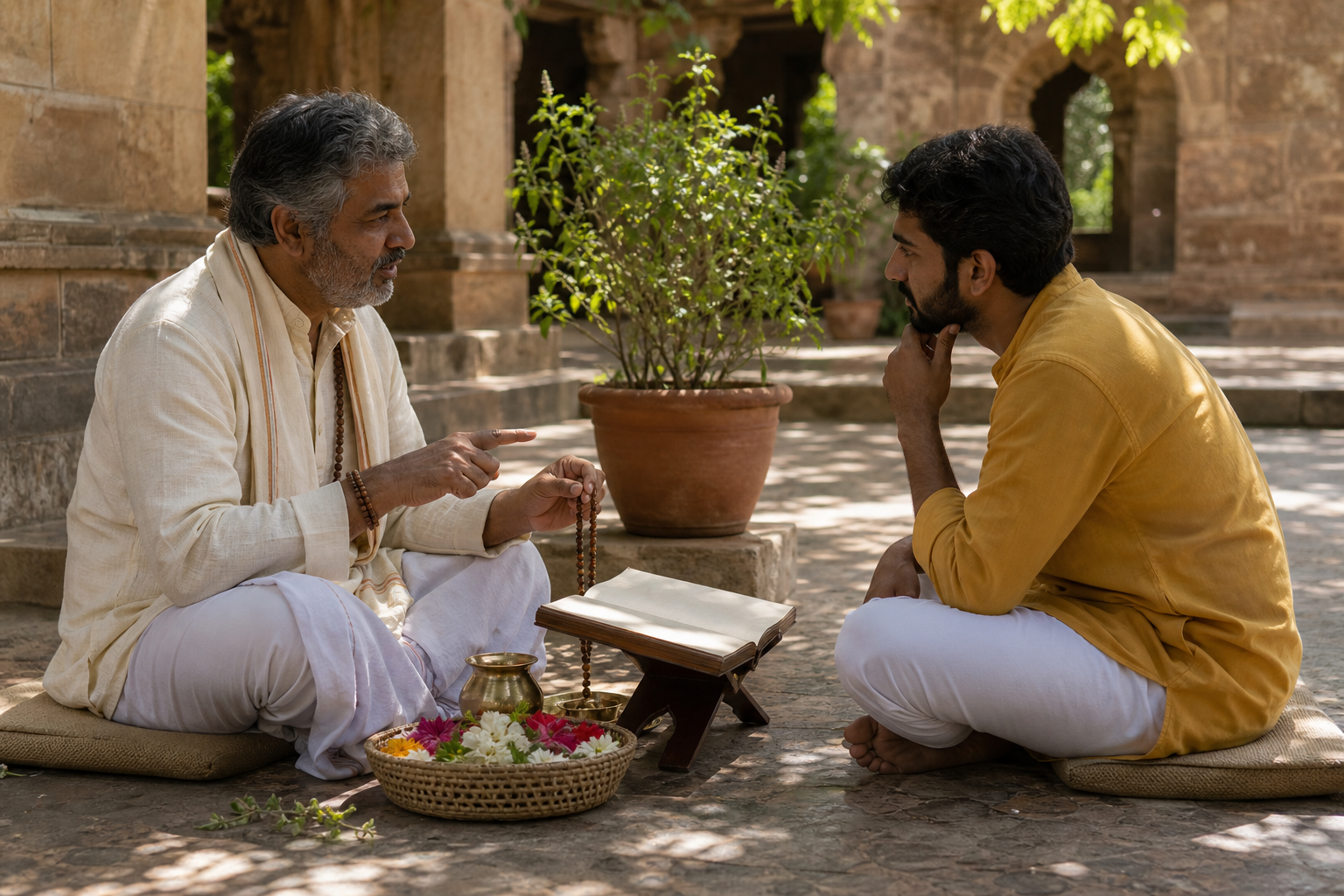
Scripture can be misread through haste, habit, or preference. A capable teacher helps you distinguish the text’s claim, the tradition’s interpretation, and the application being proposed for your circumstances. That distinction matters. It lets you receive guidance seriously without confusing every illustration or personal emphasis with the whole siddhanta.
The Sunday Feast pattern represented at ISKCON Alachua brings discourse into a setting of kirtan, prasadam, discussion, service, and community fellowship. This is more than convenient programming. Sacred sound opens attention, teaching gives attention direction, discussion exposes confusion, prasadam places grace within ordinary embodied life, and fellowship gives practice a social setting in which it can endure.
You will gain more from a discourse if you arrive with a live question rather than a blank demand to be inspired. The question can be plain: Why does my japa become mechanical? How should awareness of Paramatma affect an ethical decision? What does service look like when family duty already fills the day?
Then listen in three layers:
- What is being established? Identify the central theological claim and the scriptural passage supporting it.
- What is being clarified? Note the misconception, false choice, or careless reading the teacher is correcting.
- What is being asked of you? Write down the practice, restraint, duty, or act of seva that follows from the teaching.
Afterward, explain the teaching in your own words without relying on the speaker’s stories. If you cannot do that, you probably remember the atmosphere more clearly than the instruction. Revisit the relevant passage, ask a precise question, or discuss it with a mature practitioner.
A useful discourse should make Krishna more definite, your duty clearer, and your conduct more responsible. It should not leave you dependent on constant novelty or on the personality of a speaker. Gratitude to a teacher bears fruit when it becomes steadier remembrance, compassionate restraint, and service.
Let temple rhythm train relationship, not spiritual tourism
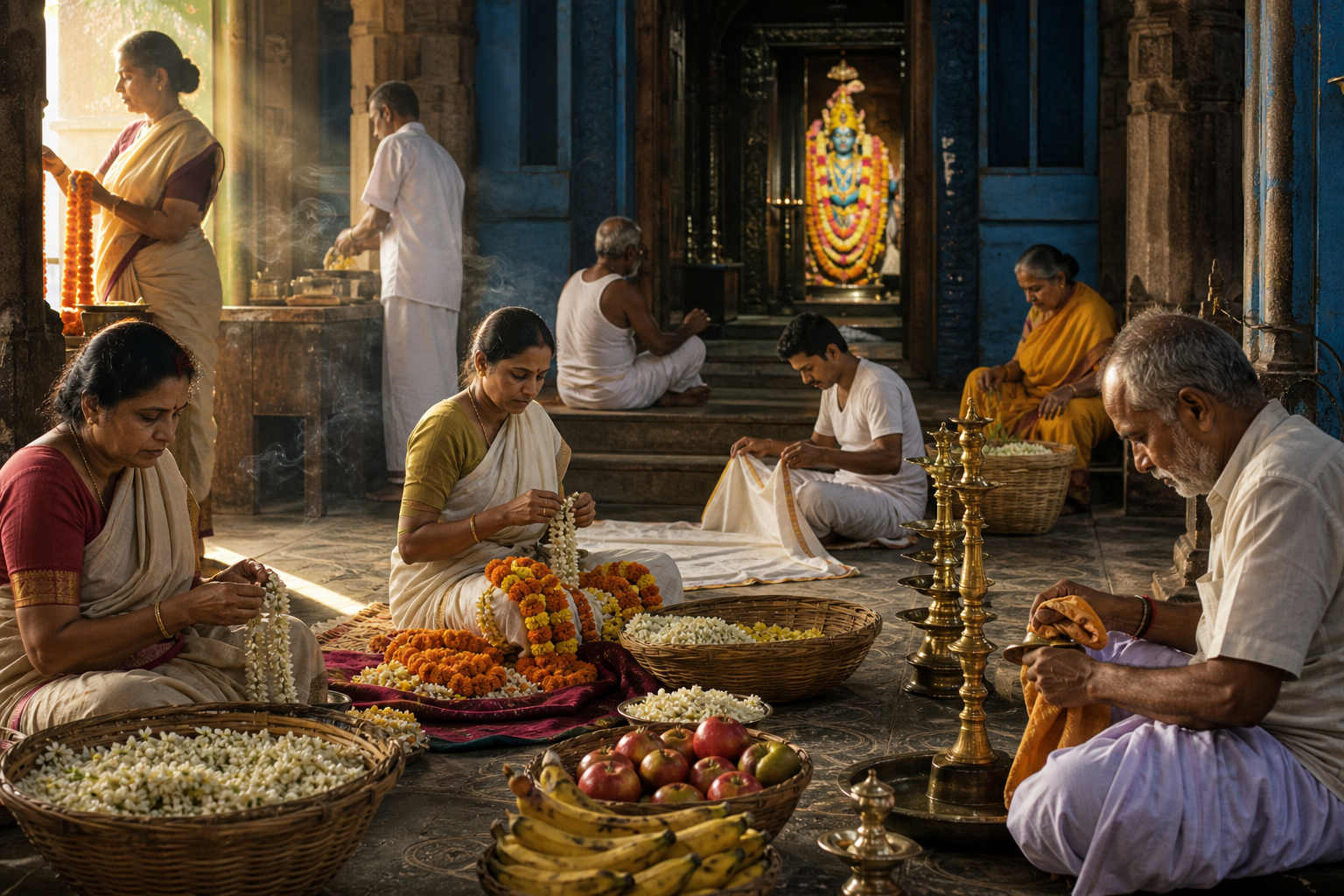
A temple teaches through sequence as well as speech. The doors open and close. The murti is adorned, greeted, served, offered food, praised through music, and approached in distinct moods. Time itself becomes devotional education.
At Govind Dev Ji Temple in Jaipur’s City Palace complex, the daily cadence includes Mangala, Dhoop, Shringar, Rajbhog, Gwal, Sandhya, and Shayan darshan. The schedule may change with the season, but its underlying lesson remains stable: Krishna is approached in an unfolding relationship, not viewed as a static exhibit.
You do not need to collect every darshan on a first visit. Choose a part of the day you can enter attentively. Mangala emphasizes the beginning of worship; Shringar directs attention to adornment; Rajbhog foregrounds offering; Sandhya gathers the heart at the day’s transition; Shayan closes the cycle in a mood of rest. The point is not to rank these encounters but to notice what each asks you to remember.
Before visiting, check the current local schedule rather than assuming the sanctum remains continuously open. Dress modestly, observe the temple’s photography rules, and preserve quiet where quiet is requested. Arrive with enough margin that impatience does not govern the moment the doors open.
During the visit, notice five things:
- Sound: How do mantra, kirtan, bells, and aarti gather many minds around one sacred centre?
- Form: What do the day’s garments, flowers, ornaments, and arrangement communicate about the particular mood of service?
- Timing: How does waiting for darshan change the assumption that the sacred must always be available on demand?
- Service: Which visible tasks make worship possible, including preparation, cleaning, organization, singing, hospitality, and care for the gathered community?
- Return: What element of attentiveness can you carry home when the intensity of the temple is no longer surrounding you?
The temple’s location within Jaipur’s royal precincts adds another lesson. The murti came from the Braj region and was installed in Jaipur by Maharaja Sawai Jai Singh II, placing Krishna devotion near the heart of civic and royal life. Bhakti was not confined to a private mood. Darshan and public duty were placed within one moral horizon.
That principle remains useful even if you hold no public office. Your work, parenting, study, trade, or community responsibility should not become a Krishna-free zone. Temple life prepares you to return to those duties with a more accountable mind.
Join reading, listening, japa, seva, and darshan into one loop
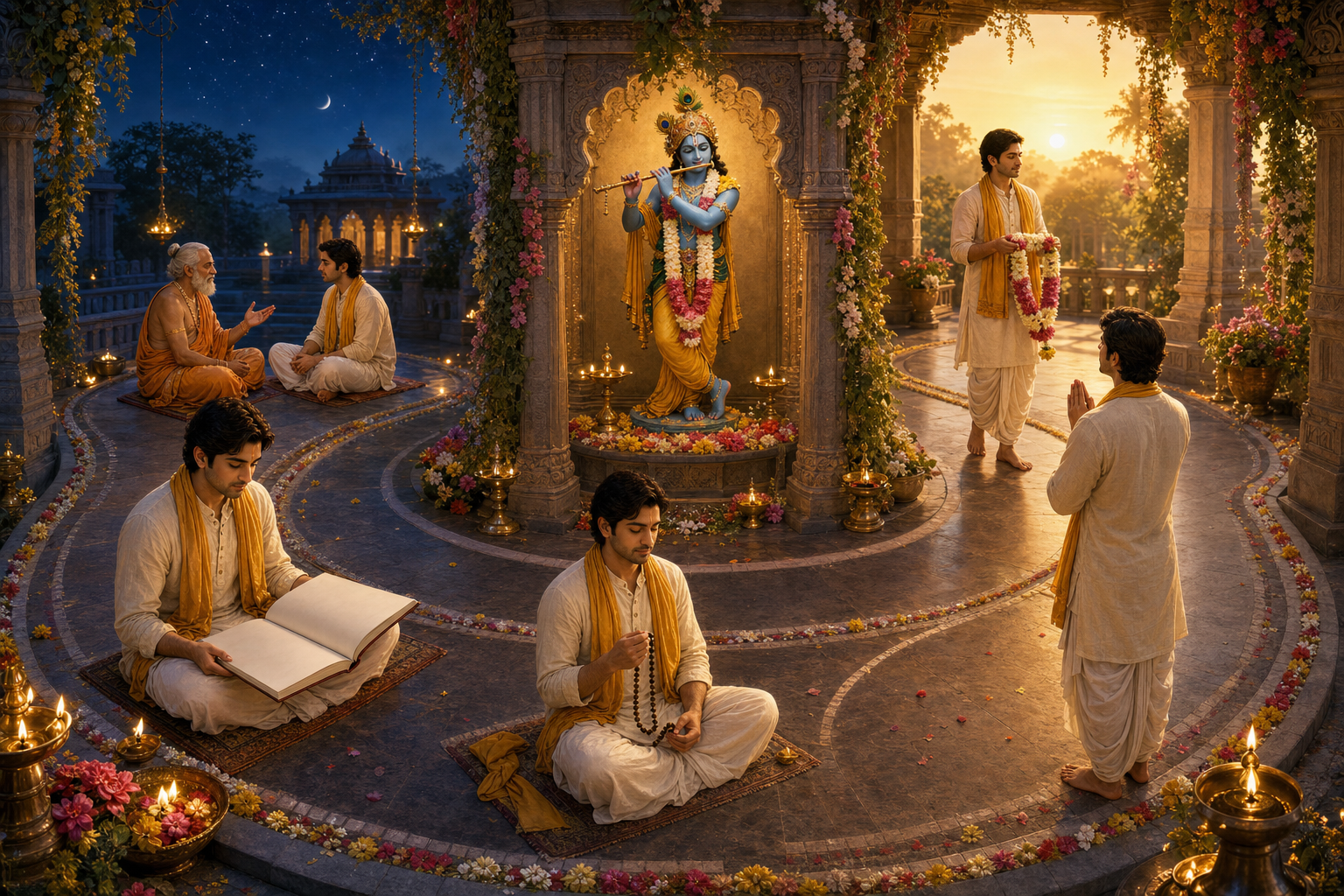
The practices reinforce one another only when you deliberately pass something from one to the next. Without that handoff, you can remain busy with religion while your habits stay largely untouched.
- Anchor the day in a passage. Attach svadhyaya to a transition you already keep reliably, such as the period after bathing or before rest. Consistency matters more than choosing an impressive quantity.
- Carry one divine quality into the name. Let reading supply the focus for japa. If you studied Krishna as the inner witness, chant while remembering that your attention, avoidance, and return are already known.
- Bring one difficulty to teaching. Listen for help with a real obstruction rather than collecting unrelated spiritual content.
- Enter the temple looking for service. Darshan is central, but also notice the human labour that protects the space of darshan. Ask what you can support without making yourself the centre.
- Test devotion in conduct. Look for greater truthfulness, patience, reliability, non-harm, gratitude, and willingness to repair a wrong. These do not replace bhakti; they show whether remembrance is reaching action.
This loop can also shape household practice. Read a short passage together, let each person state one question, listen to a trusted explanation when clarification is needed, and choose a shared act of seva. A family does not need identical temperaments to share a devotional direction. One person may respond most strongly to study, another to kirtan, another to temple service. The common centre is Krishna, not sameness of personality.
Watch for several signs that the loop has broken:
- Reading without remembrance: you can repeat concepts but do not carry them into japa or decisions.
- Listening without digestion: you move immediately to another discourse because the feeling of receiving instruction has replaced the work of applying it.
- Darshan without service: you judge access, crowds, music, or arrangements only by whether they satisfy your preferred experience.
- Humility without dignity: acknowledgment of limitation turns into a fixed belief that grace cannot transform you.
- Emotion without accountability: intense devotional feeling coexists with careless speech, avoidable harm, or neglected duty.
- Unity without clarity: shared values among Hindu, Buddhist, Jain, and Sikh traditions are used to erase real theological differences. Compassion, ahimsa, discipline, and seva can create genuine dharmic fellowship without making every path doctrinally identical.
When you notice one of these patterns, do not respond by adding more content. Restore the missing connection. Take the teaching back to its passage, the passage into japa, japa into conduct, or temple emotion into concrete service.
Key takeaways
- Read scripture to identify a truth about Krishna that must alter a present habit or decision.
- Hold grace and accountability together: the inner witness knows your conduct, and divine mercy makes genuine return possible.
- Approach a discourse with a live question, then separate its scriptural claim, explanation, and practical application.
- Visit a temple according to its actual rhythm and etiquette; observe how darshan, aarti, kirtan, offerings, and seva form one devotional culture.
- Judge the integration of your practice by what happens after the sacred moment: in speech, duty, restraint, compassion, and repair.
At your next point of practice, do not add another obligation. Make one connection. Carry tonight’s reading into the next japa, bring one unresolved question to the next teaching, or bring one temple lesson into an ordinary duty. Krishna bhakti becomes steady when each encounter prepares you for the next one.
References
- Dandavats — SB 10.86.31 Bahulashva’s Praise of Krishna: Witness of All Actions, Awakener of Bhakti
- Dandavats — Anuttama Dasa’s 2025 Sunday Feast Lecture: Inspiring Bhakti, Unity, and Practice in ISKCON Alachua
- Hindu Pad — Govind Dev Ji Temple, Jaipur: A Soul-Stirring Krishna Shrine in the City Palace Complex
