

You may have read deeply, sat in meditation, and learned the right vocabulary, yet still wonder whether you have actually understood anything. The practical test is simple: when a thought, emotion, or difficult decision appears, can you see it clearly before habit speaks for you?
Sacred inquiry helps you close the distance between knowing a teaching and living it. You begin with immediate awareness, examine your interpretation, and let the result shape conduct. The aim is not to manufacture a mystical experience. It is to notice what is already present and become more truthful about what you do next.
Begin where the question is already happening

When you ask whether consciousness is present, the question itself gives you somewhere to look. The capacity to ask, hear, see, and know an experience is already functioning. You do not have to infer awareness as you would infer an object hidden in another room.
This observation is a starting point, not a shortcut through every philosophical dispute. Recognizing that experience is known does not force Hindu, Buddhist, Jain, and Sikh traditions into one metaphysical conclusion. It simply moves you from speculation about awareness to an examination of awareness as it is lived.
- Pause at the appearance of a question. Do not rush to answer it with a remembered doctrine.
- Select something present. Notice a sound, the breath, a bodily sensation, an emotion, or a thought.
- Separate the experience from its interpretation. Tightness in the body is directly noticeable; the belief that everything will go badly is an interpretation appearing as thought.
- Ask what is knowing it. Let the question direct attention toward the fact of knowing rather than toward another theory about knowing.
- Resume the situation consciously. Carry that clearer attention into the conversation, task, prayer, or decision in front of you.
If a verbal answer immediately appears – awareness is the Self, awareness is the brain, awareness is emptiness – notice that answer as another known thought. You do not have to reject it. You only have to distinguish the concept from the awareness in which the concept is presently known.
This distinction makes inquiry experiential. You are no longer trying to win an argument inside your head. You are testing whether your attention can recognize a thought without being carried away by it.
Give curiosity a discipline, not merely permission

Curiosity becomes sacred when it is answerable to truth, humility, and conduct. Hindu vicāra, the Buddhist invitation ehipassiko, Jain anekantavada, and Sikh vichar each make room for examination joined to experience and compassion. Questioning is not treated as a failure of faith. Nor is every restless doubt treated as wisdom.
You can give a spiritual question a reliable shape through śravaṇa, manana, and nididhyāsana: attentive learning, careful reflection, and deep contemplation. A final movement into conduct keeps the sequence from remaining intellectual.
- Listen accurately. Before agreeing or objecting, state the teaching in a form its practitioner would recognize. If you are working with a sacred text, teacher, or lineage, preserve its actual terms instead of replacing them with your preferred vocabulary.
- Reflect honestly. Ask what the teaching claims, what it does not claim, which assumptions you bring to it, and where your resistance arises.
- Contemplate directly. Sit with the meaning in present experience. If the teaching concerns awareness, observe awareness. If it concerns attachment, notice attachment as sensation, thought, and urge.
- Translate insight into conduct. Choose an action that would be different if your understanding were genuine: listen before interrupting, correct an inaccurate statement, release a needless insult, fulfil a neglected duty, or offer service.
The order matters. Without attentive learning, you can spend time defeating a teaching no one actually holds. Without reflection, contemplation can become repetition. Without contemplation, reflection remains an elegant rearrangement of ideas. Without conduct, even a sound insight has not yet entered your dharma.
Suppose you ask why another person’s words offended you. Begin with what was heard. Then notice the bodily reaction, the story attached to it, and the response you want to make. Ask which part is observation and which part is interpretation. Finally, decide what truth and non-harm require. You may still need to disagree firmly, but your disagreement need not be driven by the first surge of anger.
Find common discipline without flattening the paths
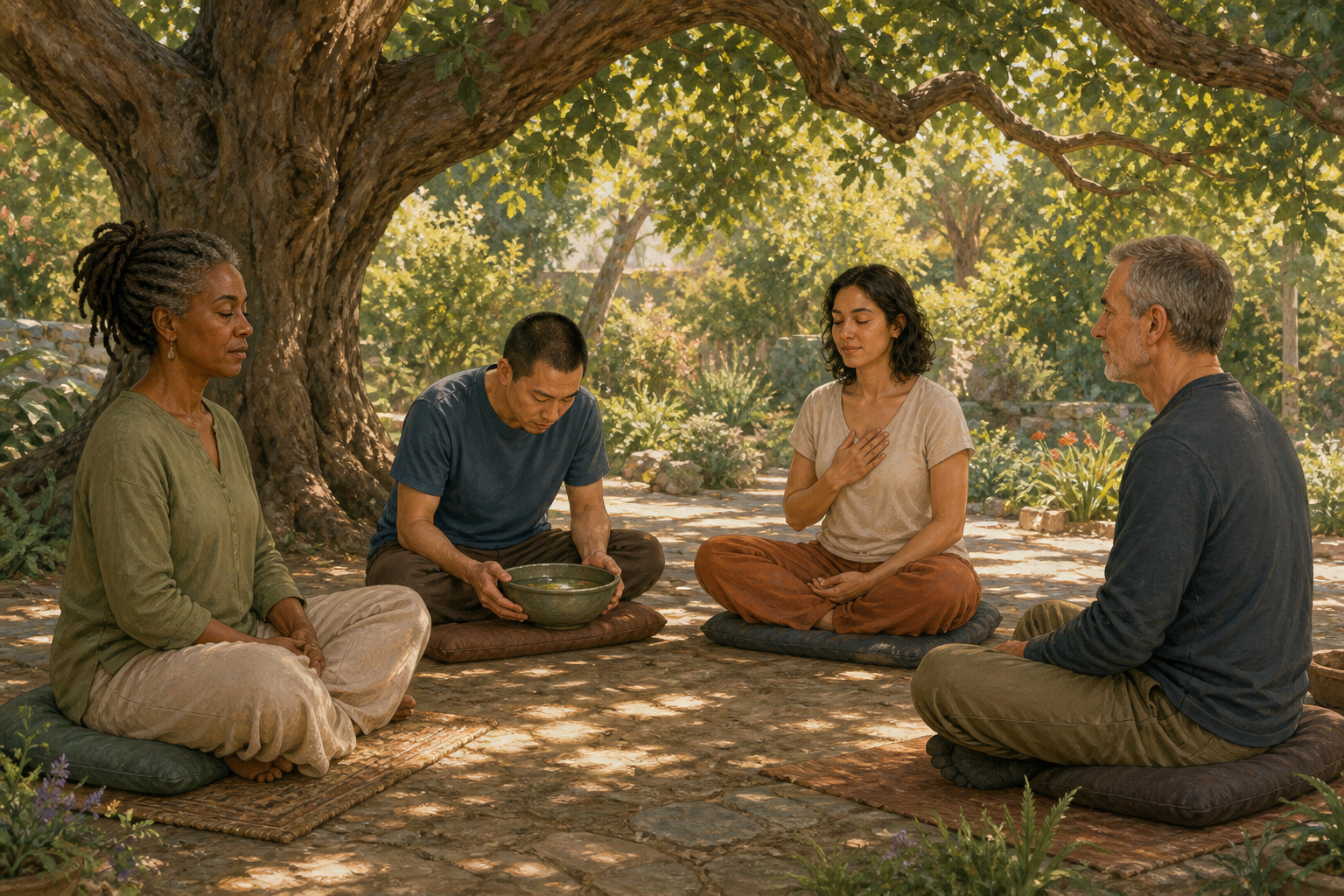
The Dharmic traditions share a confidence that disciplined attention can transform understanding and action. Their practices nevertheless have different theological and philosophical settings. Witnessing awareness, mindful presence, equanimous awareness, and remembrance should be placed in conversation without being declared interchangeable.
| Path and mode of inquiry | What to examine in experience | A useful guardrail |
|---|---|---|
| Advaita Vedānta and witnessing awareness | Notice that thoughts, sensations, and identities are known. Ask whether the knowing presence can be reduced to any one passing object of experience. | Do not mistake a sentence about the witness for direct recognition of witnessing. |
| Buddhism and sati | Attend carefully to what is arising in body and mind, including the impulse to grasp, resist, or construct a fixed conclusion. | Do not import an Advaita conclusion merely because mindful attention has become quiet. |
| Jainism, Samayik, and anekantavada | Cultivate equanimity and examine how attachment or a one-sided viewpoint narrows judgment. | Many-sided inquiry calls for precision and humility; it does not make contradictory claims equally sound. |
| Sikhism, simran, and vichar | Notice whether remembrance steadies attention, clarifies the heart, and supports service. | Do not reduce remembrance to mechanical repetition separated from truthful conduct and seva. |
This approach lets you learn across the Dharmic family without erasing lineage. If you have a rooted practice, go deeply enough to understand its own purpose and disciplines. Use another tradition’s questions to refine respect and expose assumptions, not to manufacture a blended doctrine that none of the traditions teaches.
Unity is strongest when it can accommodate real difference. Shared commitments to disciplined examination, compassion, self-restraint, and ethical action provide substantial common ground. Sameness is not required.
Take inquiry into the moment a decision begins

A practice that works only in a quiet room is incomplete. Home, work, study, temple, gurdwara, community, and the natural world all supply occasions for curiosity to become listening, discernment, gratitude, and responsible action. The most revealing moment is often the interval between an event and your first interpretation of it.
Before an important reply, accusation, or choice, use this decision screen:
- Name the observable facts. What did you actually see or hear? Leave motives out for the moment.
- Notice the inner movement. Identify the emotion, bodily reaction, repeated thought, and action impulse now present.
- Expose the protected assumption. Ask what you need to be true in order for your preferred conclusion to survive.
- Seek the missing standpoint. What might another person, community, or lineage perceive that your present angle hides?
- Apply the ethical test. Which response is more truthful? Which avoids needless harm? Which serves duty rather than vanity?
- Act and observe. Take the clearest available step, then let its consequences correct your understanding.
During a disagreement, for example, replace a sweeping claim about the other person’s character with the precise words or act you observed. Notice the anger without pretending it is absent. Ask for the missing context. Then make the boundary, correction, apology, or request that the facts support. Awareness does not remove the need for judgment; it makes judgment less captive to reflex.
Nor does many-sided inquiry require indecision. Considering another view and abandoning discernment are different acts. Ahiṃsā asks you to examine avoidable harm. Satya asks you not to distort what happened. Dharma asks you to carry the clearer perception into an appropriate response.
When inquiry has become another escape
Sacred language can conceal avoidance as easily as ordinary language can. Watch for these patterns:
- The question only produces more versions of itself. Return to one present sensation, thought, or observable fact, then identify the next ethical action.
- A memorized answer arrives before observation. Set the doctrine aside briefly and examine the experience the doctrine is meant to illuminate.
- You chase an unusual state. Remember that awareness is present before a special technique or conclusion. Quiet, intensity, and emotional uplift may occur, but none should be confused automatically with insight.
- Witnessing becomes an excuse not to care. If you use detachment to dismiss emotion, relationship, duty, or harm, bring inquiry back to conduct.
- Unity erases meaningful differences. Return each term to its tradition and ask what purpose it serves there.
- Questioning becomes a display of superiority. Ask whether your words make truth easier to see or merely make another person easier to defeat.
A mature inquiry should leave you able to describe the situation more precisely, hold your interpretation with less arrogance, and choose a more responsible action. If none of these changes, the question may still be circulating at the level of identity and argument.
Key takeaways
- Begin with the fact that an experience is being known, not with a theory about the knower.
- Treat every immediate philosophical answer as a thought that can itself be noticed.
- Move through attentive learning, reflection, contemplation, and conduct instead of stopping at intellectual agreement.
- Honor the distinct purposes of Advaita inquiry, Buddhist mindfulness, Jain equanimity, and Sikh remembrance.
- Judge an insight by the clarity, humility, and ethical responsibility it brings to an actual situation.
Before the day ends, choose one question that is genuinely alive for you. Write it plainly. Pause before answering, notice what is present, separate observation from interpretation, and choose one truthful action the clearer view requires. Return to the same question when its next real-life test arrives. That is where sacred inquiry stops being an idea and begins to reshape how you live.
References
- DharmaRenaissance Blog – Is Consciousness Within? Sri Sri Ravishankar’s Transformative Insight for Daily Awareness
- DharmaRenaissance Blog – Let Curiosity Guide the Heart: Timeless Hindu Wisdom for a Unified Dharmic Journey
