
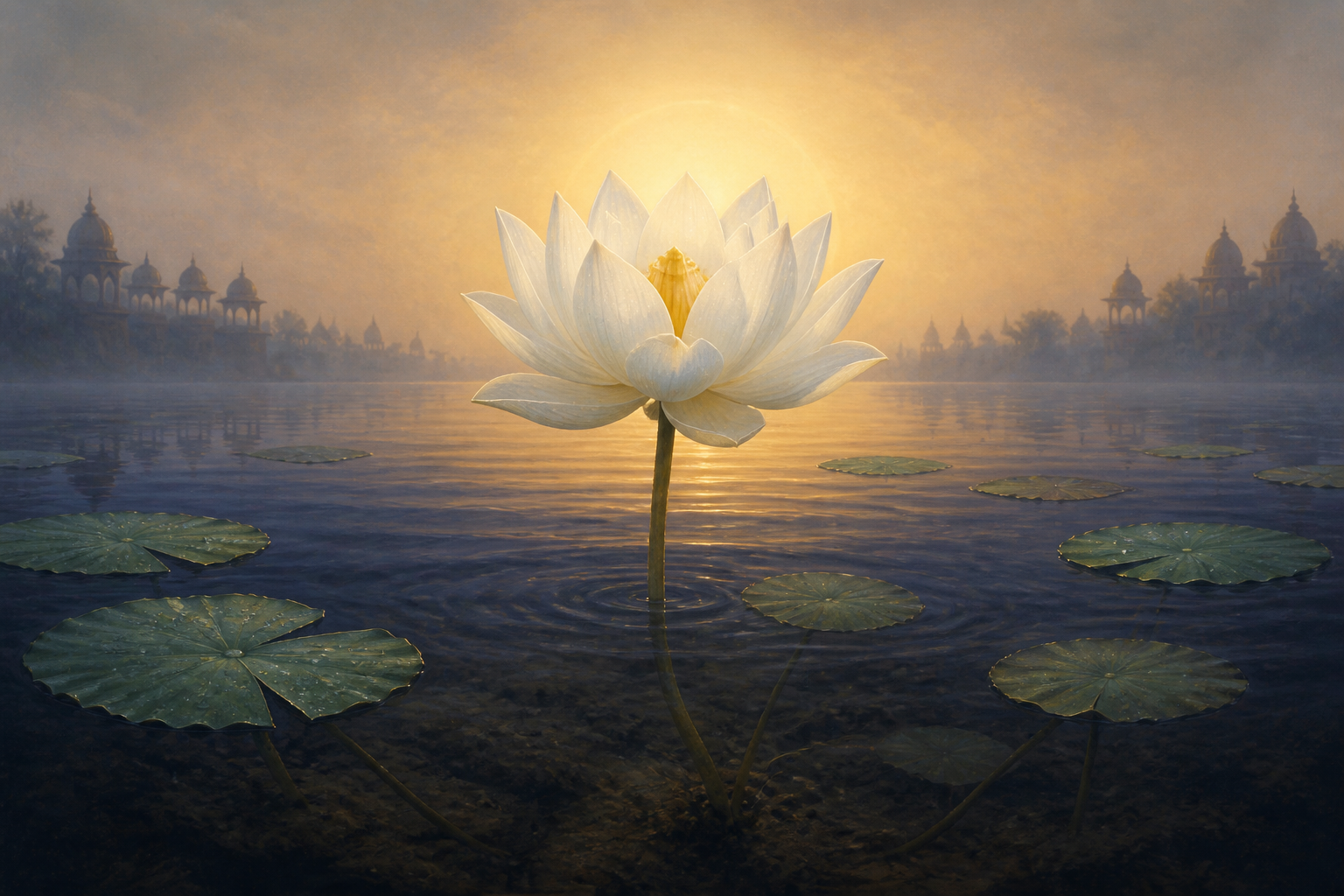
You have noticed a white lotus beneath a deity, beside a sacred figure, or at the center of a meditation image. Does it simply mean purity, or do its color and placement communicate something more precise? The safest answer is that the color forms only one part of a larger visual sentence.
The white lotus generally directs you toward clarity that survives contact with a complicated world. To read it well, look at three things together: what the lotus is doing, who or what is associated with it, and how the surrounding tradition understands purity, wisdom, and liberation.
Begin with the lotus, then let whiteness refine its meaning
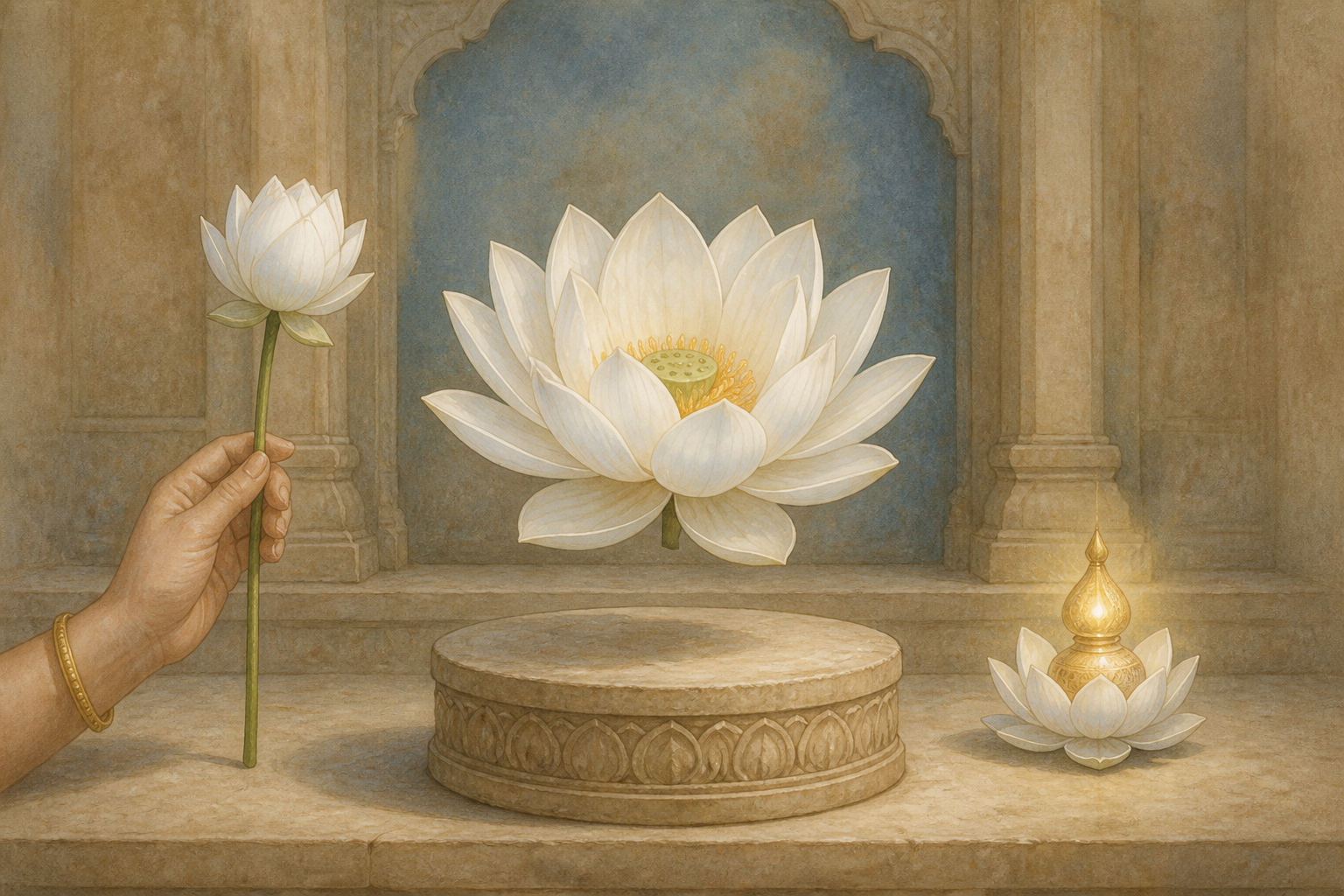
The basic lotus metaphor depends on contrast. Its roots are in mud and water, yet the flower opens above them without displaying their stain. In Dharmic thought, that makes the lotus an image of spiritual life conducted within the world rather than beyond its reach. Difficulty, desire, work, and responsibility remain present; the question is whether they govern your consciousness.
Whiteness sharpens this teaching. It often indicates purity, serenity, refined sattva, and spiritual awakening. Here sattva is not merely quietness. It is lucid, balanced awareness expressed through truthful thought, ethical conduct, and peaceful discernment. In a liberative setting, the white lotus can therefore point toward moksha: freedom from the inward adhesions that keep consciousness bound.
Do not reduce this to a color code in which white always outranks every other lotus. Pink lotuses also serve as sacred seats, and the colors used for a figure can vary across schools, regions, periods, and artistic conventions. White usually modifies the lotus metaphor; it does not replace the need to understand the rest of the image.
- A white lotus pedestal: The deity seated or standing upon it is presented through the language of unstained consciousness, wisdom, and divine purity. The padma is a theological statement, not merely an ornamental base.
- A cosmic lotus: The flower concerns creation and the quality of consciousness from which manifestation proceeds.
- An inner or yogic lotus: The image maps the teaching onto consciousness and contemplative awakening.
- An offered white lotus: The flower expresses the devotee’s aspiration to approach the divine with a purified intention.
This distinction matters when you are identifying an image. Color alone cannot establish the deity, school, or doctrine. First identify the figure and the lotus’s role. Then use white as a clue to the particular quality being emphasized. If the work is an unpainted sculpture or its pigments have not survived, do not assume that an apparently pale stone lotus was originally intended to be white.
The associated deity changes the question the lotus asks
The white lotus keeps its central association with unstained clarity, but each divine context bends that clarity toward a different aspect of dharma. A useful reading should tell you more than what the symbol means. It should show you what kind of attention the image requests from you.
| Iconographic context | What the white lotus emphasizes | A question for the viewer |
|---|---|---|
| Saraswati | Pure knowledge, refined speech, contemplative lucidity, and compassionate wisdom | Is what I am learning making my thought and speech clearer? |
| Lakshmi | Prosperity governed by dharma, generosity, stewardship, and inner abundance | What is my prosperity serving? |
| Vishnu as Padmanabha and the emergence of Brahma | Creation arising from pure, balanced consciousness | What quality of mind is shaping what I create? |
| Mahagauri or serene forms of Shakti | Purification, auspicious renewal, and sattvic serenity | What must be cleared for renewal to become possible? |
| Sahasrara | The opening of awareness beyond the narrow claims of ego | Can awareness become spacious without turning the experience into another possession? |
Saraswati’s association is especially direct. Her white lotus reinforces vidya and jnana as forms of knowledge that clarify the person who receives them. The symbol does not celebrate information accumulated for status. It directs the student toward disciplined attention, truthful expression, and wisdom that does not become proud or harsh.
Lakshmi is more commonly associated with a pink lotus, so a white lotus is worth noticing when it appears with her. It does not cancel her connection with prosperity. It gives prosperity an ethical frame. Wealth becomes sound when it supports generosity, balance, service, and responsible care rather than accumulation for its own sake. If you are contemplating such an image, the practical question is not whether abundance is spiritual. It is whether your use of abundance remains aligned with dharma.
Vishnu’s epithet Padmanabha evokes the cosmic lotus from which Brahma emerges. Although that lotus is often rendered pink, white versions occur in regional and period-specific representations. In that setting, whiteness stresses creation proceeding from untainted and equilibrated consciousness. The image asks you to examine beginnings: the motive present before a decision, project, or act takes form.
In Mahagauri and other serene Shakti contexts, the white lotus supports the language of purification and auspicious renewal. The emphasis is not passivity. Renewal becomes possible because obscuration has been removed and clarity restored. This is why the same flower can communicate both repose and spiritual power.
A shared Dharmic grammar does not erase distinct traditions
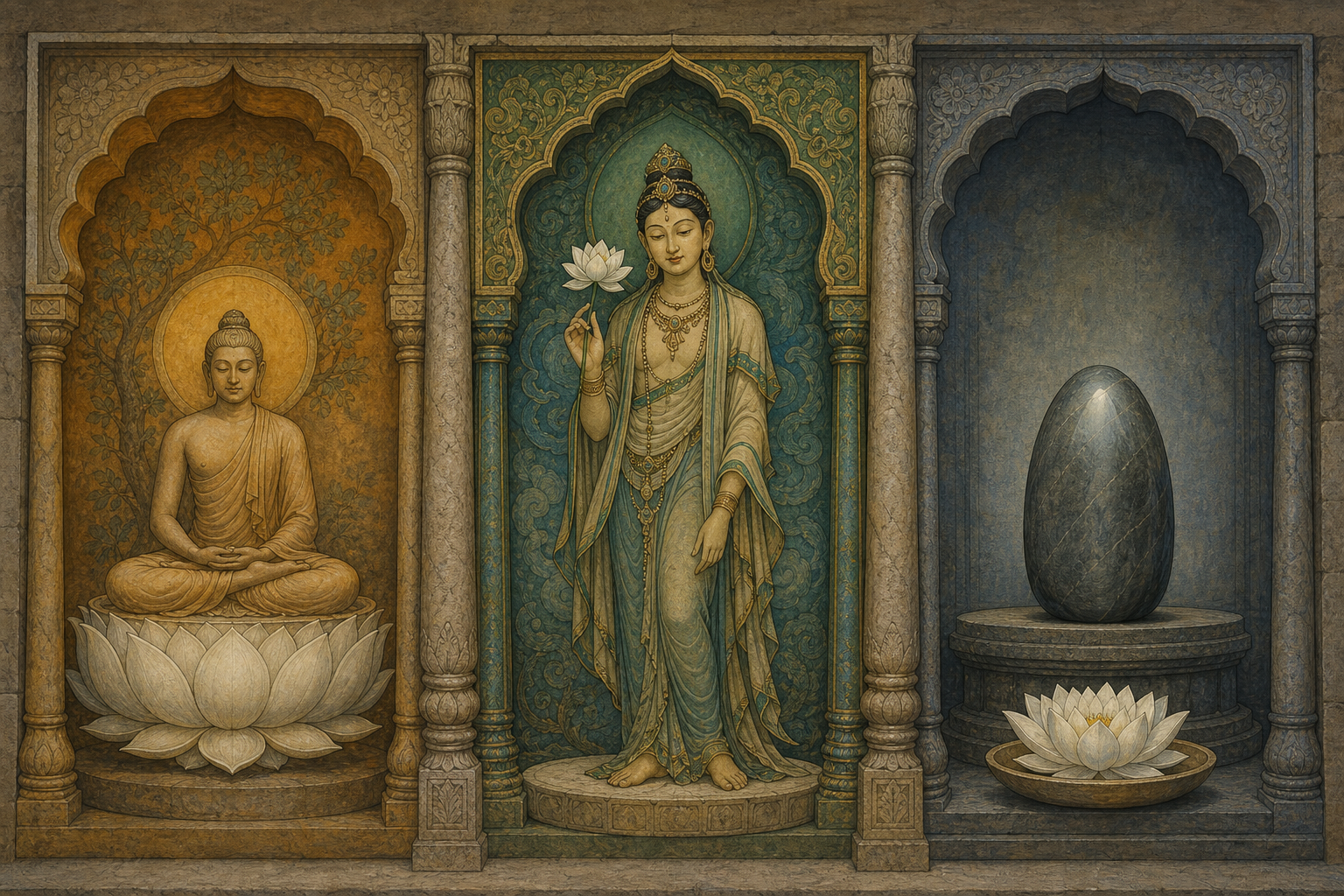
Hinduism, Buddhism, Jainism, and Sikhism all use the lotus to speak about inward purity amid worldly conditions. That resemblance is meaningful. It points to a shared civilizational confidence that disciplined consciousness need not be defeated by its surroundings. But the resemblance should not be used to declare that every tradition means exactly the same thing or employs the same iconographic forms.
- In Hindu traditions, the white lotus can mark divine purity, refined sattva, liberating knowledge, the cosmic ground of creation, or the opening of consciousness. Its role as a deity’s padma pedestal is particularly important.
- In Buddhism, the white lotus is associated with pristine wisdom. Read it through the Buddhist setting of the image rather than automatically importing the identity or theology of a Hindu deity.
- In Jain traditions, lotus emblems support teachings about purity of conduct and contemplation. The ethical discipline of the path supplies the relevant frame.
- In Sikh tradition, the lotus appears prominently as a metaphor in Gurbani for graceful detachment while living in the world. Do not force the Hindu deity-throne model onto a Sikh scriptural image; the shared metaphor is expressed through a different religious mode.
The responsible way to describe an unfamiliar work is therefore to name the shared structure first and the tradition-specific teaching second. You might say that the lotus evokes unstained life amid worldly contact, while its Buddhist setting directs that metaphor toward pristine wisdom. Or you might explain that Gurbani uses the lotus to teach inward freedom without social withdrawal. This preserves Dharmic kinship without flattening real distinctions.
The Bhagavad Gita’s image of a lotus leaf untouched by water supplies a particularly practical Hindu expression of the principle. The teaching is not to abandon action but to avoid being inwardly possessed by it. Sikh lotus imagery likewise turns detachment toward life in the world. Across these uses, purity is active: you still learn, work, create, serve, and accept responsibility, but you try not to let attachment distort the action.
Turn the symbol into a brief contemplative practice

Sacred iconography becomes useful when observation changes how you see and act. The next time you encounter a white lotus, move through three deliberate passes rather than settling for the label of purity.
- Observe the form. Is the lotus a throne, an attribute, a cosmic point of emergence, an offered flower, or an inner yogic center? Is its whiteness clearly preserved or specified?
- Read the relationship. Identify the deity, sacred figure, text, or contemplative system associated with it. Ask which quality of that context the white lotus intensifies.
- Return the image to conduct. Take several quiet breaths and choose one action in which you can preserve clarity without avoiding responsibility.
The final action should fit the image. Before Saraswati, it may be more careful study or speech cleansed of needless aggression. Before Lakshmi, it may be directing a resource toward service or correcting an indulgence that has lost its dharmic purpose. A cosmic lotus may prompt you to purify your motive before beginning new work. A sahasrara visualization may invite still attention without grasping after a dramatic experience.
The sahasrara is often envisioned as a thousand-petaled white lotus. In yogic psychology, it represents consciousness opening beyond the ego’s restricted frame. Some practitioners use white-lotus visualization to cultivate calm, steadiness, and gentle uplift. Treat these qualities as the orientation of the practice, not as guaranteed sensations or a performance to reproduce.
In puja, offering a white lotus can express the wish to approach the divine with a pure heart. The symbolism does not make the flower a universal requirement, and local custom still matters. Where the offering belongs to your practice, let its meaning govern the preparation: sincerity, clean intention, and attentive presence are more important than treating the flower as a decorative token.
Key takeaways
- The lotus signifies the possibility of remaining inwardly unstained while participating fully in worldly life.
- White usually intensifies the flower’s associations with serenity, ethical clarity, refined sattva, wisdom, and awakening.
- Placement changes meaning. A padma pedestal, cosmic lotus, yogic lotus, and ritual offering do not perform the same symbolic work.
- Saraswati directs white-lotus symbolism toward pure knowledge; Lakshmi toward dharmic prosperity; cosmic Vishnu-Brahma imagery toward untainted creation; and Mahagauri toward purification and renewal.
- Hindu, Buddhist, Jain, and Sikh uses share a civilizational metaphor without becoming interchangeable. Identify the tradition before choosing the vocabulary.
- When you next see a white lotus, read its role, its relationship, and its ethical demand. Then carry one point of clarity into action.
Let the next white lotus you encounter slow your interpretation by a few breaths. Notice where it appears, determine what kind of purity the setting calls for, and make that insight concrete in study, speech, stewardship, contemplation, or service. That is when iconography stops being a code to decode and becomes a form of dharmic instruction.
References
