
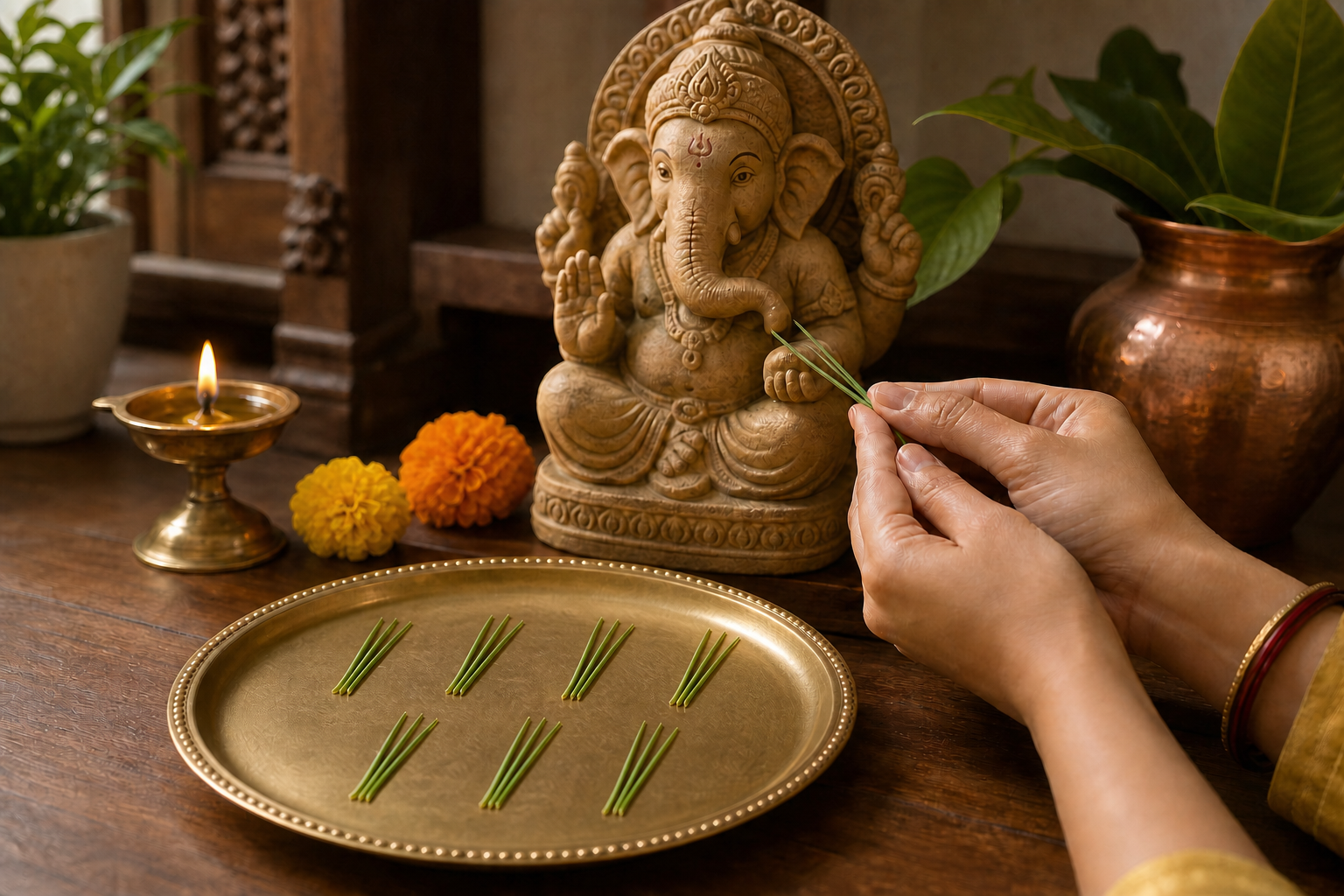
If you have durva in hand and are wondering what to count, how to arrange it, or where to place it, begin with the core custom: prepare twenty-one fresh, green blades, offer them respectfully to Ganesha, and use the counting to gather your attention.
The aim is not to manufacture a flawless bundle. This ritual joins care with surrender. You count deliberately, take a modest gift from nature, recite a simple mantra, and place your restless senses and thoughts before the remover of obstacles.
A simple way to prepare and offer the durva
The following sequence concerns the durva offering itself, not every element of a complete puja. Household, temple, and sampradaya customs may add other steps. Where your family’s practice or a temple instruction differs, follow that living tradition.
- Confirm that the grass is durva. The plant traditionally associated with the offering is Cynodon dactylon. Do not assume that any green lawn grass has the same ritual identity.
- Select fresh, green growth. Freshness belongs to the offering’s symbolism of vitality, steadiness, and cooling balance. Set aside grass that has dried or deteriorated.
- Gather only what you intend to use. Durva is a humble offering, so unnecessary harvesting and waste work against its spirit of restraint and reverence for nature.
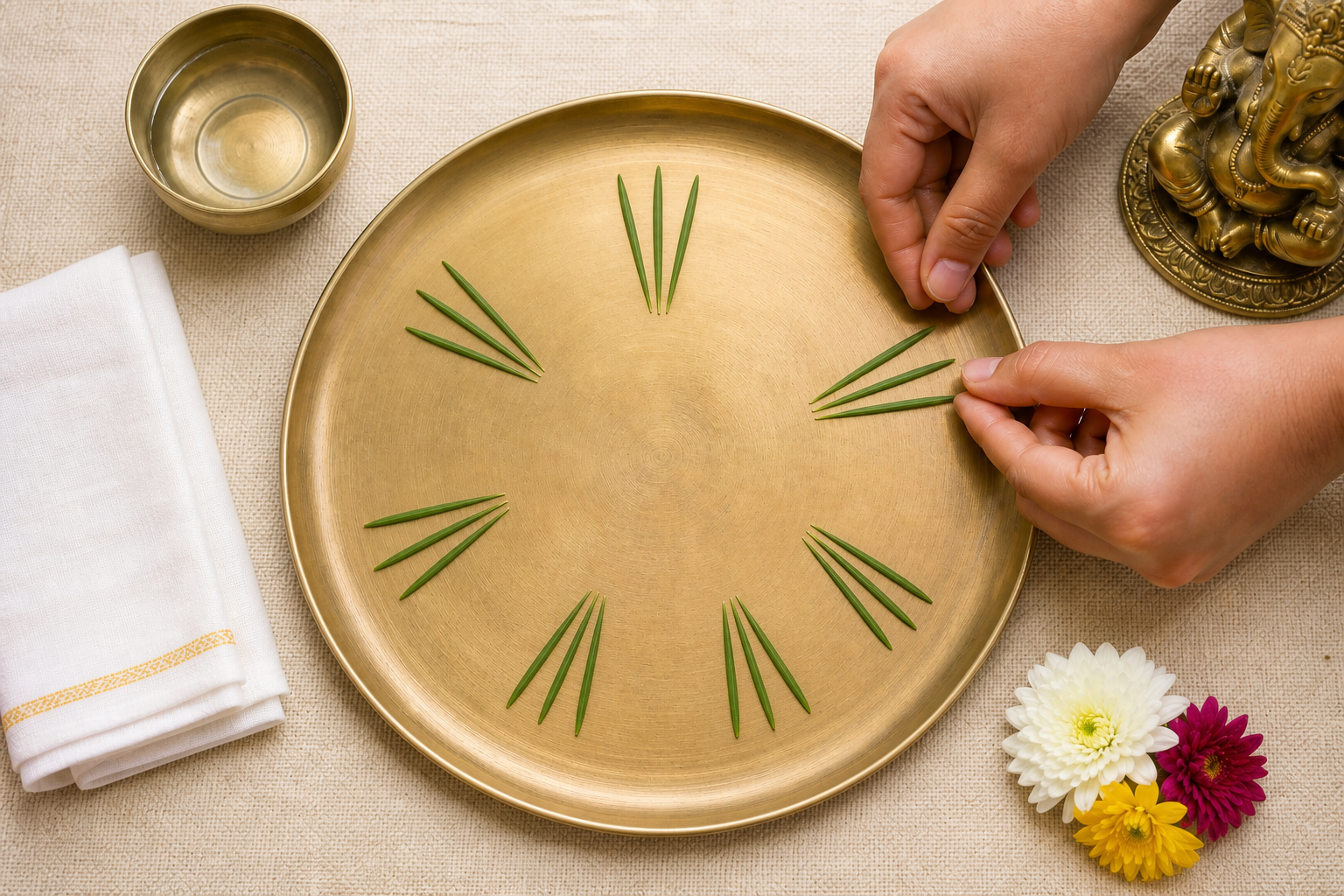
- Count twenty-one blades. Count once while arranging them and once before the puja begins. That small check prevents repeated recounting from interrupting the moment of worship.
- Observe your local rule about nodes. Many devotees prefer durva strands with three nodes. This describes the customary form of the strand; it does not mean that you should multiply twenty-one into a different total unless your tradition explicitly instructs you to do so.
- Gather the blades into a neat offering. Bind or hold them gently. The purpose is an orderly presentation, not an elaborate decoration.
- Offer them to Ganesha. Place the durva upon the head or trunk of the murti, according to your established practice, while reciting Om Gam Ganapataye Namah.
- Pause before continuing. Let the final moment be more than the completion of a count. Recall the obstacle for which you seek clarity, and consider which part of your own conduct must become steadier.
Precision has a place in ritual because it disciplines attention. It should not become anxiety. If you spend the entire puja worrying that a blade shifted or that your bundle looks less impressive than someone else’s, the outer form has displaced the inner work.
Why a simple grass offering cools Ganesha’s heat
The meaning of durva becomes clearer through the legend of Analasura. In Puranic and regional retellings, Analasura is a demon whose consuming heat torments the three worlds. Ganesha protects the cosmos by swallowing him, but the demon’s fiery force continues to burn within Ganesha.
Powerful remedies are attempted, yet the heat remains. Relief finally comes through durva, an ordinary and widely available grass. The contrast is the teaching: what grandeur cannot settle, a humble offering made with sincerity can.
The story is not a claim that a ritual plant should replace medical care or that botanical temperature explains the event. Durva is described as cooling in Ayurvedic understanding, but the katha works primarily through sacred symbolism. Fierce, uncontrolled heat represents a disturbance that cannot be answered merely with more force. Fresh grass restores proportion, simplicity, and balance.
You can notice the same pattern during worship. Anger, hurry, pride, and compulsive thought all have a kind of inner heat. Counting a small natural offering gives the mind one bounded task. The mantra gives speech one direction. The act of placing the durva down replaces grasping with surrender.
This is also why expensive display is not the measure of the offering. Durva’s resilience and accessibility matter. Ganesha does not need the devotee to prove wealth. The devotee needs a form simple enough that status cannot hide the quality of intention.
What the number twenty-one asks you to surrender
Twenty-one is not merely a quantity to complete. One traditional interpretation treats it as a map of embodied existence: the faculties through which you perceive, act, breathe, remember, judge, and identify yourself. The offering therefore represents the whole person, not one isolated wish.
| Aspect offered | What it includes | Count |
|---|---|---|
| Jnanendriyas | Five faculties or organs of knowledge | 5 |
| Karmendriyas | Five faculties or organs of action | 5 |
| Pranas | Five vital energies | 5 |
| Antahkarana | Manas, buddhi, ahamkara, and citta | 4 |
| Purusha-prakriti | The twofold relation of consciousness and nature | 2 |
| Total | The entirety symbolically placed before Ganesha | 21 |
This symbolic reading of twenty-one can turn counting into contemplation. The five jnanendriyas invite you to notice what you have been allowing into your awareness. The five karmendriyas direct attention to what you are doing and what consequences your actions create. The five pranas remind you that spiritual life is lived through an animated body, not through ideas alone.
The four parts of the inner instrument make the examination sharper. Manas gathers and coordinates impressions; buddhi discerns; ahamkara constructs the sense of “I”; and citta carries the mental field of impressions and memory. Offering them does not mean destroying thought, identity, or memory. It means asking that they serve dharma rather than impulse.
Purusha and prakriti complete this particular count. Their inclusion places both the conscious principle and the field of manifested nature within the act of surrender. The devotee is not offering a decorative object while keeping the rest of life untouched. The intended offering is the full structure of experience.
You do not need to recite this entire philosophical map every time. Choose one group when it is relevant. If distraction is your obstacle, attend to the senses. If avoidance is the obstacle, examine action. If pride has produced conflict, bring ahamkara explicitly into the offering. The number then becomes a diagnostic aid instead of an unexplained rule.
Common questions about the offering
Am I counting blades, strands, or bundles?
When your instruction is to offer twenty-one durva blades, count twenty-one blades and gather them into one orderly offering. Local traditions sometimes use terms such as strand, sprig, or bundle differently. If a priest or family elder gives a specific unit, follow that unit rather than silently converting it into another counting system.
Must every strand have three nodes?
Three nodes per strand are a common preference, but “common” should not be turned into a universal rule for every Hindu household and temple. Use three-node strands when that is your received custom. If your tradition permits otherwise, do not reject fresh durva merely because you encountered a different instruction elsewhere.
Can I make the offering at home?
Yes. The practice belongs in both home and temple worship. At home, keep the procedure modest: prepare the blades before beginning, place them on the head or trunk of Ganesha as your custom directs, recite the mantra steadily, and avoid turning the puja into a performance.
What should I do if durva is unavailable?
Do not label an unrelated plant as durva or invent a universal substitute. Continue your prayer with sincerity, and ask a trusted family authority or temple what its tradition accepts. The Analasura katha teaches that devotion outranks opulence; it does not require you to pretend that ritual distinctions do not matter.
Let the offering cool one action beyond the altar
Before the next puja, name one form of heat that is creating an obstacle in your life: an angry reply you are preparing, a decision driven by pride, a scattered habit, or a duty you keep postponing. Do not ask only for the outer obstruction to disappear. Decide which faculty among the twenty-one needs to come under steadier direction.
Then take one cooling action after the offering. Rewrite the angry message in measured language. Delay a prideful reaction long enough for buddhi to examine it. Remove one distracting input. Complete the first neglected duty without waiting for ideal motivation. This is how a ritual becomes sadhana rather than a transaction.
Humility, self-mastery, compassion, and reverence for nature resonate across Hindu, Buddhist, Jain, and Sikh ethical worlds, even though their liturgies remain distinct. The durva offering is specifically a Hindu devotional form, but its discipline is recognizably Dharmic: use less, attend more carefully, and bring conduct into alignment with what you revere.
At your next worship, choose fresh durva, count twenty-one without haste, offer it with Om Gam Ganapataye Namah, and place one restless part of yourself under dharma. Let the action you take afterward show that the offering did not remain on the altar.
References
