

If you are planning your observance for November 30, the useful question is not simply whether the day is Dashami or Ekadashi. Both tithis occur during the civil date, so your practice should recognize the transition instead of forcing the entire day into one label.
A workable plan is simple: use the earlier part of the day for Dashami prayer and preparation, verify the transition time for your location, and then welcome Ekadashi with a form of restraint, remembrance, or service that you can sustain sincerely.
The date contains two tithis, not one
On Sunday, November 30, 2025, Shukla Paksha Dashami prevails until the stated transition at 4:10 PM, after which Shukla Paksha Ekadashi begins. That makes November 30 a handover day within the waxing half of the lunar month.
This is not a contradiction. A tithi is a lunar division and does not have to begin or end at civil midnight. A Gregorian date can therefore contain the end of one tithi and the beginning of another. For your observance, the transition matters more than the date label by itself.
| Period on November 30 | Prevailing tithi | Practical emphasis |
|---|---|---|
| Before 4:10 PM, using the reference timing | Shukla Paksha Dashami | Regular prayer, completion of daytime duties, and preparation for Ekadashi |
| From 4:10 PM onward, using the reference timing | Shukla Paksha Ekadashi | Restraint, japa, dhyana, paath, dana, or seva according to your tradition and capacity |
Treat 4:10 PM as the reference given for this observance, not as a universal time for every city. If your regional Panchang gives a different endpoint, follow the local calculation. If your family, temple, or sampradaya has an established method for determining when a vrat is formally observed, retain that method rather than replacing it with a single general timetable.
Confirm the timing that applies where you live
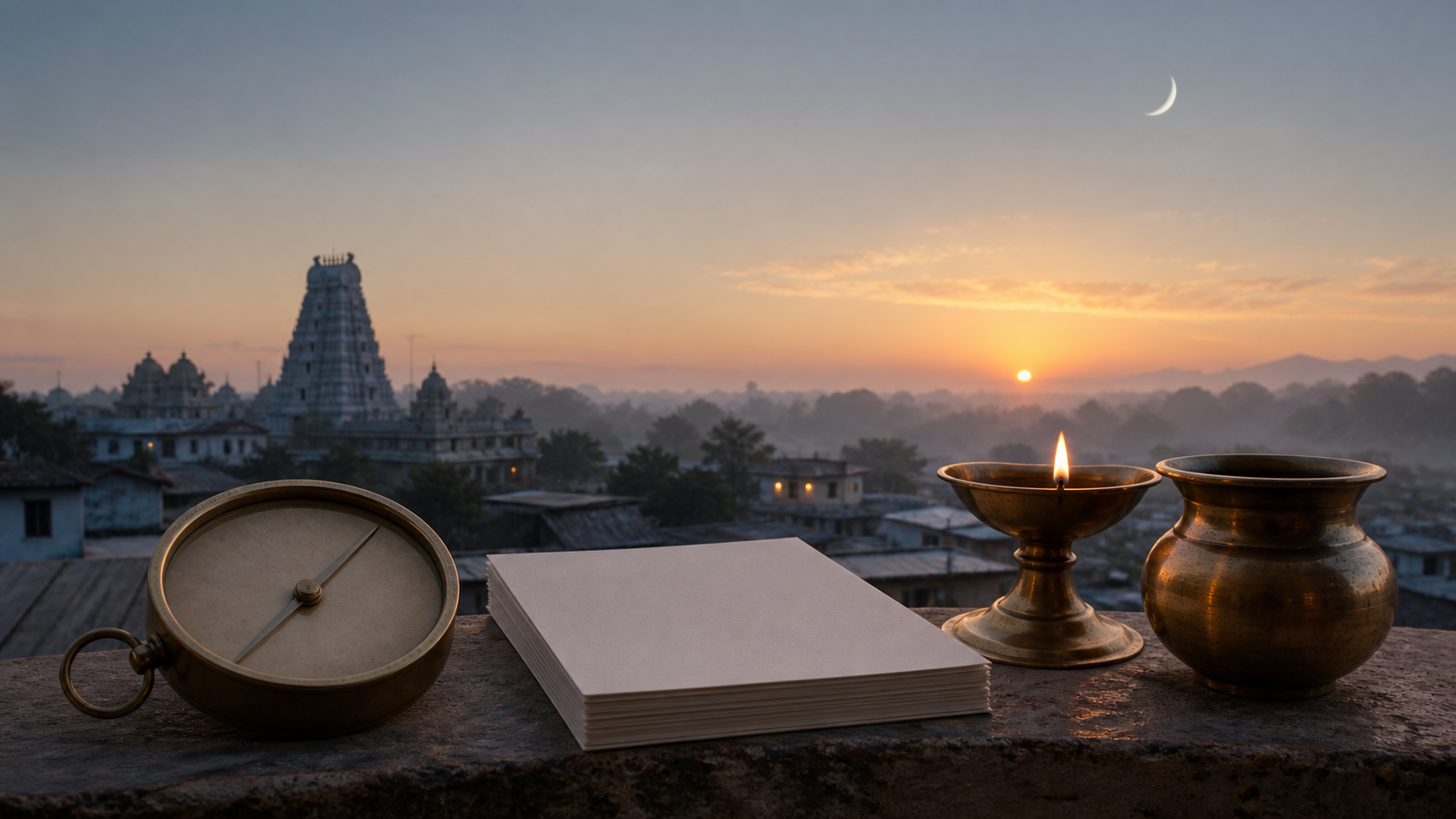
Panchang calculations depend on location. Sunrise, the tithi endpoint, Nakshatra, and intervals such as Rahu Kalam, Gulika Kalam, and Yamaganda cannot safely be copied from a calendar prepared for an unspecified or distant city. The difference becomes important when you are timing a sankalpa, formal puja, temple programme, or another ceremony for which your tradition requires a muhurta.
- Open a Panchang prepared for your city or the nearest major city with reliable calculations.
- Check the entry for Sunday, November 30, 2025, and note the local ending time of Shukla Dashami.
- Confirm that Shukla Ekadashi begins after that endpoint in your location.
- If you need an auspicious period for a formal activity, check the local sunrise and the listed Rahu Kalam, Gulika Kalam, Yamaganda, and prevailing Nakshatra instead of using the tithi alone.
- For a personal question involving Nakshatra or Rashi, use the exact time and place relevant to the person or activity, and consult a qualified astrologer when your tradition calls for one.
Local verification does not require making ordinary devotion complicated. You can pray, remember the Divine, read scripture, or perform seva without waiting for a personalized astrological analysis. The additional calculations become relevant when you are claiming that a particular hour is auspicious or when a prescribed observance depends on exact timing.
A useful rule is to record three different things separately: the civil date, the local tithi transition, and any muhurta chosen for a specific act. Combining them into one vague idea of a good time is how avoidable confusion enters a household plan.
Build an observance you can actually complete
The movement from Dashami to Ekadashi gives the day a natural rhythm. Dashami can hold your ordinary duties and preparation. Ekadashi can mark a deliberate turn toward restraint and inward attention. You do not need an elaborate programme to make that transition meaningful.
Choose the level of observance before the day becomes busy:
- A brief observance: complete your regular prayer during Dashami, verify the local transition, light a lamp after Ekadashi begins, and undertake a short period of japa or silent reflection.
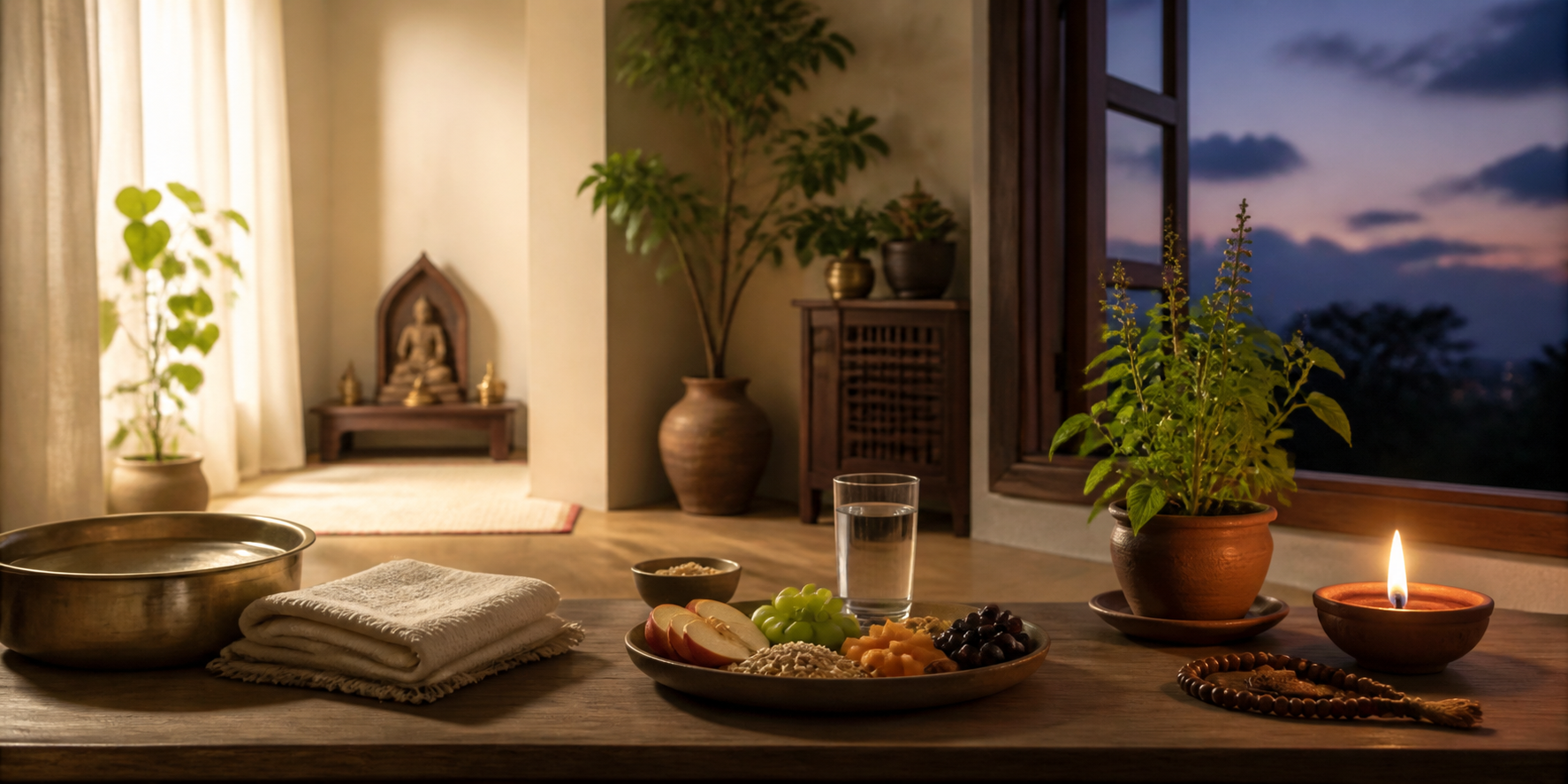
- A household observance: arrange a satvik meal plan, select a passage for paath, and decide in advance whether the family will add bhajan, simran, dana, or a small act of service.
- A fuller vrat: follow the full or partial fasting discipline recognized by your family or sampradaya, while giving more time to dhyana, recitation, restraint, and seva.
The point of choosing in advance is not administrative neatness. It prevents the vrat from becoming a last-minute argument about food, timing, or what counts as proper observance. State your sankalpa plainly: what you will refrain from, what positive practice will take its place, and when you will begin.
A practical sequence for the day could look like this:
- In the morning, offer your usual Dashami prayers and settle the form of your Ekadashi sankalpa.
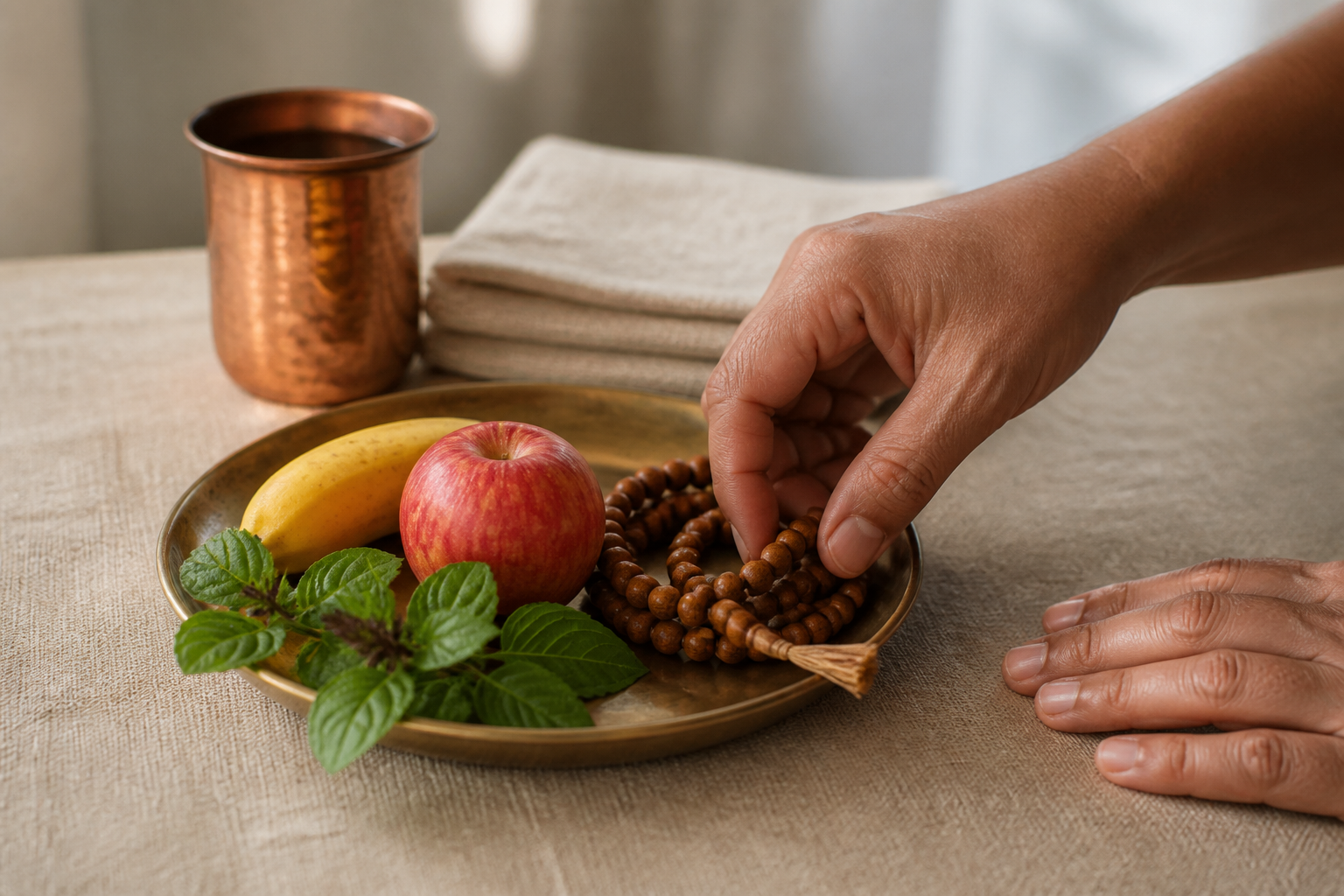
- During the daytime, finish necessary household preparations and set aside the text, mala, lamp, or dana you intend to use.
- Before acting on the 4:10 PM reference, compare it with your city-specific Panchang.
- At or after the verified local transition, pause deliberately. Light a lamp, begin japa or dhyana, read from the Gita or another text followed in your tradition, or undertake the chosen restraint.
- In the evening, carry the inward practice into an outward one through dana, seva, a bhajan, simran, or quiet support for someone in your community.
Do not measure sincerity by how severely you fast. A full fast can conflict with medication, hydration needs, an existing health condition, or physically demanding work. Do not interrupt medicine or disregard medical guidance for the sake of a timetable. A partial fast, satvik diet, or non-food discipline joined to prayer and seva is the safer form when complete fasting is unsuitable.
Keep a shared Dharmic observance respectful
The virtues emphasized by the transition – discipline, remembrance, generosity, and service – are recognizable across Dharmic life. The ritual forms, however, are not interchangeable. A shared observance becomes stronger when each person practices faithfully within their own tradition rather than treating every text or devotional vocabulary as though it meant the same thing.
In a Hindu household, the evening may centre on the Gita, japa, bhajan, or Ekadashi vrat. A Buddhist participant may choose a Dhammapada passage and reflective practice. A Sikh participant may favour simran and seva. A Jain participant may emphasize restraint, careful conduct, reflection, and dana. The family can share silence, lamp-lighting, generosity, or service without erasing the distinctions that give each path its integrity.
This approach is particularly useful for a temple group, campus association, or mixed Dharmic gathering. Announce the common purpose, make participation voluntary, and identify which elements belong to which tradition. Unity does not require a hybrid ritual. It requires enough care for people to stand together without being asked to misrepresent their own practice.
Key takeaways
- November 30, 2025 contains a tithi transition: Shukla Dashami lasts until the 4:10 PM reference time, followed by Shukla Ekadashi.
- The stated transition is not universal. Verify the local endpoint through a city-specific Panchang or trusted temple calendar.
- Use Dashami for regular duties and preparation, then mark Ekadashi with restraint, japa, dhyana, paath, dana, or seva.
- Check Nakshatra, sunrise, Rahu Kalam, Gulika Kalam, and Yamaganda when selecting a formal muhurta; do not infer an auspicious hour from the tithi alone.
- Choose a full fast, partial fast, satvik diet, or non-food discipline according to health, capacity, and established tradition.
- In a shared Dharmic setting, unite around reflection and service while preserving the distinct practices of Hindu, Buddhist, Jain, and Sikh paths.
Before beginning the observance, write down your local Dashami endpoint, choose one practice for the earlier part of the day and one for after the transition, and settle the appropriate level of fasting or restraint. That small act of preparation turns the Panchang from a date lookup into a lived discipline.

References
